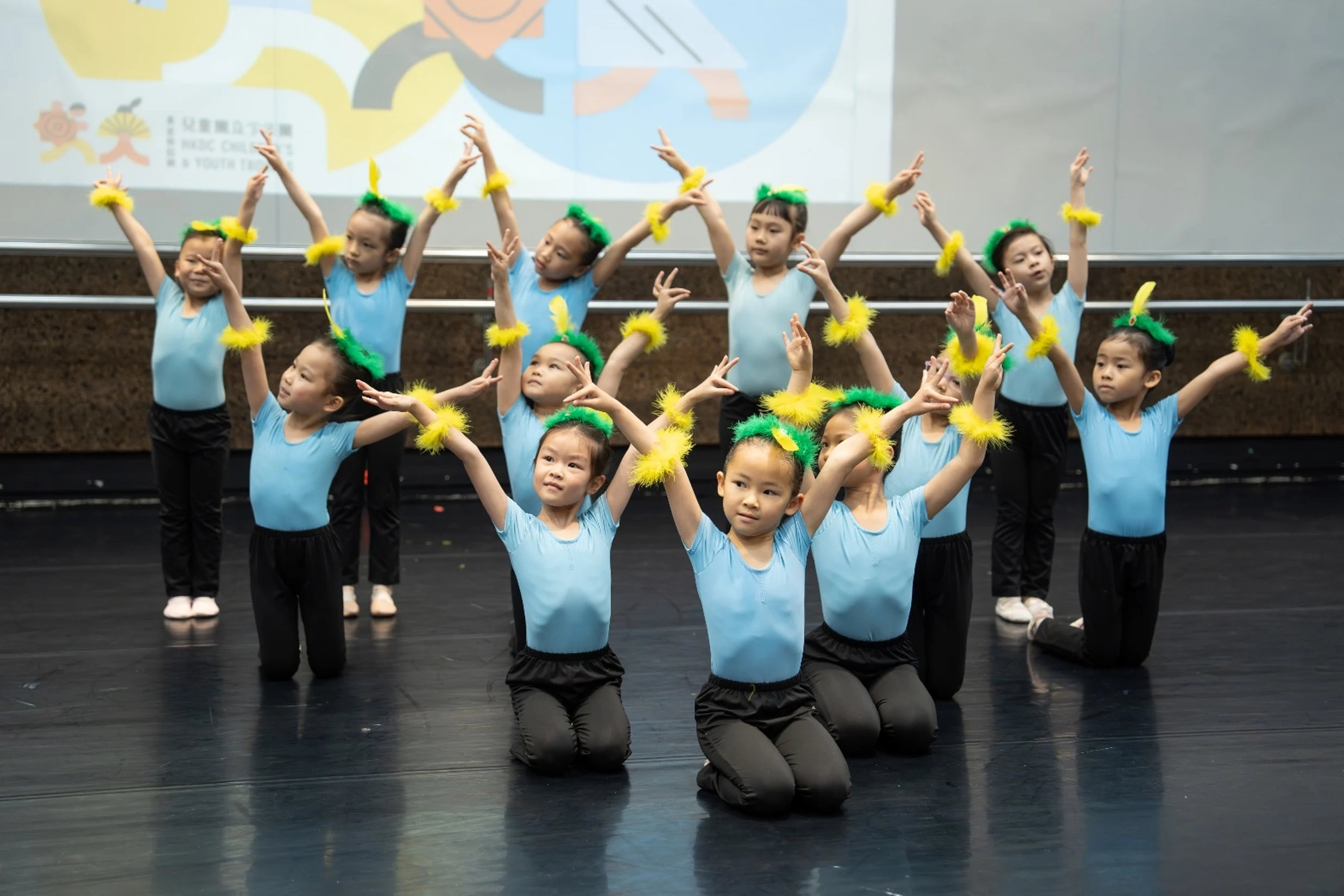
HKDance Children and Youth Troupe In-class Showcase. Photo by Henry Wong.
Meggy Cheng is the Executive Director of the Hong Kong Dance Company (HKDance Company). Established in 1981, HKDance Company promotes Chinese dance with contemporary artistic vision and Hong Kong character through stage performances and arts education. Meggy attended the Strategic Perspectives in Nonprofit Management (SPNM) Executive Education program at Harvard Business School in July and discusses the program experience in this post.
As Executive Director of HKDance Company, I came to Harvard Business School’s Strategic Perspectives in Nonprofit Management (SPNM) program with one pressing, unresolved question that had lingered for months: is now the right time to scale our children and youth dance education unit? For years, our dance education programs have empowered Hong Kong kids through inclusive, well-structured dance learning. Since I took up the Executive Director’s role, we managed to grow our number of students by +45%, from 600 members to 870, and income generated from less than USD$1,000,000 to USD$1,400,000 annually. Our education unit plays a pivotal role in subsidising our mainstage dance productions that is usually high artistic value, high cost but low return financially. It looks like it is logical to simply scale up out dance education unit. Yet, as a nonprofit organisation, I hesitated to expand. I grappled with critical unknowns: Do we have the resources to scale sustainably? What pacing fits our organizational capacity? And who holds the authority to make this pivotal growth decision? What I gained from SPNM was not just a single answer, but a transformed, collaborative strategic mindset that redefined how I lead and grow my social enterprise.
What drew me to SPNM was my desire to move beyond intuitive, experience-based nonprofit leadership. Like many mission-driven nonprofit leaders in Hong Kong, my work is rooted in passion for social impact, yet I often faced structural challenges: vague strategic direction, isolated decision-making, and uncertainty around sustainable growth amid a competitive local nonprofit landscape. Local training focuses heavily on daily operations, offering few frameworks for scalable, mission-aligned development. I joined this program hoping to bridge the gap between our on-the-ground arts education mission and rigorous, sustainable organizational strategy.
The program’s greatest “aha moment” resolved my core scaling dilemma. I once viewed growth as a top-down leadership decision—a call I alone needed to justify and execute. Through immersive HBS case studies and global peer dialogue, I learned that nonprofit scaling is never a solo judgment, but a collective, data-backed strategic choice. No single leader can account for all operational risks, resource constraints, and mission trade-offs that come with expansion. This shift alone rewrote my approach to our youth dance education unit’s growth roadmap.
Four foundational SPNM strategic principles have become my guiding framework to navigate our scaling decision: the proximity principle, feedback loops and small wins, deconstructing the Theory of Change, and systems thinking. Unlike abstract academic theories, these actionable tools have transformed our internal governance and strategic planning. Applying the proximity principle, I tried to lead my team to ground our scaling discussions in direct feedback from community, staff, teachers, students and parents, ensuring expansion aligns with genuine youth education needs rather than our organizational ambitions. We leverage small wins and continuous feedback loops to test mini-scale pilot programs, avoiding blind, large-scale expansion risks.
Deconstructing our Theory of Change helped us dissect every link between our dance education programs, youth empowerment outcomes, and long-term social value, eliminating vague assumptions about our impact. Systems thinking further enabled us to evaluate cross-departmental resources, operational capacity, and external industry environments holistically, rather than focusing solely on program popularity. Most importantly, these frameworks are going to turn my solo scaling puzzle into a structured team strategic initiative, inviting our board and management team to contribute data, insights, and on-the-ground perspectives for collective decision-making.
Beyond strategic frameworks, learning alongside 170 nonprofit leaders from 18 countries broadened my local Hong Kong perspective. Global peers shared identical struggles with mission-driven scaling: balancing growth quality and quantity, preserving core social values amid expansion, and securing sustainable resources. These cross-border exchanges taught me that nonprofit growth is never one-size-fits-all, and patience and strategic rigor always outweigh hasty expansion.
For fellow nonprofit leaders, my key takeaway is simple: mission passion drives our work, but strategic discipline sustains our impact. Scaling is not a marker of success; intentional, inclusive, mission-aligned growth is. SPNM has equipped me to lead with critical thinking instead of routine experience, collaborate instead of deciding alone, and plan systematically instead of reacting intuitively. Moving forward, I will embed these strategic frameworks into HKDance Company’s daily governance, turning program learnings into tangible, long-term social impact for Hong Kong’s youth arts education ecosystem.