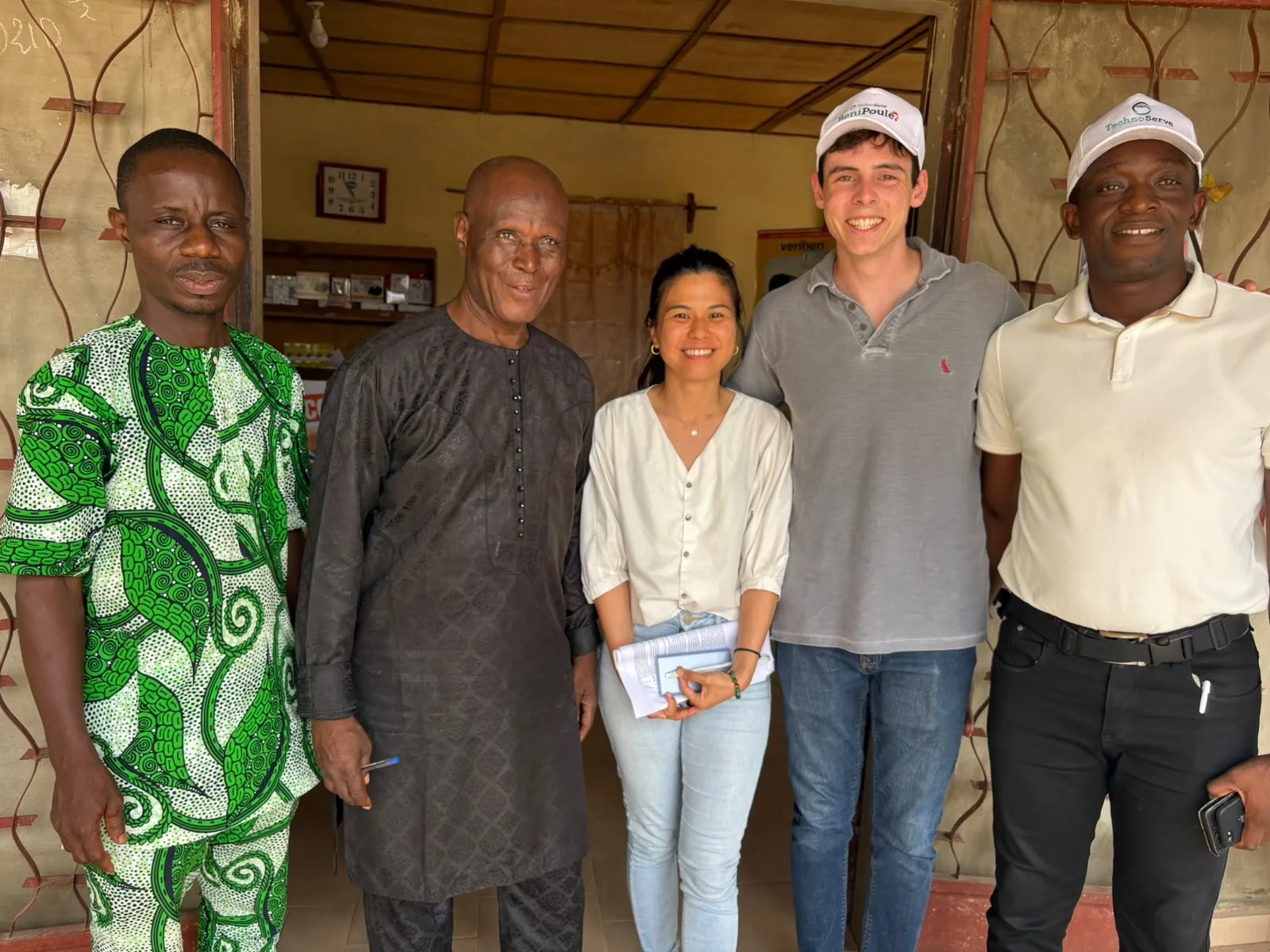
André Garcia (second from the right) with TechnoServe's BeniPoule team conducting a field interview with a veterinary doctor (second from the left).
The HBS Summer Fellows Program enables students to apply their classroom training as they explore career opportunities in roles or regions where compensation is generally lower than the traditional MBA level. This summer, we are connecting with some of our 57 Social Enterprise Summer Fellows, who are working around the world to develop skills and knowledge while having significant responsibility and high impact.
What are you working on this summer?
This summer, I am working with TechnoServe in Benin on a Market Systems Analysis (MSA) of the country's poultry sector as part of the BeniPoule program. Our team is mapping the entire value chain—from feed suppliers and hatcheries to producers, processors, retailers, financial institutions, and government agencies—to understand the systemic barriers limiting the sector's growth. Through interviews and field visits across the country, we aim to identify practical, market-based opportunities to strengthen the industry. The ultimate goal is to help design interventions that improve productivity, expand economic opportunities, and contribute to a more resilient and competitive poultry sector.
Why did you choose this internship for the summer?
I had previously worked with TechnoServe in Côte d'Ivoire before starting at HBS, so I already knew the organization had exceptional people and a collaborative culture. That experience made me eager to work with the team again. I was also excited by the opportunity to live in Benin, a country I had never visited before. It offered the chance to experience a new culture and business environment, improve my French, and contribute to the development of an industry that supports thousands of small entrepreneurs. It felt like a very good combination of professional growth, learning, and meaningful impact.
What are your goals for this summer?
My primary goal is to help identify practical, market-based initiatives that can accelerate the growth of Benin's poultry sector while ensuring that small entrepreneurs across the value chain benefit from that growth. I also hope to identify strong private and public partners that can help turn those ideas into sustainable action. On a personal level, I wanted to challenge myself by working in a new country, improving my French, and developing my ability to navigate ambiguity and multicultural environments. Finally, I hope to build lasting relationships with entrepreneurs and development practitioners in Benin, expanding my professional network beyond the countries where I had previously worked.
How has your MBA skillset prepared you to be successful in this role?
HBS has been incredibly valuable in preparing me for this experience. The case method encourages looking beyond symptoms to understand root causes, which is exactly the mindset required for market systems work. It also teaches you to develop and defend a point of view even when faced with limited, incomplete, or conflicting information—a situation that closely resembles the real world. In a country and industry where reliable data is often scarce, that skill has been particularly valuable. Equally important, the case method has strengthened my ability to listen actively, understand the assumptions and incentives behind different stakeholders' perspectives, and ask better questions before drawing conclusions.
How has the summer influenced your thinking on future involvement in social enterprise?
Before coming to Benin, I was already drawn to work that promotes social development through market-based solutions and helps people escape poverty by creating economic opportunities. This experience has only strengthened that conviction. Working alongside entrepreneurs, farmers, businesses, and public institutions has reinforced my belief that lasting social impact often comes from strengthening markets rather than replacing them. Regardless of the organization or sector I work in throughout my career, I plan to stay involved in initiatives that combine business thinking with sustainable social impact, leveraging the private sector as a powerful driver of economic development and inclusive growth.
How can someone learn more about your organization?
TechnoServe is an international nonprofit that works with entrepreneurs, businesses, and governments to build competitive markets that create economic opportunity. The organization operates in more than 30 countries across agriculture, entrepreneurship, climate resilience, and food systems, using market-based approaches to reduce poverty sustainably.
To learn more:
Website: https://www.technoserve.org
LinkedIn: https://www.linkedin.com/company/technoserve