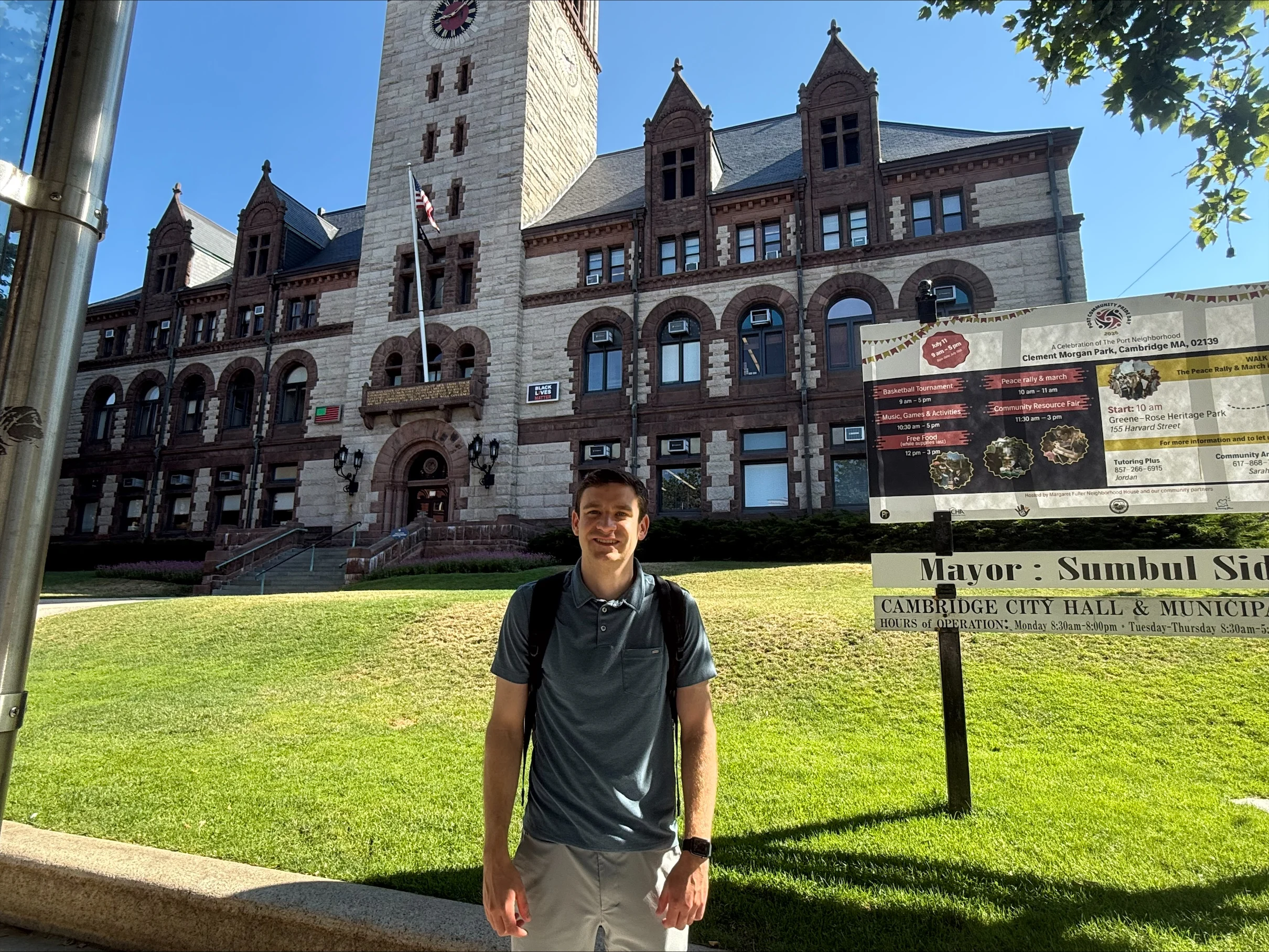
Matt Witalec standing in front of Cambridge City Hall.
The HBS Summer Fellows Program enables students to apply their classroom training as they explore career opportunities in roles or regions where compensation is generally lower than the traditional MBA level. This summer, we are connecting with some of our 57 Social Enterprise Summer Fellows, who are working around the world to develop skills and knowledge while having significant responsibility and high impact.
What are you working on this summer?
I am working with the strategy department at the City of Cambridge this summer, which is a team within the City Manager’s office that helps support strategic initiatives across the city. For the summer, my main task is working with city leadership on their AI strategy. This touches a range of topics including internal AI training and usage for city staff, external facing use cases for residents, and the role that city hall plays in supporting economic development through AI in Cambridge. This project is particularly exciting to me given the rapidly evolving nature of AI, which means I can support high impact work and help shape the city’s AI strategy for the future.
Why did you choose this internship for the summer?
Prior to HBS I worked in consulting, where I started to do an increasing amount of work with government and government-adjacent clients. My experience on those projects gave me an appreciation for the work that public entities do and a respect for the people that do them. A striking example of this for me was at a defense agency, where my client counterparts had a passion for the mission in a way I have never experienced in the private sector. My work in consulting gave me exposure to national entities, so for the summer I knew I wanted to see a more local perspective. Thus, I looked for city governments around the Boston area that had a good mix of exciting projects and high impact – and found a great fit with the City of Cambridge.
What are your goals for this summer?
On the career front, I see my experience with the city giving me a greater perspective on how government operates and where it can have the most impact. In my time so far, I have already seen how focused the city is on resident quality of life and how they leverage the principles we learn at HBS to most effectively do that. In terms of my career, post-HBS I plan to bring this perspective back to my work in consulting with public sector clients.
On the impact front, AI is one of the largest revolutions of my lifetime and will fundamentally change the way we operate and live. Thus, it is incredibly exciting to be able to work on efforts that will shape the future of AI for the City of Cambridge, impacting businesses, residents, and universities alike.
How has your MBA skillset prepared you to be successful in this role?
On AI specifically, I am so grateful to have taken the Data Science and AI for Leaders (DSAIL) course prior to this experience. It has allowed me to speak much more confidently on AI and given me the context for how companies can best approach their own AI journey. In fact, I have even applied learnings from several of our cases to inform the AI strategy for Cambridge.
In a broader sense, HBS has given me a way of framing business problems that allows me to more successfully manage my projects. For example, I pulled “customer journey” learnings from marketing and “pain point analysis” from the Strategy and from Field Immersion Experiences in Leadership Development (FIELD) courses to frame my approach to an AI use case. This allowed me to be a lot more thoughtful in my upfront framing of the problem and uncovered learnings that would have been missed without those fundamental tools in place.
How has the summer influenced your thinking on future involvement in social enterprise?
My experience this summer has cemented my appreciation for the work that governments do in our society. At the city level specifically, I get to see highly tangible work that immediately impacts my own community. I also see the care that the people working for the city have for the residents and the mission that motivates them to do their best at work. It creates a more positive office culture and an earned sense of pride in the work. For me, I plan to continue working with public sector-related projects in consulting in the near term with a longer-term interest in more formal public or non-profit work.
How can someone learn more about your organization?
You can learn more about the City of Cambridge on its website or on social media.