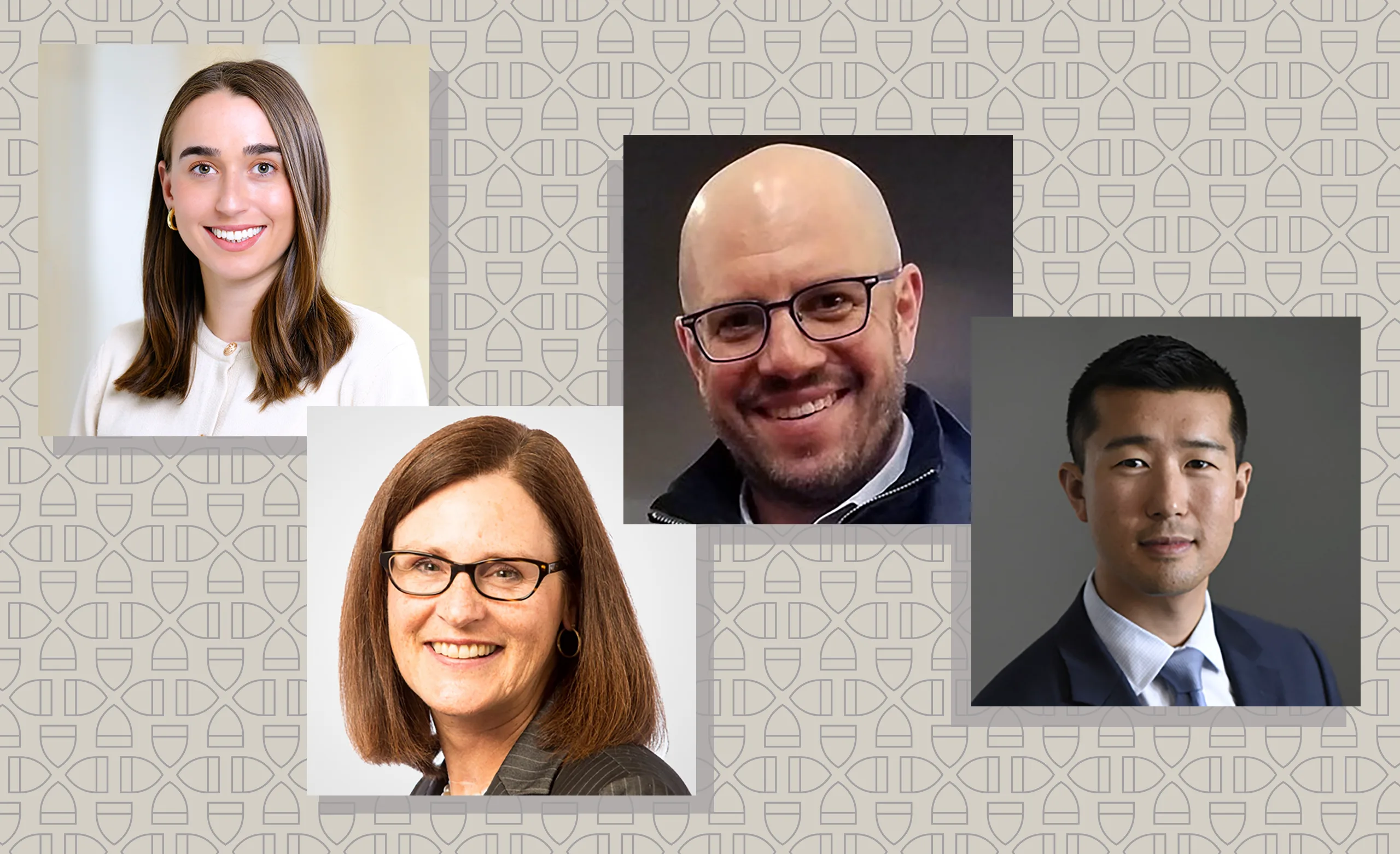
Panelists:
Anna Valuev (MBA 2024), Axim Collaborative
Donella Rapier (MBA 1992), Upstream USA; BRAC
Pete November (MBA 2001), City Year
Stephen Chan (MBA/MPA 2008), City of Boston
Careers in social impact rarely unfold in straight lines—but they are grounded in intention and purpose.
That was a central theme from a recent alumni panel in the Social Enterprise Initiative’s (SEI) Rising Leaders Forum, for social impact focused MBA students. Anna Valuev, Donella Rapier, Pete November, and Stephen Chan joined first-year students for a candid conversation about navigating careers in nonprofit, philanthropy, government, and mission-driven organizations. Moderated by SEI’s Director Amelia Angella, the session focused less on prescribed paths and more on the choices, mindsets, and skills that enable leaders to shape their trajectories over time.
As Amelia noted at the outset, it can be tempting to look at alumni pathways and assume their careers unfolded through a series of deliberate, well-planned steps. In reality, choices and transitions often feel far more ambiguous when you are in the midst of them. Rather than striving for perfect clarity, the conversation highlighted the importance of cultivating self-awareness and the courage to move forward grounded in values, guided by inquiry, and open to emerging opportunities.
Take a Hypothesis-Driven Approach to Your Career
Rather than mapping out a fixed long-term plan, many panelists described taking a hypothesis-driven approach—treating each role as an opportunity to test, learn, and refine.
“At any one time, you don’t have to think about the right answer 10 or 20 years out,” Stephen Chan shared. “Think about the questions right in front of you. What skills do you want to build? What environments will stretch you? What assumptions and mindsets are you testing?”
This framing shifts careers from linear ladders to a series of intentional “tours of duty,” each building toward greater capability and impact.
Anchor in the Problems You Seek to Solve
Alumni consistently returned to the importance of anchoring a career in a problem—or set of problems—you care deeply about.
“Anchor in the problem you’re trying to solve rather than just your skill set,” Anna Valuev advised. Keeping that “north star” at the center allows for flexibility in roles while maintaining authenticity of purpose. As challenges evolve—and as individuals grow—this orientation helps guide decisions about where to go next, what to learn, and how to connect meaningfully with organizations.
Several alumni described how their own theories of change have evolved over time, yet they still were able to remain anchored in the problems they cared deeply about. Stephen Chan reflected on becoming a “boundary crosser,” working across higher education, philanthropy, and government to connect institutions and mobilize resources. While his roles have shifted, the throughline has remained consistent: using his skill set to drive broader impact across systems.
Build Transferable Skills—and Be Ready When Opportunity Comes
Across the panel, alumni emphasized the importance of developing transferable skills—capabilities that travel across roles, sectors, and issue areas.
For Donella Rapier, building expertise in finance and fundraising created the flexibility to move across organizations—from higher education to humanitarian work—and take on new challenges. While skill-building is important, so is receptivity and readiness. “So much of it is the luck of where opportunity and preparedness meet,” she reflected. Opportunities often arise unexpectedly, but being prepared—and willing to step forward—is what turns those moments into inflection points.
Pete November similarly highlighted the value of building skills at the intersection of values, strengths, and interests. Over time, capabilities in areas like operations, people management, and leadership create a foundation that allows leaders to pivot intentionally, even as their paths become more specialized.
Navigate the Real Challenges—While Staying Grounded in Purpose
The panel also addressed the realities of working in social impact—where progress is often complex, nonlinear, and shaped by structural constraints. “Measures of success are often more objective in the for-profit space. I like the messiness of the nonprofit sector. But it takes a lot of patience, and it may not always be as clear if you’re making an impact at any given time,” Anna Valuev shared.
At the same time, alumni emphasized that this complexity is part of what makes the work meaningful. Driving change in large systems requires a long-term learning orientation, intellectual curiosity, and resilience. For many, the opportunity to engage deeply with complex human challenges—and to work across stakeholders toward solutions—is not a drawback, but a defining feature of the field.
Additionally, access to capital remains uneven and is often influenced by relationships and narratives as much as outcomes. As Anna Valuev noted, organizations must work hard to articulate their value in environments where funding is constrained and impact can be difficult to measure. As Pete November pointed out, "typically, in the business world, if you have a good product or service, people will pay for it. In the nonprofit world, it is rarely that straightforward."
Know Yourself—and Let That Guide Your Choices
A consistent thread throughout the conversation was the importance of self-awareness—and the courage to pursue a path that may look different from that of many MBA graduates.
“What guided me was discovering the kind of work that fits my values—the kind of place I was excited to show up to every day,” Pete November shared. Over time, that clarity extended not only to what he wanted to do, but also to what he chose not to pursue. “The most freeing thing for me was when I stopped pursuing what other people or institutions thought I should be doing.”
Developing this level of self-knowledge takes time—and often requires experience, reflection, and experimentation—but it is essential for making intentional decisions about where to invest energy, how to define success, and when to pivot.
Leverage Community and Resources Along the Way
A central goal of the Rising Leaders Forum is to help students explore careers in social impact, and to build relationships and support systems that make those careers possible over time. As alumni emphasized, community is not a byproduct of this work—it is a critical input.
At HBS, SEI programming, faculty relationships, summer opportunities, student clubs and career resources offer important connection points. Career coaching through the Career and Professional Development (CPD) office, faculty office hours, and alumni engagement create structured opportunities to explore interests and build networks. But alumni encouraged students to go further—to be proactive and intentional in cultivating relationships around the issues they care most about. Examples of this included leveraging independent projects and pro bono consulting projects to get to know social impact leaders outside of HBS.
Equally important are peer relationships, which often become enduring sources of support. As Stephen Chan shared, a small group of close classmates has remained a set of “lifelines” through both professional and personal decisions. “Five friends from my class are lifelines for each other. From a core life perspective, those relationships matter enormously.”
These relationships—across alumni, faculty, and peers—form the foundation of the HBS SEI community. What distinguishes this community is not just its breadth, but its depth: a shared commitment to impact, a willingness to support one another, and a habit of staying engaged over time. Even as careers evolve, alumni remain deeply connected — continuing to support one another and contribute to the field in meaningful ways.
Ultimately, the discussion reinforced that careers in social impact are not about following a predefined path, but about creating one with intention. By building transferable skills, staying anchored in a problem, approaching decisions as hypotheses, cultivating self-awareness, and investing in community, leaders can build a career in social impact with greater clarity and confidence.
As Pete November put it: “Follow the combination of what you care about, what you’re good at, and where you thrive. It’s not linear—but it is intentional.”