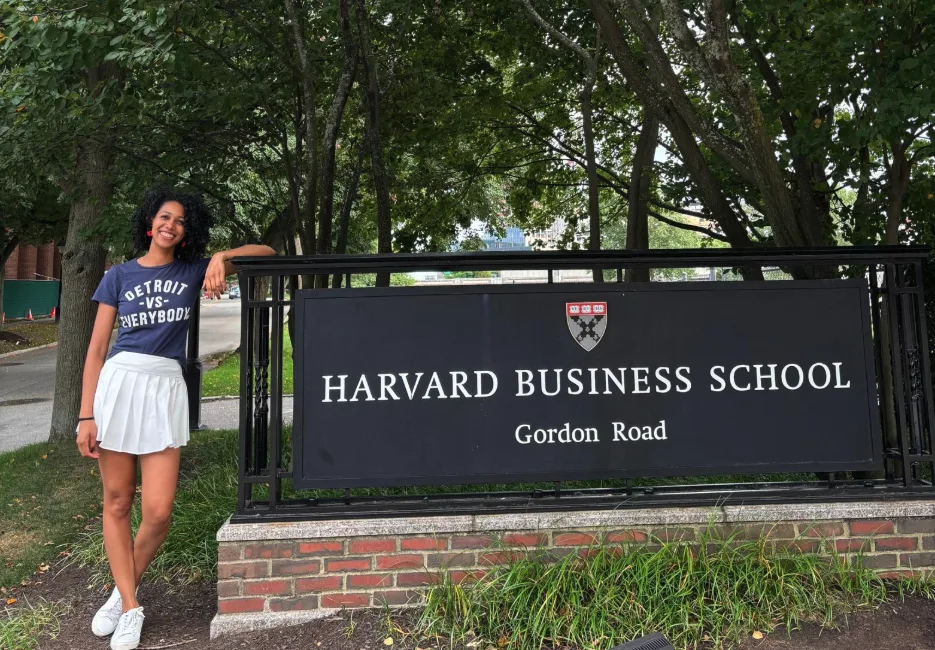
Leslie Hicks standing beside the Harvard Business School sign.
The HBS Summer Fellows Program enables students to apply their classroom training as they explore career opportunities in roles or regions where compensation is generally lower than the traditional MBA level. This summer, we are connecting with some of our 57 Social Enterprise Summer Fellows, who are working around the world to develop skills and knowledge while having significant responsibility and high impact.
This summer I'm a Summer Strategy Fellow at Runway Green, a nonprofit building an experiential education and workforce development campus at Floyd Bennett Field in Brooklyn. I'm working alongside our small and mighty team, our Executive Director, our COO, and a fellow HBS intern, on the organization's core business and revenue model questions: What’s our core mission; what programs should we offer; how do we engage with our partners; and what revenue streams are most viable as we build toward a financially sustainable organization? Alongside that work, I've also been helping plan a series of student-facing workshops we're running this summer, which has meant stepping out of the strategy and revenue model conversations and engaging directly with students and curriculum.
I chose Runway Green because it is very much a culmination of my personal and professional interests and experiences. My theory of change is built around uplifting communities of color through a combination of strategy, advocacy, and capital. Prior to graduate school, I spent five years advising leading social sector nonprofits and philanthropists at The Bridgespan Group, and I'm currently pursuing a joint-degree Master’s in Public Policy at the Harvard Kennedy School, with a focus on social and urban policy. What pulled me in was the opportunity to both meaningfully contribute to and learn from the organization's lean team, and to help make some of the decisions that will shape its fundamental architecture. I hope to one day lead a large national organization focused on economic mobility, and it's helpful for me to learn the complexities of operating and growing an organization firsthand.
My goal for the summer has been to get comfortable working in an environment that's still taking shape. I'm learning to hold two things at once: long-term strategic planning and the core business decisions that will define the organization for years, and the fast-paced, day-to-day work that startups require. I'm grateful to HBS for giving me the tools to execute on this work. I've spent time this summer reading the research of, and speaking directly with, HBS professors who are experts on some of the questions I'm wrestling with. Professor Joe Fuller's research on workforce trends has informed how I think about where Runway Green fits into the future of work. Senior Lecturers Gerald Chertavian and Brian Trelstad, with their expertise in scaling nonprofits and driving systems change, have shaped how I'm thinking about our earned revenue strategy and Runway Green's long-term sustainability.
This summer hasn't changed my commitment to social enterprise so much as sharpened it. I'm coming back to campus more convinced that social sector and mission aligned work is what I’m most excited about. I'm bringing that into my role as incoming co-president of the HBS Social Enterprise Club, and into how I choose coursework at both HBS and HKS this year. The question I'm sitting with now isn't whether I want to run a mission-driven organization someday. It's what specifically I need to learn between now and then to be ready to do it well.
About Runway Green: Runway Green is a multi-sector partnership between the National Park Service, NYC nonprofits, and industry partners to build an educational and experiential learning campus at Floyd Bennett Field in Brooklyn, where students will learn from and engage with the industries shaping the future economy.