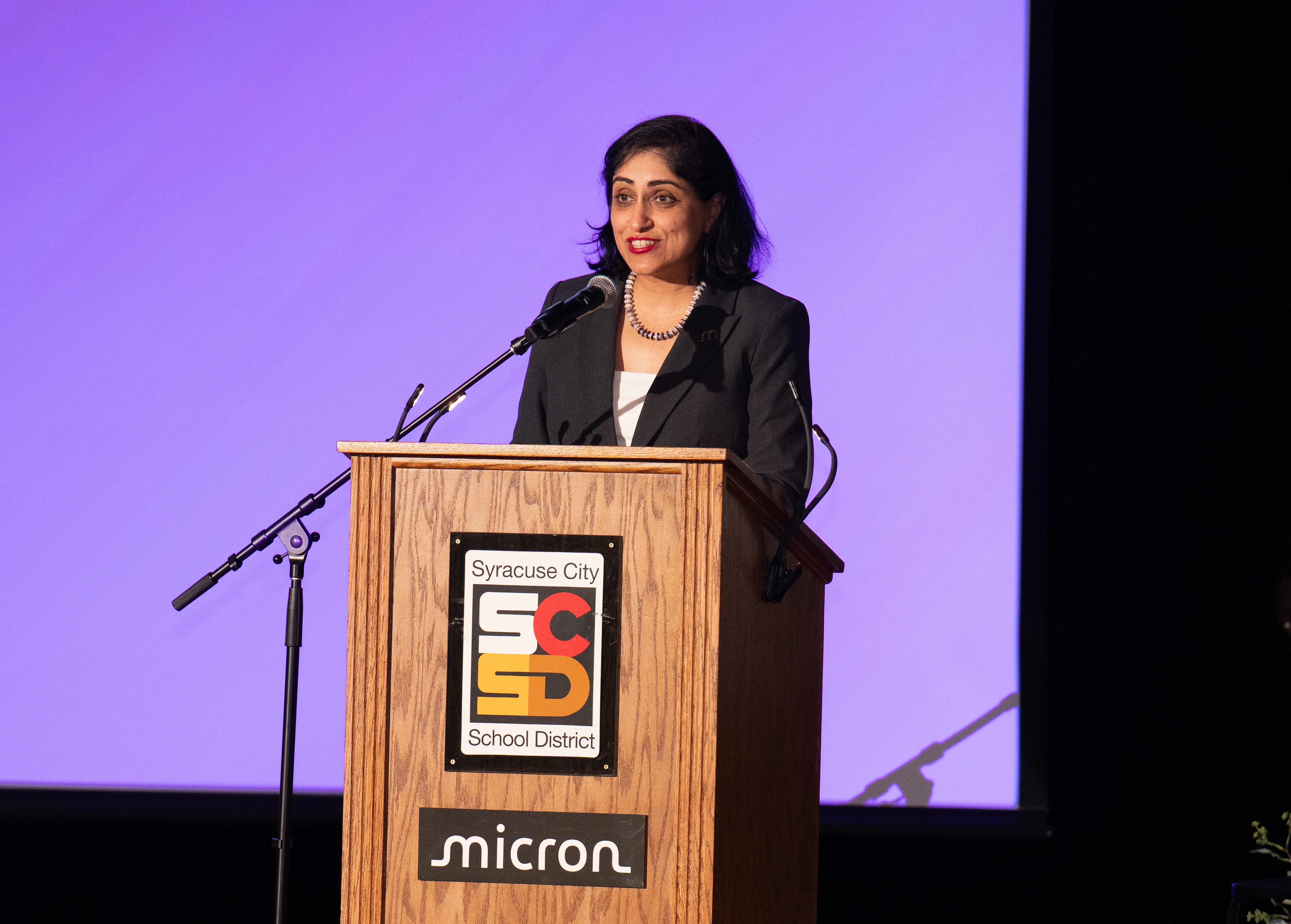
Rosita Najmi (2009) | Photo credit: Ana Gil
Editor’s note: This story is part of a series celebrating the 25-year anniversary of the Harvard Business School Leadership Fellows program and the people whose lives and work have been shaped by it. Stay tuned for more in the weeks ahead.
Harvard Business School graduate Rosita Najmi (MBA 2009) never had any doubt she wanted to work for the betterment of society.
In a 2024 HBS essay, she explained her life story as a refugee emigrating to Idaho from Iran, where her father had been imprisoned and family persecuted because of their Bahá’í faith. Her family eventually relocated to Tennessee, where they spent 15 years gradually climbing out of poverty.
“This is why I’m obsessed with financial inclusion, economic equity, and global development,” she wrote. “I learned about the potential of community and collective action because of this initial poverty, and I have spent the last 20 years working on both sides of the fundraising and grantmaking table. I am a better funder because I was a beneficiary and grantee.”
That early experience — and resulting determination — led Rosita to HBS, where she discovered the Leadership Fellows program, which helps graduating MBA students land high-impact management positions in nonprofit and public sector organizations. The fellowship program creates opportunities at leading organizations with strategic one-year roles and provides financial and professional development support.
Celebrating its 25th anniversary this year, the program has supported more than 300 students at more than 100 organizations nationwide.
“It was almost like a [medical] residency for the MBA,” Rosita said, “particularly when you have to move fast and the stakes are high.”
Her fellowship was with Mercy Corps (now Prosper Global), a global humanitarian aid organization operating in countries experiencing wars and other types of economic, environmental, social, and political instability. As a financial services strategy adviser, on assignment in Indonesia, she took part in the response to the 2010 earthquake in Haiti that killed 220,000 people.
“I helped design a reversible microinsurance product that we offered to survivors who were recovering from the Haiti earthquake,” she recalled. “It was an innovation in microinsurance at the time. My portfolio at Mercy Corps included digital financial services, microfinance institutions, and economic empowerment.”
That experience and others during her fellowship taught her lasting lessons about leadership in the social sector and the importance of staying focused on the overall mission while being flexible.
“It was a useful leadership lesson that you don’t have to stay in your assigned lane. Similarly, you don't have to perfectly stick to the job description,” she said. “It’s really about how you can have the biggest impact based on the need in front of you and being flexible.”
From that fellowship, Rosita went on to a career in international development and social impact that included roles at the World Bank, the Omidyar Network, the Gates Foundation, PayPal and UPS. She is currently Global Head of Social impact and Community Engagement for Micron and Executive Director of the Micron Foundation, which works to support global communities and expand access to STEM education and responsible and inclusive AI adoption and usage. Among the innovations she has led is an award-winning agentic AI powered participatory grantmaking program. She is also leading the implementation of Micron’s $250 million contribution to America’s youth via deposits in 530A (Trump) Accounts.
Throughout her career, Rosita is proudest of the opportunities she had to make genuine impact through work that spanned the public, private, and non-profit sectors. One example was at the World Bank, where she helped countries create broader access to financial products. “That was work on financial inclusion at a system-change level, developing frameworks, tools, an evidence base that countries could use to advance their policies and regulations,” she said.
Through all off it, her motto is a challenge from professors Kash Rangan and Herman “Dutch” Leonard, whom she met at HBS: “How do I harness the full engine of capitalism to pull that wagon of justice?”
One answer to that question, Rosita says, is a quality she first began developing during her fellowship: versatility. She addressed it directly in her 2023 TED Talk, “What’s Your Leadership Language,” which has drawn more than 1 million views. In the speech, she discussed overcoming the tendency to stick to a particular management style and the importance of being flexible.
“Many leaders obsess over leadership style when really, they just need to get over themselves,” she said in the talk with a smile. “What’s more useful is to adapt and personalize your leadership, to be the leader the situation and the people involved need. It’s not so much style as language, the living vernacular of each discrete community and culture. The successful leader will aspire to be multilingual, to speak fluently with all groups, and to translate among them.”
Now 16 years past her fellowship, Rosita says its value extended far beyond a graduate’s first post-HBS job. She says it helped establish a way of leading that has shaped an entire career: put the mission first, move across boundaries, adapt to what people and circumstances require, and recognize the potential of business as a force for social impact.
It was a one-year fellowship with lessons, she says, that lasted a lifetime.
For more information on the Leadership Fellows program and how to participate, visit: https://www.hbs.edu/socialenterprise/mba-experience/careers/leadership-fellows