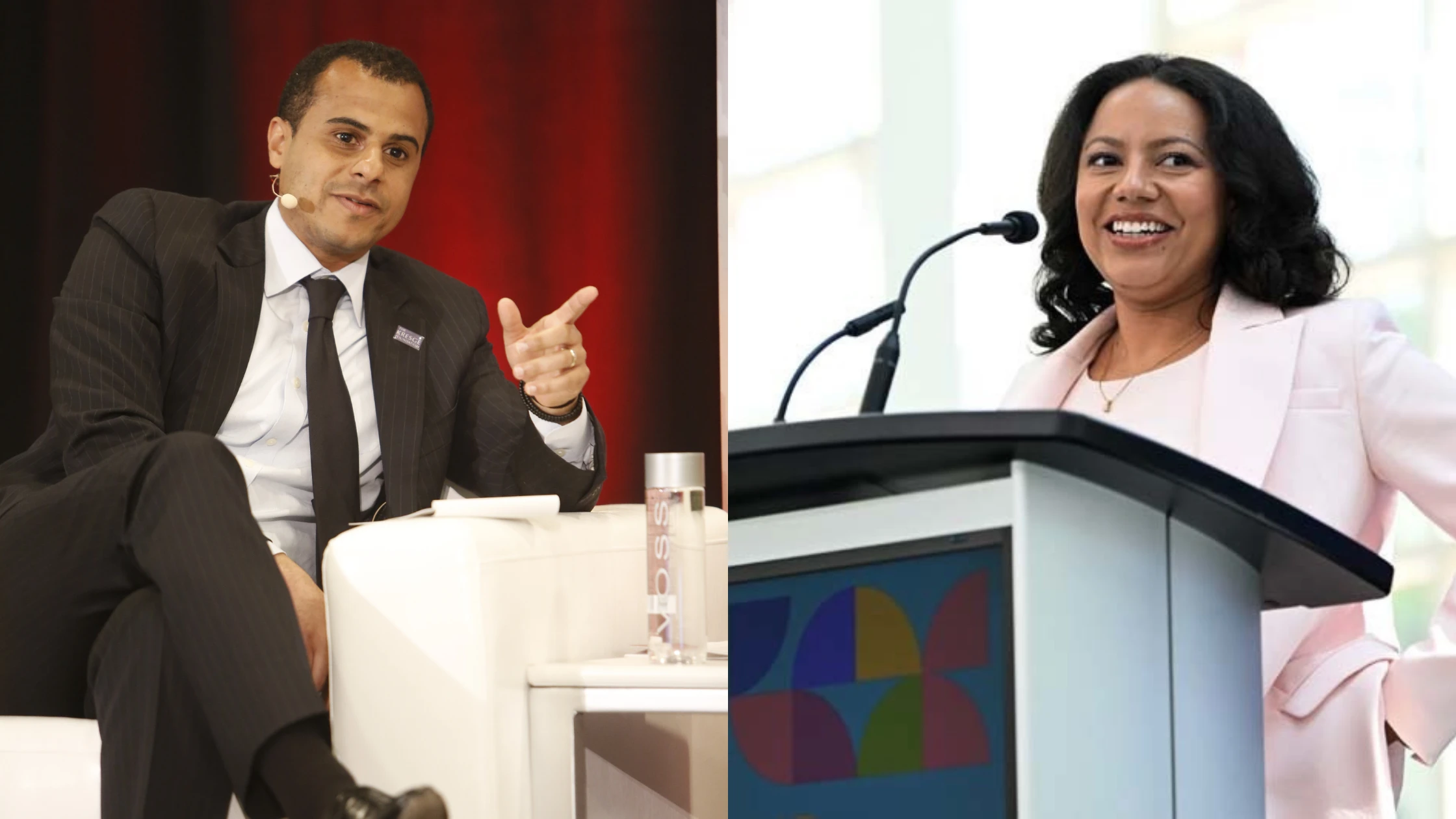
Benjamin Kennedy (MBA 2009) and Chantel Rush Tebbe (MBA 2015)
Benjamin Kennedy (MBA 2009) and Chantel Rush Tebbe (MBA 2015) enrolled at Harvard Business School’s MBA program with different backgrounds and perspectives, but both came with the conviction that they wanted to do good in the world. And they both found their way to The Kresge Foundation, a Michigan-based nonprofit focused on expanding opportunity in American cities.
Benjamin and Chantel discovered their paths to mission-driven work through HBS’s Leadership Fellows program, which helps graduating MBA students land high-impact management positions in nonprofit and public sector organizations. The program creates opportunities at leading organizations with impactful, strategic one-year roles and provides financial and professional development support.
Celebrating its 25th anniversary this year, the program has supported more than 300 students at more than 100 organizations nationwide.
“I had always wanted to put my skills to use on community problems—neighborhood, community, and local issues,” said Chantel, who started at Kresge as a fellow in 2015 and now serves as managing director of Kresge's American Cities Program. “I realized that I had always been interested in that kind of giving back.”
Benjamin, meanwhile, had no plans to pursue a career in the nonprofit world, expecting to pursue "one of the more traditional pathways, like consulting or finance" after he finished his MBA. Instead, urged on by a former professor, Benjamin connected with Kresge as a Leadership Fellow in 2009. Today, he oversees Kresge’s seven grant-making programs, which aim to help people in low-income communities navigate a range of socioeconomic issues.
"At HBS, there was a push to become more than just businesspeople,” he said, referring to the range of student clubs and initiatives across HBS. “[It was about] leadership in the context of one’s community and country and world.”
The Kresge Foundation has been an enthusiastic partner in the program, employing at least seven Leadership Fellows over the years. Benjamin was the first.
Established more than a century ago in Detroit, the foundation was created by Sebastian Spering Kresge, whose retail empire (S.S. Kresge Co.) brought low-priced goods to the masses, first through five-and-dime stores and later through Kmart. The mission, Kresge said, is to focus on the lives of average people seeking to get an education, improve their communities, practice the arts, advance racial equity, and access opportunities. The foundation provides about $160 million a year through roughly 350 grants to nonprofits.
Chantel’s Story: Getting Beyond ‘Place’
Chantel learned early how social and economic mobility can be tied to zip code.
Her father and his relatives left the south for California and Michigan, where new jobs and rising home values changed what was possible. Her maternal grandfather left Youngstown, Ohio, to look for work beyond the steel mills. Other relatives stayed behind, with fewer economic opportunities.
Early in her career, Chantel gravitated toward pro bono projects for small businesses and nonprofits. Prior to coming to HBS, she worked as senior analyst, Global Strategy and Business Development at Banana Republic, a part of Gap Inc., where she connected staff with Gap Foundation-supported volunteer work, including with a youth radio organization in Oakland, California. At Stanford University, where she studied international relations as an undergraduate, she focused on international development and political economies and imagined becoming a diplomat.
As a child in California, she was often one of very few Black students in school. In high school, she said, a classmate suggested she was admitted to Stanford solely because she was Black. “I had a lot of experiences that pointed out to me that I was different,” she said. “I experienced how race really impacted people's perception … and understanding of what was possible.”
For Chantel, social impact is an ambition aimed at the right things: giving children opportunity no matter where they are born, giving neighborhoods the resources to thrive, and creating a world in which place does not determine destiny.
“I really want to make sure that kids have access to opportunity and social and economic mobility, and that’s very dependent on place,” she says. “I see it in my own family.”
Kresge gave her a place to help expand those opportunities. During her fellowship year with Kresge, she worked closely with the foundation’s CEO, and with two vice presidents for programs. It was an unusually wide-angle view for someone entering the social sector. Chantel prepared speeches, wrote grants, and led an internal change-management project in response to grantee feedback. She also helped shape an effort to expand Kresge’s work in Memphis, where it gave only a small number of grants at the time.
More than a decade later, that seed has grown into a significant portfolio. As managing director for programs in American cities, Chantel leads similar work all over the country.
She also serves on multiple nonprofit boards and is chair of the National Housing Law Project, which advances housing protections in the United States. Chantel credits the Leadership Fellows program with helping her become a nonprofit leader and with giving her the credibility and experience to serve organizations beyond Kresge.
“The Leadership Fellows program makes unfamiliar roles easier to imagine,” she said. “I would encourage anyone who’s even curious about that as a path to give it a try.”
Benjamin’s Story: ‘unambiguously good work’
For Benjamin, the path to Kresge began with a single conversation he had with former HBS Professor Eric Werker. During a second-year independent study in Liberia with Werker, Benjamin told his professor he wanted to do “good work.” Werker challenged him to think deeper, saying what he appeared to be seeking was “unambiguously good work.”
That led Benjamin to the Leadership Fellows program and ultimately to The Kresge Foundation. The foundation was seeking a special assistant to the CEO to help build out its social investment practice. Benjamin flew to Troy — a city he didn't know — to meet the CEO and a board member.
“They were in the midst of building out a more robust staff and new functions,” he says. “It was like a start-up, and they were talking about new capital tools and thinking beyond traditional grant-making.”
Ultimately, it was the people at Kresge who convinced him to take the leap, and Benjamin quickly found that the business skills he gained at HBS were essential to his ability to lead in the social sector. “There is something to be said for those strong business planning, strategy and execution skills,” he said. “It’s not that those attributes don’t exist in the social sector, but you learn that at a very high level.”
He recalls going through case studies with dozens of other business students as an important learning experience.
“Having to engage in dialogue and articulate a way of approaching problem solving … has helped me throughout my career,” he says. “So much of what we're doing is fundamentally problem solving, problem smashing, that ability to, in a clear and crisp way, organize a problem set, and then in a disciplined and strategic and coherent way, architect and articulate a solution.”
Benjamin advises students considering nonprofit work or the Leadership Fellows program to act on those instincts. As he put it, “take the leap.”
For more information on the Leadership Fellows program and how to participate, visit: https://www.hbs.edu/socialenterprise/mba-experience/careers/leadership-fellows