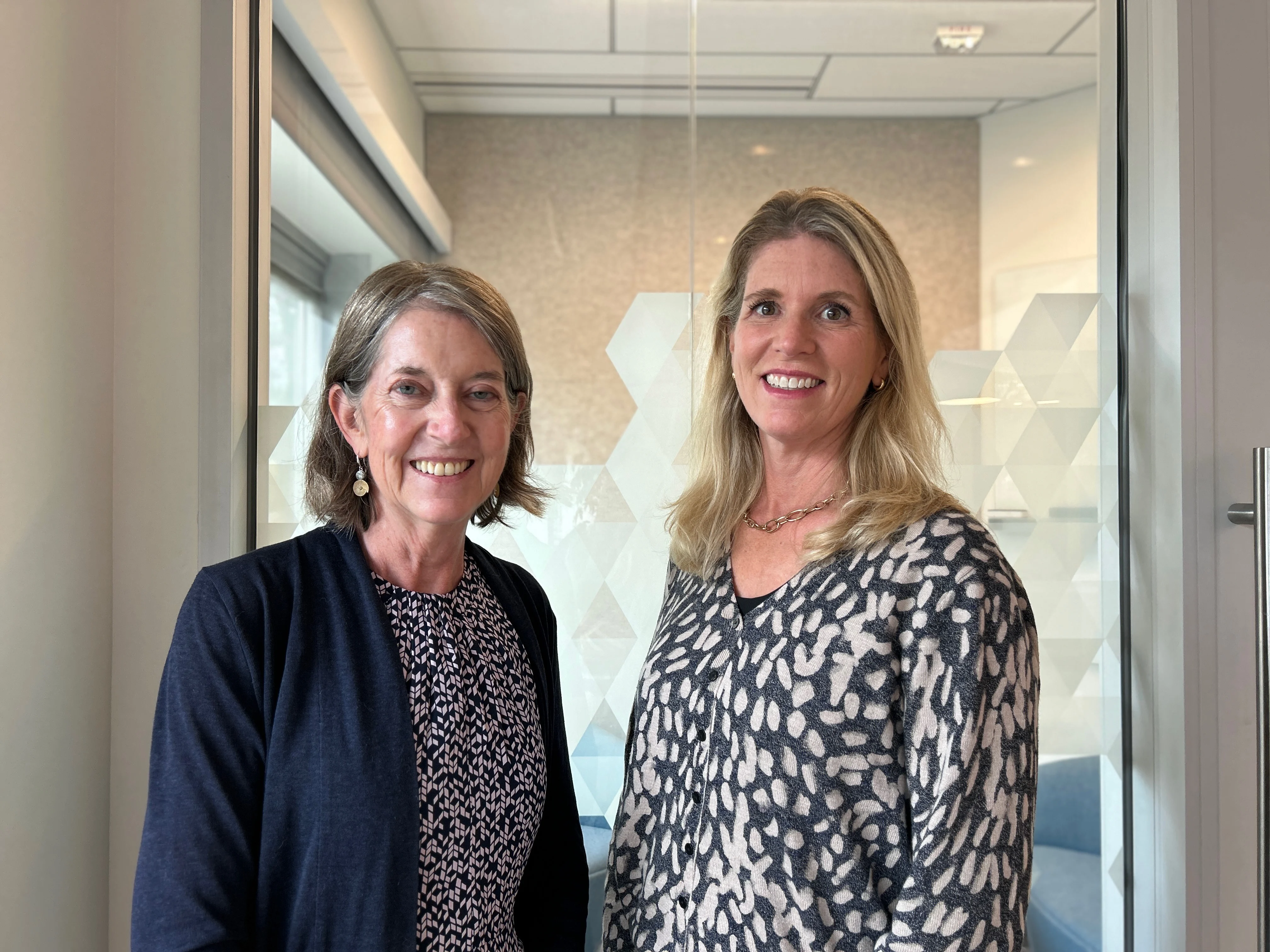
Margot Dushin, Director of Student Programs, Social Enterprise Initiative (left), and Amelia Angella, Director of Social Enterprise Initiative (right).
Editor’s note: This story is part of a series celebrating the 25-year anniversary of the Harvard Business School Leadership Fellows program and the impact of the people whose lives and work have been shaped by it. Amelia Angella, director of the Social Enterprise Initiative (SEI), and Margot Dushin, SEI’s director of student programs, discussed its impact on more than 300 alumni and more than 100 organizations where they have served. The interview has been edited for length, clarity, and style.
Tell us about yourselves. What brought you to the Leadership Fellows program?
AMELIA ANGELLA: I first came to the school as a student, because of the Social Enterprise Initiative, in 1999. I worked at a start-up nonprofit called Initiative for a Competitive Inner City that was run by [HBS] Professor Michael Porter. He was a big part of the reason why I came to the school and is a big believer in exposing MBA students to the complexity of leadership in the social sector and in the skills that we can bring as MBAs to the sector. I graduated [from HBS] in 2001, came back in 2019, and I took on the role of director in January of 2023.
MARGOT DUSHIN: I started with Social Enterprise in 1996 and immediately was focusing on student programming and my role as director of student programs. When the program first started years back, it was really a recognition by several people — Michael Porter being a primary person — that there is this opportunity for MBAs to bring their skill set to nonprofit, public-sector organizations and to learn a lot from nonprofit, public-sector organizations.
Margot, you were part of the founding team of the Leadership Fellows program. How did it start?
MARGOT: We handpicked a few organizations to say, ‘Let's test this model. What would happen if we sent a handful of MBAs out to some of these organizations that we're pretty familiar with, and see what kind of support they need? We need to make sure that we're looking at organizations that have strong leadership, that have this business mind of how to approach problems but can really benefit from the MBA skill set. And we can help in creating roles with them that will use the MBA skill set well and help in supplementing the salary during that year. So, what are those things that we can put in there to test our theory of change?’
How do you select organizations to host SEI Leadership Fellows?
AMELIA: We are looking for organizations that can work with our students on a scope of work that has some strategic importance to the organization. So, we spend a lot of time crafting, in concert with the organization, that scope of work.
We want to make sure it's distinct from any permanent, full-time position that they have. It's really designed to be this unique, one-year experience. We also want to make sure that they understand the unique skill sets that MBAs bring to the organization and are able to absorb those and understand how they can be best put to use.
We also want to make sure [the fellows] have meaningful access to the C-suite of the organization. So, we need leaders who are willing to put in that time with our fellows, to give them a seat at the table and foster their experience, so they understand what those leadership complexities look like and have a voice at the table in some of those conversations.
Do students get involved in finding host organizations?
MARGOT: In addition to organizations being able to submit applications, a couple of years ago, we started what we call a student-proposed route. That means that students can work in concert with an organization to develop a proposal. Students can look at the criteria to work with us to say, ‘Here are the kinds of opportunities I'm looking for,’ and we give them guidance. Then they come to us with a proposal in concert with the organization to say, ‘Here's what we're proposing as a role that I would go into. Can I get the support from HBS to do it?’ It has helped us to expand the organizations to different geographies.
Your survey of former Leadership Fellows found that the majority continued with social enterprise work, nonprofit work, or philanthropy in some way. Did that surprise you?
AMELIA: The vast majority of all of our alumni do some kind of volunteering or board work over the course of their career. So, this is a special group, but I also think there's a misconception that HBS alumni don't contribute in that way, and in fact, they do.
Obviously, there's some self-selection. These students have chosen this program, but I do think, once they are in the organizations, they see the impact that they can have, the impact that the organizations have. I think it's powerful for them to realize that, and then they get that bug and want to take it forward at some point in their career, whether it's full-time or volunteer work or board work. I think a lot of them get really inspired by the mission and the work they're doing.
MARGOT: It was the goal that we had for the program. And so, it's pleasantly surprising to see that happen. People might have this misperception that the nonprofit route is easier. It's actually much more complex. But it's also a place where your MBA skillset can be used to greater effect.
Perhaps it's that opportunity to live out that situation and say, ‘all right, I'm applying my skills, and I'm seeing that it's really challenging, but I'm able to [effect] real change.’ That compels them to sometimes stick with the organization, but sometimes, move into the private sector, but then look for other opportunities to continue to engage.
Why is a Harvard MBA so valuable to the host organization?
AMELIA: I always say they're boundary-crossers. They can speak the language of for-profit, but they also feel comfortable in the nonprofit and public sectors. There aren't many people who can do that effectively.
Everyone always starts with financial savvy, and that's certainly true. But I also think it's being able to think strategically, being able to approach a conversation and ask a lot of questions. To get folks to start talking about ‘What is the problem we're really trying to solve here?’ That's something that's uniquely taught at HBS through the case method, and it is such a valuable way to make progress in a mission-driven organization.
How has the Leadership Fellows program changed during its 25-year history?
MARGOT: Aside from the student proposals, we added professional development sessions, maybe five or six years in, where the fellows would come back twice during the year. That's done two things. It's given the fellows a chance to build their community with each other, to be able to continue to learn from HBS faculty, and to think about it from a career perspective, to dive in deeper on the challenges that they're facing. It's also given us this great opportunity to connect with [fellows] in the middle of the year, and be able to learn more about the program.
AMELIA: Also new is that [host organizations] can have a fellow for three consecutive years, and then they need to take a year off. That's designed to provide that space for new and fresh organizations to be able to access the program. It also provides those organizations that have had a fellow for three years the space to step back and say, ‘We can absorb that work, take some time off, and then think about how we can use a fellow going forward.’
What message does the Leadership Fellows program convey to the non-Harvard community about Harvard Business School?
AMELIA: It's a wonderful expression of the priorities of the school, and the value of an HBS MBA education, that we view this social impact work as worthy and important. We've created a pipeline that didn't exist before. That was where Michael Porter saw this opportunity to make it easier both for these organizations to hire MBAs and also for the students to say yes. We gave them that competitive salary and these really tightly crafted roles and the guarantee of access to leadership. And then we gave the organization this incredible pipeline of talent.