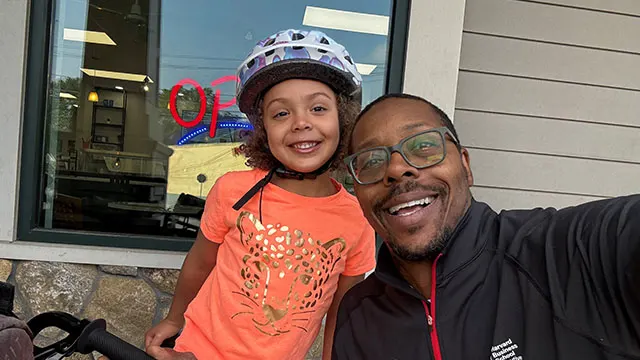
by Shona Simkin
What’s the path from giving away cars on talk shows to working at Harvard Business School? Media Service’s Shawn Alston talked with us about working in television, what brought him to Boston, what he likes to do outside of work, and more.
What is your role and what does it look like day to day?
I’m a lead technician with Media Services. I have a crew of 10 technicians—we go around and make sure that all the tech in the conference rooms and classrooms around campus work and function. We also work on all minor tech things on campus like signage. We have a hand in fixing or maintaining pretty much anything you touch that has technology in it.
What was your path to HBS?
I started as a media services technician contractor with McCann Systems in January 2022 during COVID. One thing led to another and when there was an open position, I applied and got it.
I kind of fell into this work. Another lifetime ago I worked in television. The talk show I was working on at the time, the Tyra Banks Show, was canceled and I had to pivot. I started working as a PA (production assistant) on other TV shows, which led me to a small production company setting up at conventions. That led me to this, which is basically the same thing except that everything is here, so we don’t have to set it up, break it down, and move to the next one.
How did you get into working in television?
That’s what I went to school for—that and working in radio was my first passion. I went to the University of Pittsburgh and started doing radio from there. But it felt like I was being paid to go out every night. I was in my early 20s and I knew I needed more, so I took an opportunity with a friend to move to New York. I interned at the Maury Povich Show, and then applied to work at the Tyra Banks Show, which was moving from LA. I didn’t get the job I wanted, but I got a part time job as a PA and worked my way through the system until the show got canceled three and a half years later.
Then I worked on a few different shows and pivoted because the growth opportunity was low—only a handful of people do that specific job. I freelanced on reality TV shows until I met my wife. She didn’t like my freelancing, and I needed steady work, so I went to a casting house and managed their technology. A lot of this work goes hand in hand—if you can work with cameras and production equipment, you can learn to work with any piece of equipment. I have what I call tech karma—that thing where you can’t fix it, but I walk in and suddenly it works—the more you have, the better it is. That and my ability to talk to people mean that I can work in a lot of different tech positions.
Tell us more about working in talk shows—what was that like?
Working on the audience side, you basically get lists of people applying to come see the show. The joy of it was that you got to call people and make their day, saying, “Hey, we’re giving you tickets to come out to the show for the day, you just have to get yourself to NY.” You build out an audience of about 200 people, get them into their seats and keep their energy and attention up for the show. Between scenes and going live you’re talking with them, making sure they’re comfortable, doing different things, and helping them out. And we do prizes—if it’s “You get a car, and you get a car!”, we’re the people giving them the car keys. It was a great job.
What brought you to Boston?
Family. I had been traveling a lot for work. I’d be gone for 18 days on a shoot or at a convention, then home for two weeks before leaving again. Then the TV industry shut down in the pandemic and we had a one-year-old. We moved up here to be closer to family support if I stayed with that line of work when it opened up again, but we ultimately decided I’d stay at home.
It was hard, but I think of it as the best two years of my life. My wife worked from home already, so I got to stay home and hang with my daughter. I was a stay-at-home dad for two years.
Then I got a job with a production company that does AV work for hotels. I was there for a few months and a coworker got a job here with McCann. They were looking for more people, so they brought me along. That’s the short version; I’ve had so many jobs it’s not even funny!
What aspects of your job do you enjoy the most?
The beauty of Media Services is getting to poke in on a lot of different things all over campus. I get to walk into classes regularly—sometimes I get invited to stay. I usually don’t have the time, but I can peek and get an idea of what it’s like. Our CIO knows me by name, which is unusual to me. I love being able to scoot around to all these different places, and I also love the opposite—being able to go into a room by myself, put on my headphones and try to fix something—that tinkering is what I love.
What is it like to work in higher ed after the entertainment industry?
My total experience of higher ed has been HBS. The community that I saw the minute I walked on campus was what really made me want to do this—the welcoming atmosphere, bringing people in to do more than just work; to have movie nights and things like this interview, things to bring your family to. My daughter loves this campus. We bring her in and take her to Klarman—she calls it the big TV screen—I put on YouTube videos for her, and she is amazed.
In my first year there was a service milestone event in Klarman, and I saw the list of people who had been here for 30, 40, or 45 years, and I thought it was phenomenal that people were here and happy for so long. The atmosphere here, the back and forth with people in the community, seeing the Dean around and the sea of people who are accessible—it was very different from where I had been, where people in different areas stayed very separate. That’s not how it is here and that has been very satisfying.
How do you think about the future of your career?
I think I could easily stay here for another 15-20 years and retire in my 60s and be happy. I also would love to explore my creative side and get back into some production work, which is something I could possibly do here. I just signed up for a digital photography class and a project management class at the Extension School. It’s a bit of a shift within my skill set, but I want to explore while still holding on to what I have now.
What makes you happy when you’re not at work?
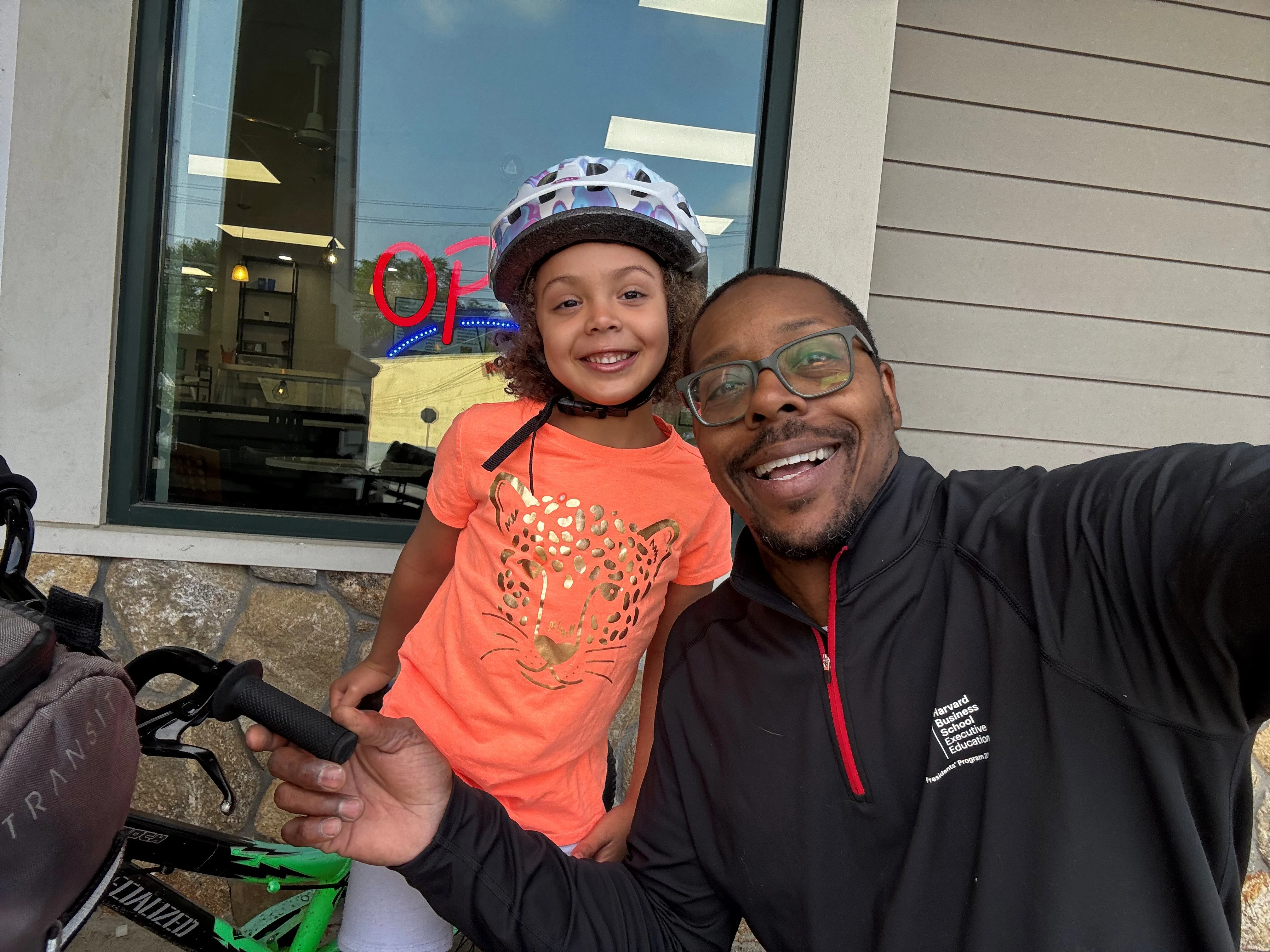
Usually hanging out with my family—my six-year-old daughter, Dylan (we call her Dot) and my wife Emily. I love to garden and they’re usually down with that too. I also just discovered mountain biking—not like jumping off a mountain, but trail riding and meandering through the back woods.