by Shona Simkin
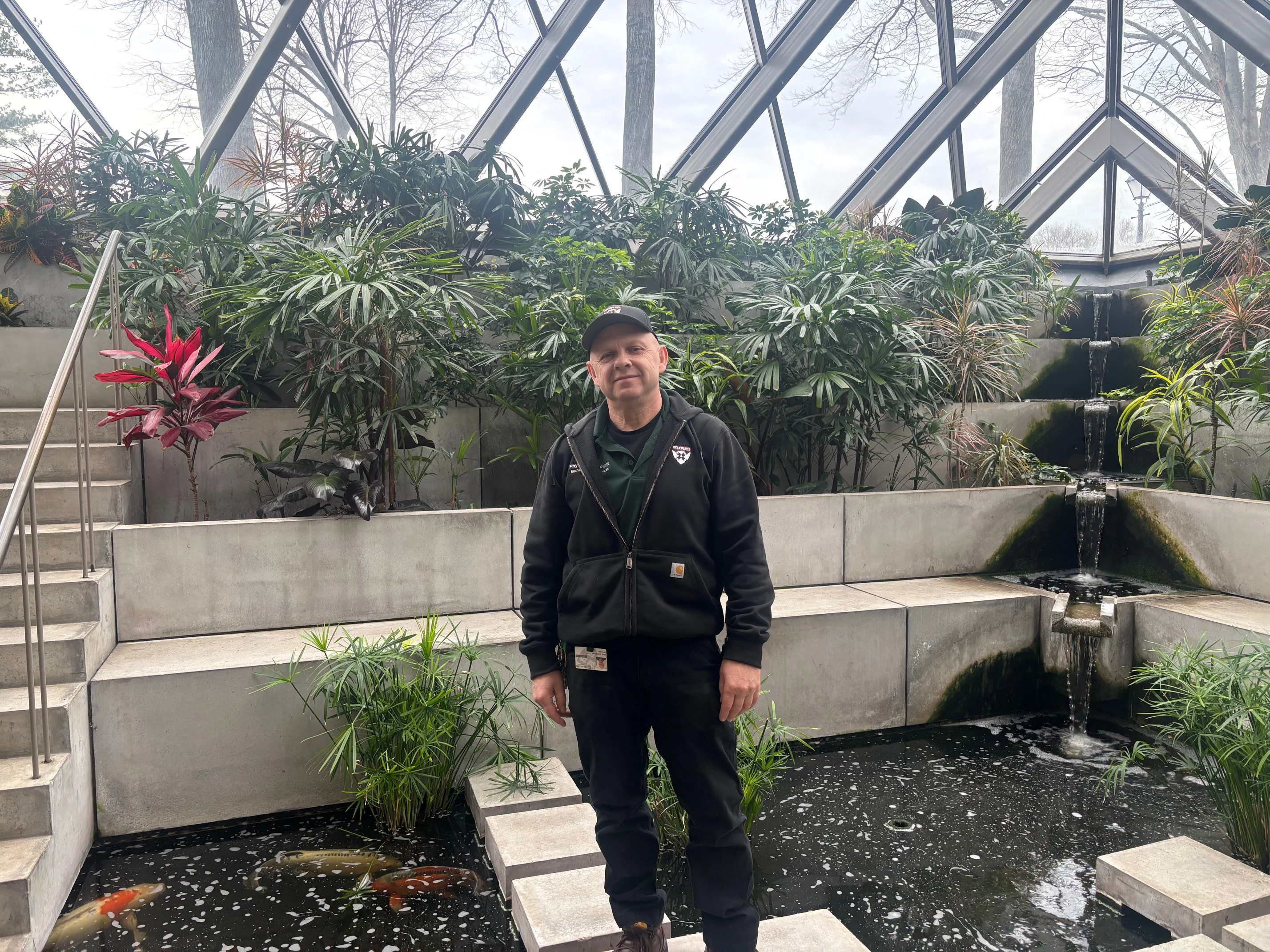
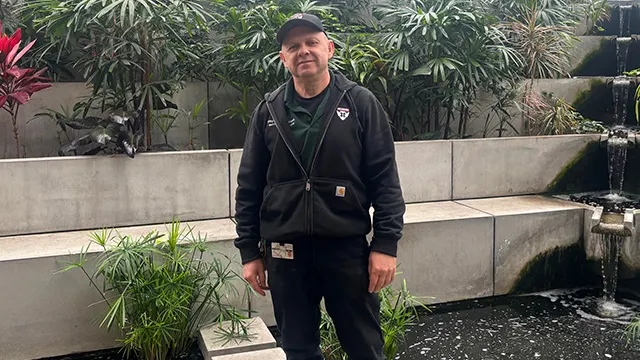
Oleg Mashtaler keeps the Harvard Business School campus running behind the scenes. As a daytime operator in Facilities, he walks miles each day, managing HVAC systems across all 36 buildings, monitoring equipment, troubleshooting issues, and responding to service requests. Originally from Ukraine, he also brings his expertise to an unexpected role—he’s known by his team as the “koi whisperer,” ensuring the Class of 1959 Chapel’s 17 fish thrive.
Tell us about your role.
I'm a daytime operator, which is 7:00 am to 3:00 pm shifts, unless I have to stay over in case of emergency or projects that need immediate attention. We provide comfort to our customers, employees, and associates. That is mainly through HVAC, so in wintertime making sure it’s warm enough and in summertime, cooling.
I make rounds in the mechanical rooms to make sure all are working normally—if you skip even one you might miss something and then it’s more effort to fix later. I always have my laptop in my backpack so I can check and walk to all the buildings; every single one is different and has different equipment, so it takes a lot of experience and knowledge. I do a lot of walking, my minimum daily routine is four miles, sometimes eight. It’s good.
My day is solving puzzles and troubleshooting—checking equipment and alarms, responding to things that need fixing, and adjusting the air handlers’ daily run time schedule based on occupancy and events; keeping an eye on it helps to save energy when events are over or buildings are unoccupied. It keeps my mind active. You never know what you’re going to find.
How did you get started in this line of work?
I graduated from an agriculture university as a mechanical engineer, and I was a chief engineer at an agricultural company in Ukraine. We supported farmers with services like consulting, plowing, soil melioration or drainage, fertilizing, and harvesting. We had huge fleets of machinery that could help farmers—even if they could not afford some services, we could take a piece of their harvest and resell it for them.
When I came here, I was stuck a little bit with what to do. In the newspaper I saw many requests for HVAC assignments, and I applied to a one-year hands-on training HVAC school. I got my first license and started from there.
What was your path to HBS?
I came to HBS in 2010. Before then I was at a similar job at the Sheraton downtown for seven years. It’s probably the biggest hotel in New England; it has 1,220 rooms. I was looking for more opportunities and for a more secure place to work—in hotel business when it’s up it’s good, but when it’s down, I worried about being laid off. Plus, I was working overnight shifts for seven years and wanted to improve my hours.
The job I got here was 3:00 to 11:00 pm. It was paradise to me. Then with seniority I moved up and got my daytime operator job. I feel comfortable here, I describe it as a home. You spend one third of your life at work, it should feel like home, and it does. I have everything I need for my job, to perform well with my skills and experience. It’s well balanced—they’re happy, I’m happy.
You also take care of the koi fish in the Chapel. How did that start?
I showed some interest when the fish were put in and things weren’t going well; they were dying. I found some baby fish after the parents died, and I did research and got the filtration system updated, added ultraviolet UV generator for sanitation that has an additional carbon filter. And after that things were going well. They can remember things, and recognize me because I feed them. They swim up to me when I come near; I sometimes pet them.
I picked up the knowledge in a month or two by reading about koi and watching YouTube videos. Now I know what happened back then—the water was too acidic without proper treatment, and they're vulnerable to that. They have slimy coats that protect them against bacteria and other diseases, and when they are stressed, they start losing the coat. Our water is lightly chlorinated; it’s not good for them, and we have to balance the pH level.
These fish are probably six or seven years old; it took them about three years to get this big. The record for the oldest was in Japan, like 90 years old. If the environment is healthy, they can live a long time. They come from a koi farm in Japan—they sell them all over the world, they come in bags filled with water in the baggage in airplanes. The price is based on size and how many colors they have—some of them can be worth many thousands of dollars.
What brought you to the Boston area?
I came to the United States in 2002. My parents moved here before me, and I moved here with my wife Oksana and my daughter Anastasia when I was 36. There were more opportunities here.
We came here when my daughter was eight years old. My second daughter was born 12 years after her. We always dreamed of having kids maybe two, three years apart but immigration took a while and after we came here, I had to start from scratch. Language, culture, everything was new. It took a while to settle down, but we built up the nest.
My sister is still in Ukraine with her family. It is very stressful now, surviving the war over there. It’s not easy. Mentally I am there. I support whatever I can, with financial support and the community at our Ukrainian Orthodox Church is very active—we do a lot, packing backpacks for soldiers, things like that.
What do you like to do in your spare time?
I have a grandson; he will be two years old. We visit him and my oldest daughter; they live nearby in Wayland. My second daughter, Kristina, is in her second year at Sacred Heart University in Connecticut. So, I spend time taking care of my kids and playing with the grandson—he is changing and growing—if we don’t see him for a week, he is already different the next week. I am also a big fan of soccer and hockey.