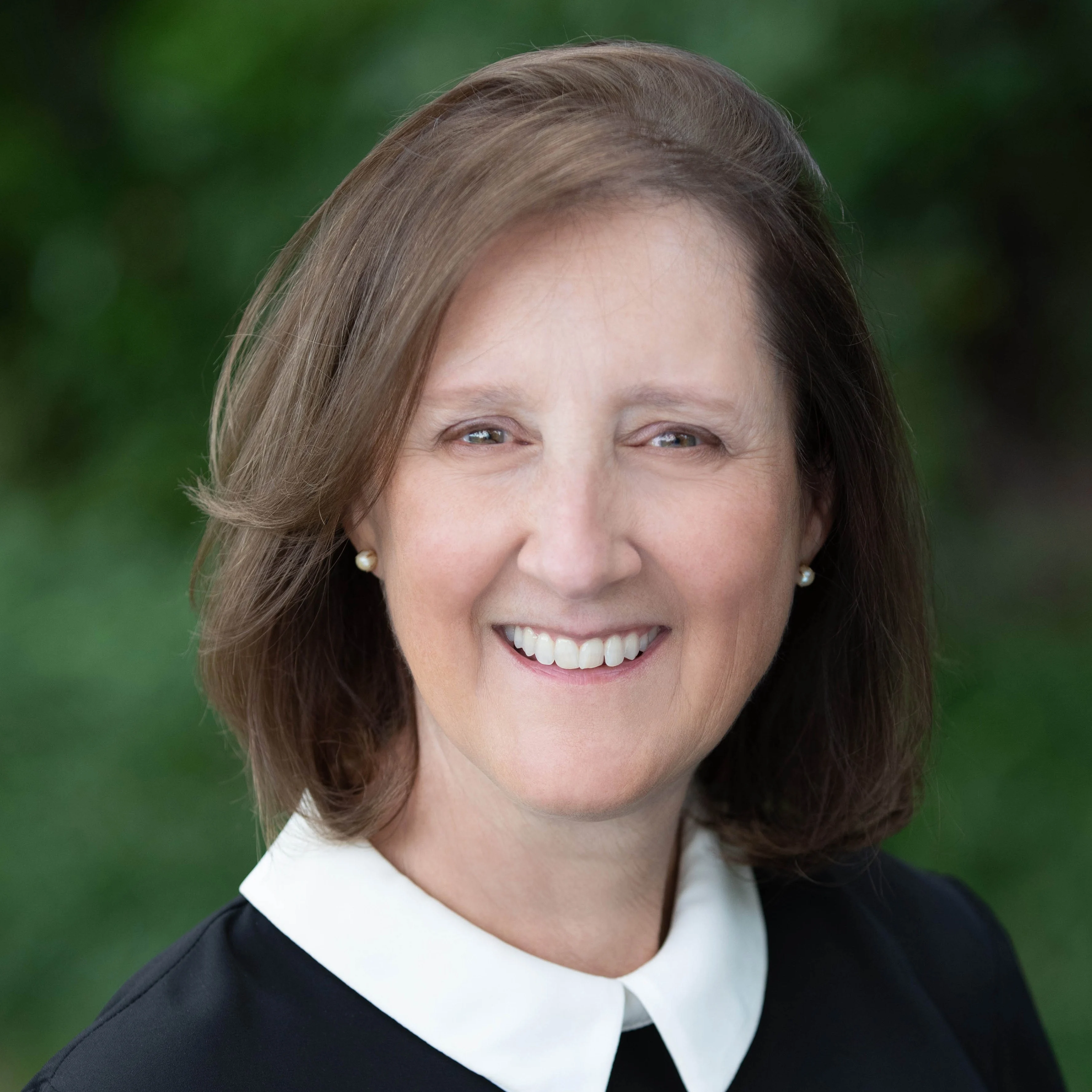
Angela Crispi, senior lecturer of Business Administration and the executive dean for administration, didn’t set out to spend her career at Harvard Business School when she embarked on her MBA degree. But one opportunity led to another, and now, 35 years later, she’ll transition fully to the faculty. We sat down with Angela to reflect on her remarkable journey, why she recommends saying yes, the community that shaped her, and more.
Why did you decide to get an MBA? What was your path to coming to HBS as a student?
I had just graduated from Boston College and had started work at Waters, a company about 30 miles from here. They make life science and diagnostic products like chromatographs and mass spectrometers. I had had several summer internships there, and was hired full time to work on various projects in manufacturing.
I realized I didn’t know much about business, and having grown up around here as a local kid I thought I’d apply to HBS. I interviewed in Morgan Hall—this was pre-renovation—and they deferred me for two years, which I didn’t even know was a possibility. They said I needed more work experience.
When Waters found out I had been deferred, they wanted me to be prepared and put me to work on all different aspects of the company. As an example, a new product was being released so I worked with R&D taking it through purchasing, production, and to the market. I worked with teams making printed circuit boards, in the machine shop, on the assembly line, and managing inventory in the distribution center—it just went on and on. I will always be indebted to them for the gift of helping me prepare. And a bonus, I was able to work with my mother while there and met my husband.
It was best to not come to HBS right away; I needed the additional time and experience.
What did you envision for yourself after getting your MBA?
I thought that I would return to an operating company. But then I intentionally chose a summer internship between my RC and EC year in an area completely different: marketing for Gerber Childrenswear in downtown Boston. The role was about positioning their products to customers: What happens in the store? What will encourage someone to buy a onesie? How should packaging be designed to promote the brand? It was a phenomenal experience.
In my second year, CPD [Career and Professional Development] hosted a recruiting briefing and encouraged students to think about working at HBS when they graduated. The talk lifted my chin. I had always been invested in education, and realized that schools are places that share much in common with running a business. It seemed interesting to stay here and start a journey in education. MBA Admissions and Financial Aid posted a position, and I was fortunate that this team became my first job here.
What or with whom do you credit with your interest in higher ed and education?
In my high school yearbook, I said I wanted to be a teacher. But it was also realizing what my parents did to enable my, and my brother’s, educations. My father was a forklift mechanic for General Motors. He worked tirelessly for multiple shifts often teaching his fellow trades colleagues on how to do the job. My mother always worked in finance and I grew up watching her work by day and study at night to earn her college degree. It took her 10 years.
So I was, in effect, the first in my family to finish college. That had such a foundational impact on me; it showed me the power of education. I was the beneficiary of a family who always encouraged us to continue going to school and never stop learning.
Reflecting over these months, I recall how I was always the one who wanted to help the teacher in elementary school—cleaning the chalkboards, getting the room ready for the next day, taking the absentee list to the nurse. I was this little wannabe, running around the school trying to help the teacher.
When you started in Admissions and Financial Aid, could you have ever imagined you’d be here for the rest of your professional career?
Not at all. I find that this is a pattern for a lot of staff; they think they might be here for a handful of years and lo and behold, they realize that with their talent and the School’s many opportunities, they stay far longer.
That's what ended up happening with me—HBS is so multifaceted and ever changing, I kept getting more and more jazzed by its mission and reach. The longer I was here and the more I learned about the importance of what the School was doing—this glorious small city had so many pieces to it—the more I loved being part of the community of people running this organization.
What do you see as the throughline between all the roles you’ve had over the years?
The people. It takes an amazing orchestration of expertise to ensure this organization thrives. Every role that I had kept revealing how talented the people were. There are hundreds of types of jobs across many specialties all while 24x7 and across the globe. Every single person’s role is integral to the whole. One position is no more important than the other. The institution draws on all types of talent, and I love that mosaic.
How did you weave together raising a family and increasingly demanding roles?
Hands down, the support of my family. My husband is incredible; he’s always open to whatever I want to do, and we've championed each other in what gives us meaning. Our children never knew anything different than parents who both worked. That's been the pattern of our life.
My parents and my husband's parents helped out a few days a week when our kids were little. It takes a village. I always made sure that I got home in time—we would always have dinner together. I was never going to miss a game or one of their activities; I chose to be a room parent and host friends camp. I was not going to miss these moments in my family’s life. Consequently, I structured my day like so many others do, racing out to get to that game. When they were doing their homework, I was doing mine next to them. To preserve family being my number one responsibility, and that the work got done, we all worked alongside each other.
I realized that the way my husband and I would talk with our children—trying to motivate them to do their best or help them through a tough day—was very similar to what I was doing at work, helping someone tackle a challenge and building confidence that our team could do something together. I drew on my personal and professional life; there were so many similarities.
I also didn't know anything different—both my parents worked. My mom would take me to work, and I’d take the staples out of invoices. And I did the same with my kids—if I was in a bind and they needed to come in with me, I’d ask them to alphabetize my files. It was a way of working together. We were always a team, asking who needed what and who needed to be where when. That togetherness made a difference.
As my kids got older, their friends wanted to talk with me—asking my advice about college or possible careers. I fell in love with that mentorship—I grew to know them in new ways, and that was an unexpected treasure.
This is a school about creating leaders—has your sense of leadership evolved over time?
I've long approached working with people and thinking about leadership as this: My job is to help others do their job.
Everyone here is an expert in what they do; I could never know their work as deeply as they do. Knowing that we have priorities and a mission, I try to consider how we make decisions collectively, pace things over time, and utilize our resources. I’m in a unique role of spanning across the School and helping to figure out how to execute on different ideas every day—how we’re going to be excellent at what we do.
When you look back at your career, what are the moments that you’re most proud of?
They all end up in the same realm—those that took many different people coming together to create something and innovate on what we now call a tradition.
Examples like how we became global—by simply expanding beyond Boston with one location. How did we start HBS Online? With a small team of people from IT and MBA. How did we completely rebuild Baker Library and shift an academic library when it lost its physical location? It took people from the library team, from Operations, and many others . So many examples—how we got through COVID; sending 930 MBA students around the world with the Capstone course; engaging with alumni during campaigns.
It always starts with an idea and a vision, and we keep iterating and evolving. We draw upon the talents of so many colleagues. I am so appreciative of what we collectively accomplished.
What advice would you go back and give to yourself as a young woman starting out?
I would tell myself to feel okay about saying yes. You hear a lot that you can’t say yes to everything—you’ll drown and not get enough done. But I was always saying yes.
When I was in Admissions, I was asked to get involved more in Financial Aid. Then in Financial Aid someone asked if I’d get more engaged in Student and Academic Services. Then I was in the MBA Program and the Dean’s Office called and asked if I’d consider joining them. When Dean Kim Clark asked if I would consider this role, my kids were five and seven and it was so perplexing, but my husband and colleagues helped me think about the opportunity and it came down to realizing that if others saw promise in me, I’d step up.
When I became involved campus planning, I by no means had domain expertise, but I realized that I understood the School. I knew what it was like to be a student and I knew what it was like to work here. I had walked these paths, eaten in the dining hall, and sat in the classroom. I wasn’t an engineer, architect, or builder, but I wasn’t supposed to be—I was supposed to lead teams and bring my understanding of HBS.
My career path has shifted often to where people invited me to go. Each time I’ve said yes I wondered if I might not be experienced enough or might get over my skis. But I was curious and never tried to be the expert; I was there to learn with others, widen the circle, and help us get the job done.
So I’d tell myself—and others—to take a chance on yourself—don’t doubt yourself, just jump. It’s ok to say yes. The reverse is also true—have confidence in others and give them a chance.
What gave you that confidence to keep saying yes?
After I was deferred from HBS, I wrote a letter to myself. I had read a lot of books about being a Harvard MBA. I was really nervous. So, I wrote a letter to prepare and keep myself grounded. I had a lot of misperceptions about what it would be like here, and in that letter I told myself to not change.
From day one, I instantly, and repeatedly, found that everyone was amazing and down to earth—first the students, then I saw the same with faculty, staff, and alumni. As my responsibilities kept evolving, I wanted to preserve that and keep the community top of my mind—we take care of each other. I could always count on the goodness of the people who are here.
A great example of that was my experience in the HBS classroom. Ninety people are sitting there, from all different walks of life, different industries, different functions, all taking the same required courses with the same incredible faculty. You realize you have a lot to learn. Coming out of that experience I vowed to believe in myself, jump in when asked, and learn along the way.
Is there anything that feels unfinished to you about your time here?
I have always recognized that we are here for a moment in time. Harvard has existed since 1636 and HBS since 1908, and our institutions will be here for hundreds of years following us. We have the privilege of shaping this School and those who come here during our time.
In the Dean’s Office, we often look back at decisions that were made and the context of those times. I always seek to optimize for the time we’re in now, while paving the way for others who will follow. We have no idea what our actions today will mean for our successors 50 years down the line, but that’s what we must consider. We are investing in transformations like AI and readying for the growth of our neighborhood in Allston—we’re doing so many incredible things. It’s mind-boggling to think about where we are headed in even 25 years.
So, I wish I could live to the year 2100 to see what unfolds! But I also recognize that our time here now is to advance the School and innovate. There is always a feeling that the work is unfinished, but that’s just the nature of a place that has had hundreds of years before us and will see hundreds of years after. You're never going to finish the job; you're always building on what came before you.
What are you excited about in your next steps?
I am excited to be in the classroom more and engage in the School in new ways—to work closely with students and to collaborate with faculty. I've always been an educator at heart. In this role, I have seen myself educating colleagues about working collectively to create an environment where everyone can do their best work. Others learn from our example and we learn from them.. I believe deeply that we're a living model of what we teach. So, in some respects, while I might soon be engaged in academic life differently, I've cared about being an educator all along.