By Shona Simkin
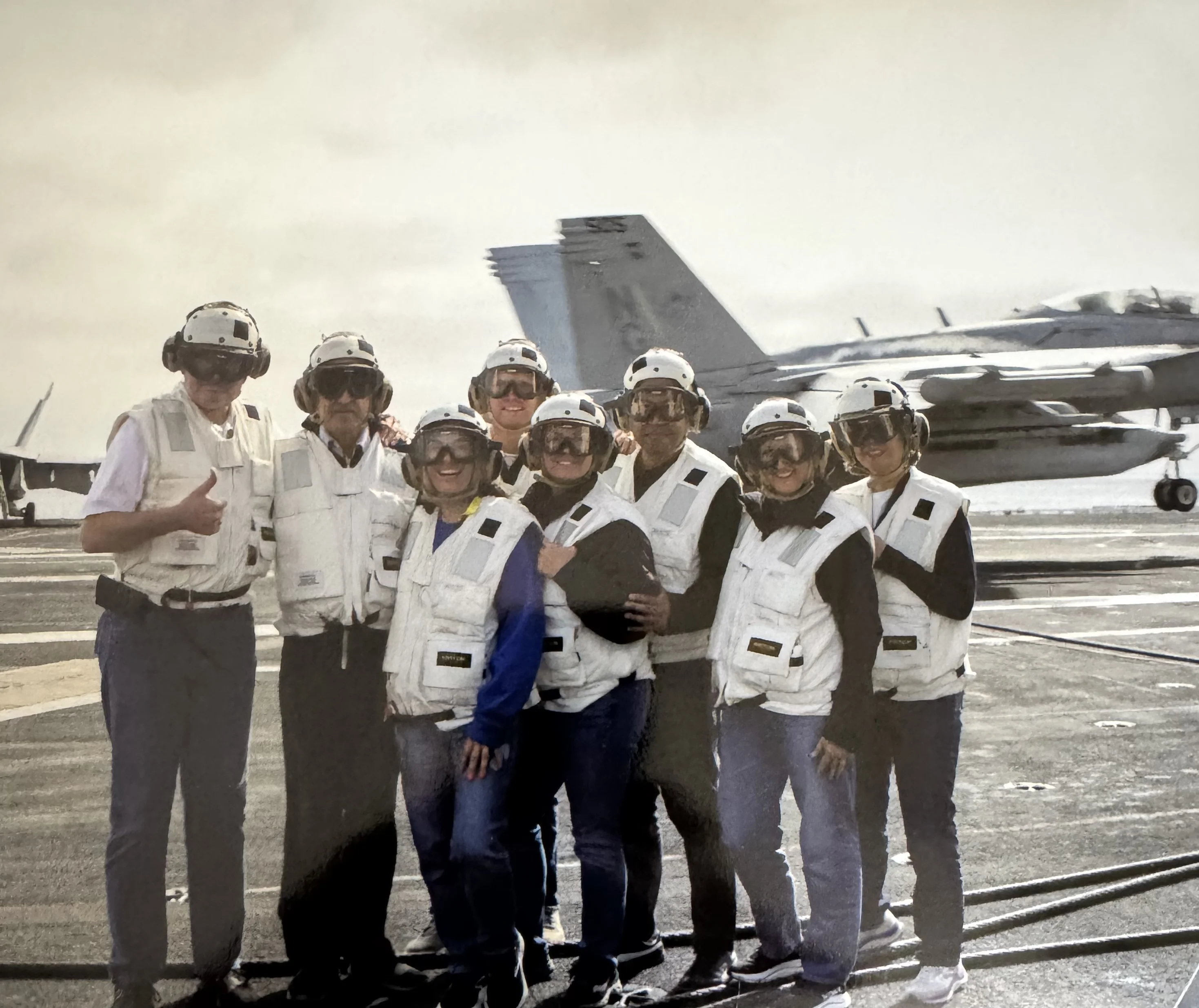
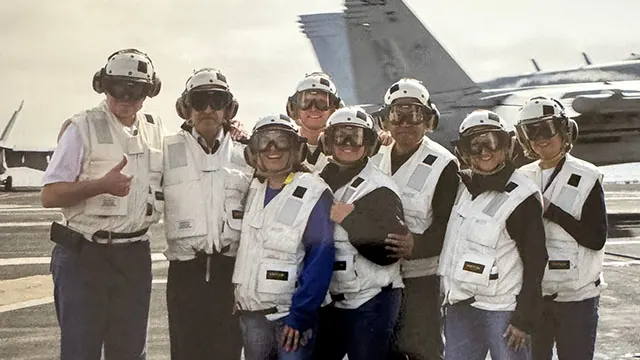
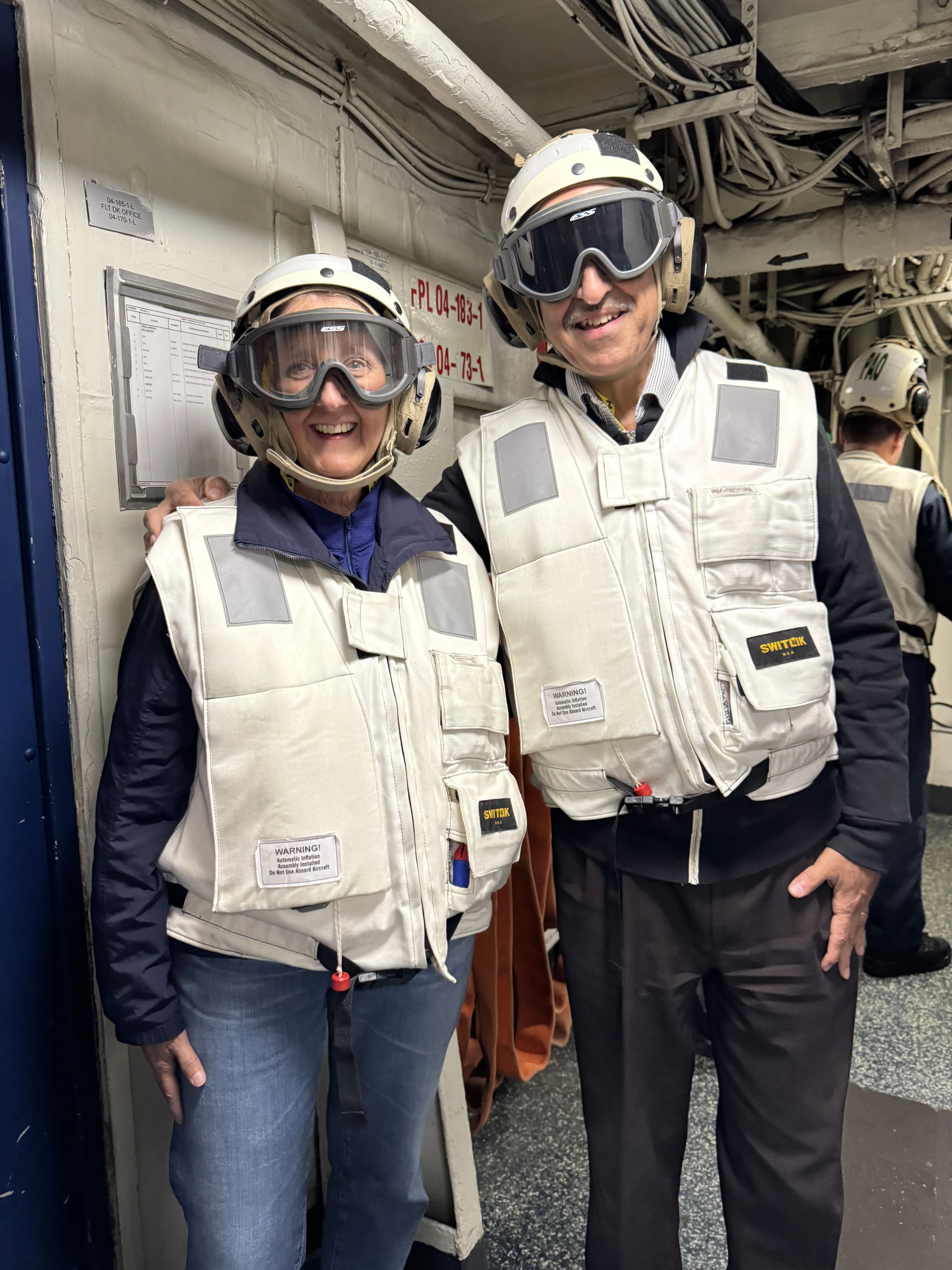
In late September, Dean Srikant Datar and Executive Dean Angela Crispi spent 36 hours aboard the USS Abraham Lincoln, a 104,000-ton aircraft carrier off the coast of San Diego. Their visit, part of the US Navy’s Distinguished Visitor Embark Program, was preceded by a day at the Naval Special Warfare Command, where Crispi met with Navy SEALs and training leaders. The experience offered insights—and many parallels—into leadership, culture, and decision-making under pressure.
The visit placed them in the heart of a four-acre floating city with more than 5,000 sailors and aviators. “Honestly, the two days were some of the most remarkable moments I have ever had,” said Crispi. “Five thousand talented and dedicated people on an aircraft carrier that was four acres wide and about 20 stories tall. I kept thinking—we have 5,000 people too, each day, on 40 acres.”
Brad Wilkin (MBA 2025), a former Navy pilot who regularly flew distinguished visitors to aircraft carriers, nominated Datar and Crispi for the embark experience—and he knew exactly what they were stepping into. “You land on the ship, observe flight ops from the deck, eat with the crew, meet the captain, and sleep just below the flight deck,” he said. “It’s an intense immersion, especially for people who come from outside the military.” The experience, he explained, is designed to give civilian leaders a clearer picture of how the Navy operates and how much coordination, discipline, and trust are required to make it work.
From observing jets catapult off the deck to navigating narrow passageways amid roaring machinery, Crispi and Datar saw firsthand the demands of managing high-risk operations.
Datar said, “It was an amazing honor to participate in this program. Seeing the degree of precision and complexity that service members are managing minute to minute and day to day was staggering. The scale, and stakes, are extraordinary. As a faculty member, I have long been aware how the School’s military veterans shape our classrooms while they are students. This immersion really illuminated how they developed the leadership experiences and qualities they bring to our community. On the occasion of Veterans Day, I am all the more grateful for their remarkable service and sacrifice—and the ways they go on to exemplify our mission of making a difference in the world after graduation.”
Datar and Crispi’s experiences and connections underscore the School’s long-standing history of military ties, from officer training programs in WWII to annual Veterans Day programs hosted in Klarman Hall to notable alumni, such as the current secretary of the Navy, John Phelan (MBA 1990), a classmate of Crispi’s.
Before visiting the aircraft carrier, Crispi spent a full day at Naval Amphibious Base Coronado with Naval Special Warfare (NSW). The visit was coordinated by HBS classmate Don Reidy (MBA 1990), who served 28 years on active duty in the US Navy—including 14 years supporting NSW—and the next 16 in senior civilian leadership roles overseeing resource strategy and budgeting for the community. Reidy arranged engagements with the SEAL Teams, NSW Basic Training Command, and Special Reconnaissance Team One.
“There is a natural connection between HBS and Naval Special Warfare,” Reidy said. “Both communities prepare leaders to make high-stakes decisions in environments defined by volatility, uncertainty, complexity, and disruption. Another common trait with HBS is purpose. SEALs are driven not by recognition, but by service—to their teammates and to something far larger than themselves.”
Wilkin also noted similarities. “When I got to HBS, I was immediately impressed with how seamlessly everything runs,” he said. “The level of operational complexity wasn’t lost on me.” It reminded him of flight deck coordination—systems running smoothly because of people, preparation, and precision.
“We talk about leading at scale all the time,” Crispi reflected. “But being on the carrier, seeing how 5,000 people stay aligned every minute of every day—it’s humbling, and it’s instructive. The trip reinforced so much about service, teamwork, and the importance of mission clarity.”