By Shona Simkin
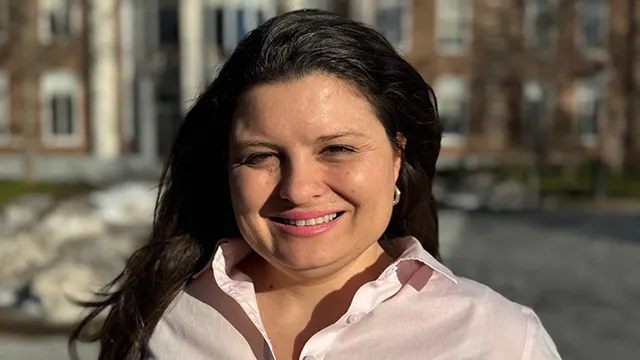
When Denitza Stantcheva isn’t helping prospective Executive Education participants figure out which program is right for them, she’s leading courses on breathwork and meditation. We talked with Denitza about her work at HBS, how a college crisis led to her lifelong meditation practice, and more.
What does your role look like day to day?
I’m a senior program advisor at HBS Executive Education and I support professionals who are exploring our courses. I help them navigate the many options available—a lot of those conversations are via email or phone, and some are even in person. I review their background and make course recommendations that align with their professional goals. Many participants come back for additional courses, even years after they've applied. With such a broad range of options on our website, people often schedule advising calls to see what courses would be the right fit. We look into their profile and background, then assess and direct them in the right way.
What do you particularly love about your job?
I love the opportunity to meet with global leaders from a variety of backgrounds. I feel like these are connections that I can really make in this organization. I've had some deep and inspiring conversations with prospects who are driving meaningful change in the world, and I feel like I'm able to help them in that in that process. I recently met with a group from the Owner President Management Program (OPM), and hearing about the impact the program has had on their businesses—and their communities—was incredibly moving. Those moments remind me of the meaningful connections we can build here.
What are some of the challenges of your work?
One is the very high volume of people that come into the programs, and the other is redirecting people if the program they’re interested in isn’t the right fit. I really have to skillfully redirect people so that they make the right choice for themselves.
How long have you been with the School, and what was your path to HBS?
I am entering my fourth year at HBS. Before that I was at Lesley College, in a similar role—advising prospective students on different programs. Prior to that I spent most of my career in the nonprofit sector working with the Art of Living Foundation in US and Europe, managing a variety of service projects for the community as well as teaching breathwork and meditation primarily to students
In Europe, I helped launch the Yes We Can! Project, which was designed to cultivate community leadership among young professionals. We offered hands-on training in volunteerism, leadership development, and social responsibility, to help empower participants to become active contributors to their communities.
I also worked on a project in Europe called Prison Smart, which is a program through the Ministry of Justice that helps inmates and staff manage their stress and emotions to cope with everything they're going through.
How did you get interested in that sort of work?
I’m from Bulgaria; my family moved to Massachusetts when I was in tenth grade. I did my undergrad at UMass Amherst, and went to Boston College for my master’s in higher education. I studied administration, but I kept plugging myself into different service projects and initiatives.
One thing that I deeply believe in is the importance of mental health. I have led some meditation sessions for our department at HBS, and I always encourage people to find ways and time for themselves, even if it's five or 10 minutes—maybe going for a walk or for coffee with a friend, or even just taking a quiet moment alone—prioritizing our own mental health and well-being is essential. The state of our mind is what determines the quality of our life. When we are happy and centered we naturally share that energy with others. Our presence conveys much more than our words in everything we do, so being happy and taking care of ourselves is important.
Tell us more about your breathwork and meditation practice.
I'm a certified breathwork and meditation instructor and I volunteer with a nonprofit (the Art of Living) that teaches programs all over the world. The breathwork focuses on realizing that breath and emotions are connected, and that breath and the mind are also connected. Have you noticed how when we are upset, our breathing pattern changes to being a little faster; when we are sad our breathing is a little heavier and deeper; and when we are happy our breathing is very light. Understanding the different breathing patterns and practicing a few minutes of breath work can really help us manage our emotions better.
I teach these programs during the weekends and in my free time. I teach courses for kids, teens, and adults. For kids and teens, it’s breathwork, discussion, and games. For adults it’s a sequence of breathing along with some guided meditation and some practical discussions on how to be more in the present moment. If you think about it, happiness is always in the present—we may regret the past or find ourselves worried about the future, but life really happens in the present, and the more we can anchor ourselves there, the more productive we can be and the more our relationships will improve. All of that is encapsulated into a three-day workshop, where people walk away with a practice that they can do daily on their own to help be more in the present and manage their mind and emotions
How did you get interested in this work?
In my second year of college, I was going through a tough phase and found myself falling into depression. I was looking for ways to feel better and have more energy. I started exploring different programs; I did some yoga and meditation, but I couldn't really find anything that was easy enough to incorporate in my daily routine. I took a workshop and learned a set of breathing techniques. I was not a disciplined person, but I started practicing this every day primarily because it was an easy practice to do, and I noticed some huge changes. I had more energy, I was feeling more relaxed, and most importantly, I noticed that I stopped feeling depressed. Because it was such a personal transformation, I knew I wanted to give back to the community. That’s how I became an instructor.
Do you still do breathwork every day?
Oh yeah, every morning I wake up and I do my 20 minutes of practice. I usually do 10 minutes of yoga, which I love, and then I sit and do my breathwork and meditation and then I start my day. I just read that someone said, “To win the day, you have to win the morning,” and I thought, “That’s right!”
What do you like to do in your spare time?
I love traveling with my husband and seven-year-old daughter. We go to California, Florida, especially in the winter. I try to take little trips. My husband is originally from India, so we're a mixed culture—we go to some of the festivals, Diwali and Holi. This year we're bringing our girl to India for the first time. I took her to Bulgaria last year for the first time, and it was an incredible experience for her to see the people and try the foods. I feel that we learn so much when we expose ourselves culturally through traveling and meeting people.
I also recently helped with the Harvard Leadership and Wellness Forum. It was during Harvard Student Wellbeing Week, which started during COVID. It was a great conversation between Dr. Bob Waldinger and Gurudev Sri Sri Ravi Shankar about mental health and wellbeing—we had more than 400 guests.