
This year marks the centennial of the Business History Review, a publication that has grown alongside Baker Library’s collections and helped establish business history as a field of study. We sat down with Walter Friedman, director of the Business History Initiative, lecturer, and the journal’s co-editor, to discuss the journal’s origins and its evolution alongside Harvard Business School.

Take us back to the publication’s founding—why was it started?
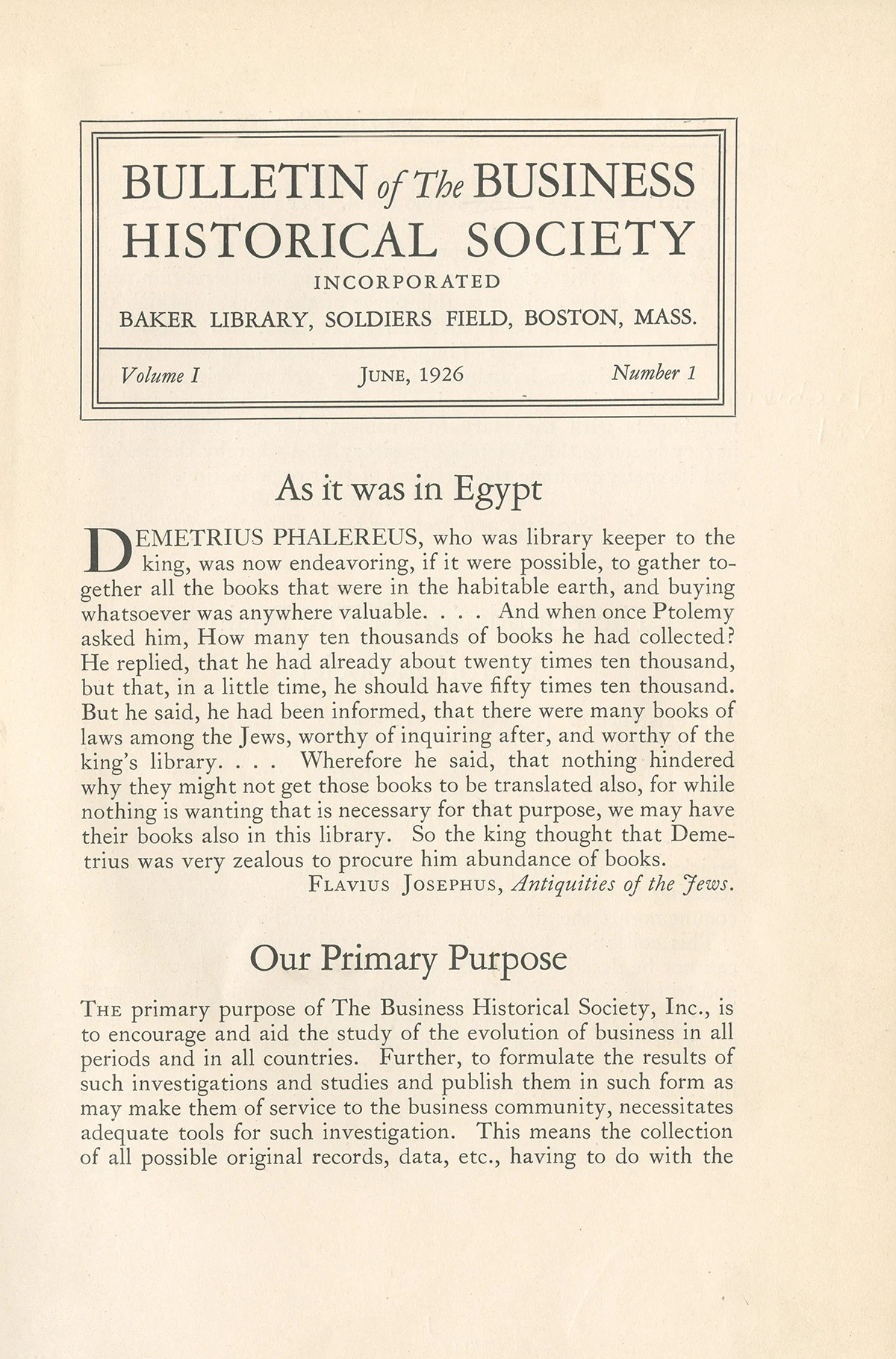
The current journal, Business History Review, traces its beginning to 1926 with the founding of the Bulletin of the Business Historical Society. The Business Historical Society was a Massachusetts state-chartered organization whose purpose was to “encourage and aid the study of the evolution of business in all periods and in all countries.” In its early days, the Bulletin was closely associated with Baker Library. In its first issue, the editors drew a parallel with the Society’s mission to preserve historical business records with that of the ancient Library of Alexandria’s effort to collect all human knowledge. That suggested, even if somewhat facetiously, the scale of the Society’s ambition.
Interestingly, the Society wasn't entirely composed of scholars but also included businesspeople from leading US corporations, railroads, and even a chairman of the Federal Reserve Bank of Boston. Three key figures were the first two deans of HBS, Edwin Gay and Wallace Donham; and Arthur Cole, who was then an economics professor at Harvard but later became the head of Baker Library.
This was happening as the HBS campus was taking shape. How were those developments connected?
In 1927, the same year the new campus opened, Dean Wallace Donham appointed a Canadian historian, N.S.B. Gras, to become the first Isidor Straus Chair of Business History. Gras wrote many articles for the Bulletin of the Business Historical Society and worked to develop the field of business history at HBS, creating a dedicated course on the subject. In 1931, he founded the Harvard Studies in Business History book series at Harvard University Press.
Another key figure in the development of business history at the School was Henrietta Larson, who was one of Gras’s students and served as editor of the Bulletin for many years. Larson also became one of the first women appointed to the HBS faculty. She and Gras produced a casebook on business history, and in 1948 Larson published a monumental Guide to Business History, which runs over seven hundred pages. In many ways, these works, and Gras’s book series, defined the field as one that was global in nature, focused on firms, and made use of primary source research.
How did the Bulletin evolve in those early decades?
One of the important turning points for the journal was Arthur Cole’s founding of the Research Center in Entrepreneurial History in 1948. Cole and his colleagues, including Joseph Schumpeter and Fritz Redlich, took the study of business history in a new direction. Rather than focus on detailed studies of individual firms, they were interested in the figure of the entrepreneur as an instrument of “creative destruction” (Schumpeter’s famous phrase).
Just as Gras and Larson pioneered the field of business history, this group developed the field of entrepreneurial history. They detailed the ways in which entrepreneurs combined resources in innovative ways to bring about economic and societal change. The center disbanded in 1958 but had a lasting influence. For one thing, it brought together an astonishing group of scholars, including some like Bernard Bailyn, David Landes, and Alfred D. Chandler, who were at the beginning of their careers and who became prominent Harvard historians.
What was behind the name change to the Business History Review in 1954?
The transition of the Bulletin to the Business History Review was the culmination of the decades-long effort to define the new academic field and launch a fully refereed scholarly journal with lengthy articles and book reviews. The first editor of Business History Review was Ray Ginger, a historian best-known for a biography of the socialist presidential candidate Eugene Debs, and he was followed by other historians, including George S. Gibb and Ralph Hidy, who became the Isidor Straus Professor of Business History after Gras.
What have been some of the journal’s most important contributions?
Some of the most important articles were those by Alfred D. Chandler, first while he was at MIT and then while he was at Harvard Business School. His 1959 article, “The Beginnings of ‘Big Business’ in American Industry,” became one of the most cited in the journal’s history.
It outlined a set of questions for students of American business history, including the need to define the “dynamic factors” of change. It anticipated the ideas in Chandler’s Pulitzer Prize-winning book The Visible Hand: The Managerial Revolution in American Business (1977), which traced the rise of the managerial class and the coming of big business in the United States. His 1994 article, “The Competitive Performance of U.S. Industrial Enterprises since the Second World War,” continued his analysis of the role of large US firms as they faced significant competition later in the 20th century.
The Review also pioneered in the study of international business. In 1974, Mira Wilkins published an influential article comparing the strategies of multinational oil companies operating in several South American countries, including Argentina, Boliva, Brazil, Chile, Colombia, Ecuador, and Peru. Geoffrey Jones, the current Isidor Straus chair and co-editor of BHR, published several articles on multinationals, including one on US multinationals in British manufacturing. BHR also published a noteworthy 1960 article by Edith Penrose on the Hercules Powder Company, which was part of her larger project, The Theory of the Growth of the Firm (1959).
Why has business history remained such an important part of HBS?
Part of the reason is that history has also been highly successful in the classroom. The Pulitzer Prize-winning HBS historian Thomas K. McCraw wrote an article titled, “Teaching History Courses to Harvard MBA Students: Building Enrollment from 21 to 1,300” that he published in 1999. McCraw noted that the School’s first two deans, historian Edwin Gay and Wallace Donham, a lawyer, both valued history in business education and advocated for Socratic teaching, especially in the form of the case method.
The case method itself encouraged students to examine business decisions in their historical context, making history an integral part of management education. While Gras introduced a case method class in business history, enrollment remained fairly small. But in the 1970s Alfred Chandler, working with Richard Tedlow, developed the course The Coming of Managerial Capitalism. This course, further expanded by Chandler, Tedlow, McCraw, and Nancy Koehn, became one of the most popular electives at the School, so much so that over 40 percent of the MBA students chose to take the course in the late 1990s. Remarkably, history courses continue to be among the most popular electives at HBS thanks to a number of remarkably talented historians at the School today.
How has the field of business history evolved in the past century?
In terms of the scholarship, there's been a broadening of the field from its beginning, when Gras framed it largely as the study of firms to also include more on the impact of business on society and culture.
Environmental business history is a growing field. Recently, historians have been focused on the history of capitalism and the variety of forms that capitalism has taken. HBS historian Sophus Reinert and his colleague Robert Fredona published a special issue of Business History Review on “Italy and the Origins of Capitalism.” The issue made extensive use of Baker Library’s Medici Collection and Kress collections in order to better explain the origins of modern economic growth.
What do you most want people to take away at this centennial anniversary of the journal?
The journal has, from its earliest days, been an important part of the School’s intellectual life, and has been interdisciplinary in nature, publishing not only the work of historians, but economists, political scientists, and sociologists.
One well-known contribution to the journal was Clay Christensen's 1993 article on the rigid disk drive industry, which became part of the empirical base of his later book, The Innovator’s Dilemma (1997). More generally, BHR is part of a broader story of history at HBS, which includes the scholarship of the faculty and the development of the fields of business and entrepreneurial history, the remarkable collections at Baker Library that have made the School a global research center, and the development of highly popular elective courses.
The next century of history will depend on our faculty and leadership continuing work in each of these different ways and developing new and dynamic ideas. Fortunately, as I have said, there is a great group of scholars interested in history and in historical perspectives currently at the School.