by Shona Simkin
For more than 10 years, Brent Benson has been building technology for HBS Online as its senior director of architecture and data platforms. We talked with Brent about how his role has scaled alongside HBS Online, what makes his work meaningful (spoiler, it’s people), and his love of music and political data models.
What was your career path to HBS?
My background is in computer science with some math, statistics, AI, and natural language processing. It's all been technology focused, but it wasn't in higher ed or learning based until I came to HBS.
I moved to the Massachusetts area to work for a startup that did mechanical engineering automation. We built a product configurator. I really like building things—that’s a big part of my interest in technology.
The startup was acquired by Oracle, and I stayed on for several years until I got a call from the former CTO of our startup company who was working at HBS on a new experimental learning platform—at that time it was called HBX. He said they needed an enterprise architect and asked if I’d come interview. It turned out to be a really good thing—it was a great time in my life to put my technology experience back to work on a learning platform. Both my parents are educators and I really like being in that space. And I love the mission of the School; educating leaders to make a difference in the world.
Where did you grow up?
In Southeastern Pennsylvania, the Allentown Bethlehem area, where my parents were at Lehigh University and Cedar Crest College. But both my parents are actually from Illinois, so I feel like I’m sort of an Illinois person as well. I was at graduate school at the University of New Hampshire and that's how I got introduced to New England and met my wife.
What were the early days of HBS Online like?
I started here in early 2015, when the first courses were just coming out. It was still very experimental. We had a core program for business basics and Clay Christensen's disruptive strategy course. We had a lot of leeway and were almost like a startup within the School building all of our own technology ourselves.
A few years after I started we were able to increase our learners to the point that we were making money for the School—which was a hard thing to do in online learning. It was so exciting to extend the reach of the School beyond Allston because not that many people can come onto campus and go to school here. We’ve educated so many people from around the world—over half of our learners are outside the United States.
How has your role changed over these past 10 years?
It’s grown alongside the growth of HBS Online. As we scaled we realized that we needed to get bigger as an organization and develop things like a marketing department. We were pretty isolated, so we worked on building up relationships with other parts of the School.
I was working on technical designs that went across the learning platform, our business platform, and marketing, and that was really exciting, but I didn't have a team. I was working along the development managers, software people, data people, and eventually I ended up managing the HBS Online data team and two technical architects.
Digital transformation is really important to what we do—collecting all the information and data for decision-making, and my role grew into focusing on data and building machine learning models for enrollment in the courses themselves. As that field has grown it’s been a bigger part of my role. I love to learn new things and use new technologies.
And we’ve changed as things change at the School—we now have a much closer relationship with Executive Education, and I oversee their data and reporting group. My responsibilities have grown as our purview has gotten bigger.
What does your work look like day-to-day?
About 80 percent is around building technology things. There are a lot of meetings, like everyone else, but most of them are about, say, the AI-backed learning components we’re building for our courses or trying to use AI and digital tools to be more efficient in the back office.
Then 20 percent is around people managing and strategic types of things—trying to do the right things for our learners and our team and working with other technology teams around the School and the University on larger projects and knowledge sharing.
What are some favorite aspects of your work?
I'm so impressed with the high quality of the people I work with—their dedication and skills, and that they’re just really, really nice people. That has been one of the greatest things. A lot of time has been spent at HBS Online thinking about our culture and what we want to be as organization. And that's been really special to me.
More and more these days—especially with AI tools—you can have an idea, code, and build something, but it’s such a richer experience when you collaborate with other people. It’s the same with music, which I do a lot of in my spare time.
Tell us more about your music and what you like to do outside of work.
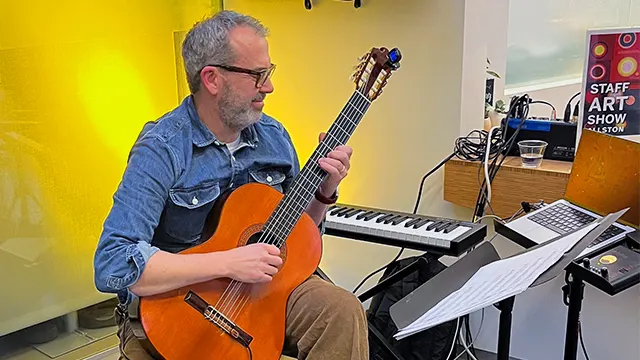
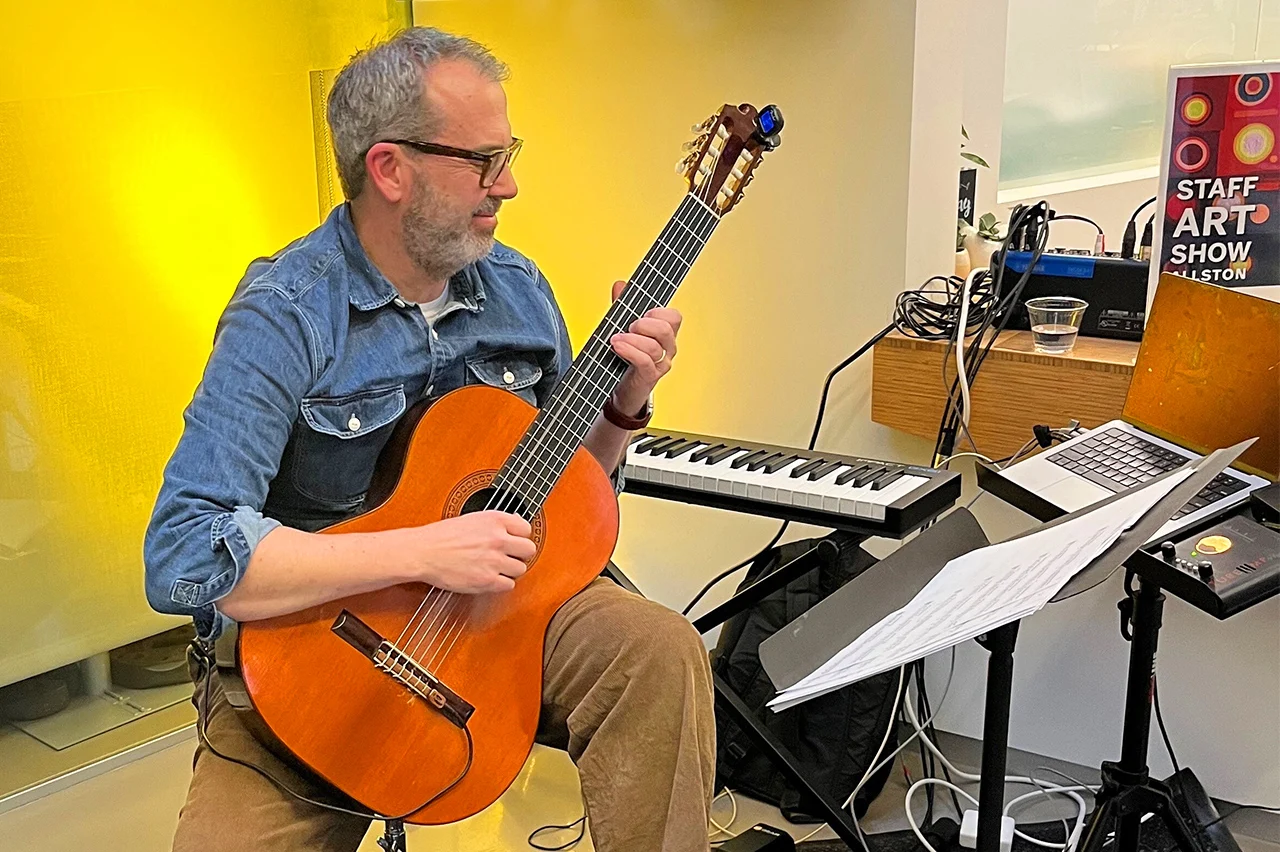
I was always really into music growing up. I went to the University of Rochester in upstate New York for college, and one of the reasons I went there is because the Eastman School of Music is part of the university. My parents weren't super encouraging of me going into music as my career, so it's always been sort of an avocation. I’ve semi-professionally played classical and jazz guitar and was in rock bands in high school, college, and later on the seacoast of New Hampshire, Maine, and a bit into Massachusetts. I played at the Harvard Staff Art show last year—I didn't know if it was open to more than visual arts, but they are very welcoming to poets, dancers, musicians, and other performing arts.
Our kids are adults and out of the house, but I love to spend time with them. My son is a professional musician in New York, one daughter lives in the North End and is able to come over for dinner and go to movies and shows, and my other daughter is in the Washington, DC, area.
I also love learning and like to take classes and work on side projects. My wife was in the state legislature for 11 years as a state representative, so I got really into statistical analysis of Massachusetts politics. I don’t always have a lot of time to spend on it, but I do keep up with my models and occasionally write pieces for the CommonWealth Beacon and other outlets, when there are interesting quantitative stories to tell.