
In January 2026, Arnold Paul was formally appointed senior managing director of Digital Transformation (DTx), following several months in the role on an interim basis. The team remains focused on designing and scaling high-quality digital products that enhance the HBS educational experience and advance the School’s mission. We sat down with Arnold to learn more about his HBS journey, his perspective on DTx’s role, and what’s ahead for the team.
What is your HBS story, and how did you become involved with DTx?
I've been at Harvard Business School for more than 25 years, serving in a range of technology leadership roles. In 2021, I joined the Digital Transformation Task Force launched by Dean Srikant Datar, a group charged with exploring how HBS could better leverage data, digital tools, and emerging AI technologies. The task force produced a landmark report recommending the establishment of a dedicated digital function at the School, and I was part of the core team that brought that vision to life. When DTx formally became a department in 2023, I was eager to stay on and help shape its future.
How do you describe DTx’s role at HBS, and what priorities are guiding the team’s work across teaching, learning, and publishing right now?
Our role is to translate rapidly emerging technologies, particularly AI, into secure, enterprise-ready products that create real value for students, faculty, and staff. Let me start by sharing a few examples of DTx’s recent work with metrics from February 2026:
FIN1 Assignment Agent (MBA RC Program)
The FIN1 Assignment Agent, designed to provide students with feedback, evaluates Excel-based financial modeling assignments, enabling faculty to deliver detailed, structured feedback to students at scale. The system can process 2,700 assignments in 30 minutes, supporting the entire RC cohort and generating anonymized section-level summaries in less than 10 minutes. This allows faculty to quickly identify common errors and adjust instruction in real time, while ensuring every student receives consistent, high-quality feedback.
Strategy Lab (Harvard Business Publishing and Review)
This chatbot is designed to support executive-level strategic analysis, grounded in HBS pedagogy and content. It enables users to apply frameworks, test assumptions, and synthesize insights across cases, articles, and research in a single interaction. Early beta results show 339 unique users, a 4.1-hour average session duration, and a 45 percent return rate, indicating sustained, high-value engagement and positioning the product as a scalable, immersive learning experience.
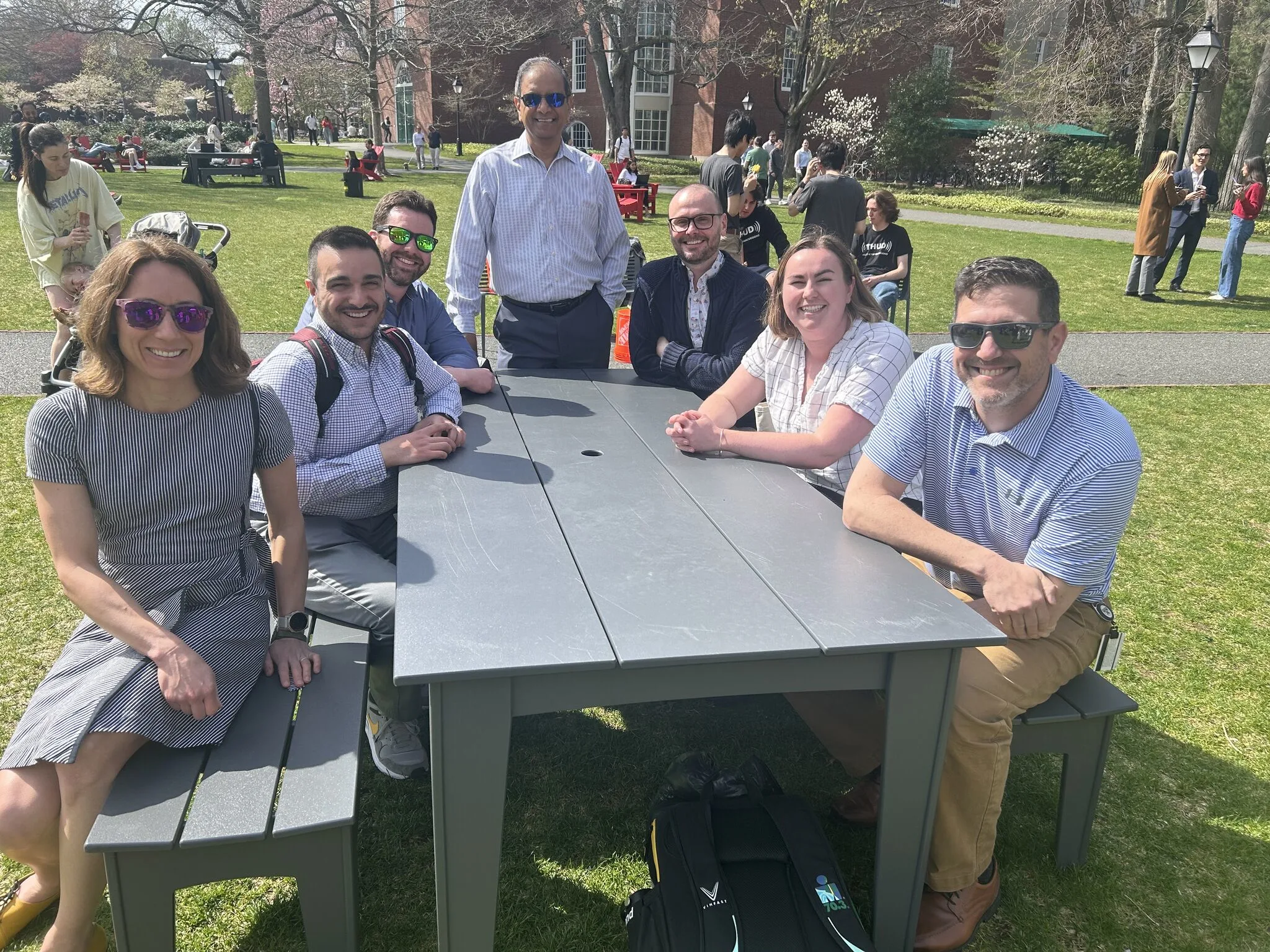
Arnold Paul (middle, standing) and members of the DTx team.
Opportunities & Connections Platform (Career & Professional Development)
This platform enables AI-driven career discovery through a natural language interface, connecting students to job opportunities and relevant alumni. The platform has supported 2,095 job queries with 469 unique users and 181 repeat users (38.6 percent). Engagement includes 8.7 percent “apply” clicks and 5 percent “connect” clicks, demonstrating meaningful interaction with both job opportunities and networking pathways.
Ultimately, our priorities are threefold: building scalable digital platforms that enhance teaching, learning, and research; aggregating the School's data and content to power smarter tools and insights; and investing in the people, processes, and infrastructure needed to sustain long-term innovation at HBS.
How is DTx bringing AI into the classroom—both on campus and online—while still preserving the core of the HBS case method?
At HBS, we’re not using AI to replace the case method; we’re using it to strengthen it. The goal is to help students come to class better prepared, think more critically, and get more meaningful feedback, all while preserving the faculty-led, discussion-driven experience that defines HBS.
In the MBA Program, for example, we’ve introduced AI-powered chatbots directly into course platforms. These tools are built around specific course content and faculty intent, so students can use them to test assumptions, explore ideas, and clarify frameworks as they prepare. They’re not there to hand out answers. In fact, it’s the opposite. They’re designed to push students to ask better questions and engage more deeply with the material before they walk into the classroom.
We’ve also expanded our MBA AI Feedback Agents, which give structured, rubric-aligned feedback on written assignments. That means students get consistent, high-quality input they can act on, while faculty still maintain oversight and academic standards. It’s a way to scale feedback without diluting it.
And in HBS Online, we recently launched the AI for Leaders Course Assistant, a chatbot built into the virtual learning platform. It helps learners work through course concepts and apply frameworks to real-world situations as they go.
Across all of this, the approach is pretty consistent: use AI to enhance preparation, personalize support, and extend feedback—but keep everything firmly grounded in HBS pedagogy, faculty judgment, and the integrity of the case method.
How do you see DTx's role evolving in the year ahead under your leadership?
The AI landscape is evolving at an extraordinary pace, and with it, the scope of DTx's work continues to expand. Capabilities that felt experimental even a year ago are now becoming embedded in everyday workflows. At the same time, AI tools are becoming more accessible and intuitive, which means adoption across the HBS community is accelerating. That shift changes our role. We are not just building tools; we are helping the School think strategically about where AI can create the most meaningful academic and operational impact
Over the year ahead, I see us leaning into problems that were previously considered too complex, too time-intensive, or too difficult to scale. As technology matures, we can apply AI to more sophisticated teaching support, content development, research enablement, and operational challenges. Our focus will remain on building secure, enterprise-ready capabilities that align with HBS’s mission and standards while empowering others to innovate responsibly. The opportunity now is not just to experiment with AI, but to systematically embed it where it can unlock new levels of effectiveness and reach.