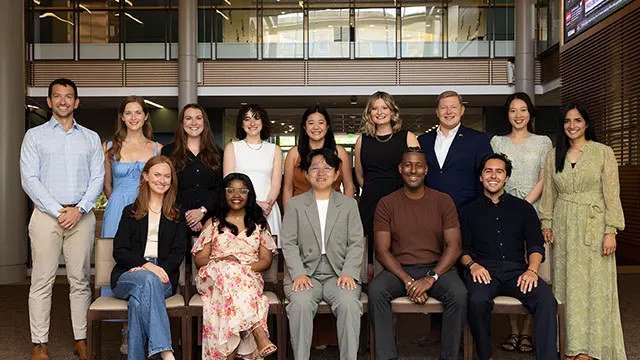
BOSTON—Harvard Business School (HBS) has announced the 2025-2026 cohort of its Leadership Fellows Program. The program is based on University Professor Michael Porter’s vision of developing a network of HBS graduates with cross-sector experience who are committed to addressing societal issues throughout their careers. Since 2003, it has placed over 300 fellows at organizations such as the City of Boston Mayor’s Office, Harlem Children’s Zone, Equal Justice Initiative, Mercy Corps, and Whitney Museum of American Art.
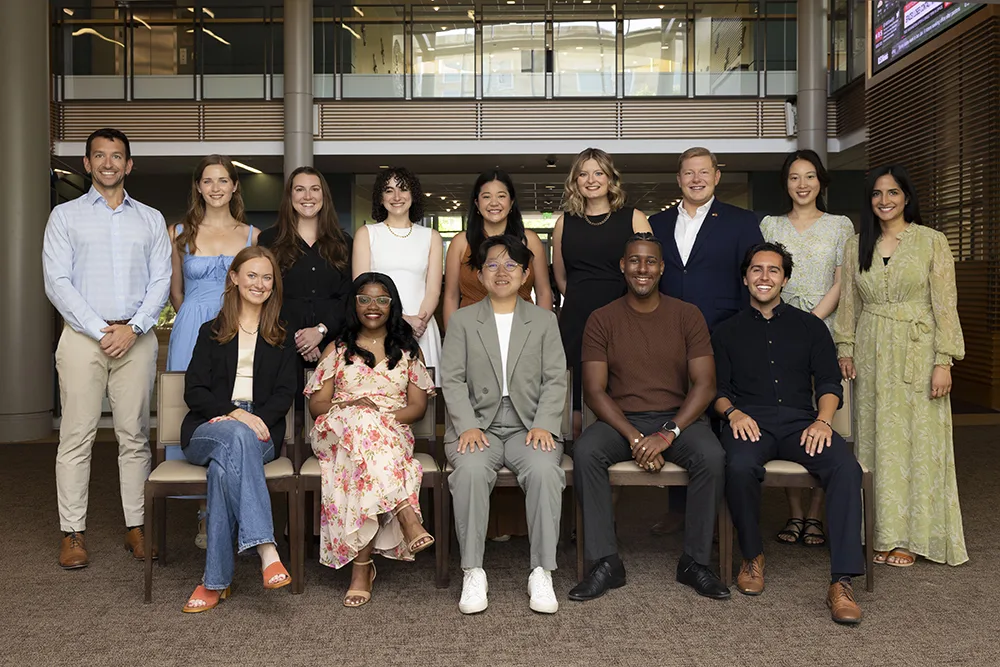
Photo courtesy Susan Young.
Through their participation, graduating students—also known as fellows—are offered once-in-a-lifetime opportunities to experience high-impact management positions in nonprofit and public sector organizations for one year at a competitive salary. At the same time, the hiring organizations leverage the experience, energy, and strategic and analytical skills of MBA graduates in roles that produce immediate results and build long-term capacity.
“The Leadership Fellows are a group of extraordinary graduating MBAs who are seeking to learn from and have immediate impact on some of the most dynamic organizations tackling society’s important problems,” said Shawn Cole, John G. McLean Professor of Business Administration in the Finance Unit, and chair of the Social Enterprise Initiative. “They embody HBS’s mission: to educate leaders who make a difference in the world. Past experience shows some will stay with their organization for the long run, and others will move onto leadership positions across the private, public, and nonprofit sectors. All will bring with them the valuable perspectives gained from their time as leadership fellows, and will, over the course of their careers, continue to contribute in a variety of meaningful ways to society.”
The 2025-2026 cohort will work at a wide range of organizations across fields like arts, education, environment, healthcare, and the public sector. They are as follows:
JAMES BEDFORD, Evidence Action
DARREN BERRIGAN, Massachusetts Bay Transportation Authority
SIMON CUI, Planned Parenthood Direct
MARA GOLDMAN, Whitney Museum of American Art
MEREDITH HECKMAN, City of Boston
GENEVIEVE HUMMER, Prime Coalition
SUE JIA, Mercy Housing
KAREEM LAND, Harlem Children's Zone
ALESIA MICHEL, Year Up United
BRANDON MOORE, State of Connecticut
KATE SWAIN-SMITH, Ownership Works
AMAL TARIQ, American Civil Liberties Union
ANNA TAYAG, Massachusetts Bay Transportation Authority
ANNABEL WARE, Allied Climate Partners
LEXI WATTON, Boston Ballet
ZIJUE ZHENG, The Juilliard School
Hear from the fellows in their own words about why they are excited about their upcoming opportunities.
Harvard Business School is grateful for the generosity of donors who have been vital to the HBS Leadership Fellows Program: James A. Attwood Jr. (MBA 1984) Fellowship, David J. Dunn (MBA 1961) Fund, Horace W. Goldsmith Foundation/Richard L. Menschel (MBA 1959) Endowment, Richard Lumpkin (MBA 1963) Dean’s Discretionary Fund, Margaret T. Morris Foundation Endowment, Carl and Lily Pforzheimer Foundation Fellowship, Michael E. Porter (MBA 1971) Service Leadership Fellowship, and John C. Whitehead (MBA 1947) Fellowship for Not-for-Profit Management.