
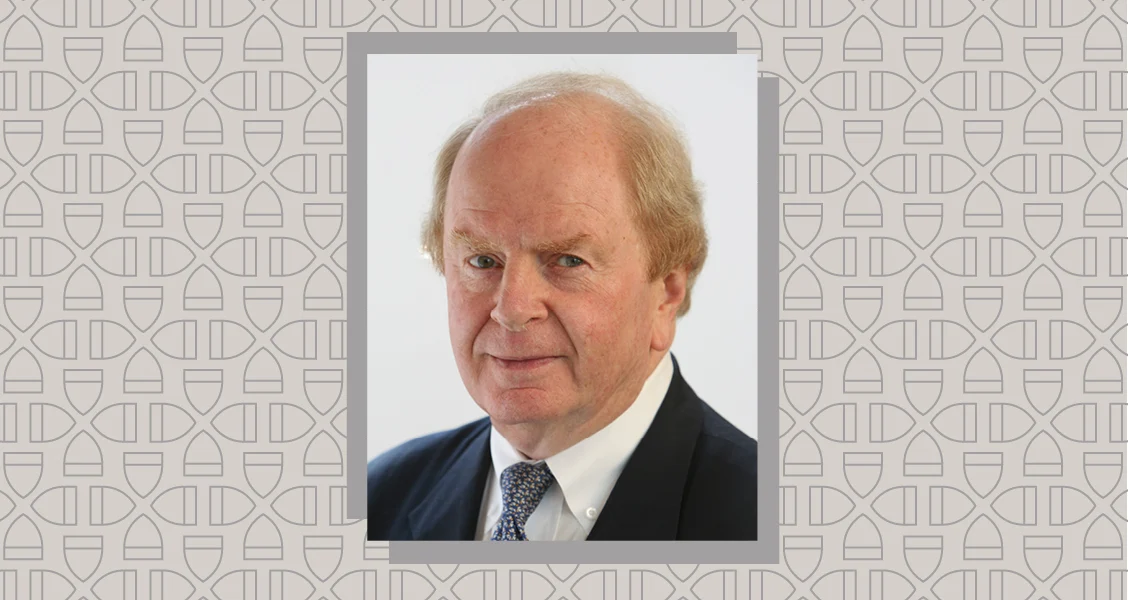
Howard H. Stevenson, the Sarofim-Rock Professor of Business Administration, Emeritus, whose scholarship and teaching helped define entrepreneurship as a field of study and practice, died on September 27 at the age of 85. A member of the Harvard Business School faculty for more than 40 years, Stevenson was a gifted scholar, prolific author, passionate teacher, successful entrepreneur, and generous mentor to generations of students, colleagues, and business leaders.
“Howard was beloved by all who knew him for his intellect, his wit and humor, his curiosity, and his incredible generosity and kindness,” said HBS Dean Srikant Datar. “It is impossible to overstate the impact he had on the field of entrepreneurship. He spoke often of the gifts of time, treasure, and talent, and was an exemplary role model in this regard. We are all the beneficiaries of his leadership within the Business School and across Harvard University.”
Stevenson is widely credited with giving entrepreneurship its most influential modern definition: “The pursuit of opportunity beyond the resources currently controlled.” The idea captured his conviction that entrepreneurship was not a personality type or a gift reserved for a fortunate few, but a disciplined approach to management—one that could be learned, practiced, and applied in organizations of every size and age.
“Howard liberated entrepreneurship from the idea that it was simply a stage of a company’s life, an economic function, or a personality trait: he showed that it is a repeatable process,” said HBS Professor Emeritus Bill Sahlman. “His cases and teaching transformed how entrepreneurship was practiced and taught around the world. Howard was the Johnny Appleseed of entrepreneurial management, spreading ideas, cases, and disciples across business schools, executive education, and companies, while demonstrating through his own work as a founder and board member that the lessons applied far beyond startups and high-growth ventures.”
Stevenson earned a bachelor's degree in mathematics with distinction from Stanford University in 1963, then came to Harvard Business School, where he received his MBA with high distinction in 1965 and his DBA in 1969. He joined the HBS faculty in 1967 to teach business policy, then took a leave of absence to serve as vice president of Simmons Associates. With the expertise he developed in real estate and investment banking, he returned to HBS in 1971 to teach Real Property Asset Management and Real Property Asset Development. In 1978 he left the faculty to join Preco Corporation, a manufacturer of specialty and commodity papers, as vice president of finance and administration.
In 1981, Dean John McArthur recruited Stevenson back to HBS to lead the School's research and teaching in entrepreneurship. In 1983, Stevenson launched the elective course Entrepreneurial Management, which drew more than 575 students—nearly three-quarters of the student body. He was the first incumbent of the Sarofim-Rock Professorship, established to provide a continuing base for research and teaching in entrepreneurship, and remained on the active faculty until his retirement in 2011.
Stevenson's influence extended well beyond a single course or academic unit. He developed cases that presented entrepreneurship as a set of behaviors rather than an innate trait, featuring people of different ages, backgrounds, and circumstances so that students could see themselves as potential entrepreneurs. He also emphasized that entrepreneurial activity was not limited to start-ups: It could take place inside established organizations, through teams as well as individuals, and in the pursuit of both commercial and social goals.
His research and teaching laid the foundation for HBS's Entrepreneurial Management Unit. He helped entrepreneurship become one of the School's most important areas of study and his published work gave the field both its vocabulary and its practical tools. In books such as New Business Ventures and the Entrepreneur, he used the entrepreneur's perspective to illuminate core questions of general management, while Entrepreneurship in the Social Sector examined how organizations can pursue meaningful social impact. In Just Enough, Make Your Own Luck: Winning Angels, and Getting to Giving, he explored success, risk, early-stage investing, and fundraising. Together with nearly 150 cases and a wide range of articles, these works made his ideas accessible to students and practitioners worldwide and helped establish entrepreneurship as a rigorous discipline.
Stevenson was equally committed to the broader life of Harvard and HBS. He served as senior associate dean and director of financial and information systems; senior associate dean for external relations; senior associate dean for HBS Publishing; head of the Entrepreneurial Management Unit; chair of the Owner/President Management Program; and chair of the Colloquium on Participant-Centered Learning. At Harvard University, he served as vice provost for planning and resources and played an important role in the University's fundraising strategy and planning initiatives.
“Howard had many, many friends, mentees, students, and colleagues who loved him,” Harvard President Alan M. Garber reflected, “and countless people benefited from all that he created and shared. I found working with him and learning from him to be a tremendous gift. He understood leadership; he was simultaneously caring and clear-eyed; he was principled; and, of course, he loved Harvard and made it a much better place.”
Stevenson was equally active outside the University as both an advisor on numerous corporate and nonprofit boards and a founder. In every setting, his experience and expertise were invaluable. Seth Klarman, CEO and portfolio manager at The Baupost Group, remarked, “Howard Stevenson was instrumental in the founding of Baupost and remained involved over the years to provide advice and insights. I will always be grateful for the confidence Howard placed in me in Baupost’s early years and for his mentorship and counsel.”
His board service included National Public Radio, where he was chair; Olin College; the Museum of Science in Boston; the Isabella Stewart Gardner Museum; and the Boston Ballet, where he was a life trustee. He also supported entrepreneurship education internationally, including through work with the European Forum for Entrepreneurship Research and institutions in Brazil and Croatia.
Stevenson's influence was inseparable from his character. “For over 50 years Howard was one of my closest friends,” said HBS Adjunct Professor Emeritus Bill Poorvu. “When I think of Howard, what most comes home to me is his love of life, his sense of humor, and the meals, trips, and debates we had together. We spent hours talking at his home a few weeks ago and despite being 85 he still had the mind of a 50-year-old, full of insights and optimism. He will truly be missed not only by me but by our entire community. He was one of a kind.”
His students included leaders in business, government, and philanthropy, many of whom continued to draw on his practical wisdom long after leaving HBS. The Howard H. Stevenson Professorship of Business Administration, established by alumni and colleagues, honors his dedication to advancing research and teaching in entrepreneurship at the School.
Stevenson is survived by his wife, Fredi, their children and grandchildren, and a wide circle of colleagues, students, and friends. He will be remembered not only for changing how the world understands entrepreneurship, but also for the care, wit, and humanity he brought to the people and institutions fortunate enough to know him.