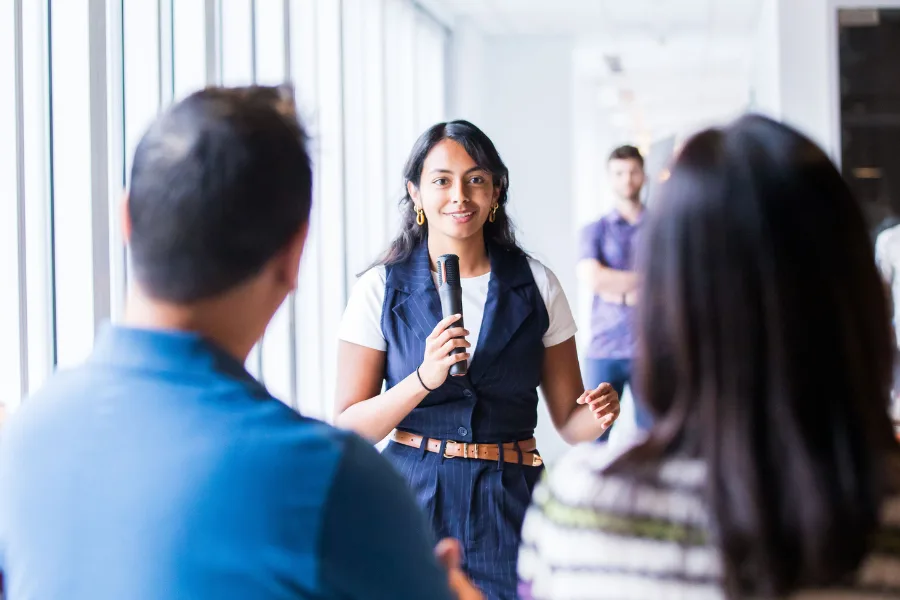
The Rock Venture Catalyst is a summer immersion where ideas gain momentum, and founders turn ambition into action. For the summer, a select group of student founders set aside internships and distractions to build their ventures full time with the HBS community behind them every step of the way. In this blog, Smita Bhattacharjee (MBA 2027) shares her experience in the program and what she learned while building Civ Foundry.
What I Didn't Know I Didn't Know
I came into this summer with a problem I cared about and almost no idea how to turn it into a company. Which, in hindsight, is probably the most common starting point for any founder, but it felt uniquely terrifying at the time.
I have spent time in local government, and I kept seeing the same thing: good technology would show up, people inside the city would get excited about it, and then it would stall somewhere before the pitch or between the pitch and procurement. Sometimes the champion leaves. Sometimes the budget shifts. Sometimes nobody could figure out who actually had the authority to say yes. I kept thinking that someone should fix this ecosystem. Eventually I realized I was waiting for a person who wasn't coming.
What made business school feel like the right next step was knowing that, while I cared deeply about this space, I did not have the tools or frameworks to build something sustainable within it. GovTech is a genuinely hard industry to build a business in: the buyers are complicated, the sales cycles are long, and the way money moves is completely different from the private sector. I wanted the time and space to develop strategic thinking and business-building skills that would allow me to turn the challenges I saw in my previous roles into actionable solutions, rather than just having strong opinions about what was broken.
The Rock Venture Catalyst gave me twelve weeks to do that over my summer. We spent four weeks in person with about sixty other founders going through shared programming, and the rest of the summer building individually.
What Building a Venture Taught Me
Civ Foundry is a platform for GovTech sales teams and founders. We help them find and win target cities by processing and contextualizing public data to surface signals that show a city is ready to buy their product. It comes directly from what I wished existed when I was on the government side, where I sometimes saw founders waste months on cities that were never going to buy (or took inbound calls that weren't relevant to our city). The difference now is that instead of wishing someone would build it, I have the agency to try building it myself.
The first thing I learned is that I genuinely did not know how to sell. I have done hard jobs in tech and government that required building things from scratch, but that was always on behalf of someone else's organization. I had never picked up a phone and tried to convince a stranger to give me twenty minutes of their time and take a bet on something I was building all on my own. The summer program put me in front of advisors much earlier than I expected, doing pitch after pitch, and the feedback was humbling: too broad, unclear problem space, why you? But doing it over and over started to change things. My pitch got sharper and I got comfortable enough to tell my story clearly. I stopped performing and started having real conversations.
Why This Environment Matters
There are days when I feel like nothing is working. You send emails and hear nothing. You build a thesis over weeks and someone takes it apart in five minutes on a call. You wonder if you are building something real.
What has helped is having other student founders around me. It's having an accountability buddy where I can say "I think this might not work" and they can talk me through it. Being around people who are equally motivated to build but also have the business and strategy instincts to push back on your thinking makes you sharper and braver than you would be on your own. So many of my peers have pushed me to do the uncomfortable thing and take action instead of getting stuck in overthinking. The mentors in the HBS ecosystem are just as crucial. They give real feedback, want you to succeed, and help you figure out which tests are worth running, so that no matter what happens you come out having learned something.
Going into my second year, I feel a lot more confident, but not because I have all the answers. I still do not know if Civ Foundry will succeed in the way I hope (though I have to believe it will!). But I can articulate the problem I am solving, explain what I have tried in my pilots, list my metrics for validation, and describe a road map that makes sense based on my customer. That clarity did not exist six months ago. Rock Venture Catalyst gave me the space to care deeply about a problem and the tools to try to fix it from the ground up, all while being surrounded by people who make the process feel exciting rather than daunting.