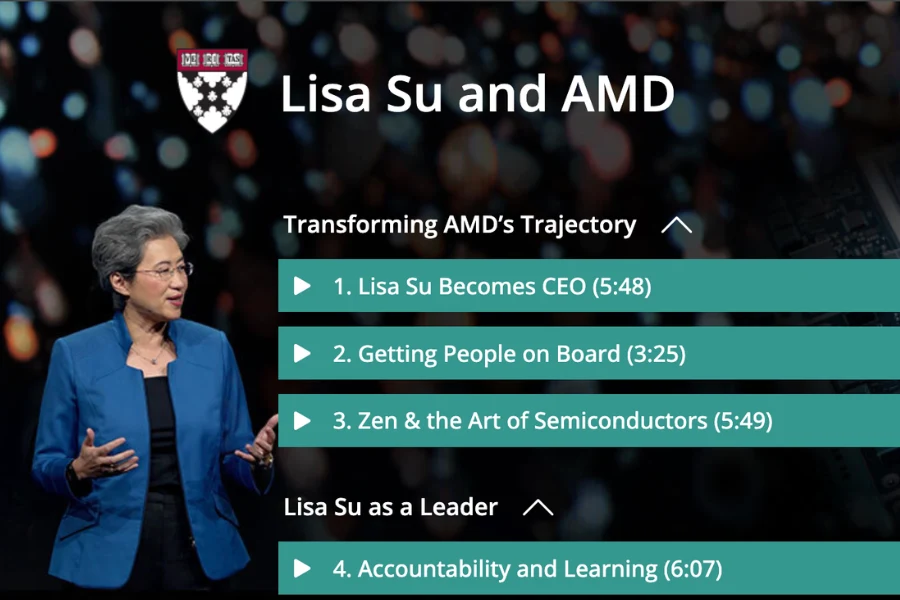
Last fall, first-year MBA students at Harvard Business School arrived at their classroom under an unusual circumstance: they had purposely not read a case prior to class. Professor Tony Mayo dimmed the lights and played a short video clip of AMD CEO Lisa Su—Time magazine’s 2024 CEO of the year—describing a company on the verge of collapse and her early days confronting skepticism from customers, investors, and her own engineers. Mayo asked, “What would you do next?”
Hands rose, and students began debating the issues plaguing the semiconductor company and how Su should approach them. Mayo pressed play again, and a new piece of information upended half the strategies they had just suggested. The real-time delivery dropped students straight into uncertainty—it became a leadership challenge unfolding moment by moment.
This format, an in-class multimedia case, is a new product category in Harvard Business Publishing’s catalog. Taught entirely through real-time information, it’s a methodology more than 10 years in the making.
An Idea Takes Shape
HBS students read about 500 cases during their two years, and multimedia cases—which integrate video segments with case, graphics, and interactive materials—appear throughout. But the Su case is only the second in-class multimedia case at HBS, and students, faculty, and alumni praise it as an exemplar of the methodology.
Professor Joshua Margolis was inspired while watching Professor Rohit Deshpande teach his Terror at the Taj multimedia case. Though Deshpande focused on customer-centricity, Margolis noted that the videos and discussion also addressed organizational culture. In his Executive Education courses, where it was a challenge for participants to prepare four cases a day, he wondered: Could he teach the material using video alone?
“I played the videos and turned the case into a puzzle,” he said. “I’d ask: Where do you think they recruited from? How did they train people? Participants were engaged—as executives themselves, they picked up on management nuances—and they didn’t need hours of reading to do it.”
Over several years, Margolis refined the approach, working closely with the HBS Multimedia Development group led by Ruth Page and Dave Habeeb. “They’re an amazing team; incredibly attentive to what you’re trying to teach and how you’re trying to teach it,” he said.
“We really see ourselves as partners in teaching,” Habeeb explained. The team sits in on classes, studies the case discussions, and observes how students respond so they can design materials that truly support faculty goals. “We’re not just a tech crew—we’re ambassadors for HBS,” he said, noting that their job requires understanding the School’s pedagogy as much as the equipment.
With only eight people on the team and often just two traveling per project, each member fills multiple roles, from producer to interviewer to camera operator. The small footprint builds trust and agility. “We do everything ourselves—lights, camera, sound—and at the same time we’re talking with the faculty about the teaching plan,” said Habeeb.
For years, the team tinkered with Margolis’s case and similar faculty requests—creating custom video menus, adapting videos for class sessions—but it was always on the back burner.
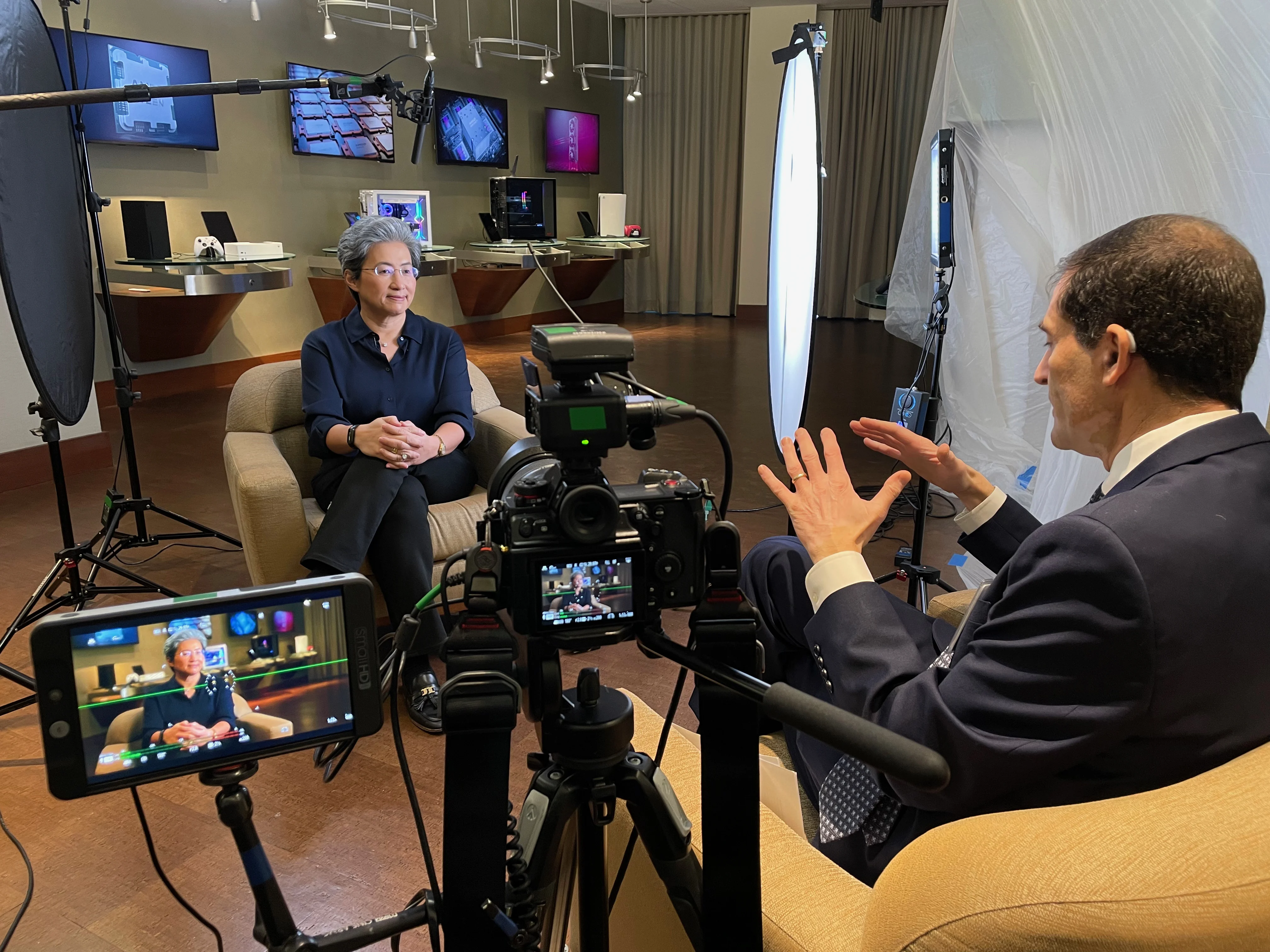
Professor Joshua Margolis interviewing AMD CEO Lisa Su. Photo courtesy Dave Habeeb.
The Right Case
That experimentation proved essential when a suggestion from Professor Lynn Paine alerted Margolis that AMD’s turnaround might be an ideal subject for a case study. Margolis took the idea to the team: Could the story be developed from the ground up as a real-time multimedia case?
“Lisa Su is an unexpected leader,” explained Margolis. “People imagine the extroverted MBA as CEO, and she’s an MIT PhD with exceptional business and technical skills. If we could capture her presence on film, we’d have material about leading a corporate transformation that requires no prep and teaches something core to our curriculum.” With the multimedia team and AMD on board, it was a green light.
Habeeb and Page were preparing to travel to AMD headquarters in Austin when COVID hit, delaying the project. Once travel became possible, the HBS team gained access to AMD’s engineering labs, offices, and leadership conversations. “We were told more than once, ‘No one usually gets to film this,’” Habeeb said. “But the trust we built made it possible.”
After filming wrapped, they shaped the material into a structure suited for real-time teaching. Matt Preble, the team's senior producer, explained that they “reverse-engineered the arc of the case,” identifying what information students needed before discussion and what should instead be revealed in class. Page added, “We’re documentary storytellers, but this isn’t a documentary. Everything we include has to serve the learning.”
From Pilot to Product
Margolis piloted the case at Alumni Weekend in the fall of 2024. Typical reunion case sessions lasted an hour, but he requested three—including an intermission. Would alumni remain engaged? “I thought people could leave if they wanted,” he said. But every participant returned, and post-event survey reviews were glowing.
“It was a total test, flying without a net. We had the conceptual spine, and in the room were alumni who knew the industry as executives and investors, and they found it worthwhile. That’s when I knew it could work.”
The case debuted in fall 2024 for first-year MBA students, and other sessions followed for Spring Reunions and in Executive Education
With the success of the case format on campus, more are already in development and Margolis sees its value growing.
“In the age of generative AI,” he said, “this gives us another way to augment how we teach. Students can’t prepare in advance—they have to make sense of things as they unfold and then respond. That’s what leaders actually do.”
This article was originally posted on the HBS Newsroom.
The views and opinions expressed in the MBA Voices blog are those of the authors. Any political views shared by students are their own; HBS does not endorse a particular party or candidate.