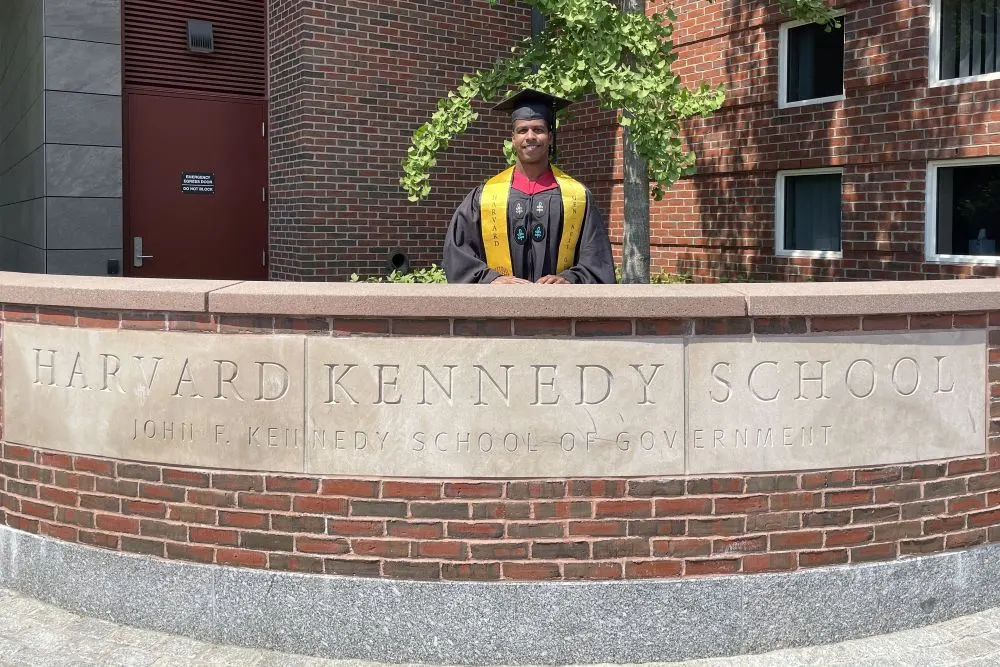
During the 2020–2021 academic year, Caleb Bradford (MBA/MPP 2021) served as HBS Student Association Co-President as Harvard Business School navigated the unprecedented challenges of the COVID-19 pandemic. Most recently serving as a group product leader at the intersection of technology and financial inclusion, Bradford recently spoke during a joint degree program webinar and reflected on what the program taught him, how it shaped his career, and why the community continues to be one of its greatest strengths.
What stands out most when you look back on your time in the joint degree program?
The people really make the experience worthwhile—and I’m saying this having completed the program during the COVID years. The joint degree program brought together people who cared deeply about making change, and who approached problems from different angles. Those conversations, friendships, and relationships have stayed with me long after graduation.
Your career has crossed engineering, investing, consulting, government, and now technology. What originally brought you to the HKS/HBS joint degree program?
I came to the joint degree after earning a double engineering degree from Princeton in aerospace and mechanical engineering. I spent time at NASA helping with lunar missions, working on green investing initiatives at BlackRock, and spending time in the startup world.
I was inspired to come back to graduate school and pursue the Master in Public Policy and Master in Business Administration joint degree to better understand how I could help create meaningful change, particularly for underrepresented communities.
How has the joint degree prepared you to lead across sectors?
It has forced me to hold two seemingly incompatible frameworks at the same time—and become very comfortable in that discomfort.
At Harvard Business School, the questions you’re often asking are: What creates value? Who captures it? How do you build something that sustains itself?
At Harvard Kennedy School, the questions are different: Who has the power? Who’s excluded? What are the second-order effects? What does the state owe its citizens?
In the real world, you need both questions simultaneously. A business model that doesn’t account for political economy will get killed by regulatory capture or community resistance. A policy solution that ignores unit economics will eventually run out of money and disappear. I found that in my own work—whether working for governors in Connecticut and Arizona or later in consulting—I was most effective when I could walk into a room full of policy experts and think like an operator, or walk into a room of operators and ask the policy people’s questions. That translation capacity is something the joint degree program signals, and more importantly, something it directly builds.
Looking back, what do you wish someone had told you before you started?
The first is how fast it goes. Three years sounds like a long time, but it isn’t. You blink, and it’s over. The temptation is to treat your first semester like a warm-up—to think you have plenty of time before things really matter. The reality is, you don’t. What matters is the relationships you build, the intellectual risks you take, and the moments you say “yes” to things that scare you a little. Those all compound much faster than you expect, and the window is much shorter than it feels. Looking back, I really believe you have to be ruthlessly intentional about your priorities.
The second thing I wish I had known is that you’re walking into a culture of change. Not change as a buzzword—but change as a lived experience. Everyone at Harvard believes the world can be different than it is today, and they intend to be the people who make it so. That energy is contagious. Your ideas may evolve while you’re here, but it’s incredibly helpful to spend time thinking intentionally about the kind of change you hope to create before you arrive.
As someone who’s now several years removed from graduation, what has stayed with you the most?
It’s always going to be the people. The community is amazing, the administrators are incredible, and the professors are unmatched. But the world shrinks dramatically after you graduate. You begin finding yourself in the same rooms as classmates—or people your classmates know. For me, that’s been the greatest value of the joint degree. The education and opportunities are exceptional, but it’s the people who continue to shape your career long after you’ve left campus.
The story was originally published on the Harvard Kennedy School Admissions blog.