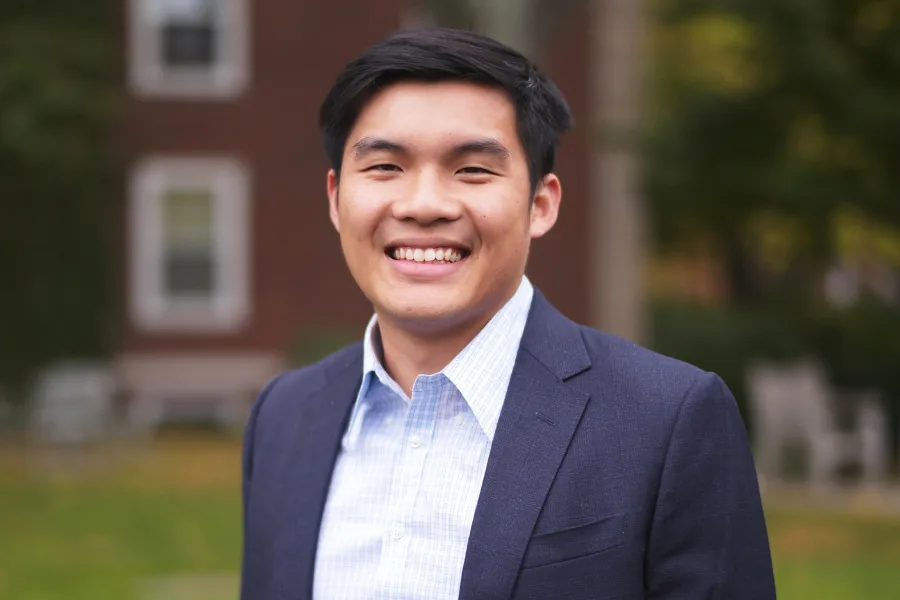
The HBS 2+2 program is a deferred admission process for current students in their final year of study, either in college or a full-time master’s degree program. If you are admitted through 2+2, you work for two to four years in a field of your choice before enrolling in the HBS MBA Program. This spring, we’re speaking with current MBA students who were admitted through 2+2 to learn how they spent their deferral years. We sat down with Edward Doan (MBA 2026) to learn more about how he spent this time.
Why did you decide to apply to HBS via the 2+2 deferred admissions process?
As an undergraduate in chemical engineering, I initially envisioned a strictly technical career. Through internships and conversations with mid-career engineers, however, I kept finding myself more interested in the upstream questions: What market need justified a given process? What factors drove cyclicality in commodity prices? Who ultimately decided to build a new plant? Within the technical career I had mapped out for myself, I realized I was unlikely to be engaging with these types of questions, within a decade, if at all.
An MBA program, HBS in particular, offered a reorientation. Compared to my engineering training, the case method teaches judgment of the problem at hand and needs of the people in the room and enables an entirely new set of career paths. Applying through 2+2 allowed me to commit to that pivot early, rather than risk delaying my goals by spending additional years in a purely technical role.
How long did you defer your 2+2 admission?
I deferred for two and a half years.
I had genuine uncertainty about whether I was making the right decision and wanted to give the engineering path a fair test before committing to leaving it. Over time, those deferral years clarified where my energy naturally gravitated: the business context around a project held my attention more than the technical execution did. Conversations with other deferred students also helped solidify that realization, not only with their encouragement that my ambitions were possible, but with tangible support towards my goals.
What job(s) did you work during your deferral?
I spent two years in engineering roles at Procter and Gamble and Stryker Medical. Those roles were incredibly valuable: they gave me enough exposure to large company operations to know I wanted to build and run something smaller, where the decisions I made would be directly visible in the outcome.
The last four months before I started at HBS were probably the most formative of my deferral. I had developed an early interest in search funds and entrepreneurship through acquisition, and through 2+2 peers I found a pre-MBA internship with an operating company started by recent HBS graduates. That experience made me realize that delaying the MBA would directly delay my goals.
Did 2+2 change your path or alter your post-undergraduate plans?
Significantly, as the original plan was to pursue a traditional engineering career, but the 2+2 program allowed me to see that career as an experiment, with an aperture as wide as your own creativity allows. I started HBS with a specific destination in mind that I could not have articulated as an undergraduate.
What advice do you have for prospective students considering the 2+2 program?
First, the GMAT or GRE is simply easier to study for when you are still in school. Just as importantly, applying to graduate school forces a level of self-reflection about what you want from your career that most college students do not explore unprompted.
The cost of applying is real, but bounded: test prep, application time, and some stress during your senior year. The payoff is a sharper vision of your career and an open door to a world-class program.
The views and opinions expressed in the MBA Voices blog are those of the authors. Any political views shared by students are their own; HBS does not endorse a particular party or candidate.