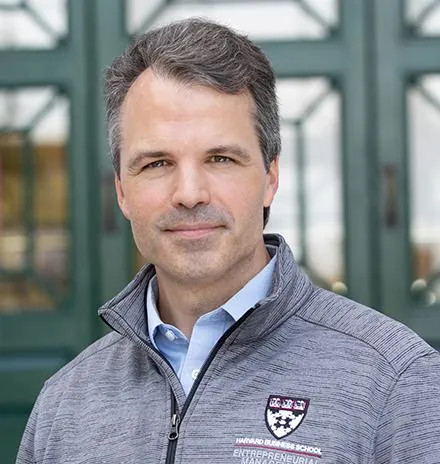

As data center investments, stock prices, and vanishing entry-level jobs grab headlines, businesses are grappling with AI use cases and workforce strategy. The veteran serial entrepreneur and Harvard Business School executive fellow assesses the organizational and talent implications.
Transcript
Joe Fuller: The Covid-19 pandemic demonstrated the value of remote and on-demand knowledge work. Now leading organizations are starting to reassess their business strategies in light of their early experiments with AI. How can employers redesign work and talent systems to integrate AI while helping their employees to adapt? And how can leaders usher in wholesale change to work processes without putting their period performance at risk?
Welcome to the Managing the Future of Work podcast from Harvard Business School. I’m your host, Harvard Business School professor and nonresident senior fellow at the American Enterprise Institute, Joe Fuller. I’m pleased to welcome to the podcast John Winsor—serial entrepreneur, workforce innovation expert, and author. We’ll discuss his work on digital talent platforms, including his book
Open Talent, written with Jin Paik. We’ll also talk about organizational change and leadership. We’ll look at the potential of AI and technologies like 3D printing to expand entrepreneurs’ competitive range—enabling them to operate at scale and in markets once reserved for much larger firms. And we’ll consider approaches to responsible AI, with its focus on the human element, from upskilling to finding sustainable careers paths. John, welcome to the HBS Managing the Future of Work podcast.
John Winsor: Thanks, Joe. Really excited to be here.
Fuller: So, John, you’ve had a varied career and done all sorts of interesting things, which gave you some insight into the way work is structured and how talent could be engaged. Could you tell us a little bit about your journey and how that led you to the topic covered in your book, Open Talent?
Winsor: Yeah, for sure. Thanks, Joe. Yeah, I think I’m a classic zero-to-one entrepreneur, and I’ve been in the publishing business and in the marketing services business and strategy work for a long, long time, and I was never able to staff a team big enough with full-time employees. So I really focused on using freelancers in new ways and that was really, really successful. The magazine company, I was able to sell that to Conde Nast, and I sold my agency to Havas and became Chief Innovation Officer.
Fuller: Did you want to have a career in publishing or was that just an entrepreneurial opportunity that came your way and you decided to jump on it?
Winsor: Yeah, so to tell you the truth, it was in my blood. My great-great-grandfather was in the newspaper business, my grandfather and my dad was. So when I got out of school, I was trying to decide what I wanted to do, and it seemed like the lazy thing to do to go into publishing because I knew it really well.
Fuller: Well, I’m not going to characterize that as lazy, since both my parents were professors at Harvard Business School, so I’m in the family business as well. So after your career in publishing, in marketing, and doing a lot of strategy work, you founded something called Open Assembly. Tell us about that. What is it, and how did you come to realize that was an opportunity?
Winsor: Yeah, one of the things I was concerned with was this disconnect, because I had been in the business of building companies with new talent strategies, using freelancers and crowdsourcing its methodologies, and I knew that they were really successful. It gave me a lot of flexibility to go really fast. It gave me the ability to get the very best people in the world. Even if they were working with one of my competitors, they could work with us at night on projects. And I was always really curious why the staffing industry was so big—$650 billion. But the platform business—the Upworks and the Fiverrs and down to the Andelas and the TopTals—was just a small fraction of that. It seemed to me that the talent platforms were the digital transformation of the staffing industry, yet it was really hard to make that transition.
Fuller: So you started building that up, and you went on to write a book with Jin Paik called Open Talent, which really started discussing the acceleration of—we’ll call it “gig work,” as many people do—
Winsor: Exactly.
Fuller: ... platforms around the pandemic and afterwards. What did you observe about the market then, and also, how would you characterize the state of the market now? Are you seeing the type of growth in the platforms that you anticipated when you first started thinking about this?
Winsor: Yeah. When I started the community, it was really fighting an uphill battle. The companies were really nervous about hiring freelancers. The ability of confidentiality and security and all those things. And what we saw in our communities—we went from 20 of us to about 4,000 during Covid—what we saw was that Covid provided a transformational moment for “open talent,” for this idea of digital staffing versus the traditional, more-analog staffing. And what I’ve seen since is that it really accelerated the push for back to work and all those things. People are still really reticent to think about using variable cost labor. As you know, Joe, because you’ve talked about it so much. People like the idea of having people in-house culturally and that they own the talent and think that they can direct that talent. I think what we’re seeing now is that this democratization of expertise with AI is only going to accelerate this idea of taking jobs and breaking them, unbundling them into tasks, and then redistributing or rebundling those tasks—some being in jobs, some being in projects or gigs, like you said, and some being with synthetic labor.
Fuller: That’s really interesting. I think one theme that we’ve unearthed consistently in our research here at HBS is that, for innovation that relates to talent, companies haven’t been very adept at understanding how they need to change their processes and the understanding of managers and management as to what adjustments need to be made to set up the conditions for an unfamiliar type of contributor to be highly productive. And managers weren’t used to running remote work pre-Covid, and of course, a lot of contingent work was being done remote. They gained some expertise in it during Covid, but now it’s really all the systems and structures reward that in-office five-days-a-week, managing by wandering around. Everyone’s here from 9:00 to 5:00 or 8:00 to 6:00. Or if you’re in banking, 6:00 to 9:00, the way the whole system is architected.
Winsor: HR departments, at the end of the day, they’re really there to protect the company—from getting sued, from breaking the law—all those things from compliance and security. And when you set up a system like that, you want to control access, you want to control people’s engagement with the company. Being a zero-to-one entrepreneur, I was always focused on—I had an outcome that I needed. I desperately needed it fast, running out of money, trying to satisfy clients, and so I was more interested in what were the tasks that needed to be done? How can I get that done the best? Who are the best people that I can work with on those tasks? I didn’t have the luxury of time to hire people full time in a lot of cases.
Fuller: Now, John, you’ve been an original thinker in this space for a long time and you just used earlier a really interesting term that we had a chance to discuss in our last meeting. This notion of democratization of expertise and all that does to start reshaping the content of jobs, unbundling some of the tasks. As you know, in some of my research with Matt Sigelman at Burning Glass Institute, we see jobs where AI is going to crimp the entry-level positions—but other jobs, where the requirements are going to be lowered because AI is going to do things that were hard for humans to do, and that required a lot of expertise or credentials that now will be embedded in the AI surround. It strikes me that that evolution should be a booster rocket for these nontraditional forms of work. What’s your read on that?
Winsor: I think it’s too early to tell. That’s my assumption, too, Joe. I think that we’re going to see a thing. I mean, I think the reality is that, in these disruptive times, companies have to have really strong balance sheets, and to have really strong balance sheets, they need to move more costs from fixed to variable costs. And for most organizations, labor is the biggest fixed cost. And so I think it’s only natural that we’ll see this kind of development. I think what’s happening, too—you’re totally right on in your research—what I’m seeing is that if you take a traditional job—and traditional jobs are jobs are made up of tasks and those tasks, I think, what’s happening is they’re getting unbundled—and I think what we’re going to see is a rebundling of those jobs. And those jobs now will be maybe different jobs, but it could be projects, it could be crowdsourced, lots of ways to kind of accomplish getting those tasks done.
Fuller: That’s a really interesting way to put it. And my fear, of course, is that companies are going to be looking at the technology and trying to not force-fit it but append it to the way they go about organizing work and executing work today, rather than revisiting with such a fundamental technology, which can literally morph these jobs into shapes that are unfamiliar to management. That that’s going to retard the exploitation of this remarkable set of technologies. What are you observing about adoption? And are my fears overstated?
Winsor: No, I think we’re in this adoption phase. I mean, you saw the MIT report that said that 95 percent of projects fail, new AI initiatives fail. I think it’s all because we’re early in the cycle and people are experimenting, and that’s happening. What I’m seeing is that I think we’re moving from a world of point solutions with AI—here’s a point solution to help me get this thing done—to using AI as a re-architecture of systems to accelerate the success of an organization. I think we’re going to see that with AI. Those people that use AI as point solutions to save a little money or don’t have junior developers or whatever those things are, it’s fine. Some short-term savings, won’t really be that successful. But those companies that are bold enough to re-architect their companies and really make AI a coordination tool to coordinate activities across the organization are going to be really transformative.
Fuller: I think that’s right. I think relative to the data you cited from that excellent study from MIT, one thing that we’ve observed here at HBS is that a lot of those failed experiments using AI are much more a function of the quality and organization of the data that the company could provide. Our characterization would be: the technology has actually come along faster than we predicted, but the adoption is slower. I think that’s a function of the natural caution that you were invoking. People find out that their data isn’t in very good shape. And so there’s a little bit of the, “Well, gosh, maybe I’d like to make it less clear that part of the problem is our own making.” If you were advising companies—I mean, you’ve got a distinguished history as a strategist—if you had a company that seemed to be reluctant, cautious, “Gee, we’ve got a good market position, we’ll be able to catch up if we need to,” what would you say to them to get them to reconsider that? Or would you ask them to reconsider that?
Winsor: Jen Stave and Ryan Kurt and I just wrote a couple articles in HBR [Harvard Business Review] about some of this stuff, and one of the things that we really recommend is, you’ve got to first of all get commitment by the CEO, right? You’ve got to get the CEO who is experimenting and trying stuff themselves. Everybody needs to start playing and understanding and having a firsthand experience with these tools. The second thing is we always recommend that, if you’re going to go fast or you’re going to go slow, you still need a way to understand and have context of what’s happening, not just in your industry and other people that are doing things better, faster, cheaper, but also in the overall industry. So having some kind of a center of excellence. That could be one person, it could be a team that’s really exploring ways of how do we use this new technology to accelerate things inside of our organization. And then start experimenting across the organization. The thing I always remind people about is that we’re all two years into this. We’re all trying to figure it out. And so my sense is, great thinkers like you and the folks you’re working with are going to start building frameworks that people can understand, and that will really accelerate the adoption. Because, like you said earlier, the technology’s moving so fast, without the frameworks and the ability to understand what the downside risks are with these things, it’s hard for any organization that’s responsible to really adopt them in mass.
Fuller: Well, I’m not sure the people I work with would describe me as a great thinker, John, but I appreciate the vote of confidence. I think we can actually look at what we thought would happen with the internet two to three years in. If you’d said one of the biggest single societal impacts of the internet is going to be a massive increase in demand for drivers to deliver packages, to deliver meals, they would’ve looked at you like you’re crazy. The borg called “social media,” we wouldn’t have thought that at all. Predicting where this is going to go, particularly since the rate of change is so high and the rate of improvement so dazzling, that it’s quicksilver trying to keep up with it.
Winsor: It really is. And that’s why I think you’ve got to get in and experiment yourself. I mean, the story that I always love, right off that first wave, is the Airbnb story. It’s not only changed what it means to stay in a place, in a resort, whatever, but it’s created a massive accelerant to home ownership. A lot of people now own second homes, and they can afford to do that because they have the ability to rent through short-term rentals. And so it’s really taken this kind of atomic idea of “Can I use this new technology of digital transformation, verify the person who’s going to stay on my couch, and trust that that’s going to happen in a good positive way?” And then, from that little, tiny thing, really expand into the economic force that Airbnb and the whole secondary-market chain has really accelerated.
Fuller: Looking at this through a different lens, you’ve had a very exciting, I think, from everything you’ve ever told me, very satisfying career. If you were visiting with some of my students today and saying to them, “Here are the three or four differences that you’re going to have to take into account relative to your parents’ careers, or maybe even your older brother’s or sister’s career, here are some skills that are going to be durable over the course of this technological revolution.” What pops into your mind?
Winsor: It’s interesting. My son just graduated from Denver University with a psychology degree, so I’m having that discussion right now. And some of the principles I’m offering up are very human traits. To me, one of the most important things of a young graduate is to have the attitude of “absolutely.” If somebody asks you to take out the trash, absolutely. If somebody asks you to fly to Chicago tomorrow, absolutely. That willingness to kind of put the situation first, that’s the first thing. The second thing is the ability to be curious and ask, “Well, how can I dig a little deeper? What tools can I use to do that?” And I love that ability that people, especially Charlie’s age and graduates from business school, they’re much more open to different ideas and different pathways. And then the third principle I always think about is this idea of “why not?” I think a lot of the things that I’ve done creatively that have made a difference in the world from an innovation standpoint, not just in business, but a lot of the athletic stuff I’ve done in climbing and in surfing, is instead of asking why, because I think why takes you down a path of narrow and narrow, and that’s a super important thing, but there’s also this initial moment: why not? I’ve got to go for it, I’ve got to do it. You have to have the courage and the curiosity to say, “Why not? Why not this wave? What can I do with it? How can I interpret it?” And it’s okay if you crash and burn, right? I think that the whole goal of being out of school and young in your career is to go fail a lot. Go try a lot of different things, see what you really like, what really resonates, and what you’re really good at.
Fuller: Now, earlier you said you’d tell an executive, “Experiment, try it, learn it. Why not learn it?” I guess. Our research says that Americans are about 50 percent more likely to be using generative AI in their personal time than they are at work. There are a lot of explanations for that. I think the biggest one is the companies are being cautious. What sort of metrics would you say to that CEO? “Here are three or four things I’d look for if I were you. Why don’t you start finding a way to do some business-intelligence type analysis to see that you’re beginning to get the level of experimentation and learning in the organization that’s going to stand you in good stead as this wave continues to crest.”
Winsor: One of the really wonderful HBS case studies that I’ve seen lately is the Coursera case study. First of all, the CEO of Coursera back in 2022 or early 2023 really saw this as a big—either an opportunity or a threat. And so he really started experimenting, turned his teams onto it, made a SWAT team to do it. But the real innovation came from somebody figuring out that, wow, it costs us now $10,000 to translate each one of our courses, and we can be using generative AI, we can now do that for $40 a course. And, certainly, the cost savings has been phenomenal. But I think what’s more phenomenal is the ability to share. Instead of saying like, “Oh, we are only going to translate our top 10 courses in eight languages,” now they can say, “We’re going to be able to translate all of our courses into 22 different languages.” And that kind of acceleration gets more access to people. It gives more power to the learning experience and gives more power to the Coursera brand.
Fuller: I think that is a great story, and I happen to have been exposed to a couple of versions of that with very sophisticated consumer goods companies that are creating mirrors of known consumers. They’re creating avatars of non-consumers and using AI to query the non-consuming avatars: Why don’t you use our product? Or the mirror of actual consumers: What are you doing? And the impact on performance, marketing, and social media and on all media creation, experimenting with visual treatments, text, fonts—types of things that’d be second nature to you at one point in your career—able to look at 10,000 variations and A/B test it and be done in a day. It’d be the type of thing that would be a whole campaign and take months to do just 20 years ago. As you know, I used to be the CEO of a consulting firm, and I would be certainly looking at what kind of uplift we were getting in terms of the productivity of our younger staff. And were we succeeding in creating a skilled pipeline of younger people who were still learning the business through this type of artisanal apprenticeship way that I certainly learned the industry, despite the fact that a lot of the routine tasks that I had to do—and thousands of people that worked with me at various times had to do—will now be done largely by internal LLMs.
Winsor: Yeah, no, I totally agree. I had an interesting conversation with a buddy of mine who’s a CEO of a small ad agency, and I started with, “Are you deciding to close your doors? It’s got to be horrible out there.” And his point of view was like, “Actually not. We’re based in Denver, and people still need marketing services and advertising.” What’s happened is that the drudgery, the tedious work that you discussed for consulting or advertising—in this case, he was talking about the 400 different versions they needed to do for each of the creative outputs—that’s all gone away. That’s gone to AI. But what’s happened is, it’s liberated his creative staff to think more deeply about bigger and better ideas. Now, the economics have changed, obviously, because the way that agencies used to charge were time and material. And so there’s much more of an effort of trying to charge for projects. Here’s a brand strategy, here’s a creative output or a campaign. I think companies like consulting companies and advertising agencies, those service companies, that’s the fundamental difference, right? You’ve got to figure out how to change your economic model of your company in order to take advantage of that. And it’s a radical change for a lot of companies.
Fuller: I think it will be a great change across all the professional services clusters, if you will. Legal, advertising, and marketing services, IT consulting, management consulting. And for some of those firms, it’s going to be a physician-heal-thyself moment. They’ve spent decades helping other companies overcome organizational frictions and unwillingness to change and running transformation programs. Can they do self-surgery? Self-dentistry? So as you think out eight to 10 years, how do you think this all plays out? What does the world of AI look like when we’re 15 years into the cycle? When you’ve passed through that period of narrow definition of what it’s good at and many more upper managers grow up around it. We can see a difference in our students year to year here in terms of their comfort and expertise in AI. When they’re all in upper-middle management or running companies, what would that look like? What would those enterprises look like in terms of the use of technology, in terms of the use of contingent labor, and in terms of the future of work?
Winsor: I think that organizations are going to change radically. They’ll be smaller, more nimble, the ability to bring together the best thinkers in the world very quickly, have them re-dispersed around projects. When I started Victors & Spoils and David Jones bought us at Havas, there were about 600,000 people in the ad business. Today there are about 600,000 people in the ad business 15 years later. But what we don’t account for in that number is there are 60 million creators making money on social media doing marketing services. And so really the pie has expanded. And I think what we’ll see in all of this is each category, the ability to use digital tools to do whatever you want to do, whether it’s create a product with not only AI’s integration, but also 3D printing and delivery models, and all those things. So that this idea of a billion-dollar one-person organization, I think is very much what’s going to happen. I think the hard thing for organizations is going to be, a lot of those folks that are classically trained are going to have to be very much more microentrepreneurs. They’re going to have to really focus on having a much broader understanding of how markets work, how customers work, what it means to get down in the weeds, to get all those things done and run a bunch of parts of a very small company that’s very, very profitable and has a lot of momentum, versus being at a larger company. So I’m pretty positive. I mean, certainly there’s a lot of fear and there’s a lot of concern. I’ve been really interested in this idea of ethical AI. Tyler VanderWeele over at the epidemiology department at Harvard University has a great project called the “Human Flourishing Project” that’s been going for a number of years. And I think one of the things we have to do is really think about developing AI that has human flourishing in its center. What does that mean? How does it work? How does it make sure it accelerates us as human beings? If that happens, and if we can do that from creating the guardrails on the technology side of things, I think the future is a pretty hopeful one. But it does mean that the idea of careers, that idea of working for a prestigious company, are going to radically shift to being much more project-oriented, several iterations, much more of a longer learning journey.
Fuller: John, as I talk to people in the market, what I’m hearing is that small and medium enterprises, so-called SMEs, have a hard time keeping up with what’s going on now. And that historically the big, what are often called package software businesses, the SAPs, the Workdays, the Salesforce’s, gradually kind of march down the company distribution by size and make products and offers that are affordable—maybe not as feature-rich or service-supported as the big companies can do. You introduced the concept of responsible AI. Let’s put those two things together for a second. What constitutes behaving responsibly for a large company where the innovations are generally going to be first generated, and whose market signals back to the suppliers, really drive their development paths? How does responsible AI manifest itself in large organizations which have all these constituencies they have to worry about, including their shareholders?
Winsor: I’m really focused on talent and workforce, and so I think there’s a huge responsibility for companies to help people upskill. As we kind of unbundle and rebundle jobs, what does that mean? What does that look like? I got really excited last when I read the news that OpenAI started a reskilling effort and creating certifications to really help workforce solutions with lots of different partners, specifically Walmart. And I think that’s going to be a really big responsibility. It’s “How do we make sure that it’s not just the responsibility of the AI labs and the foundation models to make sure that we leave the world a better place by upskilling folks and giving people economic opportunities?” Organization needs to learn in this new world of work, but every individual needs to learn in this new world of work. And really, from my lens, responsibility lies with the organizations to help create more momentum in those individual learning loops for each employee.
Fuller: Well, John, just to wrap things up, you’ve been one of the more expansive and febrile thinkers that I’ve known over the years. Where are you going to be spending your time in the next act? What are you interested in devoting your energy to, given all we’ve talked about?
Winsor: What I’m really focused on right now—and what I love—is working with people and working with organizations, just using my 30 years of experience building companies and going through that full cycle of disrupting industries.
Fuller: Well, John Winsor, serial zero-to-one entrepreneur and current executive fellow at my employer, Harvard Business School, it’s been just great to talk to you.
Winsor: Yeah, it’s been great, Joe. Thank you.
Fuller: We hope you enjoy the Managing the Future of Work podcast. If you haven’t already, please subscribe and rate the show wherever you get your podcasts. You can find out more about the Managing the Future of Work Project at our website hbs.edu/managingthefutureofwork. While you’re there, sign up for our newsletter.