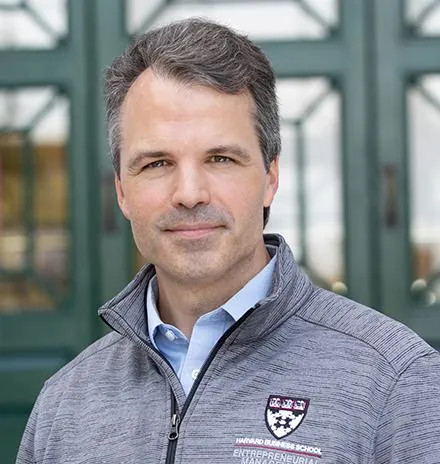

Managing the Future of Work co-chairs and podcast co-hosts, Joe Fuller and Bill Kerr, share highlights and insights from 2025 and look ahead to 2026. Top podcasts, research, trends, and a forthcoming book on managing the future of work.
Transcript
Bill Kerr: Hi, this is Bill Kerr. We’re pleased to bring you a special episode highlighting the best of the HBS Project on Managing the Future of Work from 2025 and looking ahead to what’s in store for 2026.
My project co-chair and podcast co-host Joe Fuller and I sat down in December to look back at the top podcasts of 2025, recap recent research, and preview the year ahead.
We hope you enjoy the conversation.
Joe Fuller: 2025 was a year of upheaval—around the world and in issues of workforce—really teased out the seriousness of skills gaps, barriers to workforce participation—like an absence of caregiving capacity. Obviously, AI dominated the news and is already having significant impact on the composition of work in certain fields. At the same time, we’ve had shortage in labor markets for health care workers, for certain scientific personnel, and for caregiving workers. We’re going to review, in this conversation, our findings from the year 2025, what we learned, some of the research we published and the practical implications, and then move on to talk about what we see as the big issues coming up in 2026, what we’re going to be tracking, and share with you some exciting news about a book we’re going to publish and some additional publications that we have in the hopper now that will be coming out early in the year. So let’s get started. Bill, why don’t we start off with podcasts.
Kerr: Well, Joe, it was a big year of podcasts. We had 23 podcasts. This was a year that technology loomed very large—particularly AI loomed very large—and many of the guests that we had and in terms of what the technology is doing, how it’s implementing in their workplace. Skills was probably a second big topic for us, both what were the new skills that employers were trying to foster in the workplace, and then to what degree could they hire upon those skills or were they looking to other opportunities. That led into jobs. And we had both, I think, a lot of people talking about both how to redesign work around the new tasks that are happening in the workplace, and then also could they rely on contingent work or some other people that are outside the traditional workforce to do it. And probably the last big topic area for us was about just broader organizational redesign. And I would say it’s probably safe to say, for most people, that was more of an open question on the other side. We knew how to get working on some specific use cases related to AI, ways to solve some of the immediate challenges, but these bigger picture, what could an agentic-based organization look like was a lot of times—we were like, yeah, we’re going to have to look into the years ahead to do it. What I thought we’d do is, we’re going to go through the top five downloaded episodes and just highlight them for our listeners and maybe reflect upon them here. And I’ve got the master list. Our most downloaded episode was Erik Brynjolfsson from Stanford University. He was about how AI is rewriting the rules of the economy was the name of the podcast. And one of the things that I know you have thought about, that Erik touched upon in his podcast, was the J-curve. And so maybe tell us a little bit about how you think about the J-curve, and where are organizations in that right now?
Fuller: Well, I think the J-curve is alive and well and living in large companies trying to adopt AI. What a J-curve looks like is that, even though technology has very good economics associated with it, the cost of implementing it causes the organization’s economics to actually worsen in the early stages of adoption. This can also be associated with a competency trap phenomenon where—since an organization knows how to do a certain task now—they find it difficult to move away from that current approach to a new approach. Usually, they have to run the approaches in tandem until they get used to the new approach. So they costs go up, their margin goes down, and it can look like an unattractive trade-off. Truth of the matter is, though, once you get a powerful technology like AI deployed, the economics start turning quickly. And the hope is, after that trough, you’ll round out into an ever-accelerating upward slope. And that makes your J.
Kerr: Yeah. And with past technologies, from electricity going forward, these curves have been sometimes measured in decades. And a lot of people are looking right now to say, is this one year before we start turning that corner? Will it be longer? And certainly a lot of CFOs are white-knuckled at this moment as they look at those investments. No one wants to be left behind. But, at the same time, it’s difficult to invest in front of the revenue, as they would say.
Fuller: I remember in the late 1990s, a friend of mine called Michael Scott Morton did an analysis that estimated that the total return on capital of computing for major corporations, to that point in time, had been zero. So these can be very long troughs.
Kerr: Yeah, negative, zero, it hurts either way. And Erik has a long history of thinking about technology. One of the things I valued in his podcast was he was saying that it’s not just about automation taking over all the work, that he still sees a lot of the biggest advantages coming when humans and machines get paired together in an appropriate way.
Fuller: And different types of machines. I think there’s been an under-concentration, under-focus on how AI and robotics are going to combine or robots, people, and AI in a “cobot” [collaborative robot] model to really push the reach of AI into directions we haven’t even anticipated yet.
Kerr: Yeah, that’s good. The second most downloaded was a podcast you hosted, OneTen CEO Debbie Dyson, why a skills-first builds a better workforce. Tell us about that one.
Fuller: Well, Debbie runs a project, OneTen, which is a confederation of a number of large American companies trying to move away from hiring people strictly on the basis of their academic credentials, to focus more on actually what the people can actually do. What skills do they have? It’s called skills-first hiring or skills-based hiring. And OneTen has been a very powerful influence in that debate about getting degree snobbery and degree inflation out of the workforce, working closely with large employers to have them understand how adopting a skills-first approach improves their economics. It’s not just a way to do a nice thing or to do a social good. It’s doing well by doing good. Debbie was, of course, a very senior executive at ADP, the big payroll processor, so intimately familiar with workforce issues. And that was a great discussion about how companies have to go beyond just having an intention to do more skills-based hiring but make the process changes that allow their managers who are hiring people to do that with comfort and confidence.
Kerr: Yeah, it seems in many of our podcasts, it’s so easy to say we’ve got to do some more skills—it’s all about skills these days. But when you get into the applicant tracking system, when you get into how people are sorted across opportunities, that’s where a lot of times it’s like—but how do we actually define all these skills? And we’ve had various vendors come on the podcast and talk about their companies’ approach toward doing this or educational providers with microcredentials, but it’s still a bit of a Wild West in terms of getting that realized.
Fuller: And I think people have to remember that skills—hiring, rather, is always a relative phenomenon. You don’t judge, is this candidate absolutely qualified? You’re picking, from among candidates, which one for the single position do I think will do the best job. And any, what we call, hiring manager, the person that will supervise this person that’s going to get the job, they view that through the lens of advancing their own performance, their own self-interest, their own quality of work life. So having people set aside credentials that are comforting to them, that they infer will be of value, like a university degree, when they consider who they should pick from, the pool of qualified applicants, can open the aperture on more opportunity for more people and reduce the shortage of people who are judged qualified for a job by eliminating an arbitrary standard by which the pool is being narrowed.
Kerr: Yeah, that’s terrific. Our third episode was with David Deming at Harvard. This is actually David’s second appearance on the podcast. And soon thereafter, David was announced and took over as the dean of Harvard College. So I’m glad we got him while he had a little bit of free time on his hands before he really had to start working for a living. It was called Workforce Shifts and the Future of College. And the podcasts actually began—it was centered a lot around some research that David had just released, where they looked at the amount of occupational churn, so new occupational titles being created that signifies new types of work coming into the workplace, other types of occupations maybe disappearing or dramatically reduced in headcount and there. And David describes in the podcast with me that he’d begun this idea maybe 10 or 15 years ago and looked in the data, hadn’t really seen very much of a trend, nothing to really trumpet a horn around or get people excited for. And in 2024, he had gone back and looked at the data again and realized that 2015 to 2024 was the most turbulent period in terms of occupations that we’ve had since the 1970s. So he’s like, oh, my gosh. It was very surprising that we had such a dramatic change and that was leading into some kind of need for us to appreciate the much quicker turnover that the labor market is having, how this, of course, goes back to the skills-based hiring we just discussed and building on that dimension.
Fuller: Well, it’s clear that there’s—there are infusions of technology or other economic trends like globalization that will unleash a lot of change in the labor market. And we’re finding in other research that 35 percent, 40 percent of skills churn within three years within a job. So there’s just a lot more dynamism. And it’s quite important for both aspiring workers, students today, incumbent workers, and employers to recognize that that’s going to come with a territory, has some pretty important implications. Certainly people—we talk about being lifelong learners, but organizations aren’t really configured to do all that much encouragement of their employees to learn. Our education system isn’t well configured to serve 40-year-olds, 50-year-olds unless they’re retired or hobbyists or academics. And similarly, people are going to have to understand that the skills that qualify them for a job today are probably not going to be those that ensure they can continue on that career path. So we’re going to have to think of ways to intervene—both in the education system, human resources function and talent management, chief learning organization officers—to think more about a dynamic environment where the cadence of change is going to go beyond what the current process is set up to support.
Kerr: Yeah, there’s this adaptability quotient that people are starting to talk evermore about on the person side, the employee side of being willing and open to the changes that are necessary. And then you talked about the education sector and that was the second half of the podcast with David. He’s a very big thought leader in higher education and the ways that it connects workforce. And he had some very optimistic tones that he was ending up with. He was anticipating people both buying into more education and also the value of education continuing to be—to both be a safe place to be investing in but also, maybe even more important, in an era where technology was rapidly turning over and people needed to constantly upskill and reskill. So it was nice to hear our sector might have a good future ahead.
Fuller: Well, that remains to be seen. But certainly there are going to be a lot of pressures on the education system to reform and modernize, starting with the demographic transition we’re seeing in terms of the available student body.
Kerr: Yeah. Well, our fourth one was with Cal Newport, one that you hosted on slow productivity and the next wave of AI. Tell us a little bit about that one.
Fuller: Well, Cal is a professor of computer science at Georgetown University. And we had him on the podcast a couple of years ago. He’s been an advocate of the theory that the lack of focused attention at work detracts from productivity and that a lot of technological developments—like networking, email, video conferencing—has actually eroded productivity for thought workers and that AI is going to be the next big wave of that, that his belief is it can be quite helpful because it’ll remove a lot of the transactional barriers to getting things done, a lot of the boring parts of doing cognitive work. But also as AI and given people’s propensity to over rely on technology, it could create a phenomenon where AI is being overrelied upon, that mediocre or defective output from AI is getting bled into processes, causing them to be ineffective and actually detracting from the productivity of the organization, just as previous waves of technology have.
Kerr: Yeah, you’ve talked a lot in your research about risk management and the increasing importance of that in an era where we’re building evermore on what the technology’s produced. And if there was a shaky foundation umpteen steps ago and it keeps carrying forward, it could get worse and worse as that is that transpires.
Fuller: I think that’s a growing risk, and it’s going to have several important practical applications. We talk about the ability of someone to spot what’s called a hallucination out of AI, an error it’s making. And a couple of thoughts about that—that’s going to tend to be the more experienced person, who’s been around a market or process for a while. But we know also that older workers are less comfortable with technologies like this and learn them less rapidly. So begin to suggest in the future, in an AI-heavy world, you’re going to reconfigure teams that are doing projects. Rather than having all the junior people get together and create a recommendation for the senior people, you’re going to be cutting vertically in the demographics. You’re going to be matching some more experienced people with some more technically adept people. And not only should they be looking for hallucination, they should be looking for invention. I think we have to assume that AI will create a standard distribution of outcomes. Some of them are faulty, and some of them are really insightful. And it’s going to take that older, really experienced person to look at output from an AI, not only spot the error or the potential problem that has to be investigated more closely, but also say, wow, look at this, let’s think more about this unexpected output or recommendation that might be really valuable to us.
Kerr: Some of the work I’ve been doing with senior executives—I’ve often told them, you really need to lean into this new technology, not because it necessarily is going to be the thing that’s going to make you more productive next week, but precisely for this reason. You need to understand where the productivity gains can happen in the organization. You have to role model the behavior for the young employees to have them invested in it, helps you understand where those risk areas lie, and ultimately build up this joint solution that goes back even to what we said with Erik. It’s the technology, but maybe increasingly even a more—a different sort of team formation than we’ve had in times past from there. So our fifth one was Sal Khan on AI in the classroom beyond. I was the host of this. Joe, I’m not going to keep score, but I think it was three for me and two for you in the top five.
Fuller: Yep, I was keeping it for Bill, and you won this year.
Kerr: I edged that one out. Sal is a Khan Academy founder, very well-known individual that way. And he’s always thinking about how to personalize education, how to bring a stronger environment for skill development into the community. And this is so important picking up on in the post-pandemic world where we’ve—across the world—United States and outside are really struggling with skills deficits that came out of the Covid lockdowns and lost time in schools and general things like that. And he sees a strong of technology foundation for us, closing some of those gaps and building on it. So it’s always an insightful conversation with Sal Khan but particularly around how we could use this technology more.
Fuller: Well, we’re proud that he’s a graduate of our school. And I will say that his thinking and the thinking of some other advanced institutions, more digital institutions and learning, like Western Governors University—you interviewed the president there, Scott Pulsipher, this year—where you can really see that this technology can be the solution to a problem we haven’t been able to crack, which is, how do we get more customized education and how do we make the K–12 system more equitable and more effective? That if you’ve got AI that is not only able to identify what concept—let’s just make it easy and make it about math, since a lot of people are math-phobic—that you’ve missed out on in fourth grade or sixth grade or eighth grade, that it can diagnose that, that it can preemptively explain it to you, and give you problems in sequence that cause you to work through how to do it, that informs the instructor. Let’s say that a big percentage of the class didn’t get the concept that was embedded in last week’s teaching plan, so he or she might have to review it with the class, you can start bridging a lot of the learning gaps that emerge in middle school and early high school and inhibit people’s accomplishment as they get deeper into subjects and they get more complicated. And that will have direct implications for employability.
Kerr: I can say working with my kids on their math, I can appreciate when the technology is being customized for them versus my wife and I are trying to make custom questions for the kids to help them and you realize how difficult that might be.
Fuller: Two PhD economists.
Kerr: The other thing that’s interesting about that conversation—and went to your teacher part of that—Sal was very thoughtful in presenting this about how he really wanted this to be a big boost for the teacher, the role of the teacher. So I can help on technology, help on the lesson plan, help on the grading. It’s trying to free you up for more of that very valuable time in person with the kids from there.
Fuller: Clearly thinking about tools that allow teachers to reverse the classroom where they’re really being instructed in logic or concept at home and then coming into class and demonstrating to the teacher that they understood the concept. Right now, we tend to teach concepts in class—not at the Harvard Business School, but in most schools—and then you go home and do homework. The homework gets handed in, teacher grades it a day or two later and sees that Charlie didn’t understand anything on the homework or didn’t apply himself to the homework. But now you’re two or three days further into the course, you can’t stop, go in reverse just because of Charlie’s missed something. So I think this really has a prospect of revolutionizing things and unlocking a lot of good and brighter futures for a lot of students.
Kerr: Yeah. And in this one—and also the previous ones—throughout I think there was an undercurrent of ethics in AI and whether it’s manipulation of tests and so forth, the education sector, going back to some of the others, making sure that we build the right environment for that. So those are our top five podcasts. Are there other podcasts that stuck out to you?
Fuller: We had two repeat guests who are two of the leading CEOs in the contingent workspace, Micha Kaufman from Fiverr and Hayden Brown from Upwork. And we had different conversations with them. We had Micha recently and he really talked about the impact AI is going to have on contingent work or gig work, not only in terms of the type of market opportunity it’s going to create and how it’s going to change, whether or not certain gigs are even obtainable anymore because I will just do the work of the gig worker, but also how it’s affecting his own organization. And it was interesting—entrepreneurial company, Israeli-based—where even a company like that, he was finding pockets of experienced workers that just didn’t really want to embrace the technology and how he was managing that. For Hayden, it was how, particularly for younger workers, the attractiveness of contingent work is continuing to grow. They have more agency over what they’re doing, who they’re working for, what they’re working on. They can plan it around other parts of their personal life. These are gigs for a reason. Often someone’s pursuing something else in their career. It could be something in the arts or a not-for-profit sector or government or even a full paying—full-time paying job otherwise. And, at Upwork, Hayden has taken the company at a very interesting direction, doing more B2B sales for large companies, where they’re being a turnkey provider of the contingent talent needed, a really important evolution. Because a lot of innovations like that have been powered by large companies providing the direction and the scale of purchase that allow unit cost to fall, making the same services available at a high quality to middle size and ultimately small enterprises.
Kerr: That’s great. One that I remember was a lot of fun was Shake Shack, and we had—Stephanie So is a graduate of HBS, along with Chris Stanton, our recently tenured colleague who is teaching the course around it. And they had just come out of the classroom. And it was fascinating to hear from Shake Shack’s perspective, how much technology and AI you want to have in the customer relationship? Because there’s a lot of value. Imagine you go up to the kiosk and it knows that you tend to like the following kinds of things and it sets it up for you. On the other hand, it could be too much. It could ask you, do you really need more bacon again? Is that too much for your health. So there was that part, and then it was flipping it around inside the kitchen and the workforce, how the technology helps alleviate some of the most onerous jobs that the workforce faces and frees them up to work on some other activities.
Fuller: I think that’s generalizable, that a lot of AI will be used early on to displace the least attractive, the most onerous parts a job. And that’s going to be in part selection by the employee. I really hate writing the first draft of that sales report, so I’m going to upload my last 20 sales reports and get a draft. And rather than looking at a blinking cursor and trying to think of a new topic sentence for the first paragraph, I’m going to get something to edit. It’s always easier to edit than it is to write. We had a couple of, I thought, really great conversations with senior executives this year. One was we had Bei Ling, the CHRO of Wells Fargo Bank. She’s been part of a team that took over the management of the bank after they had some customer service problems and that led to regulatory sanctions, where they came in and they were simultaneously trying to make the culture a more performance-oriented culture, meet the demands of the regulators so they could get out from this special regulatory treatment, and start accommodating AI. And I thought the way they approach that—aligning senior management, communicating effectively with internal resources—Wells has always been famous for very high continuity employment, a lot of people spend their whole careers there—how they’ve infused senior level talent from the outside without giving up on what’s special and valuable about the Wells culture was a great story.
Kerr: A couple more on my side from BuildOps, which is a company that works in the HVAC system. We had Alok Chanani, who was an army vet, that created a business that is wraparound for companies working in the HVAC space, everything from actually getting the invoices out faster and keeping track of them with customers to where do we deploy the talent today across the build sites that is most important for actually getting the work done. And someone we’ve had before that came back was Ed Glaeser at the beginning of the year. And it was an amazing foreshadow for a lot of the conversations we’re having right now. He was talking about affordability, housing, and so forth, and what makes it so difficult to build in this country. And that’s, from both political parties, been picked up a lot over 2025.
Fuller: On an upbeat note, I thought the conversation I had with Fran Katsoudas, who’s essentially the Chief People Officer at Cisco, the router maker, and the COO, Jeetu Patel, was hopeful on multiple regards. First of all, they have really partnered to run the process of AI adoption at Cisco, realizing that neither—a technical executive lacks the understanding of human assets to do it on their own, and a human assets executive lacks the technical expertise to do it on their own, so creating a hybrid model for addressing the adoption. But I think the most hopeful thing Jeetu said specifically relates to how AI is going to affect employment. They’re using AI a lot in their engineering projects, their innovation projects. And what he said AI is allowing them to do by speeding up the work being done on those projects, it’s not causing them to lay off engineers. They’re able to do more projects. Every year, they generate many more attractive engineering projects so they can fund. This is allowing them to push further, faster, get to failure with a project sooner so they don’t misplace resources, so they can redirect those and the efficiency enhancements toward further discovery. That’s a green shoots of spring story to me.
Kerr: Well, it sounds like we had a lot of good episodes over the course of the year.
Fuller: Well, I have to agree with that. And more to come. You mentioned David Deming earlier, and David and some years ago started a project that’s based at the Kennedy School of Government here called the Project on Workforce. It takes a little different spin on what we do here at Managing the Future of Work, looks more at upward mobility, economic opportunity, things like that. We published a new version of what we call the Workforce Almanac, which is an available computer tool to anybody out there listening, where they can go to our website, find a ZIP code, ask a ZIP code—that ZIP code what training providers are in this site, what types of jobs are available in the site, what type of programs are there that align with those jobs. And that model now covers about 25,000 skills providers in the United States. There are about 70,000 altogether. We think it’s covering now about 50 percent to 60 percent of the places in skills development. And we really think that further refinement of tools like that will help reduce mismatches in the labor market, get more people studying things for which have value in where they live. If you’re a college graduate, on average, you live within 17 miles of your mother. So the notion that interstate mobility is lowest it’s been since after World War II. So you need to look to see if there are jobs you’re studying to obtain actually are available where you live. And you want to know all the different programs that might get you there.
Kerr: Well, I live three miles away from my mother, but I forced them to move from Alabama to Massachusetts, so that was a little bit different of a story. So in some of the stuff I’ve been doing—this ends up not being as openly accessible, but in the Census Bureau, we have now very detailed records for 30 years of what we call employer/employee payroll files. So you can see for any company, you can look up and down, all the workforce and who’s there. And you can also look at Joe Fuller over time as he’s gone from employer to employer. And it’s—at this point, we’ve got 30 years of that data, which makes for a very powerful laboratory to think about careers and various things that people encounter in the course of a career. So one of the projects was, for example, looking at minimum wage workers. And, historically, you could look for a couple months on either side of when somebody’s a minimum wage worker, but you couldn’t look five years, 10 years in the future and try to understand, is this going to be a permanent state, is it transitory? If you see someone that’s in their early 20s, what’s the likelihood that they’re going to hit the middle of the distribution? And the other thing that relates to some of your work is we’ve been looking a lot more at—if you look in a workplace and someone that doesn’t have a college degree, but they’re in a workplace that has a lot of college workers, do we find that there’s an on the job learning of various social skills, abstract skills, those types of digital kind of things that you can see later in their career, in their workplace? And this gets tricky because you got to figure out the right ways to causally identify stuff because the kid who ends up interning in a particular company that’s very professionally very heavy, probably has some other traits about them that’s going to propel them forward in their career. We’ve been trying to isolate that. And you really do see a lot of evidence that the people around you matter. And even relative to where you live, because we can compare the people that are around you in your home block as well as the people in your work block—the people in your work block really do shape the skills that you’re developing. And you can look then 20 years in the future and find some important impacts that happen from very similar individuals, one just happens to be in an environment where they’re exposed to a number of more educated, more likely skilled, although we can’t measure it as much in the data, coworkers that then shapes how they’re going to.
Fuller: I thought that was a terrific analysis, and very interesting to think of through the lens of our colleague here at Harvard, Raj Chetty’s Opportunity Insights work, where he consistently finds that the health of the community a person is in correlates directly with economic outcomes and moving from a less healthy community to a more healthy community will affect the prospects of the entire family that makes that move, which raises all sorts of interesting questions related to the availability of housing that you referred to earlier. But, also, how can we make more investments that directly enhance the vibrancy of communities so that people, rather than having to relocate, can stay in situ, but get the benefits of the types of interaction with others, cultural resources, health of schools, health of families that are consistent with success?
Kerr: Yeah. And one thing we see as a macro trend is just workplaces are becoming more segregated, segmented on education lines. And there’s a number of productive reasons why that could happen. And so it’s not something you want to just say, oh, you should stop, but we do need to think about some of the implications on the other side for the traditional ways people would have learned all those other skills besides the education providers that now may be harder to pull off.
Fuller: Well, workplaces certainly continue to be a big focus for the project this year. We published a new version of what’s called the American Opportunity Index, where we rank companies in terms of the type of opportunities they create for workers to progress, to advance, to learn new skills. We measure everything from when someone leaves a company to where they go elsewhere to a better job than they have or is it lateral or, worse yet, are they regressing, to wage levels, promotion from within. And we extended that to Britain this year for the first time and got a lot of good learnings there and a very interesting response from the Labour government there. And we’ve just done one in Singapore, which was very, very interesting. Because unlike the UK and the US, Singaporeans have really good data. So we could see that for 1,500 companies we looked at that there was a pattern where companies that had steps in the HR system that were highly aligned created the best outcomes. So they knew who they were looking for, they knew how to onboard them, they knew how to train them up, they knew how to retain them, and that gave them a consistency in staffing and productivity edge that was really noticeable. And we’ll have a new American Opportunity Index in late January, which will cover the better part of 2,000 companies now. And, happily, it will have some very important new features like data at occupational level. So we’ll have—that data will be out there and we’ll hope people will use it for further research.
Kerr: I have one more on my side. We know that the world of innovation is very spiky. It’s not evenly distributed across the country or around the world. And one of the things I’ve been investigating is, if you’re an incumbent organization, not a startup company where startups can decide where they want to live—but if you’re an incumbent organization, you’re a Procter & Gamble, you’ve been in Cincinnati for 100-plus years, how do you then think about mapping innovation and opening up new satellite facilities? And if you see P&G open up an R&D center in Silicon Valley, does it look more like Silicon Valley? Does it look more like headquarters at P&G? And then as you think, companies can be differing degrees of how centralized their decision-making process is versus spread out. How does that affect this degree to which you mirror the local community or you stay something that’s much more tightly integrated to the corporate parent? I think we’re going to see a lot more effort in especially fast-moving technological landscape. If you’re trying to stay up-to-date with where the technology is, and it’s being created in the places like the Kendall Squares or the Silicon Valleys or the Londons of the world, how do you have the right feelers into those locations in order to take advantage of it?
Fuller: Well, I think that certainly also fits with this notion of clusters that have been widely written about and how exportable are skills—do you have to have that Porterian Diamond that—to remain competitive or can you, once you’re competitive in your core sites, export to other sites? The—one final thing I’ll just talk about is at the Project on Workforce we did, I think, some very interesting work about community colleges. We looked at how technology was being used to change curriculum at community colleges. But work I’m very proud about and still underway is on the subject of how people entering community colleges and studying community colleges do what we’re going to call career navigation. How do they start making choices about what type of career to pursue? When do they make that choice? How do they make that choice? There’s a lot of literature about the importance of career navigation, but when I look through it, almost everything said this is really important. It didn’t actually say, how do people go about it and how might they improve that process?
Kerr: Yes.
Fuller: And one of the more interesting findings from that, very sobering finding, was that a learner from a low income, low net worth household actually sets career objectives around the age of 28. And a learner from a high income, high net worth household sets career objectives around the age of 18. And the latter, of course, have greater, what we call, social access. They have assets, friends, neighbors. Their parents are probably employed, probably university graduates, given the statistics. They have a much better idea of work, of what credentials are, about where you get those credentials. They’re much more likely to get internships, which means they’re much more likely at a full-time job immediately after college. The lower net worth kids, they get through their terminal education experience. Very often they’re only really qualified for entry level jobs. Those entry level jobs tend to be not very demanding because they have high turnover rates. And that means that a person who’s only been in the job a little while has got to be able to do it, which means they’re not paid very well, which drives the turnover rate. And we’re finding that students have episodes—three, four, five, six instances of employment, usually with jobs of that nature. And then our hypothesis is, later in their 20s, they begin to say, this is the lane that’s open to me. So if I’m going to be in the hospitality business, maybe I should aspire to going from being a bellman to being a behind the reception desk worker, maybe my company’s got that. But they’re no longer—they’re constrained to what their work history has set them up to do. I can become a keyholder that opens or closes a store. I might become a manager of a fast-food restaurant, as opposed to merely just a shift manager or a shift worker. And the lack of data and objective input early on in that process, since those learners rely very, very heavily on their friends and family who have lower social assets and less experience in the breadth of work, becomes a self-fulfilling prophecy.
Kerr: Yeah, well, Joe, you teased us at the beginning, but I think we should go on the record about the book. And I wrote the earlier book on global talent. And I actually wrote every single word in the book. And the last thing was the title of the book. It came down very late in the process. And so we can throw this title out, something about the great inversion in technology, recognizing that it will shift along the way. For seven or eight years now, we’ve been working on these two forces, technology and demographics, and how they’re coming together in novel ways in the workplace. And this is going to be a manifestation of that. What are you excited for in the project?
Fuller: Well, I’m excited because it’s forcing us to think across all the many dimensions of the future of work we’ve been puzzling through and try to make a coherent story of it. And I think we have a coherent story, we may be wrestling with articulating it. But throughout all the increasing velocity of change and work requirements and technology, there’s many constants. And I think that being able to articulate those constants is going to unlock further avenues of research. I hope it’s going to inspire other colleagues of ours here at Harvard Business School and other business schools to get more involved in this field. I think it’s just ripe for research, not very deeply researched. And the key player in these markets are employers. So it’s a natural home for a lot of this research or business schools. Also, just getting—being able to put the argument out there and hear from practitioners, other scholars, social and policy leaders, what do they think? You and I put a big premium, as does everyone on the project, of doing research that’s actionable, that there is a takeaway, not be better, grow taller, but here are some things you can—here’s a specific definition of a problem and here are some things you can do about it. The book’s going to be rich with that type of dialogue and can’t wait to see whether people buy into what we’re saying.
Kerr: I like that we’re deliberately keeping one foot in stuff that is provable, whether it’s true academic studies or whether it’s case examples or that kind of genre. We have one foot in that. And then there’s but there’s a definitive second foot that is leaning out and saying the implications of this. And if these trend lines continue the way they’re going, this could be what the future looks like on steroids and so trying to identify those future states in a way that helps people, hopefully, see around the corner a little bit.
Fuller: Well, we also created some less ambitious projects, some good new cases we’ve got now and new ones coming out. Did one on Blackstone’s very innovative process for encouraging their portfolio companies to do skills-based hiring and more worker development. I was on the podcast for a company that is the most advanced, I think, in terms of matching algorithms for people in your workforce with jobs or roles. And the company with the improbable name of TechWolf, we’ve got a good case coming out on them. And we’re just finishing up a case on a very ambitious new program that the government in Singapore has launched, called the career health—Singapore Career Health. When they first called me about it, I thought it was about careers in health, but it’s the health of your career, where they’re providing everything from directed tutoring to workers, a bot that interacts with individual workers to answer their questions and advice, to dashboards for employers. It’s really as big, as ambitious—a systematic effort to address the problems that actually captured in the book of stagnant demographics, rapid technological change, and ensure that Singapore, which has a remarkable run of reinventing itself since the 1960s, can be ready for this next era, so some exciting other materials coming out as well as the book.
Kerr: I also put a plug in with our executive fellow, Dan O’Connor. We’ve been working on some notes around agentic commerce and how that’s reshaping the whole consumer sector, from the manufacturers of the goods and so forth, through the retailers, last-mile delivery, and build from there forward.
Fuller: So, Bill, what are you going to be concentrating on for 2026?
Kerr: Well, I would like to concentrate on the book as well as some other duties around here. I think I will continue to do the workforce academic research grounded in the empirical studies that sit behind it. I’ve had a lifelong passion for working on data around innovation and development of new technologies, and we’re wanting to lean even more into that going forward. I have questions, for example, around are inventors specialists, are they generalists? How do they combine together on teams and trying to make some early headway around some of those projects? So the core academic work will be there, the book will be there, and then I anticipate always wanting to understand more about agentic-based work and how that’s reshaping what we might call the “autonomous enterprise.”
Fuller: Well, we’ve got a couple of things that I’ll be finishing up that are contributing to the book. We’ve done a substantial analysis of reskilling in companies, what are the barriers to it, and it’s pretty sobering that companies really aren’t very comfortable they know how to do it. And that’s OK, a big percentage of their workforce doesn’t really want to be reskilled anyhow. So—but I think reskilling becomes hugely more important as a corporate capability in the future because as the half-life of technology shortens, you’re going to have to be able to take the people you’ve got and get them to know what they need to know faster. We’ll also be publishing some pretty deep research we did about how people think about what constitutes a good job and how that contrasts with what their supervisors think they think is a good job, the workers think is a good job, at three different levels of compensation—so lower wage workers, middle wage workers, higher wage workers. How well are their bosses understand each, the desires at each level differ, the different concentration about which factors count the most, and the ability of managers to understand is pretty—is more limited than you’d think. And, finally, we’ll have an analysis that we’ve been doing about how AI is going to influence the future shape of organizations. Most of the research has been about how AI will affect productivity and individual jobs. But we haven’t been mapping that onto what does a bank look like and how does AI affect jobs up and down the hierarchy of a bank. So what emerges of the new shape of the bank? And we see in a lot of the types of jobs that many of our—certainly I aspired from my kids, your kids are younger, a lot of the jobs that are our students here at Harvard Business School had before they got here, a lot of those jobs are going to be profoundly affected. And that raises all sorts of questions about job descriptions, about how you maintain a talent pipeline in your organization. If you are reducing the number of people you’re hiring at entry levels, about how AI will affect things like team formation, I talked about earlier, so I’m really excited to get that out there and hear what kind of feedback we get.
Kerr: That’s great. Well, that’s all coming for 2026.
Fuller: Yes, indeed.
Kerr: Well, we want to thank everyone for a great 2025. We appreciate you listening to our episodes.
We have a website, hbs.edu/managingthefutureofwork. Just write it out. That’s where you can get some of the case studies and research that Joe was mentioning, both reports that have been done with organizations, as well as also additional thought pieces. We would love to hear your comments. It could be podcast suggestions. It could be places to go do research. We very much want this to be an active dialogue toward the future. We began this project—we purposely titled it “Managing the Future of Work” and not just “Future of Work” because we are not going to, with our team and with you, completely shape what that future looks like, but we can start saying, for now, how can you prepare your organizations, your workforce for tomorrow. So that active stance is something that we very much value.
We want to thank, in addition to you as the listeners, Harvard Business School. This has been a year that the school has had to make some tough choices around where to invest and we appreciate them continuing to invest in this podcast. We thank our producer and the many team members at Managing the Future of Work for all of their contributions. And we look forward to a great year ahead. Please sign up for our newsletter and we look forward to talking to you again in one year and reviewing what happened in 2026.