
While preparing for the FIELD Global Capstone course (FIELD CAP RC) this spring, Professor of Management Practice Joseph B. Fuller saw an opportunity. With recent advancements in generative artificial intelligence (GenAI), he recognized that this course could lead the way in providing students with the practical skills to apply AI to real world business challenges.
With that idea in mind, he set out to find the right AI use case that could be thoughtfully incorporated into the course.
Synthesizing Research
The FIELD CAP RC course is a cornerstone of the first-year MBA experience at HBS. Designed to help students develop the ability to understand and manage differences and operate effectively across cultures and business contexts, the course places student teams in real-world consulting scenarios with global partners.
Some teams remain in Boston, but most travel abroad for “Immersion Week,” engaging directly with local organizations to consult on business challenges. Working with their global partners, the students conduct customer interviews, perform market analysis, and present their recommendations.
Before Immersion Week can take place, however, students participate in “Industry Week,” conducting intensive research on the industry, the company, and the country they’ll be partnering with. Given the amount of research required and the short timeframe, industry week has historically been a challenge for many student teams.
Recognizing both the potential and the challenge, Fuller reached out to HBS IT with the idea that an AI assistant could be created to aid students in their research prep. HBS IT’s Instructional Design (ID) team quickly got involved, and plans soon emerged to create the Research Navigator—a custom chatbot built in ChatGPT that could be trained to help students refine their problem-solving approach and craft more impactful, research-based recommendations.
“This seemed like a great opportunity to explore how a business might incorporate ChatGPT into their workflow,” said Fuller. “It allowed students to experiment with AI in a structured, academic setting while working on a real-world challenge.”
Enhancing Learning
The project was a collaborative effort. The ID team worked closely with Baker Library to integrate research resources into the chatbot’s responses, ensuring students could access curated, high-quality materials. They also coordinated with the Global Experience Office (GEO) and Sharon Yamamoto of the MBA Program Delivery team to align the chatbot with broader support systems already in place.
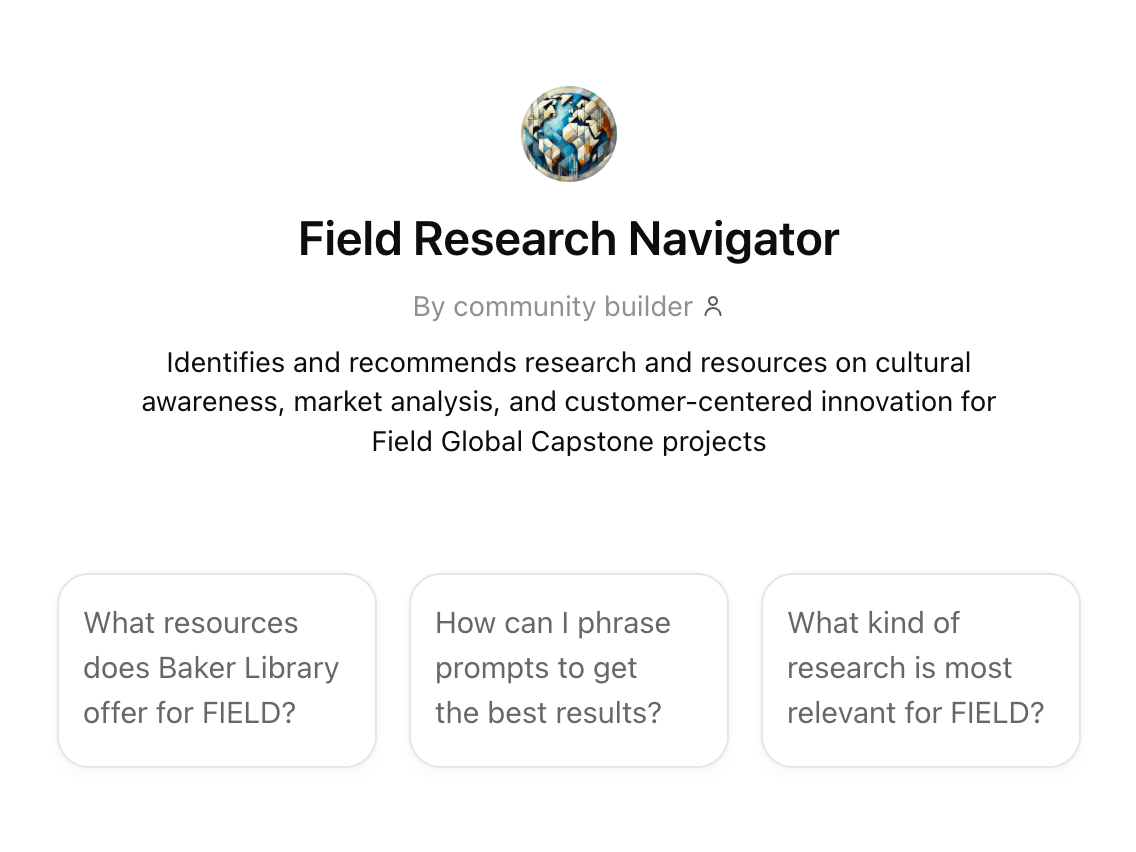
The result was a powerful, easy-to-use tool that not only helped students synthesize research more efficiently but also demonstrated how AI could meaningfully enhance learning.
And the innovation didn’t stop there.
With the Research Navigator now trained on the course and its core concepts, the ID team is already looking at new ways it can be used—including analyzing student feedback to improve future course iterations. “Maybe it’s not about building a new bot, but instead it’s about finding the right prompts that focus on the teamwork element and building a user guide that focuses on the right types of prompts,” says Learning Designer Jamie Thomas. “We can determine how to utilize this one bot for all these other use cases.”
With training from Thomas, Fuller’s research assistant Choetsow Tenzin has gone on to build custom GPTs to serve as FIELD Global Team Companions for Immersion Week. Based on the Research Navigator bot, the companion tools provide real-time, research-driven support that help student teams navigate cultural nuance, uncover actionable customer insights, and make effective decisions under pressure.
Built using FIELD course materials, RC frameworks, and deep research on the location’s business and cultural environment, the companions help students turn ambiguity into insight.
Looking Ahead
Louisa Jeng, manager of Learning Design & Training Services, explained that the ID team can work with campus partners to identify broader applications for AI technology.
“If we design a bot really well, it can do more than just research; it can help students find a way to work together,” Jeng explains. “I think the beauty of AI is that, yes, you design it for one task, but once it has the context, it can do many other things.”
As more students and faculty explore how AI can become an integral part of the learning experience at HBS, this collaboration is just one example of how HBS IT is pioneering meaningful technology solutions in the classroom.