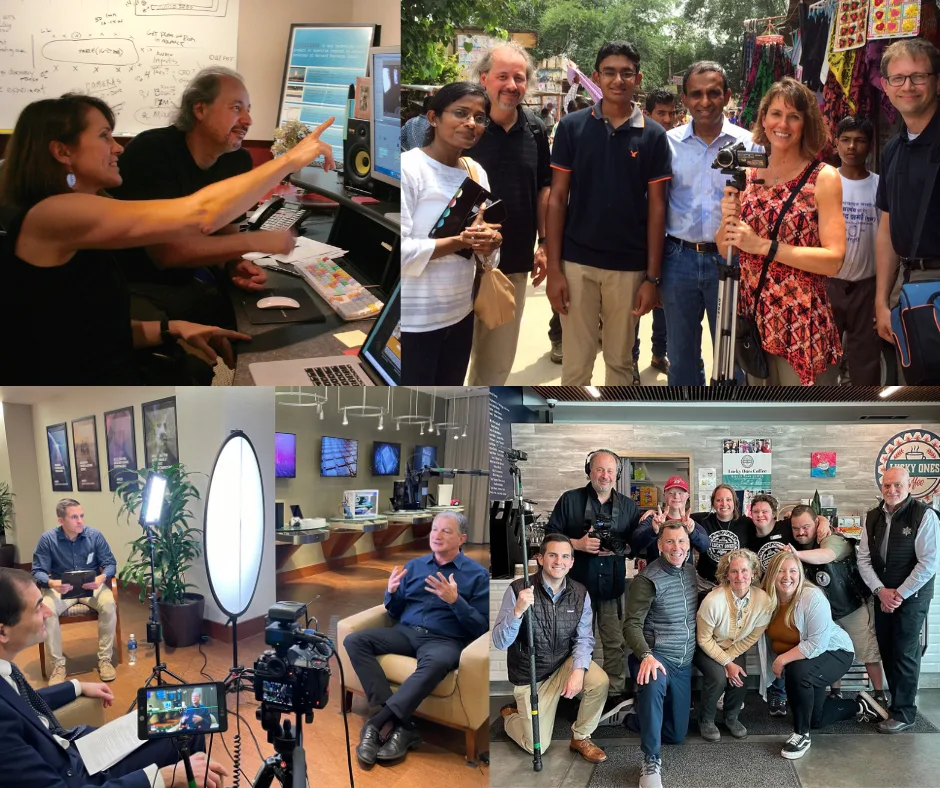
Who Are They & What Do They Do?
The HBS IT Multimedia Development team partners with faculty to create media-enhanced variations on the traditional HBS case study, which are used in MBA and Executive Education courses. The team stewards case studies from beginning to end, from initial research to field production to the first use in the classroom and publication with Harvard Business Publishing (HBP).
Hours upon hours of work go into multimedia cases. The process includes field research and location production, content curation and case writing, video editing, UI design and development, and first teaching and publishing. The small, hard-working team often faces non-flexible deadlines with extremely high expectations. Team members travel with faculty around the world to conduct original research on the subjects of each case study, whom HBS calls “protagonists.” It is essential that the team and faculty build trust with protagonists and a maintain a careful balance—cases are not intended to be exposés of protagonists or their businesses, but they are also not marketing campaigns. The team takes a genuine documentary approach, and the hope is that protagonists will be honest and authentic. The best cases happen when protagonists let the team “look under the hood” and document challenges for students to study and analyze.
The team typically films dozens of hours of content for each project, which they then edit down to create a cohesive story. And though the team begins with a thesis of what the case issue is, it can shift in the field and so must they to capture the optimal story for teaching and learning. This is a creative team, and though it can be challenging to systematize creativity, they must in order to achieve the compelling case studies the HBS community demands. When a case is first taught, the Multimedia team attends class, and there is something magical in watching their hard work in action.
Once finished, cases are published in the HBP catalogue for distribution to educational institutions around the world. In addition to the traditional multimedia case studies, the team also produces case supplements, which typically involve the creation of video segments to accompany a written case, and “classroom” cases, which are case studies that unfold real time during class and that allow faculty to teach them with little to no advance prep on the part of students.
How Do They Stand Out?
This certainly is not the kind of team that most think of first when considering information technology, but they are pertinent to the organization’s mission of pioneering technology solutions and educating our future business leaders. The Multimedia team sits at the intersection of storytelling and tech in a unique way, expounding the age old artform through modern capabilities.
The School has invested in this team’s work since 1995 and has greatly embraced the value they bring to the community. Their services aren’t typically embedded in most universities, as hiring third-party vendors is more the norm. But the institutional knowledge the team brings means that they understand the case method, have built trust with faculty partners, and are invested in meeting faculty’s pedagogical goals. This results in work that is innovative and distinctive in quality and depth.
Their value was greatly emphasized amidst the COVID-19 pandemic. When it became clear that teaching and learning would remain remote for the foreseeable future, faculty wanted multimedia, and quickly. The Multimedia team received a tsunami of demand, with more than 100 new requests in June 2020 alone, and demand has not slowed down.
In total, the team has produced more 500 multimedia products, including many cases that have become “classic” and are taught yearly. The team has earned a fair number of awards for their work, most recently eight awards in the 45th Telly Awards Competition, including a Gold Telly in the Education & Discovery category for the case study, Vinalhaven: The Downtown Project, the first time any Harvard affiliate was honored with a Gold Telly.
The Multimedia team has been raising the bar for several decades, with the first multimedia case, Pacific Dunlop (A): Beijing, produced in 1995, ten years before YouTube and far before “streaming” was part of our daily vocabulary. They’ve produced many cases that have revolutionized the case study method and teaching, and that’s no doubt it part to the way they work together. Though small, they are mighty, and work seamlessly together, with everyone willing to lend a hand at every step of the process.