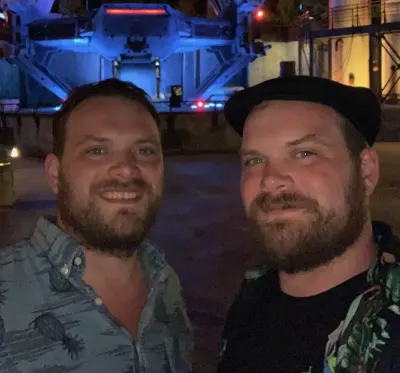
Chris and Nate Moran are twin brothers who both work for HBS IT. They have a long history of working with each other, from a paper route to IT desks in high school and college, and now at HBS. We thought it would be fun to profile them together.
How would you describe your role?
Nate: I am the IAM architect, the tech lead for Identity Access Management (IAM) related to HBS’s infrastructure, and I act as a liaison between IT and HUIT. The tagline for IAM is “the right person, the right access, the right time.” We’re getting people the digital services they need, while also ensuring they are who they say they are and then building systems around that to give them a good user experience. IAM touches everything at HBS—everything is behind a login—and flexibility is required in how these systems are implemented. We have to support the many ways there are to log in to our many systems in a way that is supportable in the long term.
Chris: I’m an architect and the manager for Endpoint Services in Technical Support Services (TSS). My team and I build tools for TSS and the HBS community to use and make folks’ jobs easier. I also oversee the setup and maintenance of computers and other hardware and assist with escalations and projects.
What’s your favorite part of your job?
Chris: I really like being able to work with my team to solve problems and make a positive impact on the HBS community.
Nate: I was going to say something similar; I like working with people and helping them to improve services and also their day-to-day experiences, whether that be helping a staff member to automate something or giving an end user an easier experience.
How do you like to start the day?
Nate: Coffee.
Chris: Same, I’m not really a morning person, so I’m trying to wake up. Once I do start my day, I’ll meet with my team and plan out what we want to accomplish that day. We meet every day.
Nate: I usually start my day with my daughter waking me up and dragging me to pick out a TV show she thinks I’ll like. She’ll be like, “Let’s watch Mickey Mouse, you love that!” Then for work stuff, I’ll plan what my focus is for the day and put non-priorities on the back burner. I don’t have a team per se, but I work with project teams, and we’ll check in about how things are going.
What’s one professional achievement that you’re most proud of?
Chris: For me, it’s transitioning all of HBS’s device management to the cloud. We did it over the course of three years; it was a lot of work, but it’s working well now. This included moving all device management to software solutions, shutting down nearly all of our on-premises servers, and reevaluating if certain services and equipment were even needed. We made a lot of automation improvements, and this bettered service for everyone. It took some tasks from taking an hour and a half to 10 minutes.
Nate: I used to work at Northeastern; I was brought in for an IAM refresh. Their environment had been built on a platform that was coming to end-of-life at the time, so we had to move it over to a new platform that then was also coming to an end of support because they’d been bought out. We finally had to move it over to Saviynt, an identity governance application, and moving all that student data took seven or eight years, half of that being the move to Saviynt and redesigning all the processes to get into the data. And I was part of a team, but student data was my area, and getting all that transitioned over with minimal issues was a really big accomplishment. They actually finally, just a couple months ago, got all of the staff data transitioned, and I’m really happy for them. All of that work took 10 years. IAM stuff is so complicated—you have to be ready for anything, and anything can be chaotic, so it’s great once you have your new system.
What’s the best piece of advice you’ve ever received?
Chris: I would say don’t be afraid to admit when you don’t know something. I feel like that’s something a lot of people have trouble with, and we should accept that everyone has things to learn. Don’t be afraid to speak up if you don’t understand.
Nate: It’s an Einstein quote: “Everyone is a genius, but if you judge a fish by its ability to climb a tree, it will live its whole life believing that it is stupid.” Understanding that when you’re working with a diverse group of people with varying skillsets, you have to help them focus on their own abilities because they’re needed. You can’t expect everyone to do the same thing. And that’s really important with IAM stuff because you have to come up with a lot of creative solutions.
What’s a book you would recommend?
Nate: For fun, The Expanse series by James S. A. Corey. I’m reading it now, but it’s my third time reading it. For work—it’s an interesting read, it came out 20 years ago, The Laws of Identity by Kim Cameron, it’s a philosophical look on Identity management. Once you understand what a person’s or vendor’s purpose is, you see they’re all trying to reach the same core principles, just in different ways. It helps a lot with architectural direction. The guy who wrote it was like a real genius.
Chris: As far as a work-related book, I’d recommend Scrum: The Art of Doing Twice the Work in Half the Time by Jeff Sutherland. It’s about Scrum and Agile, philosophies and frameworks that help teams structure their work efficiently that my team uses. As far as a personal book, I just got through reading every single Stephen King book in publication order. My favorites were Misery, The Green Mile, and Different Seasons.
What’s it like working with your brother?
Chris: Working with Nate’s been fun. We have similar interests; many of our hobbies are the same, like 3D printers. When we opened IAM, I recommended him for the job because he’d been doing it over at Northeastern. I’m on one of Nate’s projects right now, and I’m making sure he gets everything he needs. We’ve worked well together for a long time, so we’ve always had a good understanding that work is work. There’s nothing personal about it.
Nate: Yeah, and it’s been great workwise. We went to the same college and had the same major. We support each other, we help each other improve, but we’re not competitive. We tend to talk things through. I have outside of higher ed experience, previous to Northeastern, and Chris has lots of insider knowledge, so we understand things from different perspectives, and in an IAM space, you need that. Overall, we work really well together—we have our one-on-ones when we drive in together. We’ve been lucky that we get along.