At Harvard Business School, learning doesn’t just happen through case studies — it also happens through experiences. One of the most innovative ways we bring those experiential learnings to life is through simulations: interactive tools that let students test decisions, take risks, and see outcomes in real time. Behind each simulation is a collaboration between faculty and the Technology Products Group (TPG), an HBS IT team dedicated to transforming teaching ideas into powerful – and fun! – digital learning experiences.
Aizan Radzi, director of Learning Content Development and Delivery, explains how simulations add to the learning experience at HBS and how TPG partners with faculty to bring simulations to life.
What is a simulation?
Like a case study, a simulation uses real-world business scenarios to help learners practice decision-making under uncertainty. But a simulation goes further: it creates a safe real-world space to apply theories, try strategies, and explore outcomes — without the real-life consequences of failure.
Our simulations come in many forms. The simplest are calculator-like tools that let learners test theories as they read a case, such as seeing how price changes affect a business. More complex versions are dynamic, synchronous experiences where entire classes participate at once, competing to allocate budgets or gain market share in real time. These immersive exercises take longer to build but provide learners with intense engagement.
Why is this work important for HBS IT?
People may not immediately think of IT as the place where teaching products are created. That’s what makes TPG unique: we bring technology out of the background and into the heart of the learning experience. Our simulations are not just classroom tools — they are teaching instruments on the same level as cases, built right here at HBS.
Having an in-house team means we’re deeply invested and responsive. With more than 25 years of experience, we know how to adapt quickly and to support faculty after a product launches. One challenge we face is that too few people know we exist, because most of our work is discovered by word of mouth. The opportunity is that the more people see what TPG can create, the deeper the impact IT can have on teaching and learning across the School.
How do we build a simulation?
Because each simulation is custom-built, the process varies. But we generally follow these steps:
Step 1: Ideation and Proposal
Faculty bring us their ideas — sometimes for brand new products, other times to update an existing one to better fit how they want to teach this year. We meet with them to understand how they want to teach (and how their students can learn from) the simulation, and the Division of Research and Faculty Development (DRFD) provides governance and funding approval.
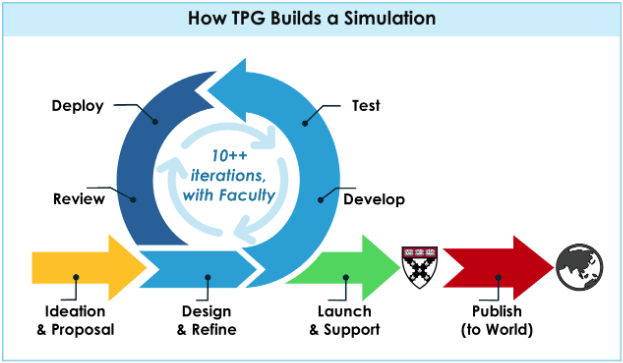
Step 2: Design, Develop, Test, Review, Refine (repeat several times!)
Every simulation is a living product. Over the course of three to six months, we cycle through design, development, testing, and refinement — often multiple times. Most simulations have both a learner-facing and an instructor-facing experience, and both need to work flawlessly.
Using an agile approach, we check in often with faculty so they can watch their ideas take shape. That constant feedback keeps us aligned with the faculty’s intent, allowing us to refine details and make improvements quickly. At the same time, we ensure our infrastructure is strong enough to support hundreds of learners at once. The result is a dynamic and reliable product that can handle the stresses of classroom use.
Step 3: Launch in HBS Classroom
The first classroom delivery is our big product launch moment. Launch is more than flipping a switch; as we approach each launch, we meet with faculty to review their teaching plan and make final adjustments to the simulation. We attend the classroom run to provide real-time support for both learners and faculty, while also collecting observations about usability and flow. Afterward, we analyze results and feedback so the simulation can be improved for its next use — even if that’s a year away.
Teaching and learning are never one-size-fits-all, and we maintain a continuing partnership with the faculty year after year as they adjust their teaching plan. Every classroom run is different, because, even if the simulation itself hasn’t changed, the teaching plan often does, and that means our team needs to adjust with it.
Step 4: Publish to the World
Once a simulation launches at HBS, the next step is to prepare it for publication. Over another three to six months, we adapt it so other schools can use it independently, without our direct support. That means making sure the simulation can “stand on its own,” and formally auditing it for Digital Accessibility compliance to ensure an inclusive experience for every learner.
Publication is more than a formality — it turns a classroom tool into a global resource. When a simulation goes into the Harvard Business Impact catalog, it becomes part of a much larger learning community. That’s why we take extra care with usability, accessibility, and security. It’s the final step in our process, and the first step in making HBS innovations available to the world.
What makes a successful simulation?
For TPG, success isn’t about how many simulations we’ve created; it’s about making learning richer, more engaging, and more effective. After we partnered with Professors Ayelet Israeli and Eva Ascarza to create the Artea simulation, the exercise went on to win the 2024–2025 MBA RC Case Award.
At the heart of Artea is an immersive exercise in data-driven marketing strategy. Students learn to analyze campaign results to design targeted outreach strategies. The award committee called the exercise “a great education not only for students, but also for the instructors who get to teach it.”
That kind of appreciation fuels our work. When faculty come back — as Professor Ascarza did to commission two more simulations — it tells us we’re not just building tools, we’re building trust. And that continued partnership is the best measure of success we could ask for.
"This would have not been possible without you. You were instrumental in being able to make this case teachable to all kinds of audiences. We are both grateful for your tremendous help!"
- Professors Israeli and Ascarza to TPG on receiving the award