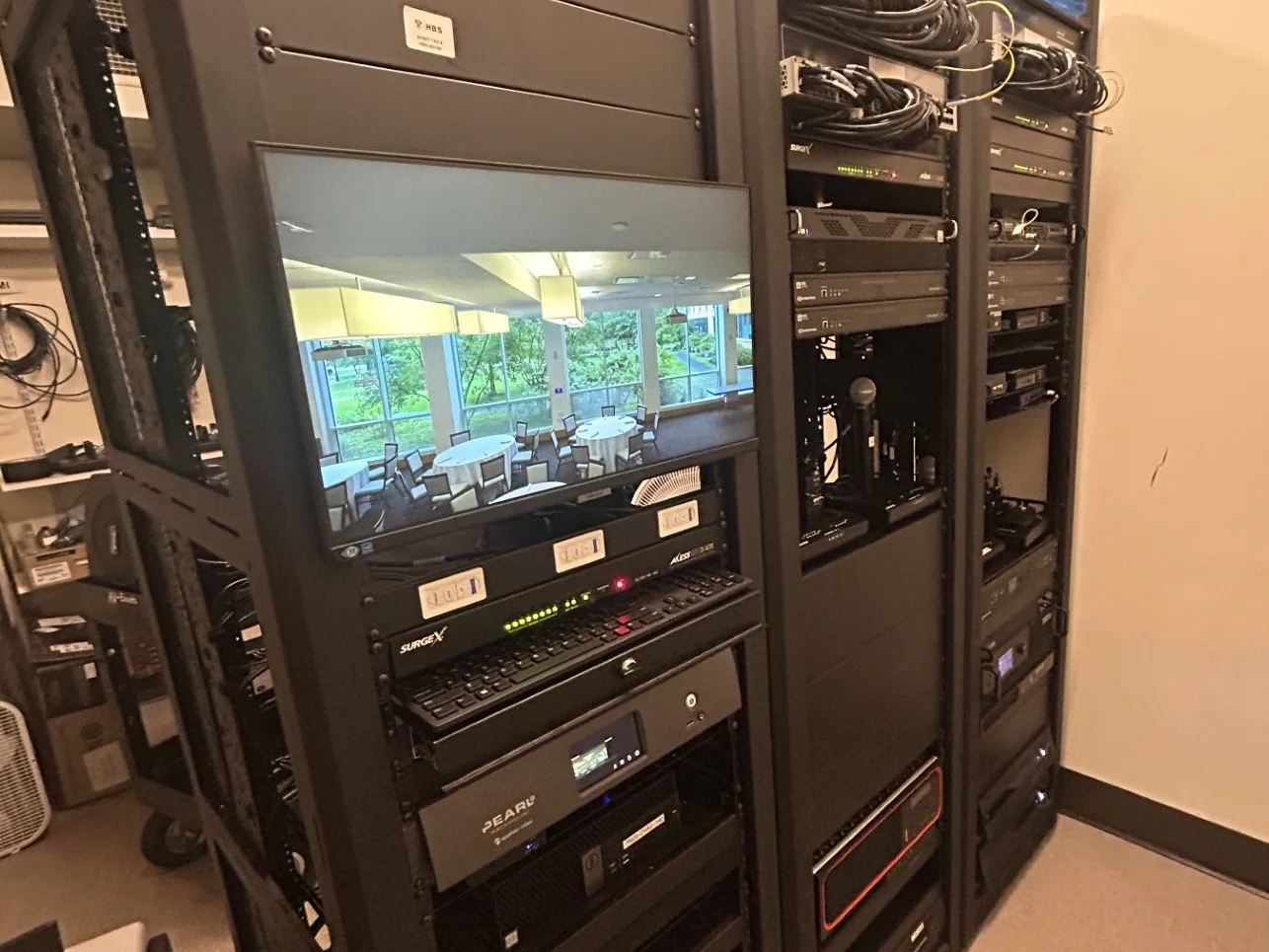
Whether you’re attending a class, conference, or event at Harvard Business School, chances are the Media Services team is behind the scenes ensuring everything sounds and looks just right. To meet the growing demands of these experiences, HBS has begun transitioning to a more modern and flexible approach to audiovisual (AV) systems: AV over IP (Audiovisual over Internet Protocol).
A recent refresh project in the Ruth Mulan Chu Chao Center, led by HBS IT's Media Services team in collaboration with key IT and HBS community partners, marked a major milestone in this technological evolution on campus.
The Evolution of AV over IP
The idea behind AV over IP is simple but powerful: instead of using specialized hardware for every AV signal path, signals are transmitted over the same network infrastructure already in place for data. This approach increases scalability, flexibility, and long-term efficiency for campus technology.
HBS IT first implemented this technology in the Chao Center nearly a decade ago in 2016. Back then, the technology was brand new and was only available from a few manufacturers, which limited the types of equipment that could be used.
When the Chao Center’s infrastructure came up for a refresh in FY24, it provided the perfect opportunity to reimagine the AV infrastructure from the ground up. HBS IT’s AV Engineering team partnered closely with the Network Engineering team to fully realize the potential of the updated AV over IP model.
A Learning Curve
The transition wasn’t just about installing new gear—it was about building knowledge, cross-team collaboration, and infrastructure alignment. Justin Fowler, lead engineer and manager, AV Engineering, explains that there was a big learning curve not only for AV engineers but also for the networking team who also had to learn about transporting AV over a network.
Davis Pasquariello, a senior audiovisual engineer, played a pivotal role throughout the effort. From learning the principles of network architecture to configuring switches and testing systems with loaner equipment, he developed the foundation for a successful rollout. He even enrolled in classes to deepen his understanding and communicate more effectively with the networking teams.
“A traditional AV team needs to be able to start thinking about and understanding networking because that’s where the industry is evolving to, and Davis really took that on and made this project successful,” Fowler says.
Limiting Disruptions
The Chao Center was an ideal space to start implementing AV over IP effort because it’s used by the entire HBS community, explains Media Services Director Ben Frey. With two classrooms, one conference room, and a series of multipurpose rooms, the building is used frequently for a variety of purposes.
“It was a good candidate for us to start with because there is a little bit of everything, and the impact is pretty widespread across the School,” he says.
However, the aspects that made the Chao Center appealing also posed logistical challenges. To avoid disruptions to the community, HBS IT worked around tight schedules—including a lot of after-hours support —to provide a seamless transfer of technology.
The team worked with Network Engineering and vendor partners to design a parallel system that allowed them to test hardware and optimize the network configuration before switching over. This strategy enabled a smooth transition when Chao Center spaces became available, reducing downtime and maintaining continuity for faculty, staff, and students.
The work in the Chao Center spanned over a year, with plans starting in 2023 and the bulk of the physical work happening in summer and winter breaks in 2024. Frey says the experience on this project will inform future implementations across campus.
“With the groundwork established and lessons learned already, we’re able to think ahead five years from now,” he says.
Expanding the Network
The Chao Center deployment serves as a model for future classroom upgrades across the campus, with additional rollouts anticipated in FY27.
While much of the impact is invisible to end users, the backend improvements are considerable. Because AV systems can now leverage the existing network structure, the technology is more stable and scalable.
This has the potential for more interconnectivity on campus, Fowler explains. For example, if classrooms share a common campus network, people will have the ability to effortlessly take video and audio from one classroom and simulcast it to another.
“That’s a big benefit that you can build this giant, traditional network, and any devices that are on that network can then be transferred to any endpoint,” he says.
Furthermore, this could reduce the amount of hardware required on campus as well as the physical footprint, enabling savings over time.
The AV over IP initiative is more than a technical upgrade—it’s a strategic step forward in the campus experience. By building modern, network-based AV systems, HBS IT is empowering the community to teach, learn, and work more effectively every day.