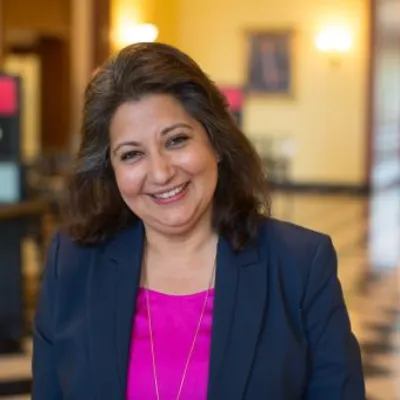
Alumni on Air: Priya Paul (OPM 28, 1999) in conversation with Vikramjit Singh (AMP 197, 2019)
June 2026 | Alumni Event
An Alumni on Air session hosted by Nupur Arya (AMP 192, 2017), in June 2026, organized by the HBS Club of India and HBS India Research Center (IRC), featured Priya Paul (OPM 28, 1999), Chairperson, Apeejay Surrendra Group and a member of the IRC’s South Asia Advisory Board (SAAB), in conversation with Vikramjit Singh (AMP 197, 2019), Founder, Chairman & Managing Director, Alivaa Hotels & Resorts. The discussion traced Ms. Paul’s journey from taking on responsibility at a young age to building The Park Hotels into one of India’s most distinctive hospitality brands. Reflecting on her experiences across business, family stewardship, brand building, and people leadership, she shared reflections on navigating uncertainty in a constantly changing world. The session also included a surprise appearance by Ajay Bijli (OPM 28, 1999), Chairman and Managing Director, PVR INOX, whose reminiscences added a personal touch to the evening. With an audience of 65 HBS alumni, Ms. Paul’s warmth, candor, and thoughtful insights made for a memorable Alumni on Air conversation.
Talk on “Love, Learn, Play: A Simple Formula for a Happier, More Meaningful Life” with Akhil Gupta
May 2026 | Event
In May 2026, Anjali Raina, Executive Director of the center, moderated two conversations with Akhil Gupta (Harvard 2015 ALI Fellow) on Love, Learn, Play: A Simple Formula for a Happier, More Meaningful Life. The conversations encouraged participants to reflect on how love, learning, and play can shape a fulfilling personal and professional life. During the discussion, Ulhas Yargop (MBA 1979), a member of the IRC's South Asia Advisory Board (SAAB), questioned Akhil about the concept of “meaning making." Attendees included alumni, business leaders, and SAAB members. The first session, hosted at the Bombay Gymkhana Club library on May 20, 2026, attracted 45 participants, while the second, hosted by the Rotary Club on May 26, 2026, drew 50 attendees.
Participant-Centered Learning Workshop for Indian Doctoral Students
May 2026 | Workshop
The Harvard Business School India Research Center, in partnership with Harvard Business Impact Education, hosted the second edition of the Doctoral Participant-Centered Learning (DPCL) Workshop in Mumbai in May 2026. During the one-and-a-half-day workshop, 72 doctoral scholars from leading business schools across India engaged with Harvard Business School's participant-centered approach to teaching and learning. Led by Professor Rohit Deshpandé and Professor Willis Emmons, participants explored how classroom design, discussion-based teaching, and active student engagement can enhance learning and enrich the educational experience. Participants described the workshop as immersive and insightful, offering a deeper understanding of how learning unfolds when students take an active role in the classroom.
May 2026 | Case
By: Sandra J. Sucher, Ruth Page and Dave Habeeb
Pre-abstract: In-class multimedia cases are designed to unfold in the classroom. The student-facing Prep for In-Class Case should be assigned to students before class. The instructor-facing In-Class Multimedia Case should be used by the instructor in class to facilitate discussion. Some in-class cases include Additional Materials, which can be used in class or shared with students after class. Some cases have instructor-facing Case Updates, which typically contain case reveals. Abstract: Layoffs are a common practice, affecting millions of employees annually and are used by managers throughout the world to adjust the size and structure of their workforces. People of all educational and economic backgrounds are laid off as managers respond to pressures for improved financial performance, changes in strategy and technology, heightened competition, and shifting global markets. This in-class multimedia case study includes several videos of individuals who have been laid off in France, India, and the U.S. to bring home the reality of layoffs, and what being laid off means to one’s self-worth, life circumstances, and family relationships. They also show the remarkable resilience of the human spirit.
2026 | Book
By: Tatiana Sandino
Structured Empowerment: How to Achieve Growth While Promoting Agility addresses one of the most critical challenges growing ventures face: how to scale effectively without stifling the innovation and entrepreneurial spirit that fuel them. Based on her research and work with retail and service organizations across multiple markets, Professor Sandino introduces the concept of "structured empowerment," a method that allows companies to grow by expertly balancing flexibility with structure. The book examines how to empower employees within a structured framework, enabling them to make choices from curated practices that propel growth while contributing ideas that enhance those practices from the bottom up. Drawing on insights from service and retail companies that have both succeeded and failed, it illustrates the principles of effective growth management—and the costly consequences of getting them wrong. The book is essential reading for business leaders, managers, and entrepreneurs navigating the tension between growth and agility.
March 2026 | Case
By: Mitchell Weiss and William Marks
As NVIDIA's CEO, Jensen Huang, prepared to take the stage their GTC 2026, the company was navigating two converging forces: the rise of AI "claws" — a new class of autonomous agents, including OpenClaw — and mounting global demands for AI sovereignty. With NVIDIA rumored to be launching NemoClaw, a new open-source agent platform, questions swirled about whether the chip giant would use GTC to signal a strategic pivot. At the same time, India's DPDP Act and similar national frameworks were pressing companies to address how agentic AI systems collect, share, and act on data — obligations few governance regimes had anticipated. How NVIDIA should balance its proprietary strengths against an open, sovereignty-conscious agentic future was the central question heading into the conference.