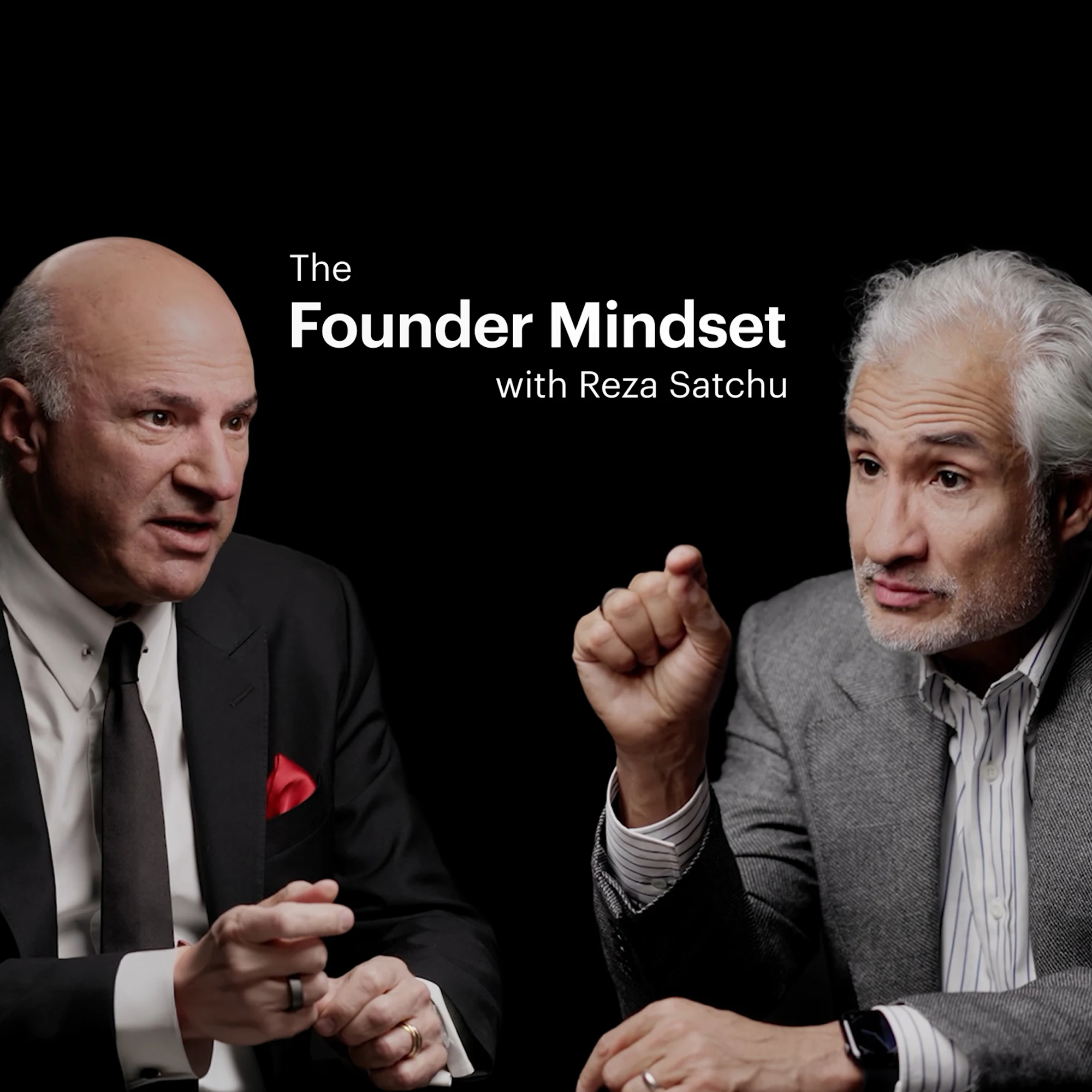
What does it take to be a founder?
From a Toronto basement startup to a multibillion-dollar exit, Kevin O’Leary built his career by betting on himself and doing the hard things most people avoid. Now, after investing in hundreds of companies on Shark Tank, he shares what founders need to know about building, surviving, and what it really takes to win.
This is The Founder Mindset, with Reza Satchu.
Resources
You can also watch the high quality video version on YouTube or Spotify.
Transcript
Intro
Kevin O'Leary: I absolutely love it when somebody says, "You can't do that." Every entrepreneur I've talked to, they don't ever tell me, oh, I did it for the money. It's never been about the money.
Reza Satchu: What's wrong with...? You go to Harvard, you get a nice job at McKinsey or BCG. What's wrong with that?
Kevin O'Leary: It leads to a life of mediocrity. There's no monopoly on genius. Who cares where they came from?
Reza Satchu: There are founders around the world that are going to watch this podcast. What's the single most important thing they need to know?
Voiceover: This is The Founder Mindset with Reza Satchu.
Reza Satchu: Every year at Harvard Business School, hundreds of students compete to gain entrance into my class, one of the most popular courses on campus, The Founder Mindset. For those who make the cut, I take them on a journey, challenging them to take risks, make commitments, and most importantly, learn judgment. One of the most popular aspects of the course are the guests we bring in, outstanding entrepreneurs who've had a truly profound impact on the world. Now I'm sharing my conversations with some of these founders on our show. I'm Reza Satchu, and this is The Founder Mindset.
Voiceover: What does it take to be a founder? From a Toronto basement startup to a multibillion dollar exit, Kevin O'Leary built his career by betting on himself and doing the hard things most people avoid. Now, after investing in hundreds of companies on Shark Tank, he shares what founders need to know about building, surviving, and what it really takes to win.
--
Reza Satchu: Kevin, thanks very much for being here.
Kevin O'Leary: Great to be here.
Reza Satchu: So I got to ask you, what's it like being at Harvard today?
Kevin O'Leary: Well, I always enjoy Harvard, particularly that it's modified its mandate a little bit away from just growing consultants like potatoes. This is way better, to get involved in entrepreneurship and see a lot of these cohorts interested in starting a company. That's very interesting.
Reza Satchu: So you and I share the same view on consultants, but let's just drill down. What's wrong with...? You go to Harvard, you get a nice job at McKinsey or BCG. What's wrong with that?
Kevin O'Leary: It leads to a life of mediocrity. It's a wasted soul. And I'm quite critical, and here's why. You think about what you actually do at a consulting firm. They rent you out, and that's fine. You do a lot of research, but never make an individual decision of consequence for yourself. And over time, you don't experience what it's like to own a decision. You never have. You never will, which is a heavy burden when you realize that not every decision you make is the right one and you're going to make mistakes.
You don't make a mistake as a consultant because you're just part of a sea of mediocrity, floating. And it's good living. You can make a few million bucks a year even better if you end up at the top after years and years. But then unfortunately, the way life is, there's the fifth level of hell where consultants die, and that's where they go. I can't stand to see a soul lost.
Reza Satchu: Yes, well, that's very generous of you. So the interesting thing about consulting or any of these advisory businesses is the question you ask yourself is, what's going to happen to these businesses in the face of AI.
Kevin O'Leary: Yeah. So I think that's a very difficult challenge for them, and I think they're going through a lot of soul searching on that, because even the companies that I invest in that used to use a lot of consultants for very specific vertical situations, like changing retail distribution, or should they keep two tiers of distribution versus three, are first going to AI, which they can do for a lot cheaper, and then looking at internal management to maybe test some of the theses that they've developed using AI. And this has only been the last 24 months. I would say the same for law firms as well.
But one of the things that you could argue is good about consulting is, if you spend less than two years there and you're going to search all 11 sectors of the economy to find out where you fit, that makes sense to me. But when I see a resume where someone wants to be a CEO of one of my companies, and has been at a consulting firm for seven years, I just tear that up.
Reza Satchu: So let's go back to this point around decision making, because I agree with you. I define learning, especially in the face of AI, is making consequential decisions that you're accountable for, because it's in those moments that you're training the one thing that human beings have that might differentiate us from AI, which is judgment. So judgment happens when you calibrate risk, when you step into the arena, and you make decisions and you suffer the consequences of it. So what that means-- and I'm curious. You've now been at Harvard over the past three years. What I'm hoping you're seeing is the tip of the spear around decision making is being a founder.
Kevin O'Leary: What I'm seeing is two things, because I'm here to measure it. Every year, 12 months later, I can see the quality of the ideas and the deals is going up geometrically year after year, when I compare what we did at the beginning versus what we're seeing today. So clearly the platform you're developing or others are doing this and focusing on it is getting good outcomes in terms of we don't know if these businesses will be successful, but certainly they're becoming more thought out in terms of how they present. And I have been drilling down for years now about customer acquisition.
Reza Satchu: Well, they're responding.
Kevin O'Leary: Because they have to, because that's the reality. But I also think there's more sectoral diversification in the ideas. We're seeing everything. I mean, I'm a multi-sectoral investor, so whether it's agtech or it's the arts, or whether it's in biotech or whatever, these students, because the cohort curation, if I can call it that, is so well thought out at Harvard, people don't understand how hard it is to curate a class like this. I mean, you have tens of thousands of applications. What's the alchemy that gets the right--
Reza Satchu: Well, you should know because your son just got it.
Kevin O'Leary: I know, and I'm very proud of him. But believe me, I had nothing to do with it.
Reza Satchu: No.
Kevin O'Leary: And nor was I allowed to have anything to do with it. But he really wanted that experience, not because-- and I told him, even from my own experience in education, it won't matter what I told you in a class you'd attend. What will matter are all the people around you you're going to spend two years with, that are going to become your base of influence around the world.
Reza Satchu: So the big risk that your son is going to have is what a place like Harvard does, is it provides you with all sorts of options. Now, we've been taught that every option has value, but the problem with having too many options-- I call it the curse of optionality-- is that you never actually learn what you're capable of.
Kevin O'Leary: You don't pull the trigger.
Reza Satchu: Because you don't commit to any one thing. And so you live a life where you're just preserving options at all times. So we'll come back to this commitment point because, before we do that, I want to talk about Harvard and one more thing, because you did something which I think many people in the Harvard community noticed and we're grateful for. You stood up for the Harvard international students. And you said that you thought their policy was misguided here.
Kevin O'Leary: As you know, and I've been very specific about this for years now, I don't shill for politicians. I shill for policy. I want the best policy outcome of every administration because I'm an advocate for small business and creation of entrepreneurship, and essentially that equates to the American dream. And so I think the number one mandate of any politician, regardless of what party they're associated with, is to preserve the American dream, which has created the most successful economy on Earth for over 200 years. It's proven. There's no question.
Reza Satchu: Right.
Kevin O'Leary: What policies made that happen, and part of the policy equation, are the institutions that founded a lot of research, a lot of initiative, a lot of work in every aspect of all 11 sectors of the economy, including the arts. And so if they've been successful for 200 years, why would you mess with something like that? Because every administration is swayed by the environment they're in, and obviously, there's a lot of reasons to look at educational institutions. But the one that's bothering me the most that I'm having a lot of trouble with is, how is it I wake up one day and the Chinese are leading in research and we're not? Why did we give them that? That's a wake-up call. I don't care what your politics are.
Reza Satchu: From your perspective, Harvard represents a place where there is world-class research, and it provides us with a competitive advantage.
Kevin O'Leary: But what I try to express in those comments is the policy works, and there's no question that it works because you have 200 years of data. And this goes for any institution, including MIT and Harvard and any institution. You go through the trouble of researching and creating a cohort of students from thousands of applications around the world, and they want to stay in America to create a job. Why are we sending them back? Why aren't we actually saying, let us vet you first. Let us give you a temporary visa to be a student. And then if you come up with an idea and you want to move your family here to create a business in America, we'll make you a citizen. Like, let's go and start competing with-- these are the best and brightest people on Earth. Who cares where they came from? There's no monopoly on genius. It comes in every form of every strata of every society. And when you find it, you want to bring it here.
Reza Satchu: What I've learned, Kevin, having taught, been a founder, trained a lot of founders over the decades, is a lot of who you are as a founder comes from your childhood, and you've had a very interesting childhood, like a very unusual childhood. And so I just want to talk about, in my mind, two very important events that happened in your life, and I'd like you to express how they influenced who you are as a person. So, number 1, your father passing away at a very young age. I think you were seven.
Kevin O'Leary: Yeah.
Reza Satchu: And number 2, your mother, who I understand was a very strong woman and played a big influence on you, marrying someone a few years later and you ending up spending every year of your teenage life in a different country, from Ethiopia to Cambodia to Cyprus.
Kevin O'Leary: Tunisia.
Reza Satchu: To Tunisia. So maybe you can just-- I mean, these are not insignificant events. These are reasonably-- losing a parent and then moving to five or six countries in five years as a teenager, tell me how these events impact you.
Kevin O'Leary: At the time, you don't think they're anything special because you think everybody's living this way, because you don't know any different. But obviously it had a profound impact on the way I looked at the world and how I realized different societies work. And I remember meeting Haile Selassie. I met Pol Pot. I met Sihanouk during all these journeys as an ex-pat in these countries. My dad worked with the ILO, so he was an expert in-- he met the founders of the UAE, and that's come back to be a very huge benefit for me.
Reza Satchu: When you say your dad, you mean your--
Kevin O'Leary: My second father.
Reza Satchu: Stepfather. When my father died--
Yeah. When your father died, how old were you?
Kevin O'Leary: I think I was seven.
Reza Satchu: So you remember that.
Kevin O'Leary: Of course. The marriage had already broken up. It was a sad place we were in, and my mother was running around Europe with us to keep us away from a court order, because in Montreal, where we were, that's Napoleonic law. And she felt that she would lose us, so we ended up going to Switzerland and the Nordic countries. We were traveling and living in hotels. It was a crazy time. And I also stayed in touch with my dad right until his death. I mean, I don't have only bad experiences.
Reza Satchu: How did he die?
Kevin O'Leary: He died from thrombosis, which is effectively a heart condition. The question was, was it really thrombosis, because back then, the coroner would come in, find a dead guy, and just say, I think he had a heart attack. That was it. But at the end of the day, my mother had met someone else, George, my stepfather, and we moved to Champaign-Urbana, Illinois, as he went through finishing his masters at the University of Illinois. He was an engineer. And then he joined the ILO, and we never looked back.
Reza Satchu: There were many things unusual about you, but this, I think, is actually the most unusual thing, is to reflect so positively on an experience where you were put in incredibly, seemingly uncomfortable positions every year.
Kevin O'Leary: But I was meeting some very interesting people. I remember in Addis Ababa, where we lived, there were no bicycles. There were only horses. And meeting Ethiopians and understanding the whole Coptic mentality, I mean, these things have made me a much better global investor today. I understand exactly the role of the French in Vietnam and what the position in Cambodia and the law they brought to those countries. Cyprus was incredible, all the Middle East.
Reza Satchu: What happened at an early age was you started getting comfortable with uncomfortable situations.
Kevin O'Leary: Yeah. I mean, to me, people, they're all different societies and they have different norms and cultures, but they've really affected me in a positive way. I'd say a lot of who I am today has a lot to do with what I learned in those countries and my appreciation for the things they bring to society globally. I mean, Cyprus was incredible. That was such an amazing place to learn about the way the Romans built mines and all that stuff. And it was really, really something and also very beautiful.
Reza Satchu: As a child, I mean, in some ways you could reframe that in a very negative way. I lost my parent. I'm moving around like crazy. I can't actually establish any friends because I'm moving every 12 months. You could easily imagine that being a very jarring, victimized type of scenario.
Kevin O'Leary: That's not how it played out, because my stepfather, he was very influential in helping me mitigate risk in my own career, because he pointed out to me, when I wanted to be a filmmaker, he said, you're not good enough. You're just not. You're not. You're going to starve to death. Why don't you take two years off and get a business degree and learn the building tools of business, and then you'll have optionality. But I was so pissed at him that I wanted to still start a television company, which I did, which ended up, because I had the tools to manage it by then, through going through business school, getting my MBA, that I actually sold that at a huge profit. It was my first deal. And that funded the next deal, which we sold for $4.2 billion.
Reza Satchu: When did you decide you wanted to become an entrepreneur?
Kevin O'Leary: Well, this story in my past is famous. It was very simple. I had my first job at Magoo's Ice Cream parlor. Yeah. And you know what's remarkable about that story is I've told it so many times, because we went back with cameras to find her.
Reza Satchu: This is in Montreal?
Kevin O'Leary: No, it was in Ottawa, Canada, and Lincoln Fields was the name. They bulldozed it, and somebody sent me one of the bricks from the bulldozing, which I have on my desk, because I made a comment once saying, by the time I'd finished my journey, I could afford to bulldoze them all, which was true. And so then it got bulldozed. But I went back to find her, to thank her, because she fired me on her first day. And I realized, if you're an employee, you have no control over your destiny.
Reza Satchu: I would say that the reason I wanted to be a founder early on, similar age to you, in my 20s, was because what I thought I wanted was control, power, money, these sorts of things. Ultimately, what I realized, what I actually wanted was freedom to have an impact on the people I cared about.
Kevin O'Leary: Well, for me, it was the horror of having somebody tell me what to do and then be able to change my life by firing me just because I didn't agree. She gave me a great, great lesson, and that's why I owe her a lifetime of gratitude. But every entrepreneur I've talked to that have had great exits and great success, they don't ever tell me, oh, I did it for the money. I was so passionate about the business that I wanted to wake up in the morning and solve for my business, because I loved doing it. And then one day I woke up, like many others, and I said, well, I'm filthy rich. How'd that happen? But that made me work harder.
It's never been about the money. It's always been, you only have so many years on Earth. Why wouldn't you want to do what you enjoy and buy freedom for yourself and your family? I'm a great provider. I wouldn't say I'm the best father, because I was never around. And even today, I work five days a week and figure out how to get my family with me on weekends, no matter what the cost is.
Reza Satchu: So I obviously know your family very well, and it feels to me like you're harder on yourself than you perhaps need to be. But where do you think you fell short on being a father?
Kevin O'Leary: I think, in the years raising the kids, I simply wasn't there because we were growing in 25 countries. We started-- classic-- in the basement, and we ended up being the largest educational software company on Earth. And so it was a remarkable experience. But you don't have a lot of time for soccer games and picnics.
Reza Satchu: Do you regret it?
Kevin O'Leary: No, I don't. I just realized that was one of the costs. But I also let celebrity go to my head for a while, and I'm very open and transparent about it. I didn't see that coming.
Reza Satchu: We'll chat about that. It's interesting because I think, as a founder, the trade you make-- people say, oh, it must be terrible to balance family. So what I would say is, as a founder, I could make almost everything that I could commit to, meaning I could go to my kid's soccer game because I was ultimately in control of my time, but I was always distracted.
Kevin O'Leary: I mean, that is not quality time with the family. And I would go further than what you're saying. I think this concept in the founder years, which I call the first 36 months, the idea of balance is complete bullshit. There is no balance. You have to work 25 hours a day, eight days a week, because some guy in Mumbai or Shanghai is going to kick your ass. It's a global competition. Whatever your idea is, there's somebody else with the same idea. And the founders that understand that sacrifice at the beginning is part of the price you pay, there is no balance. And so the ones that are successful in my book, the ones I've invested in, are ferocious, and they have a real challenge with their significant others.
Reza Satchu: What is absolutely true is you can't build the things you want to build it without having-- I mean, in my mind need a stable family unit.
Kevin O'Leary: You do. You may not think that at the beginning, but you do.
Reza Satchu: No, but you do.
Kevin O'Leary: And you really only appreciate them later. That's the whole point.
Reza Satchu: You went through a period of time where your family felt fragile, and you fought very hard to put it back together.
Kevin O'Leary: Yeah, I did. I mean, look, I'm very open about it and transparent. We separated for two years. I'm not the only marriage that that's happened to.
Reza Satchu: Well, I will tell you, I have a lot of friends who have separated and divorced. I only have one friend who fought to put it back together again.
Kevin O'Leary: I think that's important, and it's a journey you have to go through. And you start to realize, I can't build this again easily, and I don't want to.
Reza Satchu: Kevin, I remember-- this is so funny-- when I had my twins 22 years ago, and this is when I knew you were destined for TV. I had them in New York, although we'd started our storage business, which we'll talk about in a minute. And of course, the pregnancy was very complicated for Marion, and she was on bed rest for several months. So I was back and forth from New York and Toronto, and we weren't sure if the twins were going to be healthy or not. And the babies are finally born, and I get a hundred calls, everyone saying, congratulations, congratulations.
This joker calls me up, and he says, Reza, what's happening with the storage deal? I'm like, Kevin, I don't care about the storage deal. Marion's had the babies, and they're fine. What's happening with the Aldon deal? Kevin, I'm going to hang up, OK. I don't care about the Aldon deal. The babies-- and then you say to me, what's that other daughter's name of yours, who you've met hundreds times. I say, Talia. And you say, this is the worst day of her life. And I say, why? And you say she didn't just lose half of her inheritance. She lost 2/3 of her inheritance.
Kevin O'Leary: That's true. It's also factual. It's also factual. I'm sure it doesn't matter today. Hopefully you've multiplied 3x since then.
Reza Satchu: Exactly. OK, let's talk about us getting into business together, which-- so we were put together by a mutual friend, a classmate of ours, I think a mutual investor that we both sold our businesses, and we were thinking about what to do next. And you and I came up with this storage business.
Kevin O'Leary: Well, I recall exactly how that happened. Your brother was also influential with his spreadsheet showing how under stored climate-controlled storage was in the Canadian market at the time versus vis a vis Boston market, where we were very familiar with. It was basically only 1/3 built out, so that was a huge opportunity.
Reza Satchu: So from your perspective, just in terms of a deal that we did together, where we had to put our own-- and if you recall, we had to also personally finance the deal.
Kevin O'Leary: HSBC was our bank, 60% to 65% loan to value I remember, which was a phenomenal. But we had personal guarantees. But I think the de-risking there also was your dad, who was-- I'd just met him, but boy, that guy is a master negotiator. I mean, he really, really understood the game of getting permitting.
You think about the dream team, and that's actually a good way to look at any business. What elements of success do you have at the table when you start? Asif had all of the data nailed. I mean, the guy was a spreadsheet monster, and you tried to shoot holes in his numbers and you couldn't. So that's 1. 2, your dad completely understood--
Reza Satchu: The market.
Kevin O'Leary: --the market, because we were going to do-- we were really aggressive on our plans.
Reza Satchu: What value did the two of us bring?
Kevin O'Leary: Well, I thought we did a great job in raising capital, in terms of getting people confident that we could pull this off. And we also recognized weakness in management. We made many changes, if you recall.
Reza Satchu: Well, in fact, the guy that we hired is still my partner 22 years later.
Kevin O'Leary: That was a deal destined to succeed because it had all the elements to it, and I try and use it as an example. I tell people, look, I didn't know anything about the real estate sector at that time. Now I'm developing data centers, all the things I learned from your dad.
Well, if you think about that deal, I mean, we made five times our money in 4 and 1/2 years, but what makes that even more special is it wasn't a particularly risky investment.
It was well thought out, and I would say the building blocks-- 5x is fantastic in 36 months, because it was really within 36 months we were talking about exit.
Reza Satchu: And if you recall, we sold to the largest provider, and you and I negotiated that deal. And of course, what I learned there was all it takes is one. And the value of the business is not at what it's worth to you. It's what it's worth to the buyer. And I remember you and I sat in front of that buyer and said, look, we're going to bid on every single new asset and compete with you. So you can take us out, and now you'll be paying for the next asset less than you would otherwise, but you got to pay us for all that.
Kevin O'Leary: Also, because the threat to them was our of cost of capital was lower. But anyways, that was a great outcome. But I certainly use it now in everything I'm doing in real estate, and I'm doing a lot in real estate.
Reza Satchu: At scale.
Kevin O'Leary: And what I've learned about that experience is that bigger is better in real estate.
Reza Satchu: OK, we got to go, because I think I'm one of the few people that knew you at the time that you decided you were going to go down this journey of entering into media. It's rare for me to admit I'm wrong, but I will never forget when you said to me, I want to go down this media path. And I think I probably jokingly said to you, look, Kevin, I don't know if you know this or not, or if you've looked in the mirror or not, but I don't know too many people who at the age of 50 with no hair--
Kevin O'Leary: I call it the dome of desire.
Reza Satchu: I might call it something else, but the point is, it did not strike me as you having a winning hand. I would imagine most people at that time would have said that it didn't make sense, that your opportunity cost was too high to, at the beginning, to be in the basement of a small studio with a small group of people. Telling your story. I'll never forget when Evan Solomon from CBC called me and said, Reza, you'd be great. We've seen what you're doing at University of Toronto. We want you as a dragon on Dragon's Den, which is the show that ultimately you and Robert Herjavec went on, and then it became Shark Tank. And I said, I'm not going to do it, primarily, frankly, Kevin, because I was worried about the personal ramifications. Like, I was worried that it might blow up my family. That's why I chose not to do it.
But I said to him, I've got the perfect guy. OK I said to Evan, I've got the perfect guy. This guy, he makes me laugh all the time. He's incredibly witty. And Evan said, who's that? And I've said this to your birthday, so you know what I'm about to say. I said, well, it's Kevin O'Leary. And the response was, who's that? Back in the early 2000s, what tailwind's did you see that made you think it was possible that you could break into some--
Kevin O'Leary: You've got to remember the context of that time. In every country, they were starting to sell off digital licenses because they were going to start broadcasting television on the internet. It was the emerging licenses. And Tom Lee said to me, you're a Canadian. Why don't you fly up there and buy everything? Buy the dog food channel, the Movie Channel, the gay channel. Just buy it all, and we'll fund you. I said, you sure, Tom? He said, I am sure. Get on the plane and get up there. You're the 51% owner on every license you can get.
And so by the second day of bidding, Janis Mackey Frayer, who was working up there, who, by the way, is a very famous reporter today--
Reza Satchu: And she was at ROBTV?
Kevin O'Leary: She was right beside me on the left, and she said, what is this? You're bidding on everything. Like, why can't anybody else have a chance? I said, well, actually, I'm going to buy them all, Janis. She said, that's outrageous. You're coming up here with the big money. You think you can buy everything? I said, yeah, I think I can. And we got into an argument that was very transparent, very honest, and she got really upset. And the phones lit up, and [INAUDIBLE] picking one side or the other. And Jack Fleishman, the producer at the time, afterwards said, what are you doing tomorrow? I said, why? He said, come back. Let's do it again with somebody else. And that night was the beginning of my television career, because I forgot the cameras were there. I was just having a great time with Janis Mackey Frayer. It's the same thing I do on CNN today.
Reza Satchu: So I used to joke with you, back in the early days when you were in the basement studio, and we'd run into someone and he'd say, oh, I watch you on TV. And I would joke to you and say, hey, Kevin, you just doubled your viewership. So today you've got 10-plus million followers.
Kevin O'Leary: 11.3.
Reza Satchu: 11.3. If you're going to enter into the arena as you did and you can see something that others can't-- you had a call to adventure. Many said you can't do it, but you saw something. It's much easier to do that when you have tailwinds behind you. So you had three tailwinds that you saw more clearly than others. One is the rise of social media. You were on that early, and I want to talk about that. The second thing you saw was the rise of reality TV. So suddenly, you didn't need to be a trained actor, and the barriers to entry were much lower than they were before.
Kevin O'Leary: There weren't any.
Reza Satchu: Correct. And the third thing was the rise in the accessibility of entrepreneurship. Suddenly entrepreneurship wasn't this quirky thing that a few people would do. It was becoming mainstream.
Kevin O'Leary: I think the tail stream that we should really discuss is 2008. You got to remember, this show was already successful, Dragon's Den in London and then in Canada. Then Mark Burnett said--
Reza Satchu: And he said, I want you because you are a--?
Kevin O'Leary: No. He said, look, I'm looking for a real asshole, and you're it. And I said, I don't know if that's a compliment. He said, it doesn't matter.
Reza Satchu: You said, that's Mr. Asshole.
Kevin O'Leary: Yeah, exactly. But we never look back. I mean, that thing just grew geometrically.
Reza Satchu: If you believe entrepreneurship is a force for good--
Kevin O'Leary: Well, I do, and I think I've become an ambassador to the American dream, which is why I said earlier, the number one aspect of any administration is to maintain the American dream, period.
Reza Satchu: And you represent it.
Kevin O'Leary: And I do. And I go all around the world saying, entrepreneurship is the way out of every problem, because it creates jobs in every country. If you remember America in 2008, coming out of such a vicious recession, many people said, why should I work for a corporation when it's just as much risk as starting my own business? Because nobody thought a show about entrepreneurship would work. But all of a sudden, America was energized to start something new, as opposed to getting fired again.
Reza Satchu: Or a corporation going away.
Kevin O'Leary: Yes, of course, and leaving. But so at the end of the day, that is the spark that took the show into a new level, as people tested their own ideas in front of investors. And it took on a life of its own.
Reza Satchu: So if I said to you, define your brand, what are you most protective around your brand?
Kevin O'Leary: Well, I think the heat I take for telling the truth is very measurable, and people don't like it. And maybe they think I'm bombastic. And what I have learned from the experience, your job is not to get everybody to you. That is not what you're trying to do. What you're trying to do is get them to respect you so that they will follow you into war, because entrepreneurship is a battle against another competitor. And so if they respect your opinion, even though they don't like you, that's far more valuable than trying to make everybody like you, and you'll fail.
I think at the end of the day, the only thing that matters in your life is your family and maybe 25 people in your immediate circle that you want them to like you. The millions of followers I have, 50% of them hate me. But why do they follow me, I ask myself. Why do they keep writing essays about how much I hate you? And I respect them more than anything because they're burning their time saying, I don't agree with that decision, and we get into a narrative about it. It's a very dynamic, fluid situation. But 50% of my comments are, boy, do I hate you, and I love it.
Reza Satchu: So at the core, if I had to define your brand, it's some combination of direct feedback, honesty.
Kevin O'Leary: It's pure honesty. I mean, it has to be.
Reza Satchu: Well, the nice thing about being honest is you don't have to remember what you said.
Kevin O'Leary: And that my mother taught me when I was 16, and she's been right about it. Even my kids say, Dad, why did he have to say something like that? Look at all the hate mail you're getting.
Reza Satchu: Yeah, I've been part of those conversations.
Kevin O'Leary: Yeah, I know, and I say, what does that have to do with dinner tonight? What does it matter? Because those same people are now in a narrative on a topic that's meaningful and should be discussed, and both sides should be heard, which is what's so great about being in the narrative. And so people say to me, well, why did you want to do TV in the first place? Because I want to be part of the narrative. I want to be able to say, here's what I think. And that's very important to me, because maybe you like it, maybe you don't. But it doesn't matter.
Reza Satchu: For me, the reason I teach is because I can have positive impact on people who are going to build things and hopefully create jobs there. And I think that I can play a transformative effect on many of my students and have done so in the past. So tell me what is driving you from an impact perspective.
Kevin O'Leary: What keeps me going and what keeps me interested in getting up in the morning very early, as I do, is I absolutely love it when somebody says, you can't do that. I love it. Most recently for me, and I've used it as an example because I know I have a success with it, is I wanted to enter the insurance market, which is impossible. Everybody said, you can't do it. It's highly regulated in every state. And I said, I'm going to do it. Watch this.
Reza Satchu: I got to be honest, Kevin, that's remarkable. The one that I'm most amazed at. You've got a new movie, or your first movie out, with Gwyneth Paltrow and Timothée Chalamet, called Marty Supreme. So my question is, that to me feels like a big leap.
Kevin O'Leary: What I've learned-- you think about exercising every day, eating well and all those things, don't take drugs, don't smoke, all that stuff. But the one thing that I think is imperative for cognitive health as you age is to challenge yourself every day. And I remember when I was offered the part, I thought, I don't know how to act, and I certainly can't memorize 70 pages.
Reza Satchu: But you're dyslexic.
Kevin O'Leary: It's sort of like, I should take this precisely because I don't know how to do it right now, but I'll figure it out. And I just said, OK, I'll do it. And then I started using every trick in the book to try and train myself how to-- it was amazing to go into something you don't know anything about and learn on the fly because it exercises the brain.
Reza Satchu: So it turns out, going back to the point around the curse of optionality, it turns out that today's generation, whether it's around optionality around jobs, optionality around dating, they swipe left/right, the decline in home ownership, the decline in church, whatever it is, there's a decline in commitment, and people view commitment as a sacrifice and not as a superpower. And the place where I see it most is your ability to trust your judgment to commit to something uncertain. Now, we've seen that with you. You committed to build a business. You committed to try and be a media star. You committed to being a Hollywood star now, and these all are fraught with risk. And there's no way you could have done any of those things while being half in, half out.
Kevin O'Leary: What you'll find out in life when you commit to these uncomfortable comfortable moments is at least 50% of the time, you succeed.
Reza Satchu: Yes.
Kevin O'Leary: You have to do it if you have a 50/50 chance.
Reza Satchu: Yes.
Your net present value is pretty good.
Right, because if you take it-- all you have is losing one time, you can make 100 times.
Kevin O'Leary: Exactly, and so I think that's what everybody should think through. And I certainly when I go on the road and I speak to audiences about this, you must, in your 40s, start finding things that take you out of your comfort zone, whether that's playing the violin or becoming a photographer.
Reza Satchu: It's good cognitively, too.
Kevin O'Leary: You want longevity. You want mental ability to stay with as you age.
Reza Satchu: So let me ask you this question. You've shown an ability to commit to things that are uncertain. If you think about the next five years, what is going to be a place of discomfort and learning that you can commit to today?
Kevin O'Leary: Well, I'm never going to retire. So many people have said to me, why are you on the road five days a week? Well, because I really enjoy what I do, so that's never going to change. And it's become international now. Life is getting more interesting every decade for me.
Reza Satchu: You're committing to doing more, not less.
Kevin O'Leary: I'm going to do more.
Reza Satchu: And on what dimension are you most excited to do more?
Kevin O'Leary: This AI thing is really interesting, and what I'm doing in that space now is so fascinating because I'm looking at it from two perspectives. The CapEx committed to this space, even if it gets cut back by 50%, is still the largest CapEx experiment in human history. That's data centers. They're very complex projects, and I've got two monsters, and I'm doing that. But I'm also investing in teams that are working on AI modeling on verticals because, as it turns out, nobody's going to reinvent the learning model. It's going to be five companies that spend the billions to do it, and then you're going to build on their stats. There's a lot of business to be done there, solving for verticals like the insurance market or-- I just saw another deal. It's so insanely perfect. Imagine you--
Reza Satchu: Just pause. I just love the fact that we've seen hundreds of deals, and you're still incredibly excited about it.
Kevin O'Leary: Yeah, because think about this. You have 2,000 Walmart stores. Every year, you have to send guys on the roof to look at the tar on it and the AC conditioning, the chillers on the roof, and all that. They're risking their lives walking up umbrellas. In the South, the summer is melting it, and the North, they're getting killed by the winter. There's guys with drones, with 6K drones now, that go over and do a grid over the roof, comparing that photograph to last 12 months. They immediately issue a purchase order through AI right up to a satellite. There's a guy fixing the roof by 6:00 that evening.
Reza Satchu: Yeah. I mean, think of the opportunities.
Kevin O'Leary: I mean, it's huge. And this is just one little vertical. And so never have we had such opportunity. The only risk we have is the Chinese are kicking our ass on data centers because they're using coal-fired electrical generators.
Reza Satchu: So last question for you is there are founders around the world that are going to watch this podcast, and there are people who are on the precipice of deciding whether to found or not. What's the single most important thing they need to know?
Kevin O'Leary: They will fail. Most do, and I have plenty of times. But you only need one success to set yourself free. But also you have to have this concept of time. I have an idea. How long should I run with it before I realize it didn't work? Because people get emotionally attached to their idea. They're thinking that if it failed, it's on them. It failed because the market changed, or you didn't have the execution skills for that sector, or whatever it was. But you have to be able to take it behind the barn and shoot it.
I have a formula for this, because I've done it so many times. You fund a founder at whatever their first round is, a $3 million, $5 million valuation. You fund the second round on a prorated basis, because they're still trying to figure out customer acquisition.
Reza Satchu: The third round only if they have positive unit economics.
Kevin O'Leary: Exactly. That is success, because the dogs fall to the wayside, and it's not their fault. They're just-- they never found their--
Reza Satchu: There's tremendous learning in the process.
Kevin O'Leary: They're more valuable because they failed. I mean, my mean, my attitude is I'd rather invest in an opportunity that's failed a few times, because they felt the sting of failure. It's very motivational. Failure is not a curse in any way, and somehow-- it's probably your responsibility to tell these students, go out there and fail.
Reza Satchu: Yeah. Well, listen, Kevin, I got to tell you, I'm very glad that you trusted your judgment 20 years ago, despite the full head of hair.
Kevin O'Leary: Listen, I had hair when we started Shark Tank. That's how long ago it was. It's been a wild ride, and it's still going. I'll leave with some words from Robert Kraft, who I've got to know a little bit. He told me something that I think is very motivating for anybody going through the entrepreneurial journey. Every decade has been better for him.
Reza Satchu: He's in his 80s.
Kevin O'Leary: And he keeps saying, it just keeps getting better. He's a fantastic entrepreneur. He gives back and he's very, very motivated to supporting the American dream.
Reza Satchu: Yeah, terrific. Thank you.
Voiceover: You've been listening to The Founder Mindset with Reza Satchu.