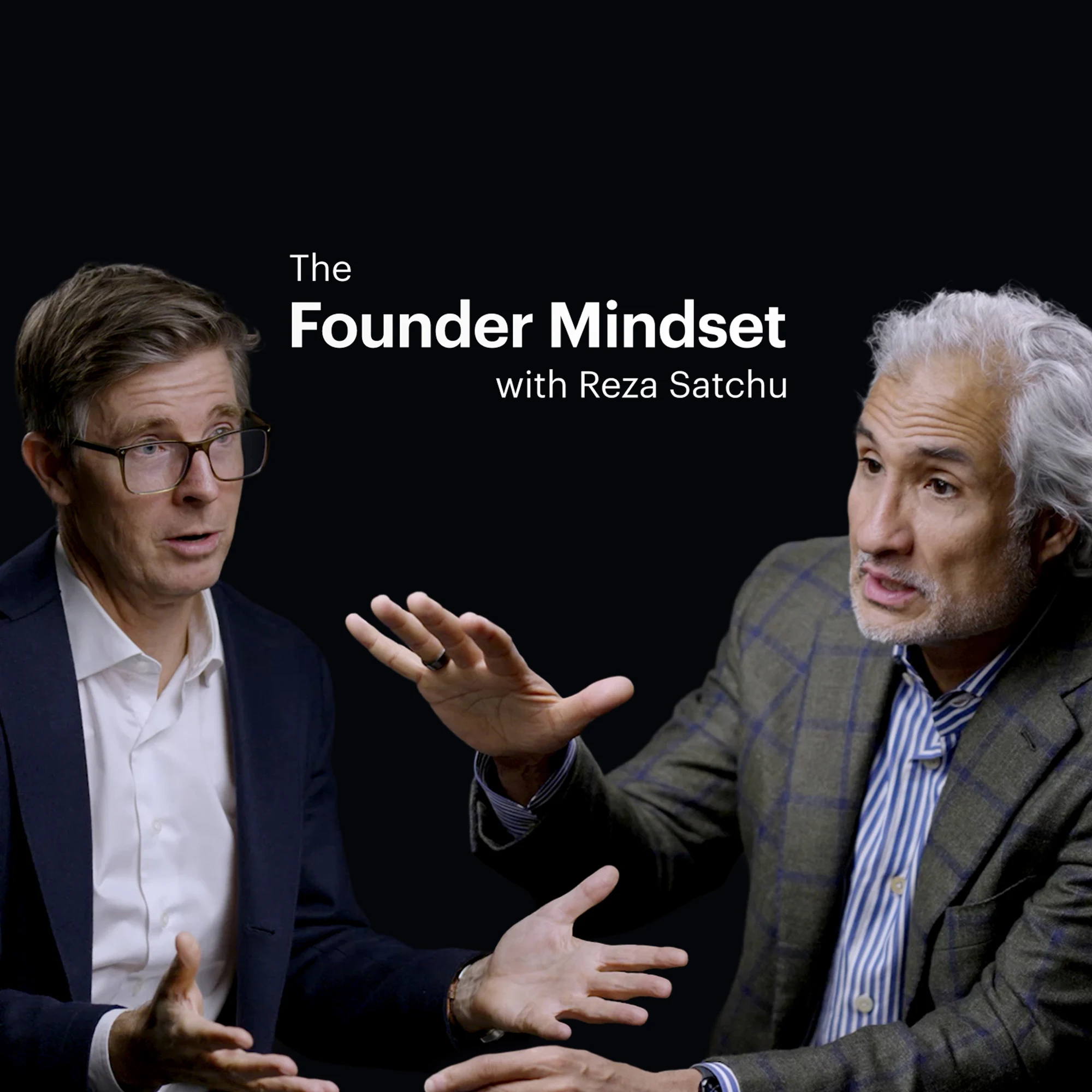
What does it take to be a founder?
Galen Weston didn’t build from zero — he rebuilt at scale. As leader of Loblaw and George Weston Limited, he transformed a legacy retail empire into a modern national powerhouse, proving that reinventing a giant can demand the same bold decisions as starting from scratch.
Transcript
Intro
Galen Weston: Every business goes through a series of ups and downs. When you're the family leader of that business, you have everything at stake.
Reza Satchu: Every founder ultimately has to enter into the arena. And then of course, you find out it's full of dragons.
Galen Weston: You choose to walk away the moment something gets tough, then you don't get to see what's on the other side.
Voice over: This is The Founder Mindset with Reza Satchu.
Reza Satchu: The Founder Mindset is not just about starting a business. It's a way of living. At its core, what it enables a person to do is to do the thing that every human being wants, to have a positive impact on the people that they care about. In this podcast, what we are gonna do is meet with some of the greatest founders, some of the people that have had the most improbable journeys, who have lived with the founder mindset.
And through this process, what I hope to do, in partnership with the Foundry, is to share this mindset with as many people as possible so that they, too, can benefit from achieving the impact that they most wanna achieve. This is The Founder Mindset, and I'm Reza Satchu.
Voice over: What does it take to be a founder?
Galen Weston didn't build from zero. He rebuilt at scale. As leader of Loblaw and George Weston Ltd., he transformed a legacy retail empire into a modern national powerhouse, proving that reinventing a giant can demand the same bold decisions as starting from scratch.
--
Reza Satchu: Galen Weston, welcome to the podcast. Thank you for being here.
Galen Weston: Thank you.
Reza Satchu: You know, Galen, one of the very unusual things about this podcast, having you here, is for the most part, what we have are f- traditionally defined founders, people who are sort of imagining a new world, a new product, a new service, and they're sort of trying to convince people that there's something there, and then they go on and try to make something happen.
This is unusual in that you oversee a very large fourth-generation family business. So does this concept of the founder mindset resonate with you in your position?
Galen Weston: Very much so. I think it's, um- I, I, I'd like to imagine that a, an owner, a multi-generation, uh, family-owned business, um, is the ultimate founder.
Um, in a way, you know, uh, I represent my father, my father represented his, and, and so on and so forth. Um, but the other thing about being an owner, um, is that every business goes through a series of ups and downs. Uh, in some cases you face existential challenges, and when you're the family leader of that business, you have everything at stake-
Reza Satchu: Right
Galen Weston: working your way through those challenges, and I think that's very, very similar, uh, you know, to a founder who's starting a business for the first time.
Reza Satchu: Yeah. It's very remarkable. I hadn't thought of this concept of an owner, um, as distinct from a CEO, right? Mm-hmm. Meaning you can imagine a CEO of a large public company is different from a mind- potentially from a mindset perspective than an owner CEO of a public company.Would you agree with that?
Galen Weston: Fundamentally different. Fundamentally different because your time horizon is different. Mm-hmm. Um, you're thinking in terms of generations, you're not thinking in terms of quarters. Um, and, uh, and that impacts the way that you make decisions. And, and, you know, the biggest difference, you know, that, that I see, um, you know, is if you have a five-year tenure, um, you know, as the CEO of, of a company, you make a set of decisions that are primarily driven by what the current third-party shareholder is looking for at that time.
Reza Satchu: Right, right.
Galen Weston: If you are an owner, um, and you're in an executive position, the decisions that you're making, um, have to take that into account if you're a public company- Mm-hmm ... like we are, but they also balance the long-term value creation, uh, and the long-term impact.
Reza Satchu: So in some ways, as a founder, of course, you cannot be thinking in days or weeks or quarters because you're imagining a world that doesn't exist today at its core, right?
Galen Weston: Right. Of course. Absolutely. Meaning you have to be thinking about something. You're creating something. You're creating something that doesn't exist today, so the parallels are quite sharp, as you said, with a, with a, with an owner who, who's thinking about things in, in terms of tenure.
Reza Satchu: When you think about the odds of a fourth-generation family business growing, if you just said s- being around would be... But, but, but I think we, we learn in class that 1% make it as far as you have. Yeah. Okay? So if you think about your family as distinct perhaps from others in that you've made it this far and have built such a robust business, my sense is it has as much to do with mindset and principles as it does with any particular business decision, and I'm curious whether that is true, and if so, what would those Weston principles look and feel like?
Galen Weston: Yeah. Uh, uh, look, I, I think, I think that is true. Um, there are a set of principles that guide, uh, you know- Certainly the way that I operate. Some of them I think I could articulate, you know- Mm ... in words, and others are more, are deeper. Uh, you know, they're sort of internal drivers. Um, I can tell you first and foremost, um, you know, it's not about money. You know, money is part of how you score, you know, your progress- especially something like shareholder value.
Reza Satchu: It's sort of an output money.
Galen Weston: Yeah. It's an output. Okay. Um, it's not a, a drive from my perspective, uh, you know, to get richer.
Reza Satchu: What is, what is the inner drive? What is the-
Galen Weston: Well, part, part of, part of it is, you know, I believe I come from, uh, you know, a, a po- position of privilege.
And being, uh, and being in a position of privilege, you have a responsibility to give back. And I don't mean give back, um, you know, specifically in terms of charity or philanthropy. I mean give back, uh, you know, to build something, uh, you know, that fundamentally improves the world or improves a community or improves, uh, you know, business.
Well, through creating jobs, lowering prices, availability, those sorts of things…it's access to food. it's access to health and wellness- Right ... you know, in the businesses that we're in. It's access to places to live. You know- we're also in the real estate business.
And it's also about thinking, you know, what, what can make, um, you know, what can make a community better beyond that? If you can more effectively manage chronic care or, you know, support people who are suffering from diabetes. These are all positive community impacts that matter as well.
Reza Satchu: Right. And I have the great privilege of having known your parents. Mm-hmm. Um, and I'd just say it's such a loss, uh, to not have them around. They played an, a remarkably important role in Marion and my life. Um, just incredibly generous people. What I'd like to understand is your childhood, okay? A little bit about perhaps some obstacles that wouldn't be obvious to others that you had to overcome.
The learnings, and where, and perhaps where this ambition to have impact came from. What did it look like having lunch with your dad or dinner with your mom? I mean, tell, tell us- Yeah ... what it looked like on a day-to-day basis.
Galen Weston: Well, look, uh- Yeah ... we had, um- We had a wonderful life. Uh, you know, I, I, uh, I started out my life, I was born in Ireland, and we grew up on a farm, a sheep farm. And spent a lot of time outdoors. We moved to Canada. My mother, as an Irish woman, when she moved to Canada, she had two requirements of her husband. She said, "Look, I'll move to Canada, um, on the basis that my children grow up bilingual, French and English of course, um, and that they become really great skiers."
My mom didn't know how to ski but she thought Canada, snow- Yes ... that's something. Right. Okay. Uh, and, and-
Reza Satchu: Well, you fulfilled those things.
Galen Weston: Well, I don't know that I'm bilingual. Okay. I don't know that I'm bilingual.
Reza Satchu: But you are a good skier.
Galen Weston: I'm a decent skier, you know, so half and half. But my parents were serious people. Yeah. Um, you know, and they, uh, they enjoyed, um, serious conversations with each other, uh, you know, with their children, and so that was part of life growing up, uh, you know, around the dinner table. Um, they were also, uh, you know, very welcoming of, uh, of people into their home. They liked to entertain, uh, but they also liked to, to bring people so that they could meet them and learn- Yes ... from them and, and- Well, they were people of ideas and debate.
Reza Satchu: Yes. Um, I, I can't tell you the number of times that I was lucky enough to be in, in those rooms with your parents, and it was always fascinating.
Galen Weston: Yeah. Right? Really fascinating. And the other thing that was very, uh, core to the way my parents brought us up was there were really, there was never a kids' table. And so we were always welcomed, you know, at the adults' table- as equal participants. And I think that gave us exposure to other thoughts and other ideas. It also imbued a sense of responsibility. Oh. If we were at the kids', at the, at the grown-ups table, we were expected to behave- like grown-ups. And that doesn't mean that, you know, we didn't have fun, and that doesn't mean but, but I think that was a really important part of how we, uh, you know, sort of, sort of how we embraced, uh, you know, more serious subjects.
Reza Satchu: I mean, it's interesting because in some ways- Other folks would have more traditional forms of discomfort, right? Meaning obstacles not of their own choosing. It's interesting. What it strikes me, what your parents were doing here was almost manufacturing some discomfort. Meaning, meaning in some ways putting you at that table, knowing that it was slightly uncomfortable, and where you had to sort of elevate to that table.
Galen Weston: Yeah, it may have been. And they certainly had a lot of belief- Mm ... uh, in, in me. They had a lot of belief in, in my sister. Um, and s- and, and I think they, they wanted to expose us. Uh, I'm not sure they went so far as to think, "Let's create discomfort for them because that will help, uh, you know, them "sort of develop their character." And then they gave us independence. Uh, they gave us the opportunity to, um, you know, to fall on our faces. Um, and, uh, and they were, they were, they were stern, but they weren't judgmental.
Reza Satchu: Right. Talk to me about the im- the, your relationship with the business, the family business growing up.
Was it preordained that you were gonna join the business? Was it ... I mean, h- t- talk to me how that ... Was it an albatross around you? Was it an opportunity? How did you- how did, how did the young Galen think about the business?
Galen Weston: Yeah. Uh, you know, to this day, uh, I don't know the extent to which, uh, my father was a generational, um, legacy builder.
He never put, um, generational pressure on me or on my sister, uh, you know, to be part of the business. He created opportunities for us. He welcomed us. But he never said, "This is part of your responsibility." You know, we were allowed and encouraged, you know, to find our own way.
And I found my way back, uh, you know, to the business partly because I had a lot of exposure to it. Um, you know, I had summer jobs, uh, you know, in retail. Uh, gate- Working, working in the business. Working in the supermarkets.
Reza Satchu: Yeah. Give me an example of a job that you had early on.
Galen Weston: Oh, I tell this story a lot. Back in, I guess it was the 1980s, um, you, we would fry our own donuts, um, you know, in store. Oh, right. And, uh, there were different roles, and there was a big boiling oil fryer that would sit in the back store of the, the, the bakery. And there was a, and there was a dough dispenser, and you'd put the dough in the dough dispenser.
You'd mix it with water. You'd put it. And then there was this arm, and you'd pull the arm, and it would plop a donut with a perfect hole into the boiling oil. And then you would do the next one, and you'd do the next one. And then you had a set of chopsticks. Right. Slightly drumsticks. Okay? And you'd have to tap them 'Cause they float. Donuts float. They, in oil, and then you would tap them to flip them, and then you would perfectly cook the donuts.
Reza Satchu: So were you the tapper?
Galen Weston: I was the tapper and I was w- whipping the oil for a minute.
Reza Satchu: Oh, that's serious responsibility.
Galen Weston: It turns out when ... Y- y- yeah. Yeah. And it turns out that when a donut drops into the fryer, it makes a little splash.
A little splash of boiling oil. So, yeah, barely noticed it. But then I have these little red marks- ... you know, all over my hands. I'm like, "What did that come from?" That's And then I realized it was- This is what it is ... the donut fryer.
Reza Satchu: That's interesting. All right. So you, you had your scars from your- Yeah, yeah work experience. Right?
Galen Weston: Yeah ... literal, literal scars. Although I think they're mostly gone now. You know, I have a phrase, um, that says every founder ultimately has to enter into the arena, okay? They have to enter into the arena with all the dragons and all the fire, and we're gonna ... To, in my mind, your entrance into the arena was when your father asked you to take over the business when you were 33 years old, okay?
In a complicated, competitive, large business that had been struggling with people with far more tenure than you, um, who were positioned to take it over. When your father asked you to do it- Was it something at the time that you were excited about? What was the emotional response when you realized that he wanted you to do it?
Galen Weston: Yeah. Well, i- in fairness, um, you know, I'd been on the management team of the company for, for quite some time, and I had strong views, uh, you know, about what should or could be done differently. Um- And you'd, you'd expressed those views. And I'd expressed those views to him. And, uh, and, and, and it ultimately, I was the one who went to him, okay?
And I said, "Look, I'd really like a crack at doing this," because we were gonna make changes, um, you know, to the senior leadership team of the business, and I put my hat in the ring essentially. And so he thought long and hard about it, as I, I was subsequently, uh, you know, uh, uh, was told. Um, and he consulted a number of people, uh, because he was trying to strike this balance between, like, is he ready?
Who else can do it? Um, you know, he wants it. You know, should I give him that chance? Um, and ultimately, you know, the answer, the answer was yes. Uh, and I came into it with strong views about what needed to happen. Um, you know, but I was 33 years old.
Reza Satchu: Yeah. So where did that convict- Because it's unusual to have that level of conviction at that age for-- with a business that's as complicated as this business, right?
This isn't a business where you have massive tailwinds, and you're sort of shooting for the moon. This is a business where you've got Walmart and Costco coming into the country. You've got razor-thin margins. Um, and this conviction, um, is unusual.
Galen Weston: Yeah, maybe. I mean, except for when you grow up in the business and you see it all the time, and you've been, and you've been, um, you know, trained to think about new products, and, and, you know, you understand what a good supermarket looks like- Right ... and what some of the challenges we were having.
Reza Satchu: So you felt you had a right to, to win, effectively.
Galen Weston: Well, and, and remember, uh, I was, I was the head of strategy for the company, um, at the time. And so I had done the strategic assessment of the business. I had identified, um, you know, on behalf of the management team what the risks were, where the sort of threat vectors, um, you know, were. And so, um, you know, I had a, a view. I had a view, and I would go home every night, and I would say, "Look, we need to be doing this differently. We should be doing that differently." Uh, it's not to say that my insight was particularly brilliant. But it gave me some conviction that on day one I would have a list of things that I wanted to, uh, try and make happen.
Reza Satchu: And so when, when the naysayers came out, right, saying- Galen Weston's too young, not experienced. Maybe he can do it, just not now, okay? And certainly there'd be few people who were of your age running other comparable size businesses. And of course, it's so consistent with a founder too, right? Mm-hmm. Who people are- Mm-hmm ... immediately saying you can't do this, okay? When, uh, whether you don't have enough information, enough resources, enough domain expertise, whatever it may be.
When you heard that noise, okay? I mean, you had this call to adventure-
Galen Weston: Yes, I had the call to adventure
Reza Satchu: ... that maybe you could do it. You had the call to adventure. I did, I did. But of course, there was- Yeah ... many people who were refusing the call. Yep. Including analysts, newspaper reporters, shareholders. Tell me how you dealt with The naysayers.
Galen Weston: Yeah, look, I, I, I don't think I realized when I stepped into it, um, you know, how negative the reaction would be. Um, and I tried my very best, you know, to shut it out. Um, you know, and my father struggled enormously with this because he had people who, frankly, we were letting go or who were leaving the business because they didn't like the direction, uh, you know, we were headed, and they were picking up the phone and they were calling him and saying, "Your son is making a mess of it."
"You must stop him."
Reza Satchu: That must have been very difficult for your dad, yeah.
Galen Weston: It was very, very difficult. Yeah. And he handled it unbelievably well- you know, in the circumstances.
Reza Satchu: So you enter the arena. Enter the arena. Okay? You enter the arena. You have the call to the adventure. Many people say, "Don't do it." You have a couple of mentors who help you get into the extraordinary world, and then of course you find out it's full of dragons.
Galen Weston: Full of dragons.
Reza Satchu: There's a lot of dragons. So talk to me about one or two of the particularly spiteful dragons. Like, what were the big challenges you faced.
Galen Weston: Yes ... so many dragons, um, you know, and that you don't even realize they're dragons until they're burning you. I think that, that, uh, that was ... It's part of the value of being young- Yeah ... um, you know, and not really knowing what you're up against. Uh, you know, I remember, uh, you know, one of our very, very first major price investment campaigns. You know, I thought makes perfect sense. We're gonna lower our prices, and we're gonna get a sales return, and we'll be off to the races. And in fact, we lowered our prices. We didn't get the sales return. Hm. And we kept our prices- Big conf- ... down. And the next thing we knew, um, you know, we lost $400 million.
And, you know, all hell broke loose. Right. And I think it was right after that that the stock price dropped to its absolute low. Um, and you know, that was an unexpected consequence. Yes. In hindsight, I should have seen it coming.
Reza Satchu: Yes. But you learn from it.
Galen Weston: Yes. And, you know, we never did that again.
Reza Satchu: You know what's interesting is, uh, I have this saying that learning, especially in the age of AI, happens when you're making consequential decisions that you're accountable for because it's in those moments that you're trusting the one trait that we most want as human beings in the face of AI, which is judgment, okay?
Galen Weston: 100%.
Reza Satchu: And so judgment will trump domain expertise any day. And so what struck me was what you were doing in those early days was starting to trust your judgment in a material way and making decisions, and frankly, even flawed decisions are better than no decisions because there's learning in those flawed decisions.
So this is an example of a decision that was flawed, but there was probably r- tremendous learning from it.
Galen Weston: Massive learning. My father used to always say, um, you know- The, the most stress comes from your failure to make a decision. Yes. Just make a decision and then move on. Yeah. Uh, and so, you know, I learned a lot.
I learned that it wasn't the end of the world if you make a mistake. Um, and then you learn from it, and then you move on, and, you know, in theory you make less and less mistakes. You know, someone else said to me once, uh, you know, I thought was another really powerful idea, "You know, you only have to get 51% of your decisions right in order to come out on top." Yes. Um, and that's a nice way of framing- To think about it, yeah ... the way you calibrate risk. Yes. You know?
Reza Satchu: Yes. And, and I would say even further because, yes, that's absolutely true, 51%, but the other thing is the 49% that you're getting wrong are valuable. Right, right. Learning experiences.
Yeah, yeah. It makes the 51% work. If you learn from it, it's, it's good. You have to learn from it. Yeah. You know, I have a phrase which says, "If in doubt, act," okay? Mm-hmm. Now, that doesn't mean that you just go in a different direction. What it means is there's a hu- there's human nature in the face of imperfection to stay the course.
But the reality is that is a decision to stay the course. Right? And so you just need to force yourself to make that judgment that I am actually staying the course- Yeah ... as opposed to sort of just pretending you're not making a decision. Yep. And so you must have found yourself in that situation many times.
Galen Weston: Oh, many, many times. Yeah. Um, you know, and, and- I guess one of the things, and this would relate back to the concept of being a founder, is when the buck stops with you. Yes. Um, you know, which ultimately it did in my case, in my father's case, and it does if you're a, if you're a founder. It's very liberating.
Reza Satchu: Yeah. Yeah. Um, you know, because you have to make a decision. Yes. And, you know, that in itself, you can't defer it. Yeah. You can't pass it on. Yeah. You can't... You don't even get to do it by consensus. Right. So it's very interesting 'cause some people listening to this might say, "Well, that sounds very stressful," right?
Galen Weston: And it is stressful, but I would also say it's, it's freeing. It's liberating. It is. Because you- You know what it's like. Yes. Yeah. Because you have the freedom to make that impact. You do. And to make that decision and to learn from that decision. Yep. Right? And if you understand, um, you know, again, that you're not making decisions that are entirely binary that you're gonna learn from. Right. Or that they're, you're gonna make a mistake, but you can correct it along the way, um, you know, it's an exciting thing.
Reza Satchu: So okay, Galen, y- you had no lack of important decisions that you made. I mean, if I think about the list of massive decisions you made, buying Shoppers Drug Mart, spinning off Choice Properties, selling your bakery business, selling Selfridges at a very opportune time.
Yeah. I mean, these are big transformative decisions. Um, can you talk about one of them? Just give us a window into how you made that decision. Um, I just wanna get a, a window into your process of making a transformative decision.
Galen Weston: Absolutely. So I'll, uh, maybe we'll start with, uh, with the creation of Choice Properties, um, because that was sort of the, the, the biggest sort of first...
It was the first step unlock, uh, you know, to all of those transformational things that we did.
Reza Satchu: Was Choice before the acquisition of Shoppers?
Galen Weston: Choice was before the acquisition of Shoppers. Okay, so that unlocked some value to enable you to go buy Shoppers. Yeah. And, and we'd been pitched for 20 years that we should unlock our real estate because there was hidden value in the real estate, and my father was adamantly opposed to it. He believed that your real estate underpinned, you know, the strength of your retail company. Um, and yet we were looking to unlock value so that we could do things- you know, with that value. And so I had to work out, um, you know, with a great, you know, team of, of people- How to achieve both goals.
And then, you know, uh, I guess the buck didn't really stop with me because I knew I was gonna have to take that decision or recommendation at that time and get my father's endorsement and support. And so what I felt was that our real estate asset, not just... It wasn't just trapped value, but it was trapped opportunity. Because a real estate company needs a different balance sheet, it has a different return profile, and it requires a different level of expertise in order to make, uh, good on the, the real estate. And, uh, and inside a retail company, it would never get the time and attention, you know, that it, uh, that, that warranted it.
I also wanted to create another diversified source of value, um, you know, for, for the company. So you spun this off outside of the company. So, so we spun it off. But the, but the trick was I said to Dad, um, "You know, we are going to own the same exact economic interest in the real estate that we had before we spun it out to what we had, uh, what we will have after."
Reza Satchu: Oh, that's compelling.
Galen Weston: Yeah. And, and so I said, "Look, it, it's no change." It's no change. Well, that- And that's because we had two companies, a holding company and an operating company, but we did that. And so we never lost the single most important, uh, asset that that real estate confers, which is control of it for the retail company.
Reza Satchu: Right, right. Okay, so now we fast-forward to today, Galen, where, you know, the stock when you joined was at four or five dollars. Today I think it closed at $63. We've got a $70 billion company at Loblaw. It is the third largest food retailer in the world. Now, number one and two are Walmart and, and Costco.
Reza Satchu: They're a little further ahead, but nonetheless we're, we're-
Galen Weston: By market cap. Okay, we're number three. There are bigger private companies in retail.
Reza Satchu: Yes, okay ... food retail. But nonetheless, by anyone looking at this they'd say you're in a very positive, strong position.
Okay? And the, the business remarkably, um, has, has weathered all sorts of competitive pressures, um, and continues to deliver tremendous value to Canadian, Canadians across health, beauty, and food. And so you're sort of at this very interesting inflection point, um, where you can think about what does the next 10 years look like and, you know, it, you know, do we play it safe?
Do we, you know, perhaps employ a founder mindset and think... And all within the context of, you know, if you look at The 25 largest companies 25 years ago, none of them are on that list today. Okay?
Galen Weston: That's scary.
Reza Satchu: Right? That is scary. If you look at the number of fifth generation family businesses, it's exponentially small.
And so you've got these headwinds as well which say that if I don't innovate, someone else will, and it, you know, we may have an incumbent. Uh, so how do you ... So I'm curious how you're thinking about the next 10 years. We have all these forces of change that are happening. So give us a window into how you think about what this business might look like over the next decade.
Galen Weston: Yeah. Look, I mean, when you spend, um, 20 years, which is essentially what we've done, um, sort of fixing and repositioning a group of companies. But now you get to the point where you're thinking, "Okay, this part's done. What's next?" Um, and you have a whole separate set of problems. So in our case now, we have tremendous financial flexibility and that is, uh, an amazing opportunity but it's also a, a, a big risk. Okay? Because now you can, now you can explore anything. Right. And I'm a curious person. Globally, across industries. I'm interested in things. I like new businesses. I like innovation. I like technology. I like all this stuff.
Reza Satchu: So how do you, how do you create a set of, uh, sort of parameters, um, you know, that, where you have a right to play? Mm. Um, you know, and where you, we, where you have the capacity to be, to be successful. Um, and that's a little bit of, of the art, uh, you know, here.
Galen Weston: Right. And we're working, working our way through it. And you can imagine, you know, there's a set of opportunities that are about, um, adjacent businesses to the ones we have inside Canada that we can build on to create more impact. Right. Um, you know, that's very compelling to me, especially in areas like healthcare, where I believe we can make a huge positive impact on the community.
Reza Satchu: So let's, let's talk about it. Because my sense of you and your family is, first of all, entrepreneurship and capitalism, business building is a force for good. Right? It creates jobs, it allows people to feed their families. It's an ama- it's, but, but what makes it even better is if in fact you can see it having a real positive impact on the community you serve. So if we could dare to dream about the kind of impact that your family business could have on millions of consumers- what does that look like?
Galen Weston: Goal number one has to be to continue, uh, you know, to deliver the best value, uh, and ideally lower prices, you know, for food, uh, you know, in, uh, in Canada.
But, but the place that, that I, that I think has the most transformational potential, you know, perhaps for our company and also for Canada, is the way that technology is gonna completely reimagine healthcare. And Canada may have an opportunity, um, you know, to leapfrog a number of other countries by the way that it deploys some of this, uh, you know, new technology. And perhaps inspire other countries to follow. And potentially-
Reza Satchu: Yeah ... inspire other countries to to follow.
Galen Weston: So, you know, think about chronic disease management. Um, you know, um, heart disease, hypertension, diabetes, uh, you know, these are all areas where the combination of technology, of the emergence of new therapies and drugs, and then good, consistent, regular attention from your community pharmacist can really expand, um, you know, the access to care model.
Reza Satchu: So I just wanna talk a little bit about commitment with you, because it strikes me, and I've now known your family for over 20 years, um, commitment seems to play an important role in your family- Mm ... in terms of how you think about generational business, relationships. And we're living in a society today where I'd say we face an existential threat because people view commitment as a sacrifice and not as a not as a superpower. Um, and we see it in the curse of optionality, we see it in the decline of home ownership, all these sorts of things. So I'm curious how you think about commitment.
It's very motivating to feel that you get out of bed and you have, um, you know, a commitment to something that you can't just put down. It also, you're foregoing other things. Yes. Okay? And it's precisely because you are foregoing other things that you learn what you're capable of. And so it's sort of this really odd thing where we live a life where we want as many options as possible because we're taught in school that options have value. But of course, what happens b- by living a life full of options is you never figure out what you're capable of, right? And also, the other thing I say that- is when you commit, magic happens. People show up precisely because this young 33-year-old says, "I can do this."
And they're suddenly saying, "Wow, this fellow's working really hard, and really w- believes in this." Yeah.
Galen Weston: And- By the way, the fact that he's not on a beach when he could behas its own kind of weird, kind of inspiration. Dynamic. You know, if you are able to walk away the moment something gets tough, or you choose to walk away the moment something gets tough, then you don't get to see what's on the other side.
You know, and in our case, in my case personally, there were lots of really tough moments. Yes. Moments where, you know, if I didn't feel this sense of commitment, I would've stood up and walked the other way. Right. Yeah. Um, and then I wouldn't have benefited from, you know, getting through it. Yeah.
Reza Satchu: Well, it turns out those moments of crises are incredible learning opportunities. Learning opportunities, and then also what comes from... Uh, th- and there's reward at, at the other end. Right, 'cause you, you made it through it. Yeah. Yeah, yeah. But- And often good things happen- Yes, yes ... you know, if you stick at it.
Galen Weston: Sometimes it's just keeping going. Yes, correct. Persevere for so long- Yeah ... as you can fail well. Yeah. Right? Yeah, yeah, yeah. Right? Don't cross that line. Okay. Sure.
Reza Satchu: So let's, let's, let's talk about commitment, Galen. As you think about, you have so many things you could do, and I, I gotta think that... You said it, right?
You're in a very sort of strong position, and there are all sorts of things you can do. And so my question to you is, what are, what is something you're thinking about committing to, uh, over the next decade that you think could ha- bring you profound contentment, uh, and hopefully profound impact? I'm a very proud Canadian.
Galen Weston: Yes. And, uh, you know, I see Canada as a country, um, you know, with almost unlimited potential, and many challenged missteps, you know, particularly over the last decade or so, and there's many other Canadians who feel this way. Uh, you know, and, and so we made a pledge as a family, um, about six months ago that we were gonna commit a billion dollars, um, specifically to projects that we believed would strengthen Canada.
Reza Satchu: That's remarkable
Galen Weston:... and that's not just philanthropy. Mm-hmm. Part of it is philanthropy- Mm-hmm ... but it's also about working on the drivers of prosperity- Right ... in the ways that we know and understand, in the food industry, in the housing industry, in places where we have lots of experience in innovation, for example, in healthcare.
These are places where we can deploy market-based principles, um, you know, with a, a, with a philanthropic, um, community-building goal, and, you know, perhaps inspire others. A billion dollars is a lot of money.
Reza Satchu: It is a lot of money.
Galen Weston: It's not enough to transform Canada on its own. But the extent to which some of the ideas and the things and the people that we're able to draw into that effort can make a bigger difference.
Reza Satchu: Yes. First of all, I think that's a wonderful thing, and I would say to you that- This kind of generosity also spars, spurs generosity in others, right? And so I think about your family's support of a charity I started called Next Canada. Yeah. Which, which in many ways was, it was the first donation that we received.
And it, you know, I will never forget your dad giving it to me and me saying, "Wait, has he just said yes?" And me asking again. And your dad said, "I've said yes." I said, "Well, I'm not gonna be really s- " But it's exactly that because it empowers people then to sort of say, "I can do this, too." Yeah.
And so I think, look, I, I think, Galen, I'm gonna ask you one last question, which is there are folks, um, that are watching this and that are considering entering into the extraordinary world as we define it, okay? And taking sort of a leap, making sort of these small c commitments to start thinking about how to, how to live a life where they can have more learning, more resources, and hopefully more impact.
What would be your advice to those people?
Galen Weston: Well, first and foremost, I think you should do it. Second of all, you know, commitment isn't blindness, right? Correct. Um, you know, you don't have to charge in a single- Right ... solitary direction.
Reza Satchu: It is not jumping off a cliff into- Right ... shark-infested waters.
Galen Weston: It is not jumping off into shark-infested waters. And, and, uh, and you know, the, the pl- the place, the destination you think you're headed to when you start on one of these journeys is not the place that you end up. Um, and that's good- Right ... as opposed to a challenge. And you've gotta stay committed and work your way through, you know, to get to the end. And, and, you know, in my experience, you know, sometimes you're moving quickly. Sometimes you know exactly what you're doing and you feel a great sense of clarity. Other cases, it's, it's foggy. Yes. But you keep walking forward. Yes, you do. And ultimately the fog clears and you get somewhere.
Reza Satchu: Well, that's a great way to end. Thank you, Galen. All right. Thank you for being on the podcast.
Galen Weston: Thanks.
Voice over: You've been listening to The Founder Mindset with-