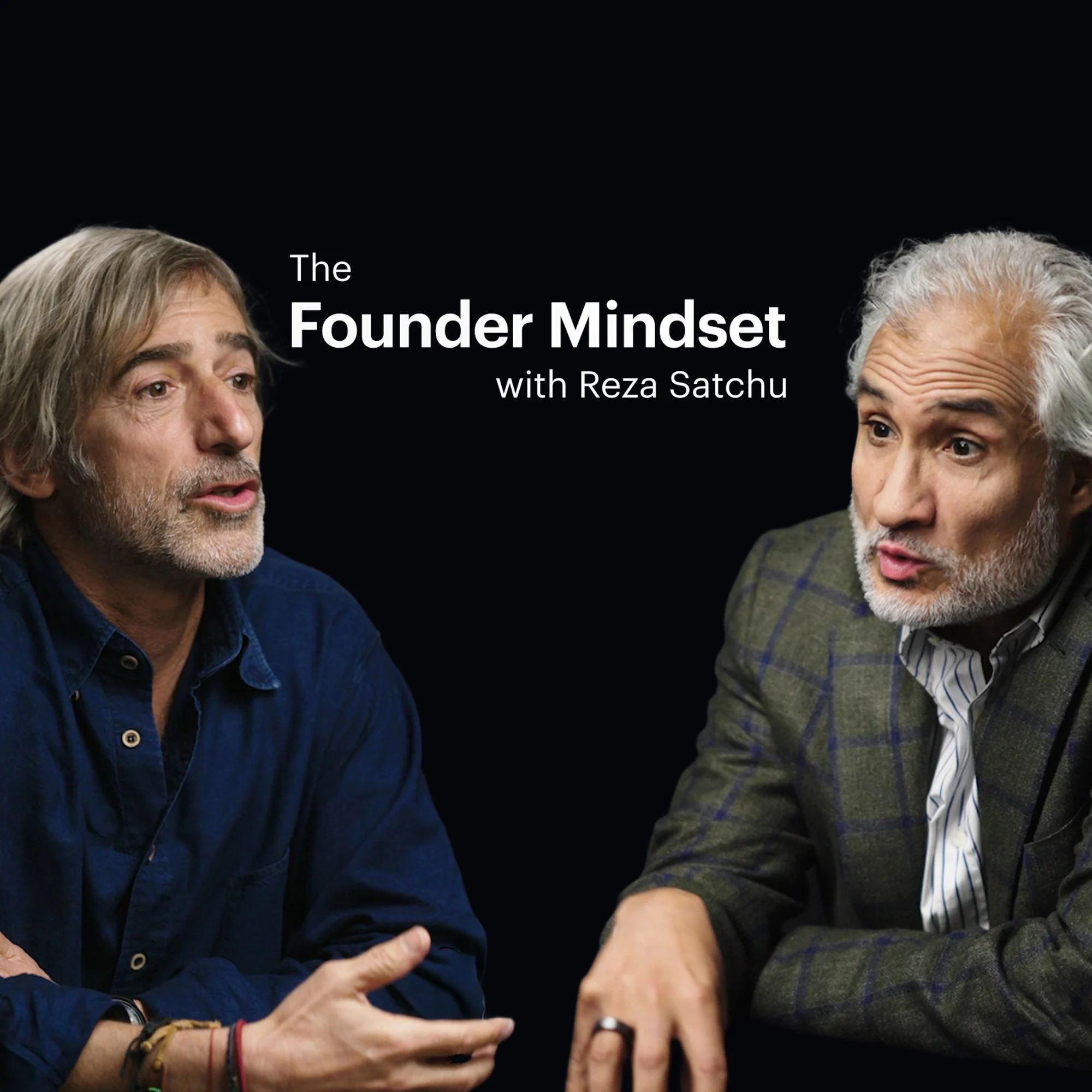
What does it take to be a founder?
Mark Pincus doesn't believe in the lightning bolt: the one brilliant idea that changes everything.
He built Zynga, the social gaming giant behind FarmVille and Words With Friends, and sold it for $12.7 billion. Before that, he'd already built three companies: one sold, one went public, and one failed.
He turned it all into a framework: Proven, Better, New. And a habit most founders resist: assume your idea is wrong, and test it faster than anyone else.
This is The Founder Mindset with Reza Satchu.
Transcript
Intro
Mark Pincus: I had a very wonderful but strong father. "You haven't become the man that I hoped you would". I said, "F*** you, bye."
Reza Satchu: So many founders are born out of the childhood difficulties and trauma.
Mark Pincus: I've always been an outsider.
Reza Satchu: These things that are remarkably painful can be the great sources of strength, because at an early age, you learn what you're capable of.
Mark Pincus: We know there's so much power in our hands, and we do so little with it.
Reza Satchu: The Founder Mindset is not just about starting a business; it's a way of living. At its core, what it enables a person to do is to do the thing that every human being wants: to have a positive impact on the people that they care about. In this podcast, what we are going to do is meet with some of the greatest founders, some of the people that have had the most improbable journeys, who have lived with The Founder Mindset.
Voice over: What does it take to be a founder? Mark Pincus doesn't believe in the lightning bolt: the one brilliant idea that changes everything. He built Zynga, the social gaming giant behind FarmVille and Words With Friends, and sold it for $12.7 billion. Before that, he'd already built three companies: one sold, one went public, and one failed. He turned it all into a framework: Proven, Better, New. And a habit most founders resist: assume your idea is wrong, and test it faster than anyone else.
This is The Founder Mindset with Reza Satchu.
--
Reza Satchu: Mark Pincus, welcome to The Founder Mindset. We are just getting to know each other, and I will tell you that when I look at your background, in many ways it's incredibly fascinating. Repeat founder, built things out of nothing, had a big impact on many people's lives in a massive way. The thing that I find most interesting is that so many people will look at your life and say, "Boy, I wish I could have this sort of impact." And there are parts of your story that are just so relatable to so many. So what I want to go to is those parts of the story that are really relatable. I have a phrase, which is: so many founders are born out of the childhood difficulties and trauma that they went through. So let's just get right there. Talk to me about your childhood trauma.
Mark Pincus: Well, I'd say that the one singular event that I can trace things to is I had a very wonderful but strong father, and he wanted us all to play certain roles in his life. He wanted me to grow to be this one kind of man. And when I was 18, he said, "This is a hard decision, Mark, but you just haven't become the man that I hoped you would. And so I'm deciding to take you out of college, and you're going to come home, work for me for a year, and I'm going to finish raising you." And I said, "F*** you, bye." And I left.
Reza Satchu: Just on that point: you described him as a wonderfully strong man, but that's not the behavior of a wonderfully strong man.
Mark Pincus: Well, people are multifaceted. And my dad, later in his life, was the best grandpa, Grandpa Teddy, the best dad, grandfather ever. But at that point, he related to his family the way he related to the employees in his company. And oddly, what I did take from that in my own company, which I'll talk about later, is: it was a democratic dictatorship. You're allowed to voice one opinion, and then he was going to tell you the answer. But he loved us the way he knew best, and he was doing what he thought was best for me. He was deeply worried that I was going to grow up lonely and disengaged from the world. And it was because he only saw one vision, which was—
Reza Satchu: What was it that he saw in you that could lead you to this negative outcome? There must have been parts of it that he saw that were true.
Mark Pincus: Yeah. The biggest thing was that I initially went to the University of Michigan, a Big Ten school, and his dream for me was to join the fraternity that he had been in at IU, Indiana University. And I thought, fraternities… I don't fit in that well. And I thought they were lame. To me, it was like a weird time machine going to this school. The cool ones were the biggest kids who could drink the most beer, and I was just like, "This is stupid. What's going on?" And my dad really wanted me to do that, and I just rejected it completely. My dad was gregarious, and he was a joiner. He joined everything and was president of everything. And I wasn't doing that. I didn't fit in at this school. I was lost. I only had a couple of friends.
Reza Satchu: And so in many ways, your dad was very much trying to bring you into the inside, and the last thing you wanted to do was to come into the inside. Would there have been outlier behavior, or was this the outlier behavior?
Mark Pincus: Well, I wasn't that interested in school. I didn't get good or bad grades. I would get just good enough, like B, B-plus. I wasn't achieving. I wasn't the best at anything. And my dad was all about achievement and resumes. So I wasn't doing anything distinctive, and he wanted that effect.
Reza Satchu: And so did you reject it because you didn't think you were capable, or because you didn't think it was relevant?
Mark Pincus: I don't think that was even in my head then. So, thinking back to then: I rejected it because I was just like, "You don't even know me. You're not connecting to me and understanding what I'm interested and engaged in and passionate about. You're trying to hand me this traditional world that you've succeeded in, and you want me to join that world. And so far, I'm not into any of it." It just wasn't for me, what was presented. I didn't particularly like college, especially being at a Big Ten school. I just hadn't found myself. He was right in looking at me and saying, "I don't see you engaging in the world."
Reza Satchu: There are so many people watching this who would resonate with this feeling of a lack of commitment, a lack of purpose, a lack of passion. And part of the reason I'm so excited to have you here is that you didn't wallow in it for decades and decades. You were able to figure out how to turn it around.
Mark Pincus: Yeah. Oddly, part of it was the fight. In that moment when I did the "f*** you, bye," my grandparents had set up a trust fund to pay for college for me, and so I didn't think it was that risky. And then my dad went after the bank until they stopped funding me, which he was very determined to win. And then the bursar's office… I transferred to Wharton, and the bursar's office called me and said, "Your dad said that you're disenrolling." He found out I transferred, called, and said, "I'm disenrolling my son." And they said, "Technically, you have to decide this." And I said, "Oh, don't listen to him. He's crazy." But then all of a sudden I was like, "Oh, s***." All of a sudden, I needed $8,000 per semester. That's how much school was.
Reza Satchu: Remarkable, right? Because in some ways, this obstacle created within you sort of a fire.
Mark Pincus: Yeah, it did. All of a sudden I was like, "I am going to get perfect grades, because grades equal money and money equals freedom." And these other kids here aren't in it for what I am. These are prep school kids, and they're not in it at the level I am. So I was extremely competitive. I had never cared about being competitive about school or grades, and now I was just like, "I'm going to get an A in every single class." I didn't care at all about learning.
Reza Satchu: It's the adversity, right? It's the adversity that led you to it. I often think about this: we come from very different worlds, but share something in common. I immigrated to Canada from East Africa, and for me it was very much looking in from the outside. And it strikes me that resonates with you as well.
Mark Pincus: I've always been an outsider.
Reza Satchu: And so it turns out that these things that are remarkably painful can be the great sources of strength, because at an early age, you learn what you're capable of.
Mark Pincus: Yeah. I was like, "Oh, wow, I can get perfect grades." I graduated second in my class at that point.
Reza Satchu: But it also struck me that you could have gotten very stuck in what I call collecting gold stars. Meaning, what was remarkable was, yes, you suddenly said, "I've got to get straight A's," and next thing you know, you're on Wall Street. Next thing you know, you're at Harvard Business School. There are a lot of checkboxes here. That is starting to not feel like outlier behavior, and doesn't feel like the Mark Pincus that we know today.
Mark Pincus: Although within that, I was also my own worst enemy. I got fired or asked to leave. I believe I was the best at every company I was at. They just didn't see it. Some even did, and I still got myself asked to leave.
Reza Satchu: And what was it about you that was getting you fired from all these places?
Mark Pincus: My yearbook quote, which your friends write for you, was: "Some people have tact, others tell the truth." And I have just lived up to that quote, and had all these career-limiting moments. If I would just keep my mouth shut… There are those moments when you just know: if I go left, I just shut up and swallow it.
Reza Satchu: But you're constitutionally incapable.
Mark Pincus: Yeah, no…
Reza Satchu: It's really amazing when I think of the number of times that something like that, which could be so problematic, can end up being a massive superpower.
Mark Pincus: Yeah. I'd say at the time, I genuinely thought that I was impressing the interviewer with my answers. But I thought like a CEO and acted like a CEO. I've always said that I'm a great team player as long as I'm running the team, and I think I portrayed that. My favorite was when I got an interview with Disney. Everyone gave me an interview because of the resume, and they said, "Here's a case study. We want you to tell us how you're going to take the Disney experience to every town in America. How are you going to spread our theme parks?" And I said, "That just doesn't sound like a good idea. Do you have any others for me?"
Reza Satchu: That's great. So you find yourself in your 20s having accomplished a lot of things, but it struck me as someone who wasn't feeling particularly content or happy about life.
Mark Pincus: I graduated without a job. But then I got really lucky, and I got a 15-minute interview with the president of TCI. They said, "Why do we need another MBA?" With 20,000 employees, that was the second MBA they'd ever hired.
Reza Satchu: The furthest thing from an MBA that you've met.
Mark Pincus: No, no. I said, "Because the future is everything. This guy George Gilder wrote this book, Microcosm, and you are the supertanker." There wasn't an internet yet. And they were having dinner with him that night, and I just nailed it enough that they gave me a job. But then I had these career-limiting meetings with John Malone, where there was a deal that my boss, John, wanted us to look at. One of them was buying a third of Prodigy, which you might remember. It was the biggest online service, bigger than AOL, and it was 400 million for a third of the company. And I said, "This is a really dumb deal. Let me tell you why. There's this company, AOL, that just went public, and it's only worth 110 million, so we could buy the whole company, and it's way better." Well, anyway.
Reza Satchu: It's interesting, because it strikes me that maybe you got this from your dad, but this conviction… Let's take the story, which, it's a shame they didn't listen to you. But where did the conviction come from, for a young person like you to feel like you could see things that others can't see?
Mark Pincus: That's such a good question. I call it the expert witness syndrome. I don't think this was unique to me. I think so many smart people in these jobs are expert witnesses, where you're closest to the data and you're closest to the answer, but you're furthest from the decision-making. And so if John Malone, I believe, had spent the time and looked at the level of detail that I had, he would have come to the same conclusion. But he's running a big company, and he was relying on other people.
Reza Satchu: My proposition to you, and I want to dive into this, "instincts are greater than ideas": effectively, my proposition is that what's happening is you're able to actually make decisions with uncertain information. You're actually able to look at information that's changing, that's volatile, that's not completely certain, and start trusting your judgment or instincts around it.
Mark Pincus: Yes.
Reza Satchu: But is the commitment better than being focused on your ideas?
Mark Pincus: It is. Well, first of all, I have this theory that's core to my book, that we have these winning instincts that we feel in our gut. You're like, "Yes, I know everyone would rather order a taxi through their phone, through a message."
Reza Satchu: That's not something that you're getting necessarily from primary data.
Mark Pincus: No, it's lots and lots of things that make up your life. But we have these winning instincts, and then we combine them with these losing ideas that we package them in.
Reza Satchu: So let's talk about the core. So many founders are trying to build a product, and they dream about taking it to mass market. Now, you have done this repeatedly, culminating in selling… You're the founder of Zynga, sold it for $12.5 billion. To me, that is incredibly impressive. But what's even more impressive is it's been a repeated game for you many times. You built these products that have broken through in a very viral way throughout the mass market. So if you were to give us… And I absolutely want to talk about your book, where I think everyone watching this podcast who's interested in building a mass-market product as quickly and as efficiently as possible should read this book. Give us a thumbnail sketch of what the core principles are: your learnings around bringing a product quickly, efficiently to mass market.
Mark Pincus: Sure. I'd say, number one, know what your goal is. Don't lose sight. I say, "Know your goal or suffer death by a thousand compromises." So first, do you have a North Star? Or is it, "I just want a product that gets traction"?
Reza Satchu: Give us an example of your North Star, just so it's relatable. When you were starting Zynga, what was the North Star?
Mark Pincus: It was social gaming. We eventually wrote down a mission: connect the world through games. It was improving people's relationships. We said success for us is that people moved buckets, that this became a new dimension in how they're doing social networking, and that you and I only know each other online, but because of something I did for you in a game, you see me across the street and you cross the street to say hi. We measured the number of marriages that came from our games. So that was our North Star. And eventually Zynga lost sight of that and became just a game company. And then it's mediocre and it's indistinguishable, because that was what was special. It wasn't the entirety of it, but that was the North Star. So number one, know your goal. Number two is this fundamental principle, the whole course I created at Stanford, that I really want your listeners to internalize. Stanford, sorry.
Reza Satchu: That's cool.
Mark Pincus: It's a community college that's on the West Coast. It's a feeder. So the whole point of this is that we have winning instincts. And I've talked about this, but they get better and better as you calibrate and you get feedback loops: "Oh, I was right. It was bigger than I even thought."
Reza Satchu: It gets better in two ways, the way you're saying, but it also gets better and better because we're in the arena making these decisions, building this judgment muscle.
Mark Pincus: Yeah, we're calibrating along the way. So there's some instinct that you feel. I have an instinct that everybody is lonely on some level, and everybody wants to improve the relationships in their life. That seems like I'm stating the obvious. That's great when it's something that everyone agrees with, like, "Yeah, okay, that's a really good instinct." But then we have ideas. Just because your instinct is right does not mean that this one idea variant is going to be right. In fact, I think you can assume that your idea is right 25% of the time at best, even if your instinct is always right. So then I say, okay, what do I do with that information? If I could go back to Mark in 2003, doing Tribe, one of the first three social networks, I'd shake him and say, "Your instincts were right there, on multiple levels, like three different industries." Facebook became a pretty big company, even though they changed their name eventually.
Reza Satchu: So, just to be clear, one of the businesses you founded was a precursor.
Mark Pincus: Yeah. Before Facebook, I started a social network when everything worked. Most social networks back then worked, and you'd get an email saying, "Mark wants to be your friend." You'd be like, "Oh, what's that?" And I still managed to fail. That took an act of willpower to fail. I had to really be determined. So if I could go back and say, "Mark, good news for you: that instinct you had, it becomes trillion-dollar companies in multiple industries. You are onto something. Bad news is, this one idea ain't going to hunt." What do you want to do with that information? What do you want to do with that cheat code? It's a time machine. Right now I can say, "Oh, thank you so much, future Mark. I'm going to just try four or five variants."
Reza Satchu: Actual advice to a founder who is getting stuck in this loop?
Mark Pincus: Okay, so that gets to my third piece of advice from the book, which is: I developed a framework, not in time for Tribe, but I did do it for Zynga, that I call Proven, Better, New. And this became a religion at Zynga. It's still a religion for former Zynga people. It became part of the PM culture of Silicon Valley. The idea is, whatever you want to do, you can find products similar to yours in the world, and you can deconstruct those down to the pixel level of the experience, in games down to the mechanic level. In anything, though, you can say all of these things make up that experience. "I'm going to take what's out there that I know works. It's the most successful, I like it, and I'm going to call that Proven. And I'm going to get a PhD in that Proven." And then I'm going to look at what I can make better within that Proven. What about that product can I make that is, again, irrefutably better? Ten out of ten of the existing users say, "F*** yes," if we're allowed to say that at Harvard. So with FarmVille, it was the crops and the crop art. Every single person thought it was better. And it's something that they really, really cared about. New is your innovation zone, and it's the novel new idea you have. And that idea will fail. One of my mantras they still say inside Zynga is "All new fails." If you assume all new fails, you will almost never be disappointed.
Reza Satchu: "All new fails," meaning if you create a product that hasn't existed, that isn't related to anything else, it will fail.
Mark Pincus: All new ideas that are introduced to the world fail at first. Yes. And there's a needle in a haystack, maybe one in a million. But the point is, okay, if I have too much new in my product, if you try to make all the proven things new, you're actually going to make them all worse, because you don't have the time. And I say it's irresponsible. If what you care about is the value in the eyes of your customer, not respect from your peers, you don't have the right to change something that's proven. You have not earned that right. You are not good enough at this, and you are not smart enough at this. You're not a PhD in whatever the f*** you're building to actually change that many things. To make something that the whole world acknowledges is better, it's usually a teeny, teeny thing.
Reza Satchu: So what's fascinating about this is that the common, you would argue, misperception of ideas is that literally you're struck by lightning and you come up with this brilliant new world that no one can see except you. And that's what you prosecute against. Your argument would be, in many ways, you're democratizing idea generation. What you're basically saying is new ideas, as you define them, are accessible to all.
Mark Pincus: Yes.
Reza Satchu: Which is an interesting point, because most founders, most people would argue that the idea is the needle in the haystack, and you could spend your whole life looking for that: "I want to found, if only I had that amazing idea." Your point, I believe, is everyone can found, because the ideas are right in front of you. And what you need to do is go learn that model, or that Proven, and try to make it incrementally better.
Mark Pincus: Yes. What I would say is, at a minimum, whatever it is you're trying to do, if you take this kind of approach, I think you're going to 4x your odds of success. Whether or not that was going to succeed, imagine if I had four shots on goal that were all very close to each other and calibrated: probably four times the chance of succeeding than one shot on goal. We can already assume your first shot isn't going to work, and you're going to learn from each shot. The one thing I'd also add, and that is another part of the book, is the importance of roadmapping and testing, and having a mantra that you want to test more ideas in a week than your industry tests in a year. Because if what you build is a testing machine, you build a failure machine, then the rate that you're going to learn is so much faster than everybody else.
Reza Satchu: One of your controversial points, or counterintuitive points, is around scale. So tell me how you think. Shouldn't every founder be pitching, "It's all about scale"?
Mark Pincus: Well, when I was here at HBS, the magic word was scale. Even long before there was an Amazon, it was Walmart and the Japanese and being the scalable leader. So one of my favorite chapters is about scale. And I hope that no one takes this the wrong way here at HBS, but when I talk to MBAs, I say you don't need to spend two years getting an MBA. There's only one point of management, which is: how do we get people to do the right thing when we're not in the room? And the first thing is, be in the f***ing room. Don't delegate. No one's impressed that you're delegating. I like to say, I don't know why McDonald's has these signs saying "Over 15 million served." That doesn't make me think my burger is going to be any better. I'd rather that the colonel is making me my burger, flipping it and really checking the quality. I'm like, "I'm not happy that you made 15 million today." So the first point is: micromanage. And I think now, with Elon, things have changed since I started, or even wrote the book. Now we're starting to fall back in love with the idea of the leaders that are in the details. But it was a bad thing. Micromanagement was a bad thing. So be in the room until you can't possibly be there anymore. Be in every single detail. If you can make a better decision than anybody else, you should. And then your job is: how do I develop the systems around us that generate the right decision when I'm not in the room? They ask the right questions. They have the right fight, they have the right debate, and the right answer wins. And that's all this whole stack of crap: mission and values and culture. I definitely skipped the organizational behavior classes here and just found them painful. I find HR painful.
Reza Satchu: You, by definition, are a strong believer in founder mode, it strikes me. So explain to me: what does founder mode mean to you?
Mark Pincus: Founder mode. I love the concept. I think Brian Chesky coined it. I loved the concept, even from where it started, that founder mode means you deserve the right to… you should be trusted enough by your investors and your board to make, I would say, unpopular decisions. The first rule, to me, of founder mode is: do you trust yourself? Are you ready to bet on yourself when nobody else does? And the most courageous place for a founder to go is to make an unpopular decision that their own team and their own investors don't support.
Reza Satchu: Yeah, because we spend so much of our career as pleasers. In particular, I want to talk to you about how you think about investors vis-à-vis founders. I have a view. I make a joke that if I, as a founder, wanted to close an investor, the most important thing I'd want is another investor. Which is, at their core, investors are watching from the sidelines. The founder is the prize, and you're the ones going into battle.
Mark Pincus: It's 100% back to high school. And who's the cool kid?
Reza Satchu: Right. But in our society, the cool kid is the investor.
Mark Pincus: Well, they're like the jocks and the cheerleaders. They're like the beautiful people. And it really is… We're kind of like the nerds, and they're deciding, "Oh, no, Mark's cool. Did you hear that?" And then they're like, "Oh, Mark's cool. So we'll go there."
Reza Satchu: No, it's remarkable. In my class, one of the things I do is I keep investors separate. And when I keep them separate, they pick very different founders. Of course, as soon as I put them together, they pick the same founder.
Mark Pincus: The first word that I didn't get to until I founded Zynga is alignment. And a lot of times, and this will sound like a paradox, or almost hypocritical, or the opposite, but I'd say one of my life philosophies is: life is too short to struggle. Therefore, it's often to our benefit to actually go slower to go faster, make things harder on ourselves in the beginning so that it's easier later. So when I was starting Zynga, I was 41 and considered too old to be a founder. You're supposed to be a VC now, and I had founded a couple of successful businesses. And I said to potential investors, "Let me read you the top ten reasons you're not going to want to invest in my company. Number one is I'll keep control, to protect you and the other investors from yourselves." And they'd say, "Thank you so much. I don't need to hear the pitch." It was like speed dating. I got turned down so much.
Reza Satchu: It's interesting. So they were excited by that because it was so unusual?
Mark Pincus: They were not excited. No, no, no. They said, "Thank you so much. We don't need to hear any more."
Reza Satchu: So ultimately you were able to raise, though.
Mark Pincus: But it made it really hard on myself.
Reza Satchu: So why did you choose to…
Mark Pincus: Think about this. At this point, I had had three companies. One was acquired after seven months for a good amount of money. The second one went public for a lot of money, and the third one failed. And now I have a company that's doing 200,000 a month in cash flow, not revenues, growing 30% a month, and nobody wanted to invest.
Reza Satchu: So why not?
Mark Pincus: A few reasons. One is it was a Facebook app, and they thought these were going to go away. And, "This is embarrassing. How is this going to help the world?" Our main app was poker, and they said, "We don't like that. Our LPs don't like gambling." But then the biggest reason was me. They were like, "Mark's controversial. He wants control." I even had a VC say to me then, "I like everything about this, but I worry that you're not coachable." And I said, "Thank you so much. You've told me everything I need to know. I'm not coachable. I am, but I pick my coaches. And given that you've never actually run a company, I don't think I would choose you as a coach."
Reza Satchu: One of the things that is clear on any founder journey… Because of course you look at your journey and you just think, "Wow, everything just went straight up and to the right." Obviously, that is not the case. Thankfully, the end points look very good, but I know that there must have been tremendous volatility along the way. Let's talk about some of the most painful moments in your founder journey. What were they, and how did you find the internal commitment to get through them?
Mark Pincus: In my book I write about this, and it's amazing how many people connect with this concept that I call the abyss. The abyss is this place that we go to, you could say before you start your first company, but it's usually after you have had a company that has failed, or even has been acquired, but now you don't know if you're ever going to work again in your life. Other than maybe needing money, you don't know if you'll ever actually have that structure, that passion again, and you don't know when you're ever coming out of this place. The world doesn't need you anymore. You're on the sidelines. You're not in the mix. And I've been in this abyss a bunch of times now in my career. My dad used to call it "in between successes," also unemployment. So I've been in these abysses. They can go on for a long time. I was in a long abyss before I started Zynga, from Tribe to Zynga. That was maybe three years, and I didn't know if I'd come out of it. And I learned that the way out of it is: you're not going to have your A+ idea and just pop out. You need to start to just pursue curiosities and passions and start to engage in small ways. But you get desperate. And so there's also a real risk and danger that you latch on to a B+ idea as a life raft. And you're like, "Okay, I got something," but it's not right.
Reza Satchu: I call this concept small-c commitments, where you start being curious, and instead of just dismissing the curiosity, you start engaging with it in a small way. And of course, the risk is that you engage in a material way with something that isn't…
Mark Pincus: And that actually happened to me. I can't remember if I talked about this in the book, but before Zynga, I created a company called Tag Sense, and it was a really good idea of a publisher…
Reza Satchu: Is this the one that didn't work out?
Mark Pincus: Well, I've had a few. I didn't get it funded. So Tag Sense was going to be an ad network that was directed by the publisher, or the blogs, and I had AdSense as a partner, and Peter Thiel said, "I'll give you $5 million, Mark. I love it." I had a team. And then I was like, "It's just not that good an idea. It's a B+, and I'm not passionate about it, and I'm not having fun." And I said, "You know what? I'm not going to take the money." And I pulled the plug on it, and it was really hard. I just pulled the plug on one of my deepest passion projects I've been working on for 20 years. I call it Dot Earth in the book. It's my version of the metaverse. We don't have time on this podcast to even explain it all, but I've been building this as an R&D project for four years. I've been building a Three.js browser-based game engine that works with AI, and I just pulled the plug, because I said, "You know what? It's not going to be commercially viable. We're not getting traction, we're not moving very quickly, and we're not copying anything. I'm writing this whole book, and none of this goes along with my book." And I said, "As painful as it is, I'm going to pull the plug." And I think future Mark will thank me, because I created this space.
Reza Satchu: So talk about this, because this is another interesting thing, where you make these commitments to yourself in a very formal way. I meet so many people who say, "This is where I want to go." Well, many don't even say they want to go there, but very few, even if they say they want to go there, do the work to actually commit to doing it. Commitment is something I think a lot about, but you've actually put it into practice on an annual basis. Talk to me about that.
Mark Pincus: And maybe I'll also backtrack, because this could be useful, to where you were at the beginning of the interview. My career really starts when I'm living in this little junior one-bedroom apartment in D.C., and I have this very small life, and I'm being pushed out of this fledgling VC firm.
Reza Satchu: Late 20s.
Mark Pincus: Yeah, I was 28, washed up. All my best friends, oh my God, either they started a $1 billion hedge fund, or they were becoming partner early at Goldman Sachs. They had amazing careers. This felt pretty bad. I had this little life, and I was being pushed out, and there was nowhere that this was going to go from here. There wasn't really venture capital yet. It was that long ago; this is 1994. And I was feeling really depressed about my life. So I went to temple over the High Holidays. I'm not super religious, I hadn't been to temple since I was a kid, but someone invited me. I didn't understand what was going on, and I sat there writing in a journal the whole time, and I just wrote about how much my life sucked. It just f***ing sucked. Every day I'd go there, and I'd just be like, "It sucks because of this." I had this dream. I wanted to be an entrepreneur, and I never even tried. And it was like it was over. The whole game had just played out, and I made bad choices. And then the single thing I hated most about myself was that I smoked cigarettes, and I said I was going to quit. And I wasn't even a real cigarette smoker. I wasn't even committed to cigarette smoking. I'd be at the bar, I'd smoke a couple, and my clothes would smell like it. So I was like, "Okay, the one thing that I hate most about myself that's in my control is I smoke cigarettes. So I can't fix the other s***, but I can do that." And so I said, "Okay, I'm going to quit. I'm going to do a lifetime quit on cigarettes." October 19th, 1994, right after Yom Kippur. And I said, "Every day I don't smoke is a day that I'm living my life. It's not living me. And I know I'm not passive. I'm a protagonist."
Reza Satchu: And so you felt like you had some agency?
Mark Pincus: Yeah, I did. And I was like, "Okay, I made a real life change that my future self will be really happy about."
Reza Satchu: So that gave you confidence that you could do other things.
Mark Pincus: Yeah. And I was like, "Okay, I can make a change in this thing. I'm not stuck. I'm not trapped on this roller coaster. " And then a year later, I quit my job to start kind of an impossible startup idea: Freeloader. This was one of the first consumer internet companies. And I had no money. In fact, I had had $80,000 saved, so I thought I could quit my job. And then I shorted the three internet stocks. And I was right eventually, but shorting doesn't reward being wrong in the short term. And I lost all my money. So then I had to borrow the 30,000 I needed from my friend who was living on my couch. I named the company after him. I called it Freeloader.
Reza Satchu: That's great.
Mark Pincus: Yeah, I was freeloading on him. And then I put the other 8,000 on credit cards. And then there's a whole story.
Reza Satchu: That business, eight months later, sells for $35 million.
Mark Pincus: And amazingly, it sold after seven months for $38 million. And my dad's company sold about a year later, after 38 years, for $38 million.
Reza Satchu: So it's interesting. So what makes it worthwhile? I think the reason this path is so attractive to so many of my students, and perhaps to so many of my listeners, is this idea, and it goes back to our initial point, which is: what founding gives you is it provides you with the learning, because you're making these consequential decisions and hopefully building your judgment, and the resources: power, prestige, money. But what those things give you is this freedom to have a positive impact on the people you care about. So my question to you is, how do you define impact? How do you define purpose? What makes it worthwhile? You, as a kid, said what you really wanted was freedom. You have freedom. So how are you going to have the impact that you most want to have? And what does that look like?
Mark Pincus: I'd say I want to build products that really can have meaning, that people can feel a meaningful connection with the product or with each other. Most of my products relate to something social. When I was really getting it right at Zynga, I said it was like communion. It felt magical. It was. And the deepest reward was when I met one of our players, and they were usually middle-aged women, really. And I have four sisters and daughters and feel a real empathy and connection to women. And they would hug me, because I got them. Because they were like, "FarmVille isn't a game, it's my hobby. It's my happy place, part of my life." It's like we gave them enough in it. We called those games "invest, express and connect." And so much of what I want is to let people feel creative, be seen as creative, not be creative. I wish that I had made Minecraft, to see mostly kids go… And we're making a mistake with this iPhone and these screens. We can be passive and consumptive, or we can be active and generative. And I believe that if Steve Jobs saw how little we're doing with these devices today, he'd be so disappointed. He said, "Think different." He wanted to unlock people's creativity. He didn't want us to do doom scrolling and just be… He wanted people to be creators and generators. And I think that we have a latent depression as a culture, because we know there's so much power in our hands and we do so little with it. So you say what motivates me. I'm like, I want to build one of these internet treasures that people can't remember life before or imagine life without. And why wouldn't I do that? I keep going back to Elon, but Elon says the most interesting story is probably what will happen, or what will win. And I think the most interesting story for any of us as product founders today is to build the internet treasures. And I think so few have been built. My iPhone, mostly the front page is either empty, or it has generic s*** like calendar and photos and weather. So that's what inspires me.
Reza Satchu: It's remarkable. You know, it's interesting: I'm writing a book about commitment, and the fundamental thesis of the book is that we live in a world where people view commitment as a sacrifice and not as a superpower. We have all these options. And so many of my students and friends have sort of suffered from what I call the curse of optionality, and they don't figure out what they're truly capable of because they don't commit to things. And so when I look at your life, there's a real purpose and commitment to have a positive impact.
Mark Pincus: Even within that, when I listen to you, I'm like, "Yes, I agree so much." But the flip side of commitment is sacrifice, right? What are we going to say no to?
Reza Satchu: Well, here's the thing about sacrifice. The thing about sacrifice, it turns out, is that that is where contentment lies. Meaning, it is precisely because you sacrifice that you learn what you're capable of. Look at the sacrifice we make for our kids. And frankly, think about how terrible it would be if we didn't have that ability to make those sacrifices. Or the sacrifices you make for your employees or your students, or whatever it may be. It's precisely because commitment requires sacrifice that it's so powerful.
Mark Pincus: And even coming back to… You had asked me a while ago about my book of life.
Reza Satchu: By the way, that's a fascinating thing.
Mark Pincus: So out of that journey in 1994 and 1995, I built this commitment to spend these ten days every year over the Jewish New Year, but people could pick any time they want, writing in the same book and reading…
Reza Satchu: Do you still do that?
Mark Pincus: Yeah, I've been doing it since 1994, and I go read the previous years. And what I find is, and it's been a lot of years now, it's like you're having a dialogue with yourself throughout your lifetime. I go back and write myself notes like, "Actually, it's going to be okay." And you see patterns, and you're like, "Holy s***, I've been saying 'Next year I'm going to launch Dot Earth' for 20 years." And that weighs on you. And now I committed to it, and this variant didn't work. But I feel fulfilled. And I don't have to create that internet treasure to have a happy, satisfied life. But I have to have gone for it.
Reza Satchu: Yeah. You have to take the shot. Thank you for coming. It's a wonderful story. Thanks for being so open, and I hope to have you back.
Voice Over: You've been listening to The Founder Mindset with Reza Satchu.