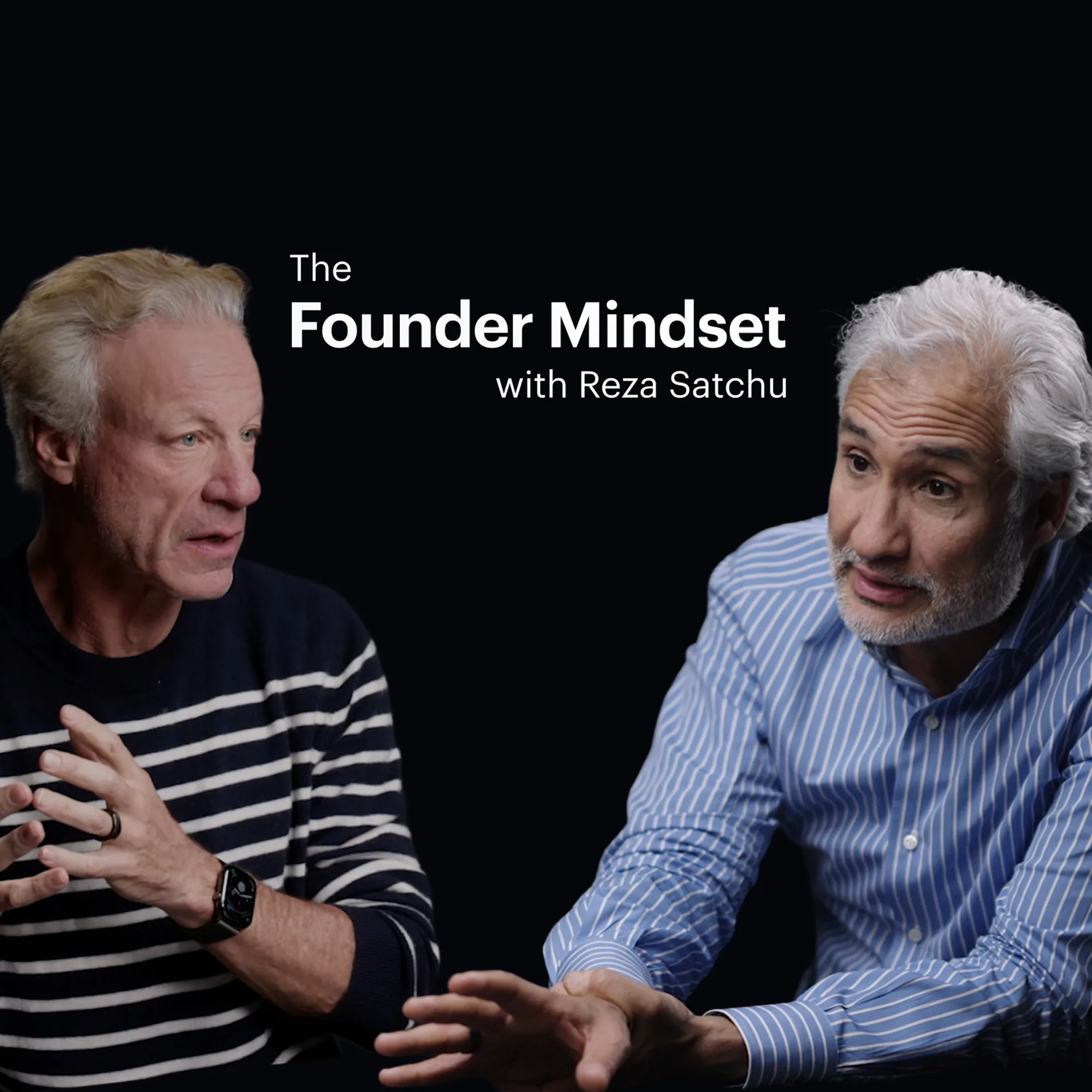
What does it take to be a founder?
David Fialkow built companies from scratch, sold them, and now backs the next generation as co-founder of General Catalyst. From transformative startups to executive producing the Academy Award–winning documentary Icarus, his edge is simple: spot conviction early — and help it scale into lasting impact.
This is The Founder Mindset, with Reza Satchu.
Transcript
Intro
David Fialkow: I wanted to be on the journey with founders, and I wanted to be empathetic
Reza Satchu: What right did you have to win an Academy Award? What right did you have to build one of the largest venture capital firms?
David Fialkow: We have always looked at the world as, what if we're right?
Reza Satchu: But the problem to committing to something is that it takes judgment.
David Fialkow: In the investment world, if I meet a founder I like, I think we should commit on the spot as much money as we possibly can. Our $13 million ended up bringing back several billion dollars.
Voice over: This is The Founder Mindset with Reza Satchu.
Reza Satchu: The founder mindset is not just about starting a business. It's a way of living. At its core, what it enables a person to do is to do the thing that every human being wants, to have a positive impact on the people that they care about. In this podcast, what we are going to do is meet with some of the greatest founders, some of the people that have had the most improbable journeys, who have lived with the founder mindset.
Voice over: What does it take to be a founder? David Fialkow built companies from scratch, sold them, and now, as co-founder of General Catalyst, supports the next generation of founders. From venture capital to filmmaking, including producing the Academy Award-winning documentary, Icarus, his edge is simple: spot conviction early and help it scale into lasting impact.
--
Reza Satchu: David Fialkow, welcome to The Founder Mindset. So you clearly have led a transformative life. When I look at where you started, where you are today- Yep ... it's a pretty remarkable journey. Okay? And so let's wind the clock back. I have a theory that much of who we are and what we want to accomplish has to do with childhood experiences and trauma. Mm-hmm. Okay? Obstacles, potentially not of our own choosing, that we experienced as a child. Okay? Mm-hmm. So give us a window into David Fialko as a kid. What was happening?
David Fialkow: Very little trauma. My parents were extremely supportive of me doing anything I wanted. My dad was a lawyer. He was the assistant attorney general. He was a lawman, and he was very straight down the middle of the fairway, and my mother was just kind of a cool groovy. And to them, they always encouraged me to do my own thing. Right. And they were not performance-driven parents. I never got good grades, so they didn't expect that. What they always wanted me to do is be curious and be a great person. And so I over-indexed toward the creativity side of my life versus the academic side, number one. Number two, I was very fortunate that I had good athletic skills, and sports gave me an opportunity to have self-confidence as a young person. So while some people may have got self-confidence by getting an A, my parents would celebrate when I got a B or a C. Mm. "Amazing. You did really well." Even though they may have been disappointed, they never discouraged me- Right ... if I wasn't doing well, and instead, they celebrated the other things.
Reza Satchu: Were you disappointed with your academic performance?
David Fialkow: I was not. I had learning disabilities. I knew that I didn't read and write as well as other people. And then I had this radical experience in my first year of college that really transformed my life, which was, I went to college, I was really excited. Excited to play sports, excited to meet people. You were a hockey player. I was a hockey player. Excited to do all these things. And then that memorable day, right when the first day of classes started, a dean came to me and said, "You know the conditions by which we accepted you to college?" And I said, "Yes. I have to work three days a week in the lunchroom, or in the cafeteria." And she said, "No, you have to take English as a second language." And I said, "I think you're confused. I'm David Fialko. I was actually born in Boston." And I made a joke, like the Three Stooges. "Were you born in the United States?" And Moe said, "No, I was born in Milwaukee." Right. And I was like, "I made a joke about it." She said, "No, you got under a 400 on your SAT." Hmm. "And we were happy to take you, but you're going to take English as a second language." And I was like, felt very defeated. Yeah. I was like, wow. Yeah. My ego went to- Right ... zero. And I went to class. I called my mom. She said, "It'll be fine." And I got to class, and there was a whole bunch of kids who did not speak English. Mm. And I felt really badly. Yeah.
Reza Satchu: So Dave, what's remarkable about this story is, in many ways, what you had that other people didn't have was a terrific support system, right? Your parents were there. My parents. But the reality was your output was poor at that time. Correct. Right? By any measure, meaning you didn't finish college. Mm-hmm. People were saying you should be taking English as a second language, and your scores were low. Because many people go through challenges in their life, right? And so your challenges were academically proved to be harder than you thought, okay? Mm-hmm. But somewhere, you didn't lose confidence that you could live a intentional, impactful life. Right. So where did that confidence come from?
David Fialkow: Because the people around me never made me feel badly. Yeah. They encouraged me, and little successes became a big deal. And then when I had a chance to do something academic in school to get a degree, I knew that I couldn't do that by taking history or economics or English lit. I chose something that was non-academic. Right. Filmmaking. Yes. So I had two choices if I was going to go down a degree path. One was to be a sculptor, and one was to be a filmmaker. And I was like, "Eh, you get dirty being a sculptor." Right. Filmmaking seems exciting. And what I didn't realize, Reza, was how lucky that negative choice was. Yes. Yes. This would lead me down an extraordinary path- Right ... the rest of my life of being a storyteller and a filmmaker.
Reza Satchu: Well, we're going to talk about that because who would've thought that that was the key part to not just your filmmaking success, but your business success. This all started With you being a bodyguard for Tom Lee. Now, I remember Tom Lee from the early days. He was a private equity pioneer. I remember the Snapple deal that he did, which was a revolutionary deal, that he sold to Quaker Oats. Sort of a very charismatic fella. And driver. Remember, I was also a good driver. And you were a driver. So just walk me through, that was the beginning of your career. You take this job. What did you learn from it? Connect the dots from being a bodyguard driver to being, ultimately, one of the people that's built one of the largest private equity firms around.
David Fialkow: Well, a lot of this is just luck and serendipity. I happened to be in law school on my first week of law school. I went to Martha's Vineyard, a place where I now live. Right. And I was on my bicycle, and I needed- You didn't have a home in Martha's Vineyard at that time. No. No, I certainly did not. I had a tent- Yeah ... that I was staying in. But I was driving by a front yard, and I needed water. And there was a guy out there with a cocktail in one hand and a hose in the other hand, and I asked him if I could borrow some water for my bike bottle. And we started to talk. He asked me what I did, and I said, "I go to law school." And he gave me this look and said, "Huh, I can buy all the lawyers I want." I said, "Michael Corleone, 'Godfather' one." And he goes, "Yeah." We started to laugh and have a good time, and he said, "Why don't you come work for me?" And I go, "Do what?" He goes, "Well, why don't you be my driver? You can go to law school." I had a motorcycle in those days. He said, "Drive your motorcycle out to my house, take my car, drive me to work, take my car to law school. Do your law school thing and pick me up afterwards." And he said, "I'll pay X amount of money," which was a lot. I didn't have any money. I was like, "Amazing." Where I did not understand my luck, that it happened to be a guy with EQ off the chart. Right. And Tom, I would drive him. These are the early days even of car phones. Right. And Tom would be on the back. He was a tycoon, talking, making deals and everything. And I would sit there and go, "Mr. Lee, why'd you say this, and this, and this, and this?" And then what happened is, one day, a bunch of his guys couldn't make it to a meeting. So it was kind of this interesting thing. So he took me to Brooks Brothers, told me to buy a suit, and he was going to take me to a bank meeting, and he wanted me to explain to the bankers why this company was s****g the bed and couldn't pay its debt. And he goes, "Just give it a shot. See what you have to say." Right. And I did a really good job of explaining to them that this was a momentary lapse of economic value, and we would recreate value long term. Yes. And he goes, "You should come work on my investment team." I was like, "That was my break." Yeah. Now, if I look back, was I willing to go work in a st job to get a better job? I didn't even know it. Yeah. I just took a job because I needed the money.
Reza Satchu: Well, look, so I think luck's interesting because when I hear that story, sure, there's a little luck, but what I also see is a kid who's willing to take a risk- Mm-hmm ... that trusts their judgment and do something that is sort of unconventional, and that is soak up as much information as they can, such that when the opportunity strikes, you can hit it.
David Fialkow: What I really learned was mentorship. Mm-hmm. Something that you and I spend a lot of our time on. Yes. Both now being a really good mentor, hopefully, to young people, but also, Tom was a great mentor. He really taught me a lot about the business world.
Reza Satchu: What was it about you? Because I remember Tom Lee back in the '90s. Everyone was trying to get to Tom Lee. He was a big deal. And so- Forehand. What's that? Forehand. Forehand. Yeah. Was that what it was? Yeah. He wanted a doubles player- Yeah ... so he could kick the s**t out of his friends on Saturday afternoon.
Reza Satchu: Okay, so you identified something that you could help him with.
David Fialkow: Yeah. I said to him, "Listen, let's go hit some balls." He liked that I hit the ball hard. And he said, "Good. Now we can tool on all my friends." Right. The second thing is, I've never been judgmental, and he is not judgmental. So we had this really good meeting of the minds. He liked people that were eclectic, and in his mind, I was eclectic. But what ended up happening is, I told him I wanted to leave to start a business, and instead of saying, "Oh, you should stay and do this," he helped my journey. Right. He said, "If you're going to go start a business, I want to back you." Yeah. I didn't want to get backed by him, but he was incredibly helpful to me and my partner, Joel.
Reza Satchu: David, I think you and I share this as mentors, and as people who've benefited from mentors. What mentors want to see in someone is someone that they trust, right? Deep down, they have to trust this person. Two, someone who they just have fun with. So Tom clearly trusted you, had fun with you, played tennis. The question I have is, I think the third thing that's equally important is they have to see in you something really great that might happen, that you have the capacity to do something extraordinary. Mm-hmm. Okay. So what did Tom see in you back then?
David Fialkow: I think when he took me to that meeting, and he saw that I could wing it, and I had no idea. I had no financial background. I had no nothing, but I could tell a compelling story. He thought maybe there was promise, number one. Number two, he liked the fact that even though he was in an industry that had staid people, I may be somebody who would be willing to break the mold and be a bit more bold and eclectic- Right ... in how I approach these businesses.
Reza Satchu: So key for a founder is sort of having their confidence be in excess of their capabilities. Absolutely. Okay. That's critical. Okay. So it strikes me that you had that early on, and this is an example where you had no right to go into that meeting and do the thing you did. So where did this confidence come from?
David Fialkow: I think that the confidence came from the fact that I always believed that if I did the right thing by people, great things would happen. And the right thing by people normally meant treating people really well, working really hard, and understanding that if I make people better, I improve myself as well. Yes. Yeah. And leaning very heavily on people to teach me, ask people questions like, "Why'd you say this? Why'd you do that?" And it was so interesting to learn from him. He was the best in the world, and I was there to watch him do it, and I learned a lot watching him. I also learned, organizationally, the mistakes that he made. He named his firm Tom Lee. Yes. Okay? He had four firms named Tom Lee because four times that firm blew up. Right. And his partners wanted to go do other things. And I learned early on to be super inclusive, both economically, strategically, decision, et cetera, that I'm going to build a leadership team where I may play a leadership role, but I want to promote other people to feel that they own the outcome as well. Right. And Tom did not do that. But if I look at the venture capital business, Joel and I started it. We said, "D-" Here's the problem. We know nothing about technology, we know nothing about investing, and we've never raised money. Yes. So I said, "We have no bad habits." "Are you in?" Yeah. And he said, "Yeah, let's go do it." Yeah.
Reza Satchu: Okay, so you've got this vision. Yeah. You're going to create this new venture firm.
David Fialkow: And the only reason why I wanted to start a venture firm, Reza, is because I wanted to be on the journey with founders- Yeah ... and I wanted to be empathetic, Joel, and I wanted to be empathetic. We knew what it was like to be a founder. Right. So that was- We know how lonely that was ... so that was your differentiator. Yes. Right? Meaning not being some jerk investor who's telling a founder what to do. No. Treating a founder as the prize they are and helping them build something of significance. I wanted to be an enforcer for them. Right. You know? Right. I grew up as a martial arts kid. I was a hockey kid. Right. I was very accustomed to being in confrontation, and I felt very comfortable that if we were to back founders, we could do a great job with them. Yeah. We didn't know a lot about their business- Yeah ... but that didn't matter.
Reza Satchu: But the remarkable thing is you can imagine that this doesn't overwhelm the fact that you have no track record. Right? Oh, right. You have this sort of interesting strategy, which may or may not work, who knows? You have no track record. And so talk to me about the depths. At what point did you go on this journey and you just thought, you know what, this just isn't going to work, right? Yeah. Tell me the moment where it really felt like this was a pipe dream, and how you got over that.
David Fialkow: Joel has been my best friend since I was five years old. Mm. Okay? This is your co-founder at- Co-founder of everything I've ever done. Wow. And he's somebody that is so loving and supportive of me, and he always made me feel good even when things didn't go well. He tends to be much more conservative than me, and he just makes everything work out. He's somebody that says, "Just tell me what you want to do, and let me help you get it to how we do it. And then let's work together and make it happen." So having that kind of support, and I had a wife that was super supportive of me, and I just felt that we weren't going to fail. Mm. We would get it right. So there was never a day... We laugh about this all the time. There was never a day we didn't think it was going to work. Mm. Never one day where we were dejected and despondent, and we found ourselves in a bar drinking, like, "This isn't going to work." We never felt that way. We said, "We just got to keep going and going, and going." And the reason why is we were motivated by more than just money and success. We were motivated because we wanted to be on the journey with founders. We knew how lonely and how hard it is to do this on our own, and we wanted to be with founders building the great businesses. Then we made a comment like, "Are we A, B, or C founders?" But we agreed we were kind of like B minus. We built some good businesses- ... but we had no business acumen. We certainly didn't have any tech acumen. And part of it was we were going to learn, at the same time, be supportive, and that combination is genius. Yeah.
Reza Satchu: This is where I think comes your other superpower, which is your ability to articulate what the world should look like- Mm ... or what the world could look like.
David Fialkow: What we did really well was storytell and fundraise. And I think I said this earlier today. I played a sport that has no metrics, hockey. Right. Baseball, I have a batting average. Yeah. Golf, I have a handicap. Tennis, I have a rating. Hockey, there's only one thing that matters, shots on goal. Yeah. Because you have no idea which one's going to go in. Yeah. So Joel and I made the decision that was very tactical, which is be really good- Yeah ... at fundraising. Yeah. Most people suck at this. Which then would enable you to have lots of shots on goal. Yes. And fundraising is all about personal- Right ... relationships. Right. Walk in a room, get Reza to love and trust me- Yeah. Correct ... and want me to be part of your world. Yes. And you want to be part of my world. My world looks exciting- Yeah ... and dynamic- Yeah ... and I want you part of it.
Reza Satchu: Well, look, I think it's why we've created such a strong relationship so quickly- Right ... is we're both sort of intrigued by each other's worlds. Right, and we want to be part of each other's world. Yes. Yeah.
David Fialkow: Well, remember, if you're a administrator at a pension fund- Yeah ... all day long, you're meeting with people that are very transactional. "This is my track record- Yes ... give me money." We tried to take them out of that transaction mode and paint a picture. We could be part of something fantastic together. Right. And people go, "I want to be part of your world." Yes. Yeah. "I want to be part of your world." Yeah. And we got good at raising money. That gave us shots on goal.
Reza Satchu: Let's just talk about some of these, and whether it's for films, whether it's General Catalyst, whether it's the travel business, these had extraordinary outcomes, right? For someone who you think to yourself, what right did you have to win in these games? What right did you have to win an Academy Award? What right did you have to build one of the largest venture capital firms? So when you reflect back, what was it that enabled you?
David Fialkow: They all have one thing in common. I was a creator who attracted super great talent that would be the leader. Mm-hmm. So I never needed to be number one. Being a founder, you naturally have a position like that. And I know you're very proud of the team you've attracted. Our first hire as an associate is now the CEO of General Catalyst. Oh, interesting. Haman Tanvircia. Yeah. And we knew early on this guy was magical. He had three things that we didn't have. Number one, he truly understood technology. At age 23, when we brought him on board as an associate, he had three or four master's- So this is a kid born in India that does- Born in India, MIT grad- Yeah ... bunch of master's degrees, really smart technologically. And at a very young age, we said, "Hey, you're going to be our chief tech guy." And we gave him a lot of latitude to go invest. So we early on identified the most important thing that any founder can do, which is the transition play, that you have a leadership team in place. So everybody in the firm knew after 10 years that we had a great superstar who, even though he was young Had the proven capabilities of being a leader, and he did it through three things. Number one, he was a great investor. Number two, very rare EQ and IQ. He's a very high EQ guy. And number three, the man is ambitious. Yeah.
Reza Satchu: My instinct always is, how do I find people to be on this journey, whatever that journey is, who have domain expertise, which I don't have, number one, who may have insights that I don't have, and kind of coalesce around them- Mm-hmm ... and get them to be part of the journey.
David Fialkow: My partner, David Ofeo, who I grew up with, David had a great run with us, he had a whole bunch of family stuff going on, and he said, "I'm going to retire." This is 2014 or '15. "But I have one favor to ask." "Sure." "I want to make one last bet. Can I put $13 million with Jeremy Lair into a digital currency company?" Yeah. And I turned to Joel and Hamet, I was like, "Well, what is digital currencies?" Yeah. Right. And they go, "Ah, it's like this Bitcoin. Who knows what it is?" Whatever. And we said to Jeremy, who we loved, who's so smart, "We're in. We don't know what you're talking about- Yeah. This is Circle ... but we blindly believe in you." Yeah. Yes. And our $13 million ended up bringing back several billion dollars. Yeah. Yeah, that works. It's venture capital home run. Yeah. Hamet, early on, did the seed round of Stripe. Right. And he brought those guys through the system, and every time they wanted to do a new round, it was expensive, but Hamet said, "We got to keep backing great people." Yeah. So those were two big wins. So we have always looked at the world is, what if we're right? Yeah. Not what if we're wrong. Yeah. Right. Remember, there's no downside. Yeah. You can't lose more money- Yes. Yes ... than you invest. You're losing one times. You can lose more. You can make 100 times. Yeah. It's not like shorting a stock where you can lose 10 times your money. Yeah. Yeah. So we're in the business, we meet people, we got to decide instantly. Right. There's no analytics. Yeah. There's no background checks that are going to tell us something. So if you meet somebody you love and you think they're smart, go for it. Yeah. If we want alpha in investing, you just got to find the right people who have the intestinal fortitude to be uncomfortable in their creativity and how they're going to build something, they are more likely to be successful.
David Fialkow: I also, to be honest, I have a bias of backing women. I would prefer to back women whenever I can.
Reza Satchu: And why is that?
David Fialkow: For two reasons. Number one is, I think it's a greatly overlooked strength of our economy, is we have all these brilliant, motivated young women who want to go do things, and still, it's harder for them to get funding and to become founders of companies.
Reza Satchu: So here's what I say, as someone who has run founder development programs now for over 20, 25 years, is if I have a man and a woman who have done the same thing, I know it's harder for the woman to have got there. 100%. Okay? So I'll let that woman in. Right. It's the same thing I would say for the most part someone who comes from a better socioeconomic background versus someone who's come from worse, someone who's an immigrant, who's not. It's not always true, but it, you- Good rule of thumb ... you sort of think to yourself, okay, that person to get to this phase has had to overcome more. Okay?
Reza Satchu: Let me close on a question around commitment and anxiety. Okay, so I have a thesis that our world- I'm good at both of those. Are you? Okay. We're going to talk about both of them. So I have a thesis which is, our world is increasingly viewing commitment as a sacrifice and not as a superpower. Okay, so you're seeing this in all sorts of ways. Decline in marriage, decline in home ownership. Also, just as people think about what I call the curse of optionality, which is, it is true every option has value, but the problem with collecting a bunch of options is you never figure out what you're truly capable of- Correct ... because you don't commit to any one thing. Okay? But the problem to committing to something is that it takes judgment, and relying on your judgment to do things can be a- That's a very interesting way to look at it, yeah ... it is, it can lead to real anxiety. Okay? Now, my view around anxiety or this fear of the unknown or uncertainty is, I've come to a point in my life where I realize I crave it and I need it. Okay? Because it's in those moments of discomfort or uncertainty where there's real return. Okay? So I've trained my mind to think not of risk as a negative, but risk as the opportunity to solve something and to build something remarkable. Okay. But I'm acutely aware that we're all dealing with this discomfort as founders. Tell me how you think about discomfort and anxiety.
David Fialkow: So I don't have a lot of anxiety about decision-making because I don't revisit my decisions. I make a decision and I don't have angst about the decisions, and I tend to make them on real time. If somebody calls me up and says, "Do you want to do this?" I say yes or no and don't think about what I could've done. And in the investment world, if I meet a founder I like, I think we should commit on the spot as much money as we possibly can. We can only be wrong- Yeah ... and there's no negative of being wrong.
Reza Satchu: But just to pause there, that's a terrific attitude, right? Meaning, most people are paralyzed- Are mucky. Yeah ... right? Meaning, you take my phrase, which is, if in doubt, act, to an extreme, which is most people when there's imperfect information or uncertain resources, they just sit on the sidelines and wait for more information.
David Fialkow: But what if you put people around you that weren't judgmental and encouraged you to go for it? Mm-hmm. And that's where I've been really lucky. You talk about commitment. I've been married to Nina for 36 years. Mm-hmm. Joel's been my best friend since I was five. Yeah. The guys I started General Cats with were my guys I went to high school with. Yeah. Yeah. Okay? I believe in long-term relationships. Right.
Reza Satchu: Well, David, what you don't know, it's why you're so happy. Right. So my question to you, and my last question is, what commitment would you be willing to make on the "Founder Mindset" podcast around something that you would like to have happen in your life where you can either benefit yourself or the rest of the community going forward? If you think about something you would like to commit to-
David Fialkow: Would I want to put a stake in the ground? Yeah. Number one, I have an absolute love affair with my wife, and the fact that she runs our film business and has been so successful- Yeah, she sure has ... has been joyful. Yeah. And watching- So you will continue to support her on that. Well, and watching her really get a spring in her capabilities And seeing how successful she is, and seeing that she is one of the most talented filmmakers in the world. Leave aside that we've won a couple of Academy Awards and other things. I don't judge it that way. The story tell that we're doing is super important, Reza, because we're telling stories of truth to power. Yes. My favorite story about Nina is we met a woman who was victimized by a cult called Nxivm, a guy named Keith Raniere, and we did a film about the cult and we sold it to HBO. They liked it so much we did a 14-part series on it and we were three-quarters of the way through, Nina looked at me and said, "We should go after this guy." And Nina got the authorities to charge and convict him, and she sat in the courtroom for three weeks in August, three years ago, and the guy, Keith Raniere, got 99 years in jail. Oh, amazing. Well done. I said, "Okay, that's the round trip." Yeah. That is the round trip. It's not- That's the impact. That's- Yeah ... the definition of impact. Yeah. Okay.
David Fialkow: The second is I look at the venture world. Look at the job creation. My favorite story around returning money is I do a retreat twice a year on Martha's Vineyard where I bring founders and LPs together, and about five years ago, we had a retreat on the Vineyard and one of our biggest LPs, a guy named Andy Golden, who runs the Princeton endowment, we were sitting at dinner, swilling his glass with wine. He said, "I want to make a toast to somebody that's been transformational to Princeton." And I said, "I'm honored." He said, "No, not you. Him." Oh. Founder goes, "Why me?" He said, "Because General Catalyst put $10 million in your company, Datalogics-" And that's it ... returned several hundred million. The $40 million- Yeah ... that you gave Princeton for our one million investment- Yes ... is 40 full-time scholarships at Princeton." Yeah. It's a beautiful thing. Yeah. There's a chance, young man- Yeah ... that you may have cured cancer. Could you imagine- It's great. Yes ... a young founder- Yeah. It's amazing ... sitting there listening- Amazing ... to the head of the Princeton endowment, Reza- Yeah. Fantastic ... saying, "You may have cured cancer." Yeah. We're all crying. Yeah. And I said, "That's the pinnacle." Yeah. That's what venture capital is about. Yeah. Great return. Yeah. People made money. Right. But it had impact. Yeah. It wasn't a ball bearing factory- Yes ... that got sold to another- Yes ... private equity firm. Yeah.
David Fialkow: So the commitment I want to make, you asked me for it, is there are seven isms of my life. Okay? And I'll repeat it. Number one is happy wife, happy life. Yeah. I think we all have to understand how important it is to take care of those around us. Mm-hmm. The second one is, no one is spared. It rains everywhere. Rich, poor, Black, white, fat, thin. Mm-hmm. No matter what. You are going to have adversity in your life. You just share the inevitable crisis. It's going to happen. Yeah. Get through it. Yeah. And be prepared for it. Yes. The third is with power comes responsibility. Yes. Great. If you want to lead, you got to be prepared to take on the responsibility of taking care of others. Yes. Number four is my favorite. Adversity does not take character, it reveals it. Yes. I have learned a lot, and you've learned a lot. Yes. When the chips are down- Yeah, who's there? Yeah ... who's there- Yeah ... and who's going to take care of you. Who's behaving in what way? Yeah. Right. Yes. Number five is just a very tactical thing. Share the dilemma. Yeah. Whenever there's a problem, bring other people in. Yes. Whether you're late for an appointment, whether you have a health problem, whether you have a challenge with a kid, no matter what, let other people around you know- Because they can help you ... that you're struggling. Yeah. And let them be helpful to you. Yeah. Number six, which is super important, is have fun. Yeah, right. Make the journey great. Yeah. And number seven is a little personal for me, dress British, act Yiddish.
Reza Satchu: Okay, well, with that, that's a great way to close. But thank you, David. Thank you. Thank you for being here. It's been an honor to be here today. It's my pleasure. Thank you. It's fun, buddy.
Voice over: You've been listening to the Founder Mindset with Reza Satchu.