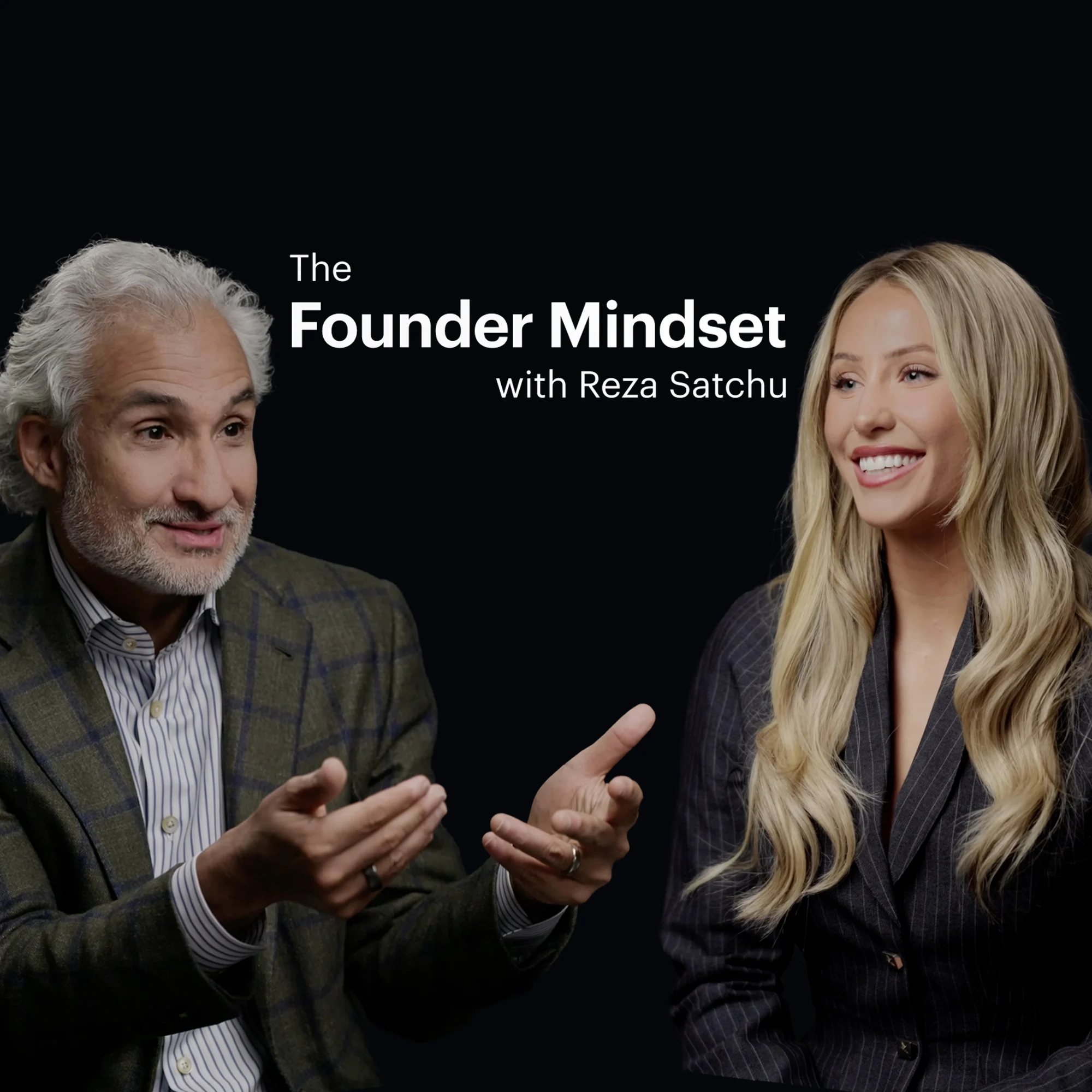
What does it take to be a founder?
Alix Earle built one of the most powerful creator brands of her generation, gaining millions of followers and sparking what fans call the Alix Earle Effect, where a single post can sell out products overnight. Now she’s making the leap from influencer to founder as she launches Reale Actives, her very first company.
Resources
Watch the high quality video version on YouTube or Spotify.
Transcript
Intro
Alix Earle: This is the biggest moment. Hopefully it's even a little bit shocking for people.
Reza Satchu: What's driving you to enter that world of complexity?
Alix Earle: My passion towards the project and towards the solution. In a dream scenario, we're having young girls loving themselves and feeling just good about themselves.
Voiceover: This is The Founder Mindset with Reza Satchu.
Reza Satchu: Every year at Harvard Business School, hundreds of students compete to gain entrance into my class, one of the most popular courses on campus, The Founder Mindset. For those who make the cut, I take them on a journey, challenging them to take risks, make commitments, and most importantly, learn judgment. One of the most popular aspects of the course are the guests we bring in, outstanding entrepreneurs who've had a truly profound impact on the world. Now, I'm sharing my conversations with some of these founders on our show. I'm Reza Satchu, and this is The Founder Mindset.
Voiceover: What does it take to be a founder? Alix Earle built one of the most powerful creator brands of her generation, gaining millions of followers and sparking what fans call the "Alix Earle effect," where a single post can sell out products overnight. Now, she's making the leap from influencer to founder as she launches Reale Actives, her very first company.
--
Reza Satchu: Alix Earle, welcome to The Founder Mindset. I'm thrilled to have you here.
Alix Earle: Thank you. I'm so honored to be here.
Reza Satchu: So Alix, let me ask you a question. So we're at Harvard Business School, and we're about to go into class to teach a case on you for the first time. How does that feel?
Alix Earle: It feels surreal. And it's also a little nerve-wracking-- I'm not going to lie-- you know?
Reza Satchu: Could you have imagined this, growing up, that there'd be a case on you at the age of 25 at HBS?
Alix Earle: No, of course not.
Reza Satchu: So what is it, walking into that classroom? Is there a part of you that feels you don't deserve to be in that classroom?
Alix Earle: For sure. I mean, I think I feel that way with a lot of what I do. I have imposter syndrome all the time. And I mean, I work hard at what I do and what I love, but it also feels crazy to be honored in such ways.
Reza Satchu: I mean, when I hear you talk about imposter syndrome-- and so many of my students talk about it. But in many ways, I look at my students, and I can understand why they might still have imposter syndrome. But I look at you, and I think about someone who's accomplished a lot of things. You're out there, you're doing all these sorts of things. How is it possible that you still feel the sense of imposter syndrome?
Alix Earle: I think because I'm only 25, and I am able to have these great opportunities from doing something that I love and I'm really, really passionate about. So it just feels like the biggest blessing in the world to be able to make work out of doing something I love.
Reza Satchu: If you could imagine this day and you said, you know what, this was a great day, what would this day look like for you?
Alix Earle: This day at Harvard--
Reza Satchu: Yes.
Alix Earle: --or day in general?
Reza Satchu: This day at Harvard.
Alix Earle: I mean, I would love to get criticism and feedback from the students, which I am a little nervous about. But--
Reza Satchu: So these students are very good at criticizing. How are you going to feel when they tell you, the last thing you should do is found a business and launch a brand?
Alix Earle: Especially right now, where I'm at, I'm already having my own type of cold feet right now. So then to hear from all these smart, incredible students, like, oh, you shouldn't launch a business, I'm definitely a little nervous towards it. But I love criticism because I love feedback, and I want to make myself better. I think I do that a lot, too, with my content online. I will look at the comments and the criticism. And just, you take it as constructive criticism, like, how can I get better? How can I do better? So whatever they say, I'm not going to take it to heart too much.
Reza Satchu: It strikes me that the thing you have developed at a young age is judgment, meaning-- and we'll talk about some of these decisions, the decision to present yourself in a different way than everyone else, the decision to go on Dancing With the Stars, the decisions to potentially launch a brand. All these are decisions. And they have lots of risk associated with them. So what has happened in your life to enable you to trust your judgment at such a young age?
Alix Earle: I think the only reason I have a platform and was able to get started was kind of just, like, trusting my gut and going with something I loved. And I'm still learning to trust my gut in a way, but I think even along this founder journey over the past three years, I would say, I have a lot more confidence now than I did in the beginning with what I was able to put together with just the team and the business. And it was hard to trust my gut, especially when I'm comparing myself to people who are 20 years older, who have had 20 years more of experience than I have. So I think it's just come over time.
Reza Satchu: So let's take that as an example. Because for many people watching this, they will have an idea, and they will hesitate primarily because what they will say to themselves is, someone else with much more experience should surely capitalize on this idea, someone with more money, someone with more years of experience. And unfortunately, they won't execute on the idea because they will assume someone else with more resources will.
Now, of course, if you think about all the great entrepreneurs, if they believed-- if they behaved in that manner, Tesla wouldn't exist because all the people at GM would have thought about how to build an electric car. Amazon wouldn't exist because the people at Barnes & Noble would figure out how to sell books online. How do you actually counteract this feeling that you don't have enough information? You don't have the years of experience, yet you will still trust your judgment.
Alix Earle: I am the customer of this, so I know what it feels like to have these insecurities and not feel great about my skin and not have products that I love or that make me feel confident. I think because I know firsthand so well what it feels like, and I am the consumer. I'm scrolling all day.
Reza Satchu: I mean, people think of you as someone at this point that has sort of massive distribution, but you also have massive information from your audience. I absolutely see you, having written a case about you, as someone who has the founder mindset, meaning, in some ways, there was a lot of clutter, and you imagined a world that didn't exist at the time, meaning there were lots of people who were trying to break out on TikTok, and you were able to do something different in a sea of many others. I mean, many others were out there. And that took some sort of initiative, creativity, and guts.
But I think all of these things are born out of our childhood experiences, meaning the ability to actually make these decisions under uncertainty and to trust your gut. And so before we get to those specific decisions, what I'd like to do is wind the clock back to your childhood. And if I said to you, what were the formative experiences that led to where you are today, both positive and negative, that taught you what you were capable of, or inspired you in some way, or challenged you, give me a couple of stories so that we have a sense of who you are and where you come from.
Alix Earle: I mean, I would say that my family has shaped me in a lot of ways, and especially my dad. I always looked up to him.
Reza Satchu: My daughter said, he's your dadager.
Alix Earle: He is. He is.
Reza Satchu: And I said, how do I become one of those? Yeah.
Alix Earle: He is Dad and manager now, but it's funny because in the beginning, I mean, he was just my dad. But I had always looked up to him and the company he had ran.
Reza Satchu: And your dad's an entrepreneur.
Alix Earle: Yes, with his brothers. They have an asphalt company in New Jersey, so--
Reza Satchu: So why didn't you go into that business?
Alix Earle: I was there for a year. That was my first internship. But he had us start working from a young age. It was like 12 years old. They had actually opened an ice cream shop in New Jersey. And it was me and my cousins.
And they put us in there, and they were like, OK, you're going to figure this out. You're going to figure out how to count the money in the register and run this. And you're not going to be at the beach with your friends or going to the fireworks at night. You're going to be here. And I was like, oh, my gosh, this is the worst thing in the world-- whatever. But it actually did teach me a lot. And--
Reza Satchu: What did it teach you?
Alix Earle: I think it just taught me about structure, the value of money. It taught me responsibility. I think that's a really, really big thing. And it also taught me what I didn't like, and to go out and look for things on my own, because I wasn't having the best time at the ice cream shop. So I went around, and I was looking for other jobs and opportunities. And I started working at this boutique thereafter. But I think it just gave me a drive and a work ethic that I think is really, really important and I think is just crucial to what I do.
Reza Satchu: So we all are products of childhood obstacles or childhood trauma in some way. So for me, it was moving to a new country, trying to establish new friends, et cetera. So if I said to you the difficult part of your childhood, would it be your parents' divorce, or would it be something else?
Alix Earle: I would definitely say my parents' divorce was difficult. I mean, I think that's difficult for anyone at any age to have your family split up and go in different directions.
Reza Satchu: So did you feel alienated? Did you feel abandoned at that point in time? What was the feeling?
Alix Earle: I would say it was-- I guess, you could say alienated in terms of in school. I guess I was feeling like I was one with divorced parents and maybe the other kids--
Reza Satchu: So you had this construct of what your life would look like, and suddenly it was something very different.
Alix Earle: Mm-hmm. But I think it just taught me to deal with adversity because that was something that was difficult. But at a young age, I was like, this is life now, and we have to get up, and we have to keep going. And I had always wanted to shelter my little sister and have her feel good. So I actually think it got me to mature at a younger age than I would have without that.
Reza Satchu: It's remarkable, right? These childhood obstacles, which are very painful at the time, can often be a privilege because you learn what you're capable of, right? You learn that you can actually get through these points of adversity.
OK, so let's talk about you at university. I just find this fascinating, you at University of Miami having a lot of fun, it looks like, but having this almost obsession on TikTok. So where did this obsession come from? It didn't take off for a long period of time, so I'm sure people were sort of like, what is Alix doing? This seems somewhat crazy. What was the drive behind it? Why even have this idea?
Alix Earle: I just had always loved creating. I love storytelling, creating. I mean, when I was younger, I would force my sister and her friends to make these music videos with me. I just had always loved the creativity of all of that. And when I had gotten my second job at that boutique, I would help run their socials and promoting things online. And I just found it to be really fun. It was something I really loved. And it was also something I wanted to be good at, and I wasn't, I guess, in terms of people following it all.
Reza Satchu: And if we say that there was perhaps a less noble instinct, meaning I think, certainly, you could say you want to do it because of learning and hopefully to create some confidence, but was there a piece of it where you were attracted to fame, power, prestige?
Alix Earle: Definitely. I had always wanted to create a viral moment. That was something I'd always looked for. I would look up to people who did have these bigger platforms, and I wanted to get there. I never thought that I really would, but I was for sure going to try.
Reza Satchu: And the reason you wanted to get there was why?
Alix Earle: I honestly can't explain the why too much beyond I enjoyed doing-- just creating content. I just-- I loved it.
Reza Satchu: Why did you think you had a shot?
Alix Earle: I didn't necessarily think I had a shot, but I knew that I would try at it, so I kind of just kept going. But it was like 3 and 1/2 years. I got somewhere-- in a smaller sense, I had a smaller following. And I would ask different managers to work with me who could help me monetize on there, and they had always declined and said no to me because I didn't have a big enough platform. So I dealt with a lot of no's from it.
Reza Satchu: At what point did you think, this is just not going to work?
Alix Earle: I would say it was like my junior year of college, which everything sort of took off my senior year. But during that point, I was getting a lot of nos from people that I wanted to work with that could help me work with brands.
Reza Satchu: Every founder gets nos all the time. And in some ways, if you think about it, it makes sense to get nos, because if everyone saw the opportunity immediately, there'd be no gain to be had because everyone else would be doing it, right? So in some ways, it's rational that you're getting a lot of nos because you're imagining a world that not everyone can see, but at the same time, getting all those nos is extremely discouraging. So what did you see that everyone that was saying no to didn't see?
Alix Earle: I mean, I think it was a little bit of, like, delusional optimism, but also, the nos had me restructure the way that I was really going about my content because something wasn't working. Something wasn't good enough to--
Reza Satchu: OK, so you took the feedback, and you think got better with the feedback.
Alix Earle: I don't think I got discouraged. I think it only made me want to work harder at it. And why can't I do this? I haven't found my niche yet in here. So that's when I really transitioned more to storytelling.
Reza Satchu: I mean, I'd imagine the people you were pitching were people who were much older than you and who, on paper, look like they had lots of credibility to make this decision. And their decision was, this isn't going to work, OK? But you, of course, saw something that they didn't see. If you had to articulate that, what would that be?
Alix Earle: I noticed, I guess, from the nos that I was getting, and I started to pay attention, like, OK, let's not think about a big win here, but let's look at the small things and the small differences. And I would notice people were attracted to when I was talking a little bit more candidly or what I was doing or what I was doing for the day, and people were a little bit more attracted to that. So then I started to focus my content towards that versus just whatever I was doing, following everyone else. And I would say that was the biggest thing, was when I stopped following what had been done before and--
Reza Satchu: Oh, interesting.
Alix Earle: --what had worked for other people because it's already been done. So I think the second I stopped trying to copy what other people were doing, I started to see a little bit more success.
Reza Satchu: It's interesting because the insight there was really the information you were getting could be coming from your audience, rather than from people who were in your position beforehand.
Alix Earle: Yes, focusing on my own lane and what's going to get me there as opposed to comparing myself or trying to replicate what others were doing was really helpful in making that switch for me.
Reza Satchu: Right, right. So OK, let's talk about this moment, OK? And you tell me whether it's overstated or accurate, which is this moment where you post the video Unfiltered, where you're having an acne breakout. I got to think that was a difficult thing to post, and it was uncertain how people would react to it. So just walk me through that decision of why you did that, what you were scared of by doing it, and what you saw might happen if you did that. I think because I had always hoped for this type of virality online, I always thought that things had to be perfect.
Alix Earle: Yeah, right.
Reza Satchu: So--
And in some ways, this is the opposite of perfect.
Alix Earle: Yeah, this was something that I felt really insecure about. I didn't want anyone to see, let alone putting it on the internet, people in my school to see. It just was something I didn't want to share. But I had gone to just such a low place mentally with myself. I mean, my face was covered, my neck was covered. I didn't want to go out. I didn't want to post anything.
And I also really loved posting. And I was like, if I don't share this and just get it out there, I'm not going to be able to keep posting because it was something that was unavoidable. I couldn't really hide. And that was the first time I really started to see a community come together and people supporting and people relating, and then that's when my mentality switched around what would work.
Reza Satchu: So before we go there, I just want to get to push a little bit on the decision to do it.
Alix Earle: Yeah.
Reza Satchu: Because I have a theory that as a founder, there are moments of great uncertainty, where you have to commit to a path that most people wouldn't commit to-- in this case, posting this unfiltered video. But there's something within you which says, you know what? This is the right thing to do. That was a critical decision. I mean, the next month, you went from 1 million to 2 million followers. As a teachable moment, I'd love to explore how you made that decision. And so it sounds like it felt very true to you. What was the fear? What was the con of doing it?
Alix Earle: The fear was I didn't see anyone else doing this. I thought that it would be criticized. But like you said, at the end of the day, it was something where if I was going to do this with no one else having an eye on it, this is something that would feel true to me and would make me feel good to see something like this. So I sort of just went off of that instinct, rather than pretending like I knew what everyone else wanted to see.
Reza Satchu: Part of the reason you trust your judgment at that point is because you've made a set of decisions already, and you'd started feeling good about those decisions. And now a decision like this is made, and what I call a sort of exponential learning, because now you've actually made a difficult decision. It's proven to be a good decision such that the next time you're faced with uncertainty, which we'll get to, you have more confidence in your decision-making. So why do you think that moment struck such a chord with your audience?
Alix Earle: I think it just was out of the ordinary, and it was refreshing for people to see. I think it was just a real, authentic moment and human life experience. And I think that is at the core of what I post is maybe I'm doing things, or I'm at Harvard or something that feels very unattainable or unrealistic, but at the end of it, it's sharing the human life experiences.
Reza Satchu: Well, it's exactly how you started. I promise you, everyone that comes to Harvard and that sits in this seat has a form of imposter syndrome, but they're not going to say it. And you are, right? And so it's an interesting approach that I think creates a connection that's unusual. So just in terms of the audience, it must have made you feel good that they were reacting this way.
Alix Earle: It did. It made me feel more confident in myself, and it gave me the confidence to keep going down that path, despite the insecurity I would felt or maybe the judgment that would come in from other people.
Reza Satchu: Do you feel like this approach also is having a positive impact on your audience?
Alix Earle: It is. They don't feel as alone. I think I always felt pretty alone in this. So I think it's nice for people to be able to relate to one another and have that sense of grounding.
Reza Satchu: I think at the core, every founder wants to have a positive impact, meaning, yes, you absolutely want learning, you want resources, you want to create equity value, but ultimately, you want to leave the world a better place. And so I'm curious whether this transition also was one where, yes, sure, they see you having a great time, but it strikes me that the reason the audience is connecting with you in such a meaningful way is because they see something relatable as well as aspirational. People can say, OK, this person's also dealing with a whole bunch of issues, but she's also got a really interesting, exciting life. And maybe that's something that I can touch and feel, too.
Alix Earle: I think, yeah, that is at the end of the day, the core of my brand, is just being honest and being real. And if I ever do pull back, I really think my audience can feel it. I was a little sad recently, and I was sort of taking a break from posting anything because I didn't want to post every day crying online. My dad, who's over there, he was like, stop--
Reza Satchu: Stop crying, yeah.
Alix Earle: --crying online every day. And--
Reza Satchu: Well, he says that he watches your TikToks to find out how you're feeling.
Alix Earle: Yeah. No, I mean, and it is embarrassing. Like, do you think I want to post that all the time? No, but it is just honestly how I'm feeling. And I think people appreciate that and the raw and realness.
Reza Satchu: And why is it that people don't accuse you of being performative?
Alix Earle: I think because I'm not. And of course, not everyone will feel that way, but I think it's just really going above and beyond and sharing everything. It really is like I'm FaceTiming a bunch of my friends on there. And that's hard to maintain at times when-- I know we talked about this, but also being taken seriously--
Reza Satchu: Yeah, right.
Alix Earle: --and then being so unserious online.
Reza Satchu: Obviously, on some senses, I remember when your publicist asked me if you should come to Harvard, and to be honest, I didn't know who Alix Earle was. So while she's calling me, talking to me about you, I google you, and I immediately say to her, there is no way I can bring Alix Earle to Harvard. This is just not happening. And then, of course, I call my daughters, walk into class, and they're like, no, no, you want Alix Earle there. And of course, what I fell victim to was, well, this person's not a serious person. I went online. I was like, this just doesn't look--
Alix Earle: Which is so fair.
Reza Satchu: Yeah. Right? OK, so it's not-- I'm guilty as charged. But of course, what I've learned is there is a real seriousness here. So tell me, what are you serious about building and doing?
Alix Earle: When you get a platform of this size and you have a lot of options, and I'm so grateful for, there's a lot of different paths you can go down. And the first thing I always said was, I wanted to build a business of my own, and--
Reza Satchu: OK, but just pause. Let's just talk about the other paths, because I think it's very interesting when someone chooses to build something. It's the same thing with my students at Harvard. I make them sign a piece of paper which says that they're not recruiting. Because suddenly I know that once they're committed, they'll figure out what they're capable of. And in some senses, yes, they've got real options that they're cutting off.
But you're cutting off really material options, ones where there's a lot of money at stake that is somewhat riskless at this point, because you've built an audience, and you've got a platform that's monetizable. And certainly-- by the way, we have to spend a minute on Dancing With the Stars. So my whole family was watching this. They were all voting for you. We think you were robbed. But even that, before we get to the brand, just quickly, to talk about that for a minute, Alix, that was a risky decision for you. That could have gone poorly.
Alix Earle: It was, honestly. And you would think now, because it was one of the best things I had ever done, that it wouldn't be a risk. But I wasn't sure. It kind of had to stop. I mean, I'm on a plane every other day, traveling somewhere else for work. So I had to be in one place, be committed to one thing, put everything else on pause for a second. And it was also a risk just not knowing how it would be perceived.
Reza Satchu: You wouldn't say this, but maybe I'll say this. I mean, there are people on that show whose trajectory didn't seem as positive as yours, meaning they were not ascending the way you were. And so you could imagine a narrative where is there something happening? And then you could also imagine you getting kicked out in the first session and it all going horribly wrong, all right? So that was the downside. OK, what did you see as the upside?
Alix Earle: I think at the end of the day and why I chose to do it was, well, one, I had watched it the season before, and I was like, I really think this is going to be a big thing this year.
Reza Satchu: OK, and why? Why did you think that?
Alix Earle: Because I was also the consumer, which is what I try to go off of, especially when we'll get into the brand. But I also am the audience.
Reza Satchu: The data you're processing that's very valuable, or that may give you a proprietary edge, is that not only are you the consumer, but you're very close to millions of other consumers. So you have access to information around how they're feeling, what do they want. That is very different than anyone else. OK, so let's just finish with Dancing with the Stars. So talk to me about what the upside looked like for you there.
Alix Earle: One, I loved dancing, and I wanted to do it. So I think that passion was also felt--
Reza Satchu: You danced as a kid, right?
Alix Earle: Yeah. It was felt with my audience, which when I enjoy something, it's fun for them as well. But--
Reza Satchu: Although, again, this is the thing about founder decision-making is there's a double-edged sword because suddenly, now, there's an expectation that you can dance, meaning she's a dancer, so she should do really well. So I mean, again, these are all things that cut both ways.
Alix Earle: But I also think the humility in it, if I'm not great or mess up or whatever, that is-- it's something I lean off of, of just sharing whatever is actually going on in my life.
Reza Satchu: What that gives you, I guess, this authentic way of living, is it gives you the ability to be comfortable with failure.
Alix Earle: I think, yeah, that's a very important part of my story. And launching this brand, which was supposed to be in the fall, then it was going to be in December-- so we had thought that this would be a great time for me to go on there and pre-tease this skincare launch and taking off the makeup every day. So it was actually-- that's how it got started. And then our launch ended up getting pushed out. So it kind of just separated the two, which is completely fine because it was an amazing journey of its own. But--
Reza Satchu: What did you learn on Dancing With the Stars?
Alix Earle: That there it was definitely a good time to be humbled and hard work and long hours.
Reza Satchu: I mean, seriously hard work.
Alix Earle: Yes, my body was fatigued. I thought I would be in a little bit better shape than I was. I was like, oh, I'm young, I'm fit. Like, what could be-- this is not going to be so hard. It was actually very brutal. But for me, I got to spend a lot of time getting to know myself. I think just, again, going with my gut and doing something that I wanted to do.
Reza Satchu: OK, so let's talk about this big going with your gut, this big decision, OK? Because I think it's helpful to understand the context of your life right now, which is there are many other paths you could pursue other than this somewhat risky path of founding something, and we'll spend time on why you're doing what it looks like. But just walk me through what a path would look like for if you didn't launch your own brand.
Alix Earle: I would probably continue doing the work I'm doing now, which is a lot of partnering with brands, either on a one-off deal or on a longer term partnership. There's brands where I'll invest in and come in a little bit more strategically and help them either marketing or behind the scenes or just showing up in real-life experiences.
Reza Satchu: And that's for you, you're probably getting lots of opportunities to do that, to be a partner in it. And you've got to pick products that are consistent with who you are, but you can get a big chunk of the upside if, in fact, you do that.
Alix Earle: Yes, so that's definitely like the safer route because it's a little bit more guaranteed. And something with founding a business and it going poorly, yes, that can be-- I can talk about it, and that could be the humility in it. But it's also a stain on me and my brand because it is a huge part of something. It's like all of my--
Reza Satchu: It's all you.
Alix Earle: --brainpower put into one with every decision-making here.
Reza Satchu: So there's real risk here from your perspective of launching this brand, meaning there's consequence, which is you're going to have to cut off some of these other lucrative options. What is it within you, as a 25-year-old who's accomplished a lot of things, that you now want to swing the bat to build something of real significance, where there's going to be employees, equity value, investors, and you as the driving force? What's driving you to enter that world of complexity?
Alix Earle: My passion towards the project and towards the solution. Of course, there's great products out there for skincare and acne. There's a million. And that's also a risk-- terrible that that's where I feel very passionate about. But it was something that off of my personal experience, I never had fun with. I actually hated skincare.
So when I started this process, which I also am proud of myself that at 22 years old, I made this decision to, three years down the line, I'm going to launch a brand, and hopefully, this is something I'm still really passionate about at the time and something I want to do. I never found products that just felt fun to me.
Everything felt so clinical. It's like a white bottle with black font. It was all prescribed to me. Or it was just a confusing space in general. I didn't know what to do, what steps, what order to do it in. And I also didn't know what was best for my skin. I think I was using a lot of things that were very stripping and very harsh for my skin. And I mean, I tried everything forever.
So once I found a skincare routine that worked before I started building this and started to see ingredients that would make a difference, then I started to say, OK, maybe there's a space here where I can come in and have fun. And even our launch campaign that we're doing with this is hopefully so out of the ordinary.
Reza Satchu: This is a big, big, big moment for you.
Alix Earle: This is the biggest moment in--
Reza Satchu: All right.
Alix Earle: --my career so far.
Reza Satchu: So we're cutting off other options, and we're committing to this brand. Tell me what this product will do for someone.
Alix Earle: So I mean, you can use it if you have acne. If you have fine skin, you can also use it. But there's a makeup remover. So that'll take your makeup off. There's a cleanser that's an exfoliating cleanser, but still gentle on the skin, and it's going to go in and clean your pores. And there's a serum we came up with, an ingredient innovation with mandelic acid and synacthen AC.
So the four products we're launching with have helped me and my skin. And that's the first thing is, we can't launch until the products are more than perfect. That has to be the grounding factor of this. But the marketing and the branding around this whole company is so, so important because it's a feeling. It's an experience. You shouldn't feel ashamed because of your skin.
And bringing a sexy side to acne is something we haven't really seen before. So hopefully it's even a little bit shocking for people, which may lead to people saying, what is this, and what is she doing? And this makes no sense.
Reza Satchu: It may also lead to people actually thinking about it in a very different way.
Alix Earle: Yeah, I hope that it can be a leader in the way that people think about the imperfections on their skin.
Reza Satchu: Can you tell me about the brand?
Alix Earle: It's called Reale Actives. And Reale was actually something I came up with before I knew I was doing skincare. I just said I want to do a company. I really like the name Reale because real was something that people had resonated with me and my content. They would always say, she's so real. It's actually a scramble of Earle, so it's R-E-A-L-E.
Reza Satchu: Oh, really? Of course.
Alix Earle: So my name's sort of in there, but hidden on the packaging. I didn't want my name to be on there, because I want this brand to be able to live beyond me. My dream is for that one day, it's in a store somewhere, and someone picks it up, and they're like, this is Alix Earle's brand. And someone's like, who is Alix Earle?
Reza Satchu: Oh, that's interesting. So that it outlives you.
Alix Earle: Yes.
Reza Satchu: Yeah. And so are you the CEO of this business?
Alix Earle: No, I'm not. So that was-- I have to be realistic about the things and the--
Reza Satchu: The time.
Alix Earle: The time that I have, but also the experience. Like, that is something where even coming down to the financials and structuring and just having the time day to day, in and out, to be spending on this business, that's not experience I've had before.
And that was one of the first things I did, was interview a ton of CEOs. And I was 23 at the time and had no idea what I was doing or what I was looking for, but the one thing that I found which, I think, was really, really important and crucial to this business, is, I went off people who were passionate about what this company stands for beyond just a paycheck, people who would pick up the phone at midnight.
How do you actually determine whether someone's willing to do that?
Alix Earle: So when we were down to the last two CEOs, it got down to this, and I was like, I really want to see who cares. And I guess I had a question or something. It was on a Saturday. And I was like, can you call me right now? One didn't answer until like Monday afternoon--
Reza Satchu: Wow.
Alix Earle: --and one answered right away.
Reza Satchu: That's a big red flag, yeah.
Alix Earle: And that is how we ended up going with our CEO, is, I was like, she answered right away.
Reza Satchu: She's in it.
Alix Earle: She cares, and she's in it.
Reza Satchu: So I love your dream, which is one day, someone's buying this, and it's not even-- you're not part of it. It's not just all about you. But walk me through-- do you imagine this company having lots of different products? Or do you see it focused on skin care exclusively? Give me a sense of what does the dream look like for this brand.
Alix Earle: We are definitely looking to launch other products. And the tricky thing with skincare is because you have to formulate, test how the formulas are going to work together, and then test out if they work on your skin, which takes a few months at least-- so I mean, we're looking at products right now for even 2028 and just starting to product map and also just innovate what we can do in this space. And I mean, I definitely want to create more in the skincare world because there's more than these four products that I think you should use on your skin and other things that I use as well. So I'm really looking forward to that.
Reza Satchu: Founding is a really hard thing to do, and you're in the middle of it right now. And so you have a vision of the thing you want to build, and especially in a place where it's as cluttered as this. You've got an idea, and it's coming out, and I think it's going to be hugely successful, but it's going to require some superpower from you.
Reza Satchu: There'll be an inevitable crisis, or there'll be something that-- it's never going to go straight up and to the right. There will always be some-- this is the thing about this founder's journey. And I want you not to be humble here. If I said to you, what is your founder superpower which will enable you to get through the inevitable crisis that every business goes through, what would that founder superpower be?
Alix Earle: My audience. Having them and, I think, launching a brand with already having an audience, it was very exciting and hoping that they're excited about this. But also, I am looking forward to sharing the ups and downs of the journey. There have been already things that have happened with packaging we had to rework, which is why our launch got pushed. One of the things that we've created for two years, the shaping of the packaging wasn't working, so we had to shift. And I, as a founder, want to be open about the ups and downs of this journey.
Reza Satchu: You've taken these inevitable ups and downs by presenting them in a very honest and authentic way. They turned out to be positive for you because your audience sees the humanity behind it and relates to it in a way that is even more emotionally connected than it would be without that. It's great that you have this audience, but I have to feel you feel some sense of responsibility to them.
Alix Earle: Yes, it's also nerve wracking because you know the second you launch-- and it's our first time around with getting orders out of the warehouse and just everything on the distribution side as well. So we haven't gone through that process yet, and we're going to be going through it in real-time with a bunch of eyes on us.
So I think that's also intimidating, going into this launch, as well, is just knowing that if there are kinks we have to work out, it's like, you might be too late because you can only launch once, and people only get a first impression once. So tried to make everything as perfect as possible, but I also have to go into it knowing that not everything is going to go as planned, and something's going to go wrong.
Reza Satchu: Part of your story, because it's somewhat-- it's very unlikely will be very inspirational to people. What would your advice be to those people who see an idea, but they're scared? OK, they're scared of taking that leap.
Alix Earle: Finding something you're passionate towards in work, I have found the most rewarding for me, because I work non-stop and 24/7, but it doesn't necessarily feel like work all the time because I love what I'm doing. And I think if there is something that you feel passionate about and a risk you want to take, I'm always a big believer in you only live once, and we're only here once.
Reza Satchu: So you'd rather try and fail than not try at all--
Alix Earle: Yeah.
Reza Satchu: --effectively.
Alix Earle: And you also learn from your failures.
Reza Satchu: Yeah. Well, that's the thing.
Alix Earle: I've learned a lot from those. I've learned a lot from mistakes. And I think it only helps you grow. But you have to just get started.
Reza Satchu: I think human beings have this massive ability to overestimate their downside and underestimate the fact that they have a right to recover from these mistakes, and there's real learning from the mistakes. And in fact, the upside can be extraordinary if you start trusting yourself.
To me, at the core of a founder journey is this commitment to this uncertain goal. I have a view that commitment on the founder journey isn't just about making money or creating equity value, although that's certainly a part of it. It's also not just about the learning, although certainly there's a lot of learning. But there's this higher calling where you actually want to have an impact. So if you could dare to dream about the impact that Alix Earle wants to have on the world, what would that look like?
Alix Earle: I would say that in a dream scenario, down the line, we're having young girls who maybe have problematic skin, but they're leaving the house feeling confident. They're not afraid to share. It comes just-- it becomes normalized. I hope that people don't feel so insecure and down on themselves as I did and as so many others do. And I hope that people can see the acne space, and you even say-- and it's like, oh, it sounds like a negative word. I hope that it's not seen as a negative anymore.
Reza Satchu: What you're really trying to cure for is confidence. I mean, you're trying to actually instill confidence in as many young women who suffer from this as possible.
Alix Earle: Yeah, and I think that's another big thing we're doing with our imaging and the models that we're bringing in. I think a lot of skincare brands, because they want to show that their products worked, they will show just clear skin photos. And I want to do the opposite, actually.
I want to show just whether it's texture, redness, imperfections, acne. I want no retouching on our photos. I just want it to be a little bit more normalized. Like, I would hope I could walk into a Sephora and see textures and zits and whatever it is, but you see someone looking confident and loving themselves and feeling just good about themselves.
Reza Satchu: Well, look, I think that's a incredibly honorable goal. I also think for young women to see you out in the world, building something of significance will also inspire confidence, both the product and the journey. And so with that--
Alix Earle: Thank you.
Reza Satchu: --I wish you the very best.
Alix Earle: Thank you.
Reza Satchu: Thanks for being here.
Alix Earle: Thank you for having me.
Reza Satchu: All right.
Voiceover: You've been listening to The Founder Mindset with Reza Satchu.