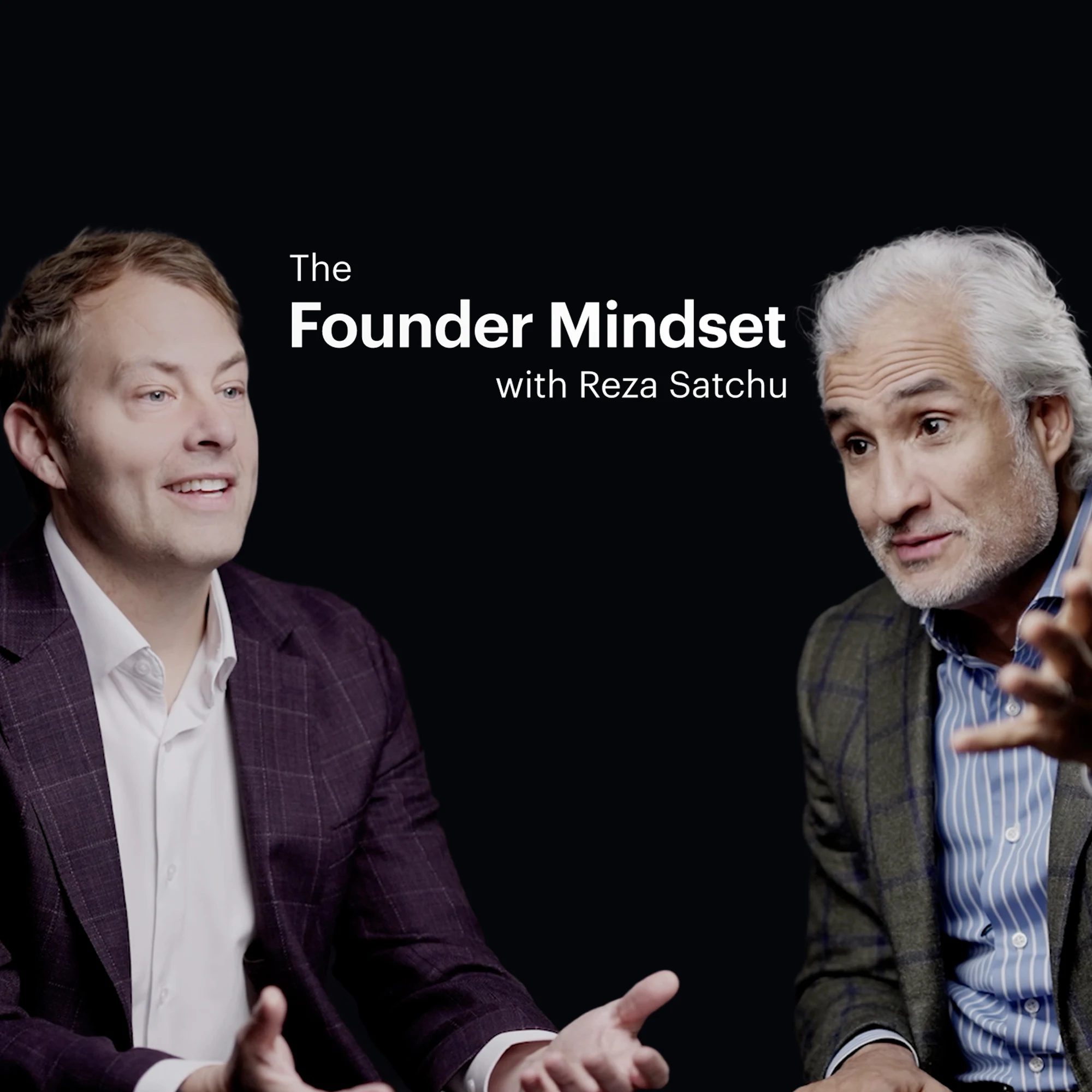
What does it take to be a founder?
David Deming is one of the world's leading economists on soft skills and the future of work, research that sits at the heart of the founder mindset. Today, as Dean of Harvard College, he's leading one of the world's great institutions through one of its most turbulent moments.
This is The Founder Mindset with Reza Satchu.
Resources
You can watch the high-quality video version of this episode on YouTube or Spotify.
Transcript
Intro
Reza Satchu: Harvard is in a firestorm right now.
David Deming: I just felt free to do what I thought was the right thing for Harvard and for the community. And then I've left you at the altar.
Reza Satchu: You've left me at the altar.
David Deming: I think that we should switch. I think I should ask you the questions.
Voiceover: This is The Founder Mindset with Reza Satchu.
Reza Satchu: The founder mindset is not just about starting a business. It's a way of living. At its core, what it enables a person to do is to do the thing that every human being wants-- to have a positive impact on the people that they care about. In this podcast, what we are going to do is meet with some of the greatest founders, some of the people that have had the most improbable journeys, who have lived with the founder mindset.
And through this process, what I hope to do, in partnership with The Foundry, is to share this mindset with as many people as possible so that they, too, can benefit from achieving the impact that they most want to achieve. This is The Founder Mindset, and I'm Reza Satchu.
Voiceover: What does it take to be a founder? David Deming is one of the world's leading economists on soft skills and the future of work, research that sits at the heart of the founder mindset. Today, as Dean of Harvard College, he's leading one of the world's great institutions through one of its most turbulent moments.
--
Reza Satchu: All right, David Deming, I have to tell you that I'm incredibly disappointed to have you on this podcast.
David Deming: Oh, no.
Reza Satchu: Yeah, oh, no. You're right. I spent five years in the wilderness looking for a partner to help me teach the founder mindset, and in you, I thought I'd found that perfect partner. And you've committed to me.
David Deming: And then I've left you at the altar.
Reza Satchu: You've left me at the altar.
David Deming: I think you're doing just fine, though.
Reza Satchu: I say to my students that they can't close, but clearly, I can't close, right? So it was surprising to me, after having been here for five years, that you were the person that I most wanted to teach with, and that I wanted to build this founder mindset with. People would look at me and say, you know what, Reza? The person you'd want to partner with is a founder, another founder. And you and I have many things that are not uncommon, but it turns out we have a mindset that may be in common. And so talk to me a little bit about how you would define your founder mindset.
David Deming: Yeah, so first of all, you're right. On paper, we don't have that much in common. I've never found anything. I'm an academic. I'm a scholar. I'm an egghead. And I've been working for many years on issues that I think we jointly care about, so maybe that's the connection-- things like labor market, skills, AI, jobs, what does it mean to be successful in the world, thinking about young people's career paths.
But I've been doing that as a scholar, somebody who does research and teaching, for almost 20 years now. And so that was really my path. That was the path I was on. And so you might look at that and say, oh, being an academic is like the opposite of being a founder.
Reza Satchu: When you think about an academic, you would think that, in many ways, it's the furthest thing from a founder.
David Deming: Yeah.
Reza Satchu: Right? I mean, you think to yourself, oh, this person just sits and reads books and doesn't really engage with the world.
David Deming: I think you may have even said that to me the first time I talked to you.
Reza Satchu: Yeah, I think I might have said that. And of course, what I learned is there's some real parallels. So can you speak to some of those?
David Deming: Yeah, I would say that-- I think I may have said this to you, too-- I actually think academic research is a lot more like founding than you might think. And that's because in both professions, the idea is to create something from nothing, to bring to life, to speak into existence some new business in one case, some new research question, some new finding, some new truth that didn't previously exist, and then to convince other people that it's important and worth paying attention to.
And so what really makes a good scholar, at the end of the day, is the ability to see around corners, to see things, to see topics or issues or problems that other people have seen for a long time and looked at it one way, and then you turn it on its head a little bit, or you find some new way in, and you answer a question. And then after you do it, everyone says, oh, well, that was obvious.
Reza Satchu: Yeah, right.
David Deming: Of course that needed to happen.
Reza Satchu: Yeah.
But yet, you kind of saw it one step ahead of everyone else. And that's-- I think a lot like founding.
But it's actually, you are correct that my perception--
David Deming: We can stop the tape right there. I'm correct.
Reza Satchu: I will admit that my perception in academia was that it was the furthest thing--
David Deming: Yeah.
Reza Satchu: --from founding.
David Deming: Yeah.
Reza Satchu: And what I've learned and what I saw with you is that there's some real parallels. And in many ways, I talk about the founder journey as being a hero's journey.
David Deming: Yeah.
Reza Satchu: And it's not that different from the process of becoming a tenured academic, which is, effectively, you have to commit to something that's very uncertain, that most people don't see.
David Deming: Yes.
Reza Satchu: Right? So you're imagining something in the world to exist that others don't see. And there's a real commitment, and there's real risk to it, because you could be wrong, and you could have wasted many years on a path that ultimately is not going to lead to fruition.
David Deming: Yes, yes.
Reza Satchu: OK? And it's almost, in many ways, like a founder where you're thinking to yourself, well, people can't see it. And on the one hand, you're upset they can't see it, but on the other hand, you realize that the reason you want them not to be able to see it is so that the disproportionate learning and resources can accrue to you.
David Deming: I tell my students all the time, if-- and they say, oh, I'm having trouble doing this. Look, if it were easy, somebody else would have done it already, right?
Reza Satchu: Correct.
David Deming: And so you have to find a problem that's really hard and solve it in a different way. I'll give you one example. When I was a junior faculty member-- so assistant professor at Harvard on the tenure track, very hard thing to do, everyone's struggling to get tenure-- I got off to a good early start. I published a bunch of papers, I would say conventionally well-published papers. Not earth-shattering--
Reza Satchu: Right.
David Deming: --but just the things I was supposed to do. And I decided-- I had always been interested in this idea of soft skills, and particularly, in teamwork.
Reza Satchu: This is an example of something which, today, everyone's talking about, but at the time, people probably thought, Deming, this is going to hurt your chances of getting tenure.
David Deming: Yeah. Yeah, so if you interview employers, they'll say, what are the things you're looking for? It's all the things people call soft skills-- ability to work in a team, ability to communicate, ability to solve problems, make good decisions under pressure, all that kind of stuff. And it was clear employers were selecting for that.
David Deming: But economists were really not taking that seriously, and particularly not taking seriously the idea that-- I would call it social skills, the ability to work well with others, is actually economically valuable. It's not valuable like cocktail party conversation. It's actually, you would hire somebody who's good at working in a team.
Reza Satchu: Yeah. Well, absolutely.
David Deming: And that was kind of a-- nobody was talking about that.
Reza Satchu: Right. Part of the reason probably no one's talking about is because-- and this is where I bet your research came in-- was it's very hard to evaluate how someone's behaving in a team.
David Deming: Yes, yes.
Reza Satchu: Right? Because how do you control the other team members? If it's ineffective, who's to blame for the ineffectiveness?
David Deming: Yes, exactly. The thing that I did, which it very did feel very much like founding, was I kind of went-- I was on sabbatical. I had some time off from teaching, and I decided I was going to spend six months working on this project, which was how to get around the idea that social skills, ability to work in a team, is much more valuable in the economy now than it used to be.
Reza Satchu: Right.
David Deming: So I had this hypothesis, and I tried to find some data, a little bit of an economic model, a way to explain it. And I didn't really know where it was going, but I said, OK, I'm going to take a few months and just try to work on this problem and figure it out. And I spent all of this time just working on it, having no idea where it would lead. Every time I told people about it, they were kind of bemused, like, oh, social skills, sounds good-- pat on the head.
Reza Satchu: Right.
David Deming: And so I spent all this time working on it and wrote this paper and had no idea how it was going to be received. And that ended up being my most influential paper.
Reza Satchu: This is very similar to a founder who has to make a judgment on something really important, and most people can't see it, but the founder stays committed. And I have this phrase, saying-- "The magic happens." So here the magic happened for you. But the question is, is, why did you have conviction at the time when others couldn't see it?
David Deming: I can't say exactly why, but I think it was-- I just felt like this is so obviously true. And I tried to imagine myself in some future world where everybody agreed it was obviously true.
Reza Satchu: Right.
David Deming: And I was like, if I do this and I pull this off, everyone's going to look at this and say, that was a good idea. That worked. And so I just had the conviction that that would happen.
Reza Satchu: OK, but let me ask it a different way, which is I find that the biggest-- you ask a group of people, do you want to be a founder, most people will say yes, OK? Because what they imagine is that they can create something, they can build something, they can accrue the resources and ultimately have the freedom to make the impact they want to have.
David Deming: Yeah.
Reza Satchu: OK, so it's a pretty positive thing. And then you will say, what blocks you? And it won't be that they don't have ideas. It will be that they can't believe that the idea that they have is worthwhile for them to pursue, given there are so many others who should have thought of it--
David Deming: Yes.
Reza Satchu: --and certainly who have more resources than them.
Now, what I will say is, most businesses you know wouldn't exist today if the founder felt that way, OK? Elon Musk had no right to build a car company under the noses of GM. Jeff Bezos had no right to build Amazon under the noses of the folks at Barnes & Noble. So my question to you here is, you had this insight that soft skills mattered.
David Deming: Yes.
Reza Satchu: OK? But there must have been a part of you saying, well, there are all these other economists who've been in and around this space for years, decades. Who am I to believe that they'd miss this?
David Deming: Yeah, part of me did think that. Or part of me thought maybe the reason they missed it was because it's actually not that interesting in the first place, and no one's going to like it. I did think about that, but I thought, once I'm in, I'm in. And so I just said, OK, I'm going to write the absolute best-- I'm going to do the absolute best version of this research I possibly can. And once I decided I was going to do it, I just pursued it with relentless conviction.
Reza Satchu: Yeah, full commitment. Yeah.
David Deming: I just went all the way with it.
Reza Satchu: Yeah.
The other part of it, too, as you know, is, once you have a new idea, if it's a business or a research idea, you have to sell it, too. So part of it is, if you're fully committed to it, and you sell it to people, and they're like, oh, that is pretty compelling--
David Deming: Yeah.
[INTERPOSING VOICES]
Reza Satchu: --to cut off other options on research.
David Deming: That's it.
Reza Satchu: That's what you committed to.
David Deming: Yes.
Reza Satchu: And I guess the magic happened because other people also saw the capabilities that you had of what you learned.
David Deming: Yeah, I would say this research agenda is what got me tenure at Harvard and what got me a lot of--
Reza Satchu: Well, let's talk about that because you got tenure pretty damn quickly.
David Deming: I did. Yeah.
Reza Satchu: Yeah. So tell me-- I mean, this is-- what I've also learned about tenure, it's a very competitive process.
David Deming: It is.
Reza Satchu: Half the people that start it don't get it anymore. And certainly very few people get it as early as you did. And so to what do you attribute that?
David Deming: Part of it is, I got off to an early start, and that was good. I would say another thing is one can go up-- so the way the tenure track works is you have some number of years at Harvard. It's usually eight. You have eight years to get tenure. And the system is what they call upper out, which means you go up for tenure, and you say, OK, make me a full professor, which means give me lifetime employment. But if you don't get it, you have to leave.
Reza Satchu: Wow.
David Deming: So you can't just--
Reza Satchu: There's no exceptions?
David Deming: No exceptions. That's why it's up or out.
Reza Satchu: And whose decision is it as to when you go?
David Deming: A lot of people have to say yes. So first it's your department and then your school. And then the president and provost do something called the ad hoc, which is at the highest level of the university. They have to approve your tenure. So you have to get through all those-- jump through all those hoops. The thing is, most people wait until the very end of their tenure clock. So if you have eight years, you take all eight years or 10 years, whatever, how many years you have, depending on the school, because it's a one-way door.
Reza Satchu: Right.
David Deming: Right?
Reza Satchu: Yeah.
David Deming: And so what I did was I went-- I got tenure early because I chose to go up for tenure early. So even though I had four more years on my tenure clock, I decided to go up for tenure, and that was because I had interests from other universities, and I decided that I was going to push my chips in. I wanted to stay, but I thought, look, if I don't get it, some of these places are pretty good landing spots. So I just decided to take a little bit of-- it was a big risk, but it worked out.
Reza Satchu: Sometimes those risks also signal something to the other side, meaning my sense is, psychologically, what's happening also is, Harvard, or whoever the people, are like-- they're saying, wow, this is impressive that this person is actually putting it all in now.
David Deming: Yeah. I would say that, and it's also partly timing. So it turned out that this agenda that I mentioned to you was going while people were talking about I had landed the paper in the top journal in the field, and so it just felt like the right time. So as with founding, timing is also very important.
Reza Satchu: Yeah. So of course, this goes back to my dilemma and why I'm not happy about you being here, is that we were supposed to do something together.
David Deming: We were. Yes.
Reza Satchu: And the idea, of course, was that, especially in the face of AI, this whole learning by doing, teaching judgment, consequential decision-making, inspiring people to build things, was completely aligned with our work, albeit from different perspectives, you as an academic and a researcher and me as a practitioner and a founder.
David Deming: Yeah, that's exactly right. Let me explain that. Because if you think about soft skills, like the soft skills we talked about, it's not-- those aren't content. So it's not like, OK, it's fifth period, so it's teamwork time. It's not really about the knowledge. It's about the pedagogy. It's the way you teach.
And so if you're actually going to build a curriculum that teaches people soft skills, it necessitates a change in the way you teach, not what you teach. And so that means learning by doing, project-based learning, working in groups. You really have to lean into that in order to teach those skills effectively. And I saw you as somebody who was already doing that in your class.
Reza Satchu: And look, I think what we saw and what we are-- I mean, look, we are still working together on this, but of course, I think you and I both believe that education is going to change over the next decade or so--
David Deming: Absolutely. It has to.
Reza Satchu: --in many ways around these functions that we're talking about. OK, so we are partners for a week, and then you get tapped on the shoulder to be the Dean of the college. OK, and so let me ask you, this is, I mean, on the one hand, a very exciting position, but on the other hand, not obvious, OK, meaning Harvard is in a firestorm right now. There's lots of critics. And the position you're in is one that is incredibly visible and potentially quite incendiary, OK?
David Deming: Yes.
Reza Satchu: I mean, there's lots that can happen here, OK?
David Deming: Yep.
Reza Satchu: So tell me about how you thought about the position and why you took it.
David Deming: Yeah.
Reza Satchu: And what do you see as the opportunities and some of the challenges?
David Deming: Well, first thing I'll say is, it was bittersweet. It was not an easy decision. So I guess the way I'd say it, Reza, is, when I-- I did a bunch of Meet the Dean things in July and August, when I started. And I did a big orientation with several hundred people, and they submitted written questions in advance. And one of the questions-- a great question was, was this your dream job?
Reza Satchu: Right.
David Deming: Meaning, was Dean of Harvard College your dream job?
Was it, or wasn't it?
And if so, what did you do to get it? Which is a good question, a career development question. And I said, kind of without thinking, actually, I left my dream job to take this job. That's not because I don't like this job. I actually do. I feel very fulfilled doing it, and I love it. But part of the reason I know that this-- being a researcher and a teacher was the right job for me and was the thing I always wanted to do, is because I had had so many other jobs that I wasn't too good at and didn't really enjoy.
And I still love it. That's who I feel I am at some level. But I think if you believe in an institution-- and I believe in Harvard, and I think Harvard is a monument to human progress. It is a great institution that has so much potential. And it's been good to me personally. So if you've been a part of an institution and/or a community that's been good to you and you believe in--
Reza Satchu: Right.
David Deming: --and you get asked to serve, you just find a way to say yes. So I just didn't feel that I could say no, even though I was disappointed.
Reza Satchu: No, and you couldn't. And you know I was incredibly supportive of you--
David Deming: Yeah. You were. You were.
Reza Satchu: --taking it. And I think it's actually an incredibly consequential position at a very important time for the institution.
David Deming: And I have a great outside option, so I don't have to--
Reza Satchu: That's right. You know what? But I know the way to get you to take it is to cut it off.
[LAUGHTER]
Reza Satchu: OK, so let's talk about this role because I agree with you. You are in a-- it's an important time in the institution, and it's perhaps why you felt compelled you had to do it to serve--
David Deming: Yes, yeah.
Reza Satchu: --precisely because the institution is under attack.
David Deming: Yes.
Reza Satchu: So tell me how that changes your opportunity set in terms of the impact you want to have, either positive or negative, or just your mindset, because it's not business as usual.
David Deming: Yes. So when I decided to take the job, I think I joke with some of my colleagues, if you've taken on the job of being the dean of any of the schools, Srikant or anybody else a few years ago, you can say to people with a straight face, I had no idea what I was getting into. And I thought about it a lot, and I decided that the only way I'd be willing to do this is if I just felt free to do what I thought was the right thing for Harvard and for the community and not worry about the consequences, frankly, not worry about getting run out of town, getting--
Reza Satchu: You're willing to take risks.
David Deming: I think you have to. I think that's what we need right now, is somebody who says, look, this is the right thing to do. This is the right course to set. And if that upsets people or makes my life difficult, you just kind of have to be willing to do it. So I don't know that what I'm doing is right, but that's the way I think about it, which is the challenge that Harvard faces is not just a challenge of today. Too few people in this country and in the world see themselves in what a university like Harvard provides.
Reza Satchu: Do you see that as the critical challenge?
David Deming: I do. I do, and I don't think it's just about the current administration. And the reason I don't think that is because actually, a year and a half ago, the Massachusetts legislature, which is a heavily Democratic legislature, seriously considered a proposal for an endowment tax.
Reza Satchu: Oh, interesting.
David Deming: And then the Republican Congress passed an endowment tax last year. And so the issue is on both political sides, people see Harvard and universities like it as not serving the public.
Reza Satchu: Right. And so is that an accessibility problem or something else?
David Deming: I think part of it is a messaging problem, because the reality is our graduates do go on to start companies that create jobs and serve in the military and run for office and do all kinds of great things, and we don't talk about that enough. But I don't think that's the only part of the problem. I think that we need to make the case to the American public that we are worth investing in. And if you're a university that is only going to take 5% of applicants, how do you possibly make that case?
The only way you make that case is if you say, look, even if you and your children and your grandchildren never come to this place, Harvard is providing value to the public that exceeds just being able to come here. So let me give an example. Like, if somebody graduates from Harvard and goes and works in a science lab and then invents a cure for a disease that kills millions--
Reza Satchu: That helps everyone.
David Deming: --then it helps everyone. And you don't really care who that person is. And so the only way we can prove our worth is to lean in to the value we provide to the public and to a group of people that is much greater than just who actually gets to be here.
Reza Satchu: Right.
David Deming: So that's the challenge we face. There's no overnight solution to that.
Reza Satchu: Right. But do you think that's more of a messaging problem? Is that occurring today?
David Deming: I think--
Reza Satchu: Do you think if Harvard is doing those things, and the alumni--
David Deming: I do.
Reza Satchu: --and the student body?
David Deming: I do, yes. Doesn't mean we can't do it better. But I think we are doing it more than you might think. There are more Medal of Honor recipients for military service, Medal of Honor recipients at Harvard in its history than any other American university, except the service academies. And we've had more of our graduates serve in public office in the US than any other university.
And I don't have data on it, but lots of people who graduate from Harvard started companies that created jobs, that created all kinds of economic value. So we are doing that. And of course, great science comes out of Harvard, too. But we could do more of it, and we can talk about it in a more forthright way. And so that's part of what I see as my role is to talk more about the public purpose of Harvard, and also to convince our students to engage more in serving the public purpose.
Reza Satchu: So if you think about one or two of the key decisions you've made as Dean, things that you're either proud of or that you had to think hard about, give me an example of one or two.
David Deming: Yeah, so a couple of things. On the educational side, we've been leaning in very hard to try to modernize the teaching and learning that happens at Harvard to reflect advances in AI that I think are really just pervading student life. Students are using AI all the time. And it's not anybody's fault that AI is basically--
Reza Satchu: It's potentially diminishing their educational experience.
David Deming: It potentially is. Yeah, I think it has great potential to make education better, but it has to be used thoughtfully. Basically, everybody's using AI. I don't think it's fair to expect a university like Harvard to have a fully worked out strategy for such a new technology now. But we have to get on it. And so I've been working a lot with the team at the Office of Undergraduate Education, trying to develop a strategy to deal with the challenges and opportunities presented by generative AI in the classroom.
So that's not one decision, but it's a decision to set that as a priority. I sent an email to students and staff at the beginning of the year outlining my priorities for the year, and that was one of them. We've been doing a lot of work trying to-- what we call recenter academics, which means just make the classroom a more central part of student experience, combat grade inflation, make teaching better, all that kind of stuff. So that's been a big focus.
And then the other thing is this communications bit. I started an Instagram. I talk a lot about the public purpose of Harvard and have been out there, on the stump, talking about it a lot more in the ways that I was describing.
Reza Satchu: What I noticed about you is that unlike what people's perception of a dean might be, is that you're very willing to engage in uncertainty, meaning you're willing to have a debate, willing to have a conversation without all the answers prescripted.
David Deming: Yes, exactly. I--
Reza Satchu: And people react very positively to that.
David Deming: Yeah, I've been holding open fora with students. So I go, and they can ask me questions on the record. Student newspapers are there, and I try to be available to students. And I've had a lot of students come to me and talking to me, unhappy about a lot of things. And I just try to take it in stride and explain to them my point of view. And the reason I have a lot of hope for our students and for the future of Harvard is that a lot of what it comes down to, when people want to say things differently, is, they're only looking at it from their own perspective.
But when I explain to them, actually, my responsibility is to not only all of the students of Harvard today, but all future students at Harvard. So if you want to think about a thing like grade inflation, OK, so any individual student would prefer to get an easy A, rather than a hard A. And I understand that. I've been there, you know? But if we just gave everybody As, that would be bad for everybody.
Reza Satchu: Yes, correct.
David Deming: Right? So--
[INAUDIBLE]
So you have to think one step higher and say, what is the right solution for everybody? And then when I talk to students about that, I say, look, we're trying to make your degree-- give your degree a sense of value that lasts. And that's something that benefits you and benefits future students. And even though you might not think this is in your interest, it actually is in your interest, and we're doing it in your interest.
And so when I've had those conversations and talked about the broader purpose of what we're doing, I feel like students resonate with that. And that's where I think the communication comes in. We just need to be much more upfront about what we're doing ...
Reza Satchu: Whenever, let's say, your term ends, in 3, 5, 10 years, whatever it may be, and we finally get you over on this side, paint me a picture of what you hope you've accomplished.
David Deming: Great question. I hope at a broad level, that more people in American society and in the world see Harvard as a force for good, and that some of the-- there's always going to be people who are cynical. We have a big endowment, we're elite, et cetera. But I hope some of those people start to understand more, that we can break through and truly provide value to the public and explain that value in a better way.
So I hope that we won't be the butt of so many jokes and that we will still be a beacon for talent around the world, that people can understand that when they come to Harvard, we want you if you're very talented. And it's not-- we want you without regard to your ability to pay. That's true now.
Reza Satchu: Yes.
David Deming: And I hope it's true in the future. So I hope we can basically be a talent magnet from all around the world and then send people outside of our walls to provide value to everybody.
Reza Satchu: So it's really a force for good in the world.
David Deming: Absolutely. Yeah.
Reza Satchu: So David, you think about-- because I think in our core, we're all driven. I call it the founder mindset, but it's actually a human desire, which is, we all want to have a positive impact on the people we care about. And that can be as small as ourselves, our family, and all the way to the world. It strikes me that your founder journey is really now-- I know you care deeply about your family, but it's also about, OK, I'd love to have this positive impact on the world through Harvard. But there are going to be a series of commitments that you're going to have to make in order to make that happen. OK? Are there any commitments that you're considering now that could be relevant to that goal?
David Deming: [SIGHS] Any specific commitments?
Reza Satchu: Yeah.
David Deming: Well, as I mentioned earlier, I've committed to always doing the right thing, even if it hurts. And there have been several times when I've had to do that exactly. And I've committed to students that I'll always tell them the truth. And so far, I've been able to keep that promise.
Reza Satchu: Yeah, so it's interesting because telling the truth-- the great thing about telling the truth is, you don't have to forget about what you said.
David Deming: Exactly.
Reza Satchu: It's easy to remember what the truth is, but sometimes it's very harsh.
David Deming: Yes.
Reza Satchu: And so but the reality is, I think, ultimately, people really do respect it.
David Deming: Yes. I heard a piece of wisdom from somebody who led a bunch of colleges, and they said, if you keep your eyes on the horizon, and you tell people you're doing that, they'll give you a little bit of grace. So I try to remember that. The idea is if they see that I'm trying to operate-- trying to do something bigger, and we're not just living in today's crisis, but we're actually trying to accomplish something more in the long run, then people are willing to buy in to that.
Reza Satchu: Tell me the most controversial decision you've had to make as Dean of Harvard College.
David Deming: Are you trying to get me fired?
Reza Satchu: Well, maybe.
David Deming: What--
Reza Satchu: I think I just might, given how all this started.
David Deming: How would you like it if the shoe was on the other foot? What if I asked you all the tough questions?
Reza Satchu: You know what? That's not the game here.
David Deming: Maybe it is the game. I think the audience would love to see that, don't you?
Reza Satchu: What are you suggesting?
David Deming: I think that we should switch. I think I should ask you the questions.
Reza Satchu: I'm not sure I'm ready for that.
David Deming: You know what we need to do.
Reza Satchu: What's that?
David Deming: We got to switch seats. Come on, let's do it. Yeah, right now, let's do it.
Reza Satchu: OK, here we go. [LAUGHS] Wow. Wow, this feels like I'm sinking over here. I think I prefer the other side, David.
David Deming: Trouble already, huh?
Reza Satchu: Just be nice to me, will you?
David Deming: All right, Reza Satchu.
Reza Satchu: Yes.
David Deming: Let's talk about your founder mindset.
Reza Satchu: I may have one.
David Deming: Yes. So you've started six companies?
Reza Satchu: Correct.
David Deming: And you exited those companies for how much in total?
Reza Satchu: Well, I exited five of them for just over $3 and 1/2 billion.
David Deming: OK. That's a lot of money.
Reza Satchu: Yes, for many of my shareholders. Here's the thing about making money early in your life. Obviously, especially given our childhood, that was great. But you actually feel at a loss because you think you have a career ahead of you, and you think you're going to do X, Y, and Z, and suddenly, you have some time and space, OK? And you also think you know a lot more than
David Deming: I mean, you can say you feel at a loss, but you feel at a gain, would be a better way to say it.
Reza Satchu: Well, OK, you feel at a gain, in some ways, OK, but you also realize that you have an inner purpose, which is that you actually enjoy building things, and you have a sense of curiosity. And so, yes, I didn't do very much for about 18 months, but I drove my wife crazy. I could only organize the fridge for so long before I go crazy.
David Deming: Hold on. So you sold your company for a billion?
Reza Satchu: Yeah.
David Deming: And then you bummed around for 18 months figuring out what's next?
Reza Satchu: Yes.
David Deming: OK, and then what did you land on right after that?
Reza Satchu: Well, so what's interesting is, it's a funny story, because I came back to visit my parents who were living in Toronto. We were living in San Francisco at the time. And I was stuck in a traffic jam, and I looked outside and saw these self-storage facilities. And I saw something that I'm sure many other people have seen.
The difference, I think, was a very fortunate thing happened, which was I said to myself, why do these self-storage facilities exist one after the other? OK, there were literally eight of them within a mile and all single-story. And I stopped the car and walked into one of these facilities. And despite the fact that it felt unsafe, it was unlit, there was no customer service, they were completely full. And it was that insight that led me to build a self-storage business.
David Deming: So you went into business number two after that?
Reza Satchu: Correct.
David Deming: 18 months.
Reza Satchu: Yeah.
David Deming: Did you worry when you started the second business that you were going to be-- maybe you were a one-hit wonder?
Reza Satchu: Yes.
David Deming: Is that how you found motivation? Like, I want to prove I can do it again?
Reza Satchu: Yeah. I mean, I think what's interesting is that I went from a high-tech business to something in real estate, so something very tangible and granular.
David Deming: Yeah. And did you do that on purpose?
Reza Satchu: I don't know--
David Deming: Was that part of the appeal?
Reza Satchu: I think in retrospect, it must have been on purpose, subconsciously on purpose. I didn't want to have the same level of volatility. I wanted something that I could touch and feel, OK, that was there. And I think that the thing about being a second-time founder is, in some ways, it's easier because you've got some experience, but in some ways, it's harder because now you have expectations. OK, you have a set of expectations from others and yourself that how could you possibly not have this succeed? And so--
David Deming: So when you say harder, though, you mean harder only in your own mind.
Reza Satchu: Yes.
David Deming: People are willing to take a chance on you, raising money is easier.
Reza Satchu: It turns out that being a founder, if I had to say what's the most critical piece to being a successful founder, it is literally all about your mindset, especially in times of crisis.
David Deming: That's why you teach a course called the Founder Mindset.
Reza Satchu: Correct. Yeah, yeah.
David Deming: So that tracks.
Reza Satchu: All these things about business model, it's all important, but the most important thing is, what is your mindset? What's your mindset around curiosity, around commitment, around building through crisis, all of the--
David Deming: OK, so was your mindset the second time around different than your mindset the first time around?
Reza Satchu: I think that the second time around, I probably trusted my judgment a little bit more because I felt like, OK-- I view judgment as a bicep. You can actually build it by using it. And so I think the commitments I would have made around my judgments would have been quicker and faster the second time around.
David Deming: And then when you did it the second time, was it as fun the first time? What was the experience of founding again? And you said that business succeeded, right?
Reza Satchu: Yeah.
David Deming: You exited that one as well?
Reza Satchu: Yeah, we sold it for $110 million. So I think that part of it is a game, in some ways. It's a game where you want--
David Deming: You want you enjoy.
Reza Satchu: Yeah, that I do enjoy. And so you're out there in the world, trying to create-- in this case, what we were doing was creating-- we were the first providers of multi-story storage facilities in high household income areas in downtown urban centers across Canada. So that was our insight, was that you could actually build up, instead of across, and build downtown, as opposed to on highways, which was-- not many people thought that was possible. We had conviction that we could do it. And look, it's fun proving your thesis out. And look, you're not always right. And but when you are, you feel good about it because you've learned a lot, and you've attracted disproportionate resources because of it.
David Deming: So you had a second company. It was 2003. You were doing very well financially. You just had kids, so you're a new father. And you decided to add a commitment to teaching on top of that. So you showed up at the University of Toronto basically begging for a job.
Reza Satchu: Yeah. In 2003, I was going back to visit my parents on the same trip that I was telling you about stopping the car. My parents lived downtown near the University of Toronto. I went for a walk. And I was thinking to myself, why is it that the kids that I went to McGill with, who were just as smart and hardworking as the kids that I went to Harvard with or worked on Wall Street with, why were they having less impact? Like, forget about money. Just, why were they having less impact?
And it struck me that I had a lot to do with expectations and exposure in undergrad, meaning in my undergrad, I never met anyone other than a professor. I didn't meet anyone who had done anything else other than academia, which is fine, but it didn't provide much exposure to anything else.
And the expectations of people that went to Harvard or I worked with on Wall Street wasn't that they were going to write a book. They were going to win the Pulitzer Prize. There's a business school called Rotman at University of Toronto, and I went there first and knocked on Roger Martin's door, who was the Dean. He wasn't there. It was literally an idea I had walking along.
So you just walked the halls of the academic building.
And then I looked outside, and there was the Department of Economics. And I pushed my way in. And the assistant-- as I look up at the board, I say, I want to see Dean Michael Berkowitz. I don't know know who Dean Michael Berkowitz is. And the assistant says, do you have an appointment? I say, no. I said, but I'd really like to meet him. Is he around? I could see around the corner that he was there.
And so I poked my head in, and I say, Dean, do you mind speaking with me? And he has no idea who I am. And he cautiously says, OK. So we sit down, and I tell him who I am. And I say, listen, I'd like to teach. He said, look, I meet lots of fancy entrepreneurs like you. You should just guest lecture. You know what? You can give us a little guest lecture. I said, no, no, no. I want a fully accredited course that I am responsible for, that I will create the curriculum. I will show up twice a week to teach.
And Michael Berkowitz said to me, have you ever taught before? I said, no. He said, do you have your PhD? I said, no. He said, well, why would I ever let you teach a class? And I looked him in the eye, and I said, because I'm completely committed to creating the best class at University of Toronto. And he just looked at me. And it's my point around commitment. And he said, you know what? This guy may be crazy, but he's fully committed, and I'm going to bet on it.
David Deming: By the way, this should make all academics like me feel good, because you went out there, and you made $1 billion, and you decided, what do I want to do? I want to teach. I want to be a teacher. That's what you wanted to do.
Reza Satchu: And you know what? It turned out that teaching has represented probably a third to 40% of my time for the last 23 years.
David Deming: So you must really love it.
Reza Satchu: Yeah.
David Deming: Because you don't need the money.
Reza Satchu: No.
David Deming: And you had a lot of other obligations in your life.
Reza Satchu: Yeah.
David Deming: So I know you're all about commitment. OK, so I want to ask you a question. You said you had six businesses. And you were only into business number two when you started teaching. So here you are, telling people they have to commit fully to something. And you've got your teaching on the side and your businesses on the side. You're preserving your optionality--
Reza Satchu: Yes, so it's very interesting.
David Deming: --are you not?
Reza Satchu: OK, so here's how I would say-- it's a great question, and I think it's something that I've thought a lot about, OK? So let's be clear. Every business, including the most recent business, which was a line of student housing, which we just sold last year, they've all been sequential, meaning there's never been two businesses at the same time. They've always been sequential. So fully committed to the business.
It turns out that teaching, for me, doesn't represent a distraction or optionality, because it's not preserving any commercial thing for me. What it is, is, it's the manifestation real-time of the founder mindset, which is the reason I want to be a founder and the reason why I think most people want to be founders is that it enables me to have the impact that I want to have, OK, concurrently with building.
David Deming: Do you think teaching has made you a better founder?
Reza Satchu: Yeah, it has. And I don't think that's why I did it, but I think it has made me a better founder, OK? Well, a few things. One is it gives me fulfillment. And so in times of stress, it's something which I feel I'm giving to the world. And a founding journey is quite isolated and a little bit selfish, in some ways. So this part of my life is something where I feel like there is no-- I don't even invest. I'm one of the only professors you know at Harvard or anywhere else that does not invest in any of my students. And let me just tell you, every student is dying--
David Deming: You mean financially?
Reza Satchu: Financially. Yeah, invest in every other way, but I'm not interested in making money out of my students.
I don't invest in my students either.
And that's good.
I mean, I invest in them, but not financially.
Right, but it's rare it's common at the business school. And I'm not saying it in any pejorative manner. It's just a common thing. And so for me, it represents--
David Deming: You're saying that's not why you're doing it.
Reza Satchu: No, it represents the purity. And I think that the volatility of founding has been balanced by two things in my life-- my family and my teaching. And I think it's made me a better founder because in those intense moments of volatility, founders just-- there's a crisis at every turn. And so what these two things have given me is a sense of calm and peace and purpose.
And I'll tell you one other thing. I didn't hit the bullseye of building businesses that had a massive social purpose to them. So I built a better student housing business. I built a better self-storage business. I built a better fixed-income broker dealer. So for me, I wasn't clever enough to hit the bullseye of figuring out a business that I can build that would meaningfully improve people's lives, not just from a customer profit perspective, OK?
David Deming: Yeah, so the teaching is scratching a different itch for you.
Reza Satchu: The teaching is enabling me to basically have the impact along the way. Right? So--
David Deming: I know your students feel that way, too.
Reza Satchu: Yeah, I hope so.
David Deming: They're very devoted to you. I've heard from many of them. And it is inspiring. I mean, that's one thing I will say. Another reason why our partnership has worked is I've seen you in the classroom, and I've seen the impact you have on the students and how much you care, even though that sometimes involves some tough love.
And I remember, when I sat in on your first lecture, when I went up to the next candidate and I saw this, it was a classroom full of students. And you went in there and you said, OK, we're about to give out an award. I forget the details. There's three of you that are going to get to pitch. I want you to stand up if you think you deserve it. I was like, what is this? So then a bunch of students stand up. Maybe seven or eight people stand up. And you're like, hey, I know you. You're good. And then you made them pitch in front of everybody why they should get the spot.
Reza Satchu: Yes, correct.
David Deming: And then you walked over to another student who was sitting right in front of me, and you looked at him in the eye and you said, I've literally never heard you talk in class before. Honestly, I feel like I wasted a spot on you. There are lots of people who wanted to come, and you took it. So why do you think you should be able to do it?
Reza Satchu: Yes.
David Deming: And I was like, I can't believe this is happening. And he made some kind of half-hearted pitch about why-- you got to put yourself out there, you taught me that-- and you're like, OK, well, I gave you your audience, but this is a complete waste of time. And you just moved on from it. That was striking. And it had some pedagogical purpose. But why don't you talk a little bit about that?
Reza Satchu: OK, so everything I do in that classroom, for better or worse, is completely orchestrated and I think about, OK, meaning someone could look at that and be like, oh, Reza's just flying off the handle. Absolutely untrue. OK? I know the greatest teachable moment for that kid is to understand that he has an opportunity lost here, that as directly as I can tell him, that he misplayed this. There could have been much more learning, much more impact for him, or her-- I can't remember who it was-- and that they didn't take advantage of the opportunity.
And so I can either say something middle of the road and say, well, you're not the right fit here, where there's no learning, OK? There's zero. Or I can look them in the eye and say, effectively, you could just never let that happen again. Like, life is too short not to take advantage of opportunities like that.
David Deming: So I'll tell you two things about that that struck me. One was, it's so different than the pedagogical approach I've seen in most classrooms in a way that really made me think that I thought was really interesting. And without knowing whether it's the right thing for that student, I was just like, wow, that's really intere-- and people seem to buy it. The other thing was--
Reza Satchu: On this, David, what it turns out is I think the pendulum in teaching moved too far to one around comfort, OK? And so the problem with comfort is what we're actually trying to teach students is how to make decisions under uncertainty. Another way of saying it is leadership happens when you're uncomfortable. So I believe I need to create the most uncomfortable situation in the classroom so that they can learn how to perform and how to make judgments in those positions of discomfort so that they can exert themselves in the proper way, hopefully when they're put in those situations later in things that matter much more than a classroom.
David Deming: Yeah, and I'll say, the other part of the strategy that you haven't mentioned that I think works, is, it's a signal to everybody else in the classroom, too. So you're telling them this is a high-expectations, high-accountability environment.
Reza Satchu: I mean, let me give you example. My class in Harvard Business School, I mean, professors that come to my class are always in shock. No one would dare show up late. No one would show up unprepared. I just cold-call all the time. Everyone is prepared, and the quality of the discussion is super high.
David Deming: Do you think there are any people who could be founders, but who are sufficiently turned off by that approach that they don't take advantage of the opportunity in your class? In other words, do you think there are any costs? I get that there are benefits. Do you think there are costs to it?
Reza Satchu: So think of my class as a journey. And there's no question that there are people who take my class, and after the first quarter, they're just like, oh, my god, I can't. This is a nightmare. I can't do this. OK? And for me as a teacher, it's exactly those students that I'm most excited about impacting. OK? Because what happens through that journey, if I'm effective, is they actually realize what they're capable of. And the intensity of the class, the discomfort of the class is the thing that they become comfortable with.
David Deming: Yeah, and I will say, for the audience, I've seen you do this with students where you're tough on them, but then you also give them access to opportunities, introduce them to people, let them teach.
Reza Satchu: Correct. I test them. Yeah.
David Deming: And you love a comeback narrative.
Reza Satchu: I do love a comeback narrative. And I got to tell you, too many people like to operate in a position where their capabilities are in excess of their confidence, OK? Especially in the face of AI, that's a real mistake, because the thing we're really trying to teach is judgment, which means their confidence must be in excess of their capabilities. Now, not to such an extent where they become arrogant, but that's where judgment lies. And so what I need to do is create situations where they have to step in to uncertain situations. And yes, I love-- you're absolutely right that I love a comeback story.
David Deming: Yeah. How do you think that your teaching has changed over time? Because you've done two things. You've got more experience. You've started more companies. You've gone from University of Toronto to Harvard Business School. So how has it changed?
Reza Satchu: It's interesting. If my kids were here, they've watched me for 21 years teach. And I'm not sure if this is true or if they just were traumatized when they were younger, but they would say that I am softer today than I was 15 years ago. But I don't know if that's empirically true. It may just be for a seven-year-old watching this, they're a little more traumatized than a 22-year-old.
But I'd say the way it's changed is, I've done this long enough, both teaching and founding, that I have a great deal-- that doesn't mean I don't have things to learn, but I have a great deal of confidence in the subject matter that I'm teaching, meaning, students can disagree with me, but what I tell them is what I really believe to be true, born of my own experience.
And so when I talk to people about commitment, risk calibration, crisis management, all these things, I'm thinking of dozens of examples in my head. And so it's something where I've got more comfortable that what I'm doing is valuable and that it is quite differentiated. And at a place like Harvard, I've been able to create two courses from scratch, which are now amongst the most popular.
But what I'm much more interested is not that they're the most popular, it's that they're the most demanding. And so one of my classes, you can't even take unless you commit to not recruiting. So imagine that. Think about Harvard students--
David Deming: So just so people know, not recruiting means they're not looking for other jobs.
Reza Satchu: Correct. It's like cutting off their right arms.
David Deming: I'm not going to go work at McKinsey or Bain--
Reza Satchu: Correct, correct.
David Deming: --or Goldman Sachs.
Reza Satchu: Correct.
David Deming: I turn all those offers down in order to take this class.
Reza Satchu: Correct, correct. And the reason I do that is because I know the single-most important thing I can do to improve the profitability of that business launching is not business model optimization, it's mindset optimization. It is getting that person fully committed to making this work. And it's not just for the obvious reason, which is they'll find out what they're capable of. It's for the equally non-obvious reason, which is everyone else will look at this and see the fear or the ambition in that person's eyes and want to be part of it.
I mean, I do think the other thing, which you've done a good job of pointing out, is that I think students vastly overestimate the consequences of this. They think, oh, if I don't recruit now, I'll never get any opportunities. And actually, if you start a business and you fail--
Reza Satchu: Correct.
David Deming: --you're still a Harvard Business School graduate.
Reza Satchu: Correct.
David Deming: You're still pretty talented. People are still going to take a chance on you. So it's not-- the downside is not as big as you perceive.
Reza Satchu: Well, look, I mean, David, I love it when academic research backs up things that I've been saying. In this case, it really did.
David Deming: And not so much when it doesn't.
Reza Satchu: Yeah, exactly. That doesn't make the speech. But Paul Gompers, one of our colleagues, actually looked at 5 milliion data points. And what he showed was, if you look at people from similar educational backgrounds, and you look at one subset that goes to traditional jobs and one subset that founds and fails-- forget about founds and succeeds-- those people that found and failed re-enter into the traditional workforce with 2 and 1/2 years of seniority, because the market actually values the judgments.
I'll sometimes tell my students, if you go and you work in a smaller firm, or you go and you work for the government, you're going to get a lot of experience because you're making important decisions, and your office is much more understaffed, whereas if you go work at some big company, you're just a cog in a machine.
David Deming: Correct.
Reza Satchu: And so if you go have that experience, you might make less money, you might fail. But the learning that comes from that is going to benefit you the rest of your life.
I also think we're entering into a world where learning happens in decision-making, meaning learning--
That can only be acquired through experience.
Reza Satchu: Well--
You can't do it.
Reza Satchu: --you actually have to do it. You can't observe it. You can't advise on it. You can't memorize it. You have to do it. And you have to feel the weight of the risks and the consequences of making that decision.
OK, so speaking of feeling the weight of the risks and the consequences, I want to ask you about your last business, Alignvest. So--
Reza Satchu: Student housing, yeah.
Student housing, yes. So you had an offer to sell your business in 2023--
Reza Satchu: Yeah.
--for $1 billion.
Reza Satchu: A billion 50, yeah.
And did you take it?
Reza Satchu: OK, so this was very interesting. So we had several interested private equity buyers-- Blackstone, TPG, and others. And we had an offer for a billion 50, which would have been a massive home run for us, OK? And I would say, at the time that we got this offer, I did a real live case at Harvard Business School, and I asked my students what--
Very meta.
Reza Satchu: Yes, very much.
Case about your own things.
Reza Satchu: Yes, correct, correct. And I'm literally negotiating. Well, my 90 students are-- and so I asked the 90 students, what would you do? And every one of them said sell, OK? I chose not to sell, OK? And I think my partner of 22 years-- I controlled it, so ultimately, it was my decision. But I'd say that most of my team were very disappointed that I didn't sell.
And I think that for me, the reason I didn't sell wasn't because I was certain that it was the right decision not to sell, but that when I looked at it and I sort of thought to myself, OK, what is the downside risk here? And I thought the downside risk was that maybe we would lose a multiple, so potentially the price would go down from a billion 50 to $900 million. But I felt like there was an equal chance that the upside could be several hundred million dollars. And that, to me, felt like a good trade, whereas for everyone else, what they were looking at was, you could lose-- the price could go down to $900 million.
Colloquially.
Reza Satchu: Yeah.
And are you still holding this business right now?
Reza Satchu: No, no.
OK. Did you sell it then?
Reza Satchu: We did sell it.
What did you sell it for?
Reza Satchu: A billion 7.
Yeah, that's why you're smiling so much.
So that worked out very well.
Reza Satchu: Part of being a founder is you have to believe in yourself when no one else does. But is there a point at which that goes too far? And the answer is clearly yes in some sense. Like, it could have gone down.
Yes.
And so you basically made an actuarially correct decision. You thought there was a better-than-50% chance it would go up versus--
Reza Satchu: Correct.
--down or whatever.
Reza Satchu: Correct.
And so you decided to roll the dice on that.
Reza Satchu: Yes.
But maybe you wouldn't have if you were going from negative net worth to your first billion.
Reza Satchu: Yeah, I think that's an entirely--
So the question is, for the founders out there, how should they think about that? Is doubling down always the right answer?
Reza Satchu: So I think for first-time founders, in a situation like that, you can structure a deal where you take some liquidity and maintain your equity. So in that situation, the right answer for me as a first-time founder, if I think about it, would have been ideally to have just sold a minority interest, taken some liquidity--
Enough to where you feel comfortable [INAUDIBLE].
Reza Satchu: Where I feel comfortable. Correct, that I'm OK and keep writing it. And so that would have probably been the right answer as a first-time founder.
Is there a larger lesson in that? Like, you have to figure out where your non-negotiables are.
Reza Satchu: Yeah, correct.
And then once you do that, you can feel free to take the appropriate risks beyond that.
Reza Satchu: Yeah.
What share of decisions that you've made would you say you got right?
Reza Satchu: OK, so here's the thing about being a founder, is, you are on a path where you are constantly failing. And so you think to yourself, well, how is it logical that I think highly of myself, and yet I'm failing all the time? And then you realize that it's entirely rational. And the reason it's so rational is because the reason there are such disproportionate gains in learning and resources for founders is because they see something that others can't. And because people can't see it, you have a very hard time.
You have to convince them.
Reza Satchu: You've got to convince them. And most times, they still don't see it, even when you try to convince them. And so that could be investors. That could be employees. Like customers, let's take customers. Every business I have built, it's been the first 10 customers have all said no-- the first 20 customers.
OK, so one of your businesses failed. Tell me about that. What was that like?
Reza Satchu: OK, I think what I'm good at is, I'll look at an idea, and I'm willing to explore it and to believe that even though I don't have much resources, it's worth at least the soft C commitment, OK? So in this case, I had personally been investing in hedge funds, and I'd gone to a hedge fund conference.
And I wasn't on the HBS faculty at the time, but I was listening to an HBS faculty mate, a fellow named Randy Cohen, who I didn't know, talking about outperformance of a hedge fund manager selection. I thought, wow, this is very interesting. This is a scalable idea. I'm kind of doing this on my own, on a small scale. And so I went to Randy, and I said, listen, Randy, one day, if ever you want to make money, give me a call. And I gave him my business card, and that was the end of it. So he did call me the next week, OK?
And so very quickly, we came together, and we created a firm called Stellation, where we were going to find the world's best outperforming managers, get access to them because of my relationships, Randy's research. And we put together a all-star team, like, literally, a world-class team. And we very quickly raised $300 million, and we were doing fine.
And look, I love my partners from that firm, but I would say the reason-- I had decision-making authority, and I decided to give the money back. It was probably the hardest business decision I had to make, because at the time, it felt like a complete failure. It literally felt like a complete failure.
I mean, it was a complete failure. It just led to other successes down the line.
Reza Satchu: It did. But yeah, correct. And it really was a failure. But ultimately, the reason I gave the money back was because there wasn't stability in the partnership. OK? I had reverse-engineered skill sets, rather than making sure that we were all committed.
And you hit that experience of having a business fail because of the partnership, rather than the business, led you to believe in this idea of founder mindset, the idea that it's really more about the person?
Reza Satchu: Correct. I think, actually, no one said that, but I think that's very true. That's very interesting. Yeah.
That's why I'm in this chair now.
Reza Satchu: Yes, exactly. You may stay in that chair.
That's right.
Reza Satchu: Booting me out.
I think that's a wrap. Reza Satchu, thank you for being on Founder Mindset.
[LAUGHTER]
Reza Satchu: Take it over. All right.
Voiceover: You've been listening to The Founder Mindset with Reza Satchu.