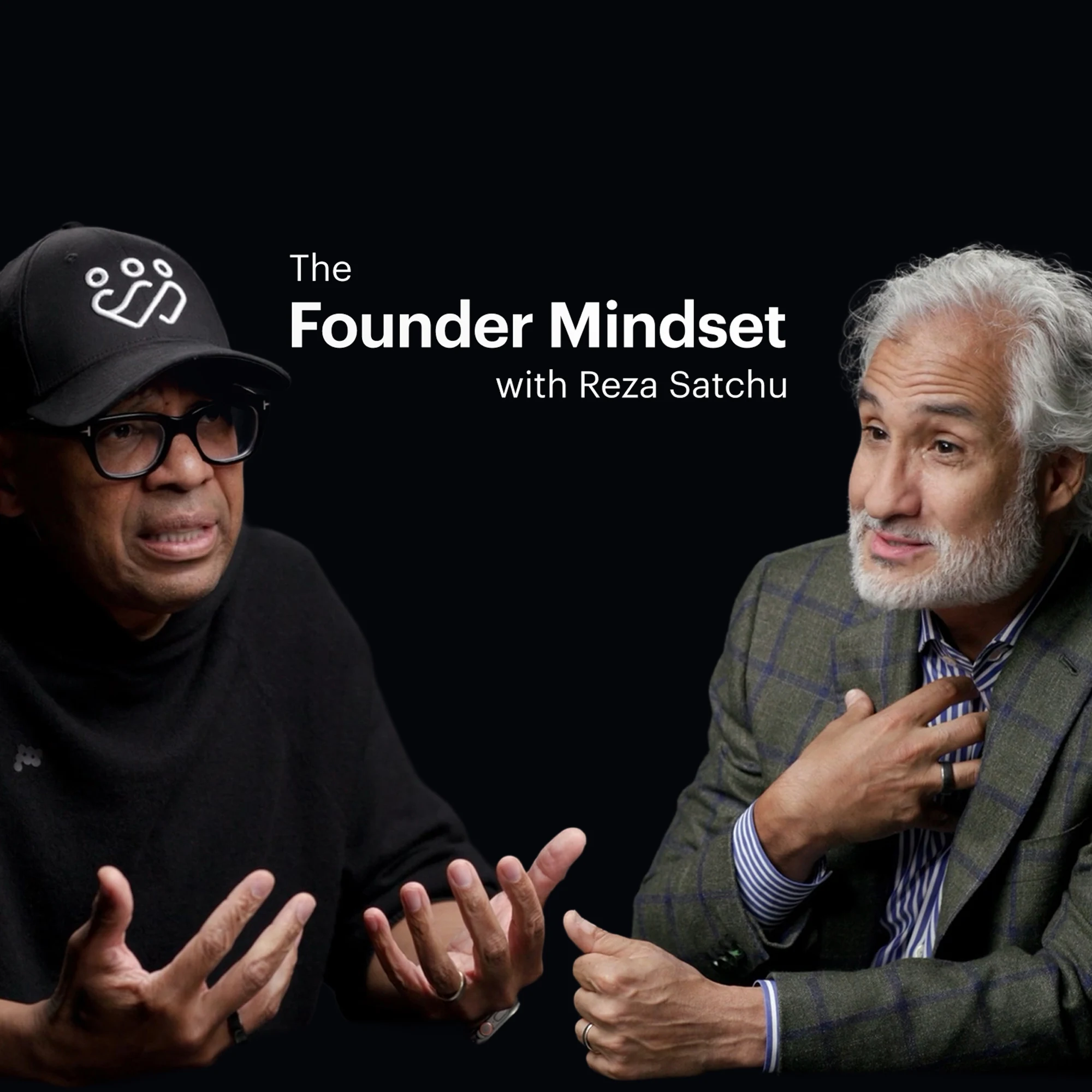
What does it take to be founder?
Demond Martin never took the obvious path. In 2022, he bet that a company could do what philanthropy alone couldn’t: close the health gap for communities like the one he came from.
His company, WellWithAll, provides daily wellness products, from supplements to beverages, and gives away twenty percent of its profits, with a goal of raising $300 million for community health programs over the next decade.
Transcript
Intro
Demond Martin: I saw literally violence every day.
Reza Satchu: So your thought was you stay there. There's a real chance that you're going to be killed.
Demond Martin: Absolutely. There's a 23 year life expectancy from Back Bay, which is predominantly white, and Roxbury, which is predominantly black and brown. And those places are less than three miles away from each other.
Reza Satchu: I mean, you were having a positive impact.
Demond Martin: Yes.
Reza Satchu: But you decided to...
Demond Martin: It wasn't enough because I've seen so many times philanthropy fail. My thought process was like, you have to solve this through capitalism, these life expectancy gaps that exist in our country. I'm going to help close them.
Voiceover: This is The Founder Mindset with Reza Satchu.
Reza Satchu: The Founder Mindset is not just about starting a business, it's a way of living. At its core, what it enables a person to do is to do the thing that every human being wants to have a positive impact on the people that they care about. In this podcast, what we are going to do is meet with some of the greatest founders, some of the people that have had the most improbable journeys, who have lived with The Founder Mindset.
Voiceover: What does it take to be a founder? Demond Martin never took the obvious path. In 2022, he bet that a company could do what philanthropy alone couldn't: close the health gap for communities like the one he came from. His company, WellWithAll, provides daily wellness products from supplements to beverages, and gives away 20% of its profits, with a goal of raising $300 million for community health programs over the next decade.
--
Reza Satchu: Demond Martin, it's a thrill to have you.
Demond Martin: Thank you It's a pleasure to be here.
Reza Satchu: You know, Demond, it's funny if I think about when we met. It was quite recently, and it was quite improbable. We met on a plane with my son and our close friend, David Fialkow. Flying to the Masters?
Demond Martin: Yes.
Reza Satchu: Okay. Who would have thought it. Okay. Like. Like. I'm just curious. What do you think about. That's our meeting. Okay. We're flying to the Masters.
Demond Martin: Certainly. If I look at my life and I think about that, I think that is massively improbable.
Reza Satchu: Okay. I'm curious what? You're sitting on that plane and thinking about heading to the Masters, and we're going there. What are you thinking?
Demond Martin: I'm thinking that I've lived this improbable but possible life. I mean, it is possible, but it's certainly improbable. Certainly. Where I started from. You know, my parents got a divorce. I was born in Columbus, Ohio. My mother wanted sort of a brighter horizon, so moved the two of us to California. But it was during the height of the crack epidemic.
Reza Satchu: Right.
Demond Martin: And at one point, we lived in this place called the Jungle. Apropos of the environment. I mean, there was drug use. There was a lot of gang violence, a lot of fear and despair.
Reza Satchu: And your mother remarried.
Demond Martin: She remarried.
Reza Satchu: Someone was productive or not productive.
Demond Martin: He ended up being a heroin addict. So as a kid, like, I saw things that kids should never see, I saw a lot of domestic violence. I mean, I and I talk about this in my book, Friends of the Good, where I was standing out in the street one day, just tossing a football with a neighbor and then a fight that that my mother and stepfather were, were having a out into the street and, and he slapped and punched her. And I tried to intervene, but I was way too small. I wanted to kill that man.
Reza Satchu: Yeah, right.
Demond Martin: All of these traumas and pieces of experiences that I've had have shaped who I am as a as a human right. And so I think that when you experienced something like that, it can do 1 or 2 things. It can break you or it can give you a level of empathy.
Reza Satchu: Yeah.
Demond Martin: I was always looking for how to be out of that situation. Like I tell a story about how McDonald's had this monopoly game back then, and I was I was hoping every every time I got a spare dollar, I would go and try to get a game piece in order. Like, that was my first attempt to be a millionaire.
Reza Satchu: Right.
Demond Martin: I think I've innately, for some reason, had this duality that there can be pain and despair and hope, all at the same time. I think my childhood was defined by uncertainty and instability.
Reza Satchu: Yeah.
Demond Martin: Which is actually turned out to be a superpower, because having to show up in all these different environments to move to different apartment to different apartment, across the street to across town, you know, that allowed me to be comfortable in just about any environment because I had to make new friends. Every new place that I went, I had to engage and figure out the lay of the land. Understand? Should I be afraid? Should I run, should I hide, should I stay? Should I, you know, engage or not? Those are all things that actually have turned into skills. I talk about a teacher that I had in fifth grade, Miss Johns, who invested in my life.
Reza Satchu: What a remarkable woman.
Demond Martin: I think what I realized later in life is that I was I'm actually dyslexic. And so just because you wanted another challenge thrown at me, I don't have enough, right? So I would deflect. I learned how to deflect, you know, in the classroom with my personality and my ability to engage with folks. And so Miss Johns early on, you know, took a liking to me because I think I was funny and whatever. But what she found when she was tutoring me was like, yeah, this kid can't spell, but he's really good at math. And so that actually became my academic identity, her working with me and highlighting that, you know, that I had this ability was a stabilizing factor for me and allowed me to take pride academically
Reza Satchu: given, given that, I would think in that moment there were many other kids misbehaving or doing things that, you know wouldn't have been productive.
Demond Martin: Sure.
Reza Satchu: How was she able to keep you? Well? How were you able to keep yourself motivated on the right track?
Demond Martin: She actually she ended up tutoring me on the weekends for free, which was amazing. She was like, hey, if you're interested, you know, come and I'll spend time with you. And so that was the reciprocal part. I showed up, I went, I engaged, I worked hard, I learned. I started seeing the benefit and then and that that just continued to.
Reza Satchu: She's still alive.
Demond Martin: She is. And actually. Yeah. No. Yeah. We've been texting back and forth
Reza Satchu: and because the other part about your childhood, which is very interesting, is there was a real duality to the childhood. Right? Like you had two kind of different experiences. And I think your, your phrase is, you traded drug dealers and gun violence for Confederate flags.
Demond Martin: Yeah, right.
Reza Satchu: So talk to me about that.
Demond Martin: My dad had moved to rural North Carolina, where he was from, and I would visit him every summer. And right before my freshman year in high school, I said, I'm supposed to go to Inglewood High. I'm going to die if I go there.
Reza Satchu: If you really believe that to be true.
Demond Martin: I definitely did.
Reza Satchu: Wow.
Demond Martin: I mean, I saw literally violence every day. I knew exactly. I mean, the reputation was real. And so he said, come live with me. So I moved into a single-wide trailer with my dad in rural North Carolina. But with that came, you know, I've seen a cross burn, the Ku Klux Klan, you know, hoods walking down the street. There was all of this intimidation built to, you know, certainly keep people.
Reza Satchu: And was that better than the alternative
Demond Martin: I lived? Yeah, right.
Reza Satchu: Well, that's a better.
Demond Martin: I guess it's better. And I will say, you know, my mother, throughout my entire life, from the very first moment, I mean, she told me over and over again how special I was the first time she saw me. She realized that I was going to be something great. And she just reinforced.
Reza Satchu: All it takes is one person who believes in you.
Demond Martin: Yeah.
Reza Satchu: And so again, paint me. Paint me a picture of the tension you felt in North Carolina, living with your father.
Demond Martin: By the time I got there, I had my self-identity already figured out. I had a clear path. I was going to college. That's all I had heard from my parents You are going to college or going to college.
Reza Satchu: And you thought it was accessible to you at that?
Demond Martin: It was because by then I'm an A student.
Reza Satchu: Yeah, right. Right.
Demond Martin: And so I have a firm academic footing, you know, both black and white kids like me. You know, I got along well within the environments that I was in, and I was performing, and I had this trajectory, but I was I was different than many because there was this inherent spoken and unspoken mentality that black folks should, should keep their place.
Reza Satchu: Yeah.
Demond Martin: Well, we would go and play basketball on the weekends at this local park. And literally almost every time we were out there playing, someone would drive by and yell n*$,
Reza Satchu: well, almost every time.
Demond Martin: Well, you know, through my entire college, high school, you know, life,
Reza Satchu: you experienced that sort of thing. Right.
Demond Martin: Regularly.
Reza Satchu: Right. So I'd imagine the first emotion is anger.
Demond Martin: Yes.
Reza Satchu: What's the is there a second emotion after that?
Demond Martin: I got to get the hell out of here.
Reza Satchu: Yeah, right.
Demond Martin: I'm going to do everything I can to succeed and get the hell out of here. And I had seen somewhere else, even though it wasn't great. I knew that other places existed. And then I began to meet, you know, a local lawyer or a doctor and begin to think about what else was possible. I mean, now you have TV. You've got TikTok. Like, there's there's a clarity, right? There's there's a curated false version of what that reality looks like, but there's certainly a clear understanding that there's something else that exists. Now it's really about the pathway. How do you take the next set of steps to get there? And I think it's just trying.
Reza Satchu: Yeah. So it's interesting because one of the things that I find fascinating about you is many people who have the story, and certainly I often tell my story in this manner. And so hearing you tell it is very interesting to me because I think it's actually much more profound and sort of more reflective of the truth, which is this whole concept of the self-made person. Okay. Right. We all love it because we're like, oh, we went and fought all the dragons and we made it, and now we're self-made and we have freedom and all that sort of stuff. And certainly as a kid with very little power, you would think that the only way out is I got to do this. Like, it's all about me. I got to do this right. But it struck me that you learned very early on. And I think the word you use, it's less about self-made. Your community.
Demond Martin: I'm community built.
Reza Satchu: Community built. Okay, so tell me what that means.
Demond Martin: Community building. If you look at every one of these steps in my life. So I, you know, I leave California, I go to North Carolina, my dad invest me, invest in me. I go to UNC Charlotte, which is really where my life changed. I got great mentorship. I ended up being student body president as a sophomore. And then I got just great mentorship from the chancellor and the vice chancellors and just all of these incredible people, this Dr. Herman Thomas, that really invested in my life and and these step functions began to happen. Oh, I get exposure. And then I go to and work at Arthur Andersen. I've got a manager and he sends me to Harvard Business School my junior year in college. I meet Jim Cash. I never I never met a black man like him before, he sat on the board of Microsoft and GE. And I didn't have him as a professor, but he was a king among giants. I mean, I ran out of a class to go and just, like, say please, you know, can you spend some time with me? Can I learn from you? I didn't ask him to be my mentor.
Reza Satchu: Right.
Demond Martin: But but he he ended up being exactly that. I mean, ever since that moment, I mean, he's been a force in every major decision that I've made in my life. I was just, you know, treating people with dignity and respect, working hard, trying to differentiate myself relative to my peer set.
Reza Satchu: Right.
Demond Martin: And some of these things began to happen as I look back and look at the threads of my life. So it's not like I saw it. And I think that's the mistake that a lot of people make. They say, oh my God, will you be my mentor? And you have no connection, no reason to. So, I think that in any relationship there's a give and take.
Reza Satchu: Right, right. So what were you offering to Erskine Bowles or to Jim Cash or to whoever? The chancellor. What? What do you think you were offering to them?
Demond Martin: I think in many cases, good humans want to mentor, right?
Reza Satchu: Right.
Demond Martin: They want to give their time. They want to give back.
Reza Satchu: And that makes them feel good.
Demond Martin: Absolutely. Yeah. And they've most often been mentored by someone else. And so providing, you know, the opportunity to do so is also in some cases a gift to them.
Reza Satchu: Right.
Demond Martin: You know, you're not necessarily giving a lot back to them other than working hard being diligent. You know, if they give you something to read, if they give you advice that you follow it, you take it. Let me try that.
Reza Satchu: Here's what I when people ask me who I choose to mentor, what I say is I look for three things. And I'm curious if you would agree with this or not, because you can imagine for students watching this, the ability to understand why people like people like Erskine Bowles and others chose to mentor you, or why we all have limited time who we might choose to mentor. Right? So I completely agree that mentoring in some ways is a self-indulgent thing, because you want to make the world a better place. Right. As a but the things you look for is someone who will always tell the truth. Like you cannot. You know, mentors typically do not want to take reputational risk. So it's critically important that it's someone that will tell the truth.
Demond Martin: Correct.
Reza Satchu: To it's someone who you have to enjoy spending time with.
Demond Martin: Right.
Reza Satchu: Like it's just got to be someone who you're, like, uplifting, optimistic, whatever it may be. And the third thing I would say, and this is the one where I'm curious whether you would agree, is, I know for me, what I need to see is in that person, it doesn't need to be 100% true, but I need to see a flicker that they could do something extraordinary.
Demond Martin: Yeah.
Reza Satchu: Okay. Extraordinarily positive. Yeah. I need to be able to see that in them. It's my own judgment, but I need to be able to see this right tail outcome of something extraordinary.
Demond Martin: I completely agree with that. So I start with values, right. If we don't have the same shared values. Like I don't care, right? Like I'm done. But they have to be high performing.
Reza Satchu: Yes.
Demond Martin: And so I've learned about myself that I don't have the patience to invest in someone that's just going to kind of sit with, with what I'm giving them. So if I think it's going to be a multiplier effect that I'm investing in that, in that person.
Reza Satchu: Right.
Demond Martin: Like one. One of my mentees, Obed, is here with me today. Like, I know by by investing in him, I know that that he's going to be a force multiplier of what I'm giving him. And then that makes me feel like the time is actually worth spent. Otherwise, I could be given that to to someone else, right? Because, I mean, the one thing that is finite is our time. So you want to make sure that the time you're spending has a potential of having a force on you otherwise.
Reza Satchu: Yeah.
Demond Martin: Because because I actually want to make impact in everything that I'm doing. And so that. And I'm not going to be here forever.
Reza Satchu: Yes.
Demond Martin: And so giving that you know, to to others, but knowing that they're actually going to do something with it and have a value set that's consistent with mine. I'm great with that.
Reza Satchu: Okay. I have to ask you this question because, I mean, there are many remarkable things about your life, but I think the most remarkable thing, it's not Harvard Business School. It's not even the fact that you ran a, you know, you were part of a very successful hedge fund. It's that at a very young age, you're in the White House in the sort of in the center of institutional power. Given that ten years beforehand you were in a completely.
Demond Martin: Okay.
Reza Satchu: So walk me through how that happened. You know, what was going on in your mind as this, as this progression was happening.
Demond Martin: So I become student body president as a sophomore, my senior year, I get invited to this event where there's an alum coming in. Karen Popp, she was White House counsel at the time.
Reza Satchu: Okay.
Demond Martin: And so we get introduced because we're both former student body presidents. And at the end of that conversation, I just because I had already had a job graduating that year, going to Arthur Andersen was the largest accounting firm in the world at the time.
Reza Satchu: I remember it blew up.
Demond Martin: Blew up. Yeah.
Reza Satchu: And you didn't do that?
Demond Martin: I didn't do that, I wasn't there. Yeah. So? So I just asked her, you know, the last question I asked, I was like, hey, by the way, is there anything I could do with the at the White House for the summer? And she was like, yeah, sure. Send me your resume. She does a check with the other people and then, you know, like the chancellor of the university, it says, okay, let me let me help you. She gets me an internship. I'm working for Al Gore's finance manager. I'm an accounting major. Everybody else is political science. So I'm getting some differentiation.
Reza Satchu: Yeah, right.
Demond Martin: And they say, hey, this kid's pretty good. So then I get recommended for a position working for the White House chief of staff. So I interview with a bunch of people, end up going to go meet him in the West Wing for the first time, go past the Marine, and I go into his office and he says, Demond, I've heard a ton about you. I'm super impressed. Come work for me and I'll change your life.
Reza Satchu: Wow. That was his opening line.
Demond Martin: That was his opening line.
Reza Satchu: It's remarkable.
Demond Martin: And I was like, yeah. Yes!
Reza Satchu: Yeah, right. I think there's an answer. Let's do that one.
Demond Martin: So, so now that's I'm 40 feet from the Oval Office every day. Oh, you know, Madeleine Albright, Bob Rubin, all these people are walking. That's my daily environment. I'm sleeping on my fraternity brother's couch six months into this because I have no money. Six months into this job, my car breaks down.
Reza Satchu: Jeez.
Demond Martin: And so now I have no money, no car to get to work.
Reza Satchu: Yeah.
Demond Martin: Erskine finds out about it, and he's like, hey, heard about your car breaking down. I'm living in this mansion in Georgetown. Just come live with me. And I was like, sir. Yes, absolutely. Because I had no other alternative. It ends up being one of the best things that possibly could have happened to me, because now we're riding into work and we're finding out
Reza Satchu: You spend time together.
Demond Martin: We're watching a football game. We're having dinner. And those things. Two people that couldn't be on the surface more, more different. We find that we have so much in common, so many things that we're parallel. And he becomes like my second father.
Reza Satchu: Right.
Demond Martin: And then from that, he starts letting me in meetings that I shouldn't be in, it's just me, him and Bob Rubin and Madeleine Albright and Al Gore. And so I'm learning how power moves.
Reza Satchu: Yeah. So, so this superpower of of people wanting to take a shot on you.
Demond Martin: Okay. Meaning?
Reza Satchu: Erskine Bowles is a prime example of this, but taking a shot on you is is really at the core of your community built argument.
Demond Martin: Yeah, that's exactly right. I mean, that's all of these people have invested in me. If you look back, if you look at anyone that says they're self-made, they're lying right there. Absolutely lying.
Reza Satchu: Absolutely.
Demond Martin: Somebody gave them a shot. Somebody opened the door, whether they realize it or not.
Reza Satchu: Yes.
Demond Martin: They. They got the ability. Like I became an investor because Phil Gross sat with me and he showed me how to invest.
Reza Satchu: Right. Right.
Demond Martin: He showed me how to be a philanthropist as well.
Reza Satchu: Right.
Demond Martin: So I just. You have to spend the time.
Reza Satchu: Yes. For sure.
Demond Martin: You have to dedicate yourself into those environments where you can learn. But these people pour...
Reza Satchu: So really, the learning about the community built is not just you building relationships. It's actually an insight that just about everyone is community built.
Demond Martin: Everyone is community.
Reza Satchu: Yeah, yeah.
Demond Martin: If you really dissect it. And again, this is I didn't set out to be community built. I look back and with true reflection.
Reza Satchu: True reflection.
Demond Martin: And that's exactly what we are. Right?
Reza Satchu: Right.
Demond Martin: Absolutely.
Reza Satchu: Okay, so let's talk about this. This concept of you come to us and you talk a little bit about sort of. And so many of my students feel the same way. And it sounds like you and I had the same feeling when we came to HBS, which was this feeling of sort of this imposter. Oh my God. Right. We're surrounded by all these brilliant kids, right? Like they know so much more. They came, you know, they rolled out of the Upper East Side and went to, you know, Collegiate and then to Princeton. And they're from Goldman here. And like,
Demond Martin: yeah, I tell this story where I'm in one of the first classes and we're breaking down the Apollo 13.
Reza Satchu: Right.
Demond Martin: And so it's customary for someone to say, well, when I worked at Ford, you know, and they put their experiences in and this guy raises his hand, he was like, when I was a rocket scientist.
Reza Satchu: Yes.
Demond Martin: And everybody's starts laughing. And he was like, no, it's true. When I was a rocket scientist. And I'm like, what the hell am I doing?
Reza Satchu: Yes, yes. so I can totally picture it because I feel like I was there with you, where you're sitting there in the first few classes and you're looking around, you're thinking, someone here shouldn't be here, and it's me.
Demond Martin: It's me.
Reza Satchu: All right. So at what moment and what led to you realizing that you, your whole set of life experiences and what you brought here was sufficient?
Demond Martin: It wasn't actually until I started working that I fully understood that.
Reza Satchu: Yeah.
Demond Martin: Like when I, when I was, you know, a partner at Adage Capital, that's where I began to realize from a differentiation standpoint, my ability to assess and understand people, in addition to having a rigorous analytical framework and understanding of every aspect of these businesses, the people run the business.
Reza Satchu: Yes.
Demond Martin: And so, you know, when you're sitting across from someone and you're like, that guy is just like the drug dealer. I've seen every archetype of human from saint to killer.
Reza Satchu: Yeah, right.
Demond Martin: And having that in your sort of understanding,
Reza Satchu: you know, it's interesting because and the reason I'm excited about this podcast is because what Harvard's doing with this podcast is having it go through something called the Foundry.
Demond Martin: Right.
Reza Satchu: So my big mission at Harvard Business School is not just to teach 180 lucky students or a few hundred lucky students. It's really to take what's the best at Harvard and push it out through the world. And that's what the Foundry does. So it really democratizes entrepreneurship around the world. And I know that around the world, there are a lot of people who haven't had the benefits that most of our Harvard Business School students have had.
Demond Martin: Okay.
Reza Satchu: But what I need them to believe, or what I'd like them to consider, is that those obstacles that they've overcome, right, and where they are today, correct, should be a source of power for them.
Demond Martin: Absolutely.
Reza Satchu: And certainly when I look at you, that's what I see.
Demond Martin: Yes.
Reza Satchu: And I think one of the great definitions of intelligence is to be able to take something that is working over here and apply it in a completely different context.
Demond Martin: Right. You know, I've got dear friends that are incredible athletes, right? And so like that same determination, that same discipline of what you put in your body, that same working out every day. And so having, you know, young people understand that the same thing that it took me to be successful in just getting out of this neighborhood.
Reza Satchu: Yeah. Right.
Demond Martin: And to traverse these circumstances, I can apply that discipline. I can apply that understanding. I can apply apply that that capability in this other context and it'll allow me to be successful.
Reza Satchu: Let's talk about this moment where seemingly everything is going great for you.
Demond Martin: Sure.
Reza Satchu: Right. Like, I mean, this trajectory is remarkable of where you came from and where you are, right? And you go through a crisis, right? You've got a loved one within your family that is suffering. Can you just tell us a little bit about what happened?
Demond Martin: Yeah. I mean, I was standing in the middle of an emergency room with someone I love dealing with depression, anxiety, suicidal. And, you know, you talk about getting your heart ripped out every single day, going through something like that. It was. It was unbearable. And what I realized in the worst moments of this, though, is that I was now on the other side of inequity, right where I live.
Reza Satchu: Cause you could have access.
Demond Martin: I when I walked in the door, because I've been a philanthropist for over 20 years, the CEO of the hospital made sure that someone came and said, Mr. Martin, we have a room for your family. No paperwork.
Reza Satchu: Right? Right. Right.
Demond Martin: And so, you know, as I wasn't sleeping during that period of time, anyway, what I started thinking about is like, if this were me when I was 14, living in that trailer in rural North Carolina, going through the exact same thing, I'd be dead or in jail. Like, my mind just started racing, you know, over this period of time is like, how could I create something that would actually be significant and sustainable to impact those?
Reza Satchu: Because you could have imagined that in that moment there could have been many paths you've taken. Right. So I want to go to that moment where what's actually going on in your head is this concept of racial inequity. Yeah, right. Because it's not obvious.
Demond Martin: Yes.
Reza Satchu: Right. That that's the path you would take. So just walk me through that.
Demond Martin: If you look here in Boston, there's a 23 year life expectancy from Back Bay, which is predominantly white, and Roxbury, which is predominantly black and brown. And those places are less than three miles away from each other, the North Side of Chicago versus the South Side of Chicago. There's a 30 year life expectancy gap.
Reza Satchu: Right.
Demond Martin: And these are things that are actually preventable right now. The problem is, is that, you know, there's not enough tax dollars and there's not enough philanthropic capital to solve these issues. And so my my thought process was like, you have to solve this through capitalism.
Reza Satchu: Yeah. Is it fair to say that deep down, this impact was an impact that you knew you wanted to have?
Demond Martin: Even as a kid, I've always wanted to help others in some way, fashion or form. This directly focused on wellness, right. Health and wellness. I define it as
Reza Satchu: I mean, to me, what you are doing in some ways is certainly in the hospital, as I've, as I've heard from you, is what you were really thinking hard about is someone who looks like me, that didn't have the path that I had, could not save my family.
Demond Martin: That's exactly right.
Reza Satchu: And so I need to make that more equal.
Demond Martin: That's exactly right.
Reza Satchu: And so but that of course, involves like that goal is a large goal.
Demond Martin: It is.
Reza Satchu: And it involves real commitment.
Demond Martin: It does. And you have to have the foundation in order to do it.
Reza Satchu: Yeah.
Demond Martin: There's no way I could have started WellWithAll ten years prior to this, because I didn't I didn't have the understanding. I didn't have the political capital. I didn't have the resources to to do all these things. And so, like, and, you know, the people that are working with me on this journey, I had to witness and see that they would be.
Reza Satchu: But in some sense, all of that is true. But you also have much more to lose theoretically. Okay. So from your perspective, was it an obvious decision?
Demond Martin: So and just know that when I, when I started WellWithAll I didn't intend to actually run it. I intended to stand it up like I had done many other things and have somebody else run it. And it became very clear if this was ever going to be what I needed to be, I needed to be the person.
Reza Satchu: Yeah, yeah. So talk to me. What was your decision to start this business? What was the primary motivation to starting it and what was what was the other side of your head saying? What was the argument not to do it?
Demond Martin: The primary motivation was to make a significant and sustainable impact on society. I mean, as a philanthropist, right? You've made a ton of cash, right? Like, but at some point you're not going to be here.
Reza Satchu: Yes.
Demond Martin: And so how do you create an economic engine that is going to continue to do this well beyond the time that you're on this earth? And so, like, that was the whole thought process of, of an economic engine significant and sustainable, and how with the resources, the skills, the relationships that I have to actually truly make a difference of real significance and, and be sustainable because I've seen so many times philanthropy fail when the donor walks away.
Reza Satchu: But this decision, you know, one thing I know to be true of every human being is on their deathbed. They're not counting their money. Right. To the extent that they're counting anything, it's. Did I make a positive impact?
Demond Martin: That's exactly right
Reza Satchu: on my kids, on the family. And hopefully something and maybe something much worse. Okay. But, but but that moment is when you. I mean, you were having a positive impact.
Demond Martin: Yes,
Reza Satchu: but you decided to.
Demond Martin: It wasn't enough.
Reza Satchu: Yes. Okay. So that's where I'm getting at. How do we. How did you know? Was it the moments in the hospital that made you realize it wasn't?
Demond Martin: The moments in the hospital were that. That was the moment where I was like. This is not if this were me. Yeah, this. I'm dead. Yeah. And there's so many people that are exactly in that position right now. Like, that is the thing that just
Reza Satchu: so basically from your perspective, you're like, I can help solve this.
Demond Martin: There's a problem. I feel it, I see it.
Reza Satchu: Yes.
Demond Martin: Like it's right there. I can feel it right now. And even if I can't solve it, I can make a big-ass dent in it.
Reza Satchu: Right? Okay. Right.
Demond Martin: And that's the thing. Like, this problem is so big that most people are like, yeah, yeah, but but I there's a certain set of things that I can do that I can impact that I'm going to run really hard at. And when I do that and I show that other people are going to follow.
Reza Satchu: Okay. So tell us, tell us about the business. Tell us about WellWithAll. What does it do?
Demond Martin: WellWithAll. So in simplicity for the folks listening. Like if you looked at what Paul Newman did with Newman's Own, he gave away $640 million over the life of that business.
Reza Satchu: Right.
Demond Martin: And selling salad dressing and lemonade. And so this is a 2.0 version of that where we have an incredible all natural energy drink. It's a great substitute for sugary. So.
Reza Satchu: So it's good for people.
Demond Martin: If you look at the number of folks that are so 80% of the people in this country that are pre-diabetic don't know.
Reza Satchu: Yeah.
Demond Martin: And so if you think about, you know, the heart attacks and strokes that people are dying from on a regular basis, it's because of what we're putting in our body. So so we take 20% of the profits of everything that we sell, and we use that to, to impact health equity.
Reza Satchu: Right.
Demond Martin: There's so like so, you know, there's 140 rural hospitals that have been closed, you know, in the in the United States over the last 15 years, you know, since 2022, 17 veterans a day commit suicide.
Reza Satchu: Right.
Demond Martin: And I talked about, you know, the the distance between, you know, Roxbury and Back Bay and the normal number of folks who are just living 23 years less because of where they live. We've done some, some really cool things. You'll see this in some really big retailers where we have health information. We're breaking down, you know, some of the things like DBT therapy or how do you prepare to go to the doctor?
Reza Satchu: Right. Right.
Demond Martin: Simple information about blood pressure, people knowing their numbers and changing their life in a way that actually will, will attack some of these things that are impacting our ability to live longer, healthier lives. And then we did something really cool called the Million Dollar—
Reza Satchu: I heard. Tell us about it.
Demond Martin: WellWithAll Prize, where we're giving on October 15th, we're giving away $1 million of prize money to AI innovations that close health equity gaps. This technology, you know,
Reza Satchu: so is that a competitive process where people are applying. And then you'll
Demond Martin: we have the applications have already closed. We've got a ton of really great applications. And we're going to find some innovations and invest behind those with our partners like M&T Bank and some other cool folks to to make these innovations available to, you know, a lot of people.
Reza Satchu: Amazing. And so if I, if, you know, a lot of people would say this form of capitalism doesn't work, okay. Meaning that this idea that you can, you know, do good and make money somehow are incompatible with each other. And so at an extreme, you know what? Make all the profits for your shareholders, and then you can give it away as you get the money. Okay.
Demond Martin: So it's very clear that we are at this place where tax dollars and philanthropy are not going to solve these problems alone. There needs to be an aid to that. And businesses have to take a greater stance. And by by the way, you know, if you look at, you know, societal surveys, folks are expecting companies to have a bigger impact in the daily problems that they're engaging with, and they're having greater affinity for those brands. We're already seeing it in our results. So I'm very excited about what we're doing. If other companies don't want to do that, that's okay. I'll take that market share.
Reza Satchu: Okay. So so so what I will say is you're certainly on the surface in a very competitive space.
Demond Martin: Yes.
Reza Satchu: Right. Meaning there's lots of people trying to do their massive tailwinds, which is positive, but lots of people are. And I I'm thrilled to announce, or I think I can announce that that you've just entered into a deal with Walmart, which is fantastic. So tell us about that deal and why Walmart chose you amongst, I'm sure, many others.
Demond Martin: I think we bring something very different to the table. Again, a lot of folks are consuming caffeine to to stay awake. There's nothing synthetic in our in our product and it tastes fantastic. In addition to that, you know, Walmart and WellWithAll are going to be educating consumers together to to help close these health equity gaps that we're addressing. So our first two markets are Boston and Chicago where where those gaps are the greatest. And so there's just a really exciting opportunity to take that across the country together.
Reza Satchu: Yeah. So if I asked you to if you are it's funny, interesting to me that that you were going to step back and not be the face of this brand because it's so obvious to me that this brand aligns so much with who you are. You know, I haven't say that a founder of superpower is getting people to do things that they wouldn't otherwise do rationally. Like your first investor, your first buyer, and you have that ability.
Demond Martin: Okay.
Reza Satchu: And so if I said to you as a founder, what what is your superpower?
Demond Martin: Okay.
Reza Satchu: The reason why Walmart's here, why the business is doing as well as it's doing. What would you say? Demond Martin's founder superpower.
Demond Martin: I think realizing that it's all about the people in every in the partnerships, in the employees of WellWithAll, understanding that it's all about the people and investing in those relationships, investing in the common areas that we overlap. And we want to create change together. I mean, that's been the superpower.
Reza Satchu: Okay. So I think this is a great segue to your book.
Demond Martin: Okay.
Reza Satchu: Because Friends of the Good. So so you've got everyone. So Michelle Obama loves the book.
Demond Martin: She's fantastic.
Reza Satchu: So tell me. Michelle's read a lot of books.
Demond Martin: Yes.
Reza Satchu: Why did she like this book so much?
Demond Martin: I think it in this time of loneliness and despair, folks are, you know, hear over and over again this feeling of burnt out because they're working too hard. I think people are burnt out because they're trying to live life alone. We're living life in silos, and we talk about, you know, the connectivity that is necessary in order to have joy, like having true friends, friends of the good in your life to support you.
Reza Satchu: I don't know, an epidemic around young men to
Demond Martin: 1,000%.
Reza Satchu: Yeah.
Demond Martin: Because, look, I mean, how often are men vulnerable?
Reza Satchu: Right.
Demond Martin: I mean, we've often grown up with the thought process that, you know, vulnerability, you know, cost us something, but actually not being vulnerable with the people that you love, that cost you much more.
Reza Satchu: Yeah. So, I mean, I was fascinated by these three sorts of friendships or relationships that you talked through here. Can you. Can you walk me through them?
Demond Martin: Aristotle gives us a framing that is so perfect, and that he believed that friendship was one of the most essential elements of joy, and he bucketed friendship in the three categories. Transactional. You scratch my back, I scratch yours. Friends of pleasure. We go out and we party together and have fun. But both of those friendships are fleeting in nature. When the transactions go away, so does the friendship. When the fun goes away, so does the friendship. But friends of the good. The third category. Those are friends of valor. Those are people that you have a common value set with. And those are the friends that that stick with you through the tough times and support you. And they show up at birthday parties. Right?
Reza Satchu: Right.
Demond Martin: And those are the friendships that you have for life.
Reza Satchu: So it's interesting, right? Because a colleague of mine here at Harvard, Bob Waldinger, did a study. Are you familiar with the Harvard Happiness Project?
Demond Martin: I am, yeah.
Reza Satchu: Okay. So so it's remarkable because it speaks to exactly what you say. Right. Which is, you know, they interviewed, unfortunately, just men, but 800 men, 400 who went to Harvard and 400 from inner city Boston. And they're now in their 80s. There are about 550 of them still living. And you can imagine they've had all sorts of different life outcomes. Okay. Right. But he did a test and he said, okay, to what do you attribute your contentment, such as it is. And by a factor, by a material factor, the thing that mattered most was do you have long term enduring relationships?
Demond Martin: Absolutely.
Reza Satchu: Now, the thing about long term enduring relationships is, by definition, they go through crisis.
Demond Martin: Yeah.
Reza Satchu: That's what makes them long term and enduring. So I'm curious, when you think about it, because it seems counterintuitive that going through crisis, staying committed is the thing that ultimately leads to this third category of Friends of Valor.
Demond Martin: Yeah. Right. Because because you're not showing your valor unless you've actually shown up and gone through crises. But that builds like, think about an entrepreneurial venture.
Reza Satchu: Right.
Demond Martin: Like going through the fire with someone and coming out on the other side that that bonds you forever. And I think that no. And some folks are going to jump ship. And those are the people that those relationships won't last forever. And so the people who show up and, you know, when you go through crisis, like, like we have, you're sometimes surprised at who shows up and who doesn't. And it's okay to have friends of pleasure and transactional friends. Just knowing where they sit is really important.
Reza Satchu: Okay, so I want to dig into this because it feels to me like this is a very important place because to the extent that you believe that friends of valor are not just a key to living a sort of a highly successful life, but leaving a highly content life.
Demond Martin: Yes.
Reza Satchu: Right. What? How do you show up in a way that projects a friend of valor?
Demond Martin: Well, a friend of a friend of the good is someone that does show up.
Reza Satchu: Yeah. First. Yeah, that's a good start. That's a good start.
Demond Martin: Did you just show up?
Reza Satchu: Right.
Demond Martin: Like, you know, there's birthday parties, there's funerals, there's. I remember, you know, when my sister passed away.
Reza Satchu: Sorry to hear.
Demond Martin: Of cancer. And the number of people from Adage—
Reza Satchu: it's the hedge fund.
Demond Martin: Yeah. They just showed up.
Reza Satchu: Right.
Demond Martin: I mean, and I had no idea. I just cried, I just and my kids are always making fun of me because I cry. But, you know, like, they just showed up. And when people show up for you in those moments of your deepest pain, man like that, that bonds you to them in such a special way.
Reza Satchu: Talk to me. Because I think for. Let's start about crying for a minute. Okay. I look at your story. Powerful man. Started from nothing, built this family, built this life. And so few men cry.
Demond Martin: Yeah.
Reza Satchu: Okay. Like I can count on one hand the number of times I've cried. Okay. And. But I've learned is crying is probably a more powerful thing than not crying.
Demond Martin: Yeah.
Reza Satchu: So talk to me about why showing vulnerability and emotion as a man, you know, who seemingly has a lot of power and control.
Demond Martin: Yeah.
Reza Satchu: Is a positive thing.
Demond Martin: So the benefits of it are so much more tremendous than people, particularly men, realize. Like I think about when we were in the middle of this crisis. My wife, with her brilliance, Kia, said, we have to tell the people that we love what's going on or we're going to crumble. And she was right. And what once we did that, like the weight of this mask that we were trying to put on. Everything's okay.
Reza Satchu: Yeah. Right.
Demond Martin: And things were not okay.
Reza Satchu: Yeah.
Demond Martin: When we when we did that, the the wisdom that we got from other people that had lived through the same sort of thing and said, hey, this is I never told anybody, but this is what's happening.
Reza Satchu: Yeah.
Demond Martin: And the doctors and all of the things that we received and the love, just the openness to be able to receive love from people because we weren't, you know, being a fraud, you know, to our friends and family. It was tremendous. And I think that that's what we miss is that people can't help you if they don't know that you're struggling.
Reza Satchu: Right.
Demond Martin: And if you really have people in your life that truly care about you, they should know when you're struggling. Because the curated version of ourselves is the loneliest version of ourselves by far.
Reza Satchu: You know, it's interesting. I refer to the hero's journey a lot in my teachings, and you're a prime example of it. And so when I think about, you know, we're all born in this ordinary world, we have a call to adventure, and most of us have this call to adventure, and we reject it because we just don't think it's possible. Right? So many people in your situation would have said, you know what, I'm going to choose the anger route. This is just hopeless. How can I get out of here? Like there are people dying around me. People dropping out of school. This is hopeless. But you had the good fortune of meeting a mentor and a couple, right? And your grandmother and Miss Johns. Right. Who gave you the confidence to go to the other side and to commit to this sort of extraordinary world where in some phases, you didn't belong? Right. At UNC, you know, in the White House and at Harvard. But through that period you sort of go through a tremendous learning process and you learn what you're capable of.
Demond Martin: Okay.
Reza Satchu: And of course, we're all searching for this elixir, which is that somehow we can come back from that extraordinary world and make the ordinary world a better place.
Demond Martin: Okay.
Reza Satchu: But of course, we don't actually get that ability to do that unless we commit to uncertainty. That's in the extraordinary world, fighting these dragons and our demons and everything else to get the learning and the credibility and the resources to do the things we want to do. And so when I look at you, I see that journey, you know, up close and personal. So if I were to ask you to, what do you, Demond, want to commit to in the future? Okay. If I said to you, you are now here. You've now built WellWithAll. Hopefully it's going to go to the moon. But if I said okay, what is the thing? As you this hero's journey, what I've learned is that it's not a one stop journey. Like, you just keep going through life on this journey. Right. And so to what are we committing to now?
Demond Martin: One, I'm committed to my family that I'm going to love them and give them everything that I have. And then the second thing is, you know, these life expectancy gaps that exist in our country, I'm going to help close them. WellWithAll is going to be a catalyst, you know, for that. And if we do that, you know, I actually will in that instance, feel like a hero.
Reza Satchu: Yeah. Well, I think you'll deserve it. And I hope and I hope I can help you. And I'm very glad that we met on that plane.
Demond Martin: Oh. Me too.
Reza Satchu: Thank you for being here.
Demond Martin: Thank you.
Voiceover: You've been listening to The Founder Mindset with Reza Satchu.