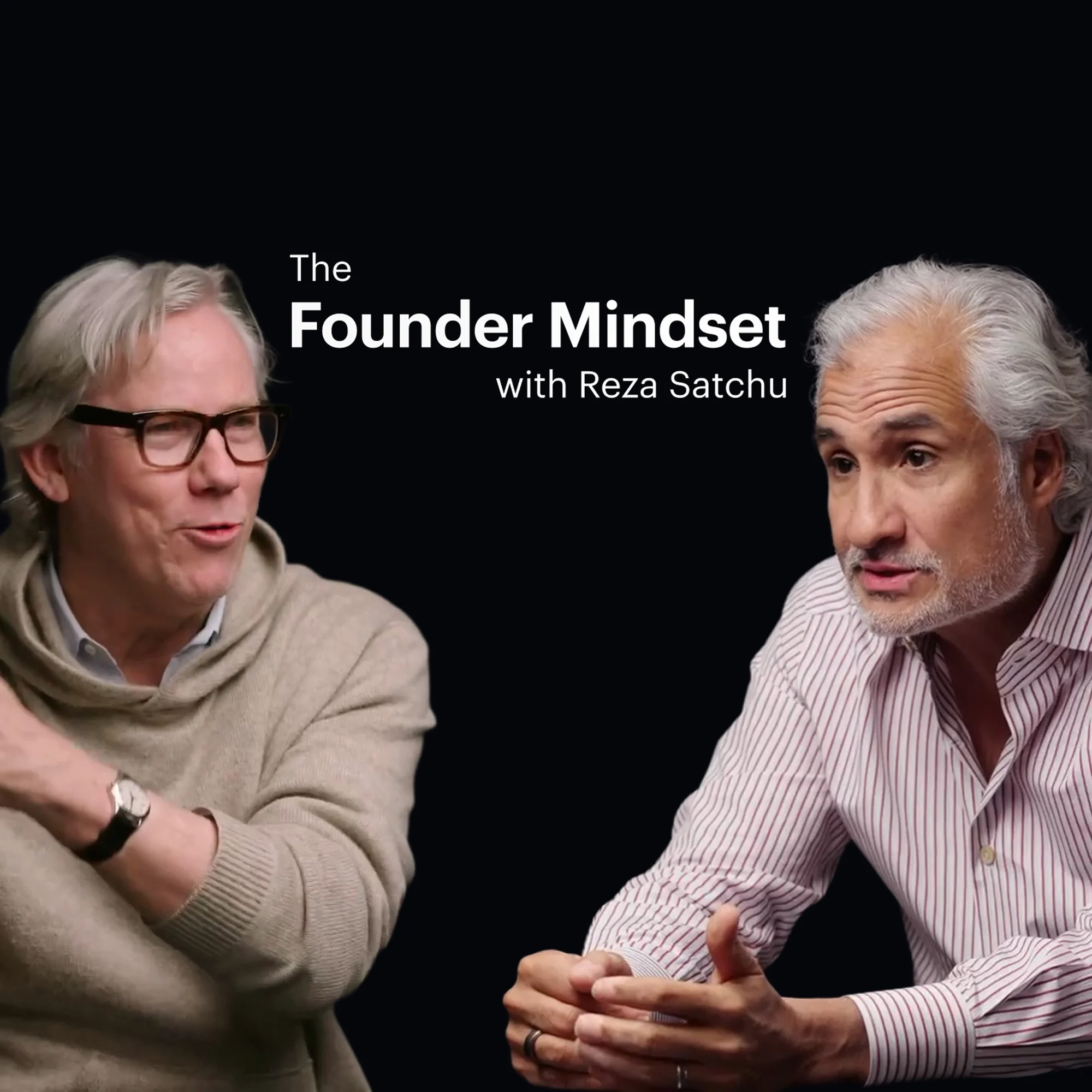
What does it take to be a founder?
Brian Halligan co-founded HubSpot and pioneered inbound marketing. Today, the company generates more than $3 billion in annual revenue. But before starting HubSpot, he was a sales executive who didn't have the confidence to become a founder.
He wasn't born one. He learned how.
This is The Founder Mindset, with Reza Satchu.
Resources
Watch the high-quality video version on YouTube or Spotify.
Transcript
Intro
Brian Halligan: I was a busboy. I washed dishes. I had a painting company in high school.
Brian Halligan: It's a very painful process.
Reza Satchu: Why would anyone choose pain?
Brian Halligan: If the pain is the right kind of pain, there's a giant return on the other side.
Brian Halligan: If everyone's going this way, I'm going to want to go that way.
Reza Satchu: We live in a society where commitment is seen as a sacrifice and not as a superpower.
Brian Halligan: If you want to be CEO of a great company, you got to start it.
Voice over: What does it take to be a founder? Brian Halligan co-founded HubSpot and pioneered inbound marketing. Today, the company generates more than $3 billion in annual revenue. But before starting HubSpot, he was a sales executive who didn't have the confidence to become a founder. He wasn't born one. He learned how. This is The Founder Mindset with Reza Satchu.
--
Reza Satchu: Brian Halligan, welcome to The Founder Mindset. I'm thrilled to have you here.
Brian Halligan: Thrilled to be here.
Reza Satchu: Founder of HubSpot, partner at Sequoia, an all-around great guy.
Brian Halligan: Appreciate that.
Reza Satchu: So let's get started. All right. So one of the things we do here on The Founder Mindset is — a proposition I have is that obstacles not of your own choosing in your childhood often lead to your founder mindset, lead to the kind of person you're going to become as a founder. Now, the challenging thing here: when I look at your childhood, I don't see that many obstacles.
Brian Halligan: I had a regular childhood. Wasn't that remarkable. I was a good student. I was a good athlete and went to a good school. I wasn't great at any of those things, but one of the things I might have indicated is I was a worker. Like, I had a paper route when I was in diapers, and I was a busboy, I washed dishes. I had a painting company in high school, all through college. So I was a very early, hard-working entrepreneur.
Reza Satchu: So, you know, people talk about sort of, you know, the traditional storyline of, oh, an immigrant, or from poverty, and you sort of work yourself up. Your storyline is not that.
Brian Halligan: No.
Reza Satchu: And you've done a lot of research, it seems like, on what that might look like. And it turns out that there are many people with your background that end up being founders. Why is there such a disconnect between the reality and the perception?
Brian Halligan: I don't know, but there's definitely a narrative that all the top tech founders are immigrants. And if I look at the ten trillion-dollar outcomes, the founders of those companies, three of them were immigrants — like Elon was an immigrant, obviously — the rest were born here. Two of them, I believe, parents were immigrants. But mostly the CEOs of the trillion-dollar founders are upper-middle-class kids that were very well fed.
Reza Satchu: So where does the work ethic come from? I mean, I had a paper route as well. But there was a real part of me where I felt like I needed that money to help my family. I'm not sure I would have had a paper route if I identified as middle class or upper middle class. And in some ways, making that decision to work when you don't need to work — or maybe you did, I don't know — but the question is, where did this drive come from, around a work ethic?
Brian Halligan: I don't know. My dad was a worker. He was quite successful, but man, he was a worker. Traveled a lot. I don't know. I just was kind of born with it. And I was a grinder, and I grinded during the summers, and they didn't give me a lot, so I had to make my own pocket change. I had to pay for a lot of stuff myself. But I was just born a worker, right?
Reza Satchu: And so as a child, was there a vision of where this was all going to go? Or was it — okay. So tell me what that vision looked like.
Brian Halligan: I grew up in western Massachusetts, which is not that exciting. A town outside of Boston, and everybody in the neighborhood's dads — back then, not moms — dads worked for Wang Computer and Data General and Digital and these companies, and most of them were executives in those companies; they weren't the founders. And I always thought, if I really make it, I'll be a VP of blah, blah, blah at some big tech company out on Route 128 in Boston. That was sort of the vision and the goal.
Reza Satchu: Okay, so at that moment, as a kid, there was no thought of founding, or sort of this hero's journey that we talk about, of imagining a world that didn't exist today and being the conqueror, that you'd actually have an archetype for. There wasn't, like, someone in the neighborhood like that?
Brian Halligan: No.
Reza Satchu: And you go off to University of Vermont, which seems like a, you know, not an outlier thing to do.
Brian Halligan: No.
Reza Satchu: Okay.
Brian Halligan: And so I majored, by the way, in electrical engineering, but I minored in smoking marijuana.
Reza Satchu: You're still taking that course. Okay, so Vermont. To you — I mean, one of the fascinating things about you in Vermont is the seminal experience, my understanding, is not what you learned in class, but this interaction with this band. So let's talk about the Grateful Dead. Because this might be quite inspirational to many who also — or not — who also might be inspired by things like that. So why was the Grateful Dead so important to you in your life at that point in time?
Brian Halligan: Okay, so I was a fan. I started a painting company with this guy, Eric Olson, and he had an old-school boombox, and we would paint, he'd crank live Dead shows, and we listened to it. And then the Dead were coming to Saratoga Springs, and he's like, come on, on the bus, we're going to go. So we hitchhiked to Saratoga Springs from Boston, camped out, went to a couple of shows, and I was like, I'm on the bus. So, as a fan, I traveled around and I really enjoyed them. And always in the back of my head was, huh, they have a very unusual business model, a very unusual community of fans, very unusual way of buying tickets. And the whole thing — you compare it to The Who or the Rolling Stones, it's like totally different. And I was kind of fascinated by that.
Reza Satchu: And so what was fascinating — the fact that they were just doing something different?
Brian Halligan: Well, initially it was just I enjoyed the music, and I enjoyed the community, by the way. Half music, half community, like meeting so many friends.
Reza Satchu: And can you recognize this difference? I often say that, you know, the world is full of curiosity where you sort of say to yourself, you know, why doesn't that exist? There's a problem there. And you just sort of think to yourself, well, you know what? The problem exists and it must exist. And if it was going to be solved, it would be solved by someone with far more resources. So what was it about this difference that actually had you thinking about it?
Brian Halligan: I'm very good at that, I think. I'm not very good at many things, but I notice that something's amiss. I know that there's something different in the pattern, and I've always sort of been like that. And if there's a hole and there's a problem, I obsess over that problem and I want to fix it, right. That's served me well.
Reza Satchu: Yeah. So is this — if we were to say — and, you know, one of the things I love about you, Brian, is that you're very self-deprecating. But if I had to say you have a superpower, would that be the superpower?
Brian Halligan: No, I think a lot of people have that superpower.
Reza Satchu: So what would you say is the superpower? Because that's a pretty important power, right? To be able to see something that others can't see, and more importantly, to drill down into it and spend time with tremendous uncertainty that you may be wrong.
Brian Halligan: I'm a little obsessive, and I got obsessed with the Grateful Dead. My first job, I worked at a company called PTC for ten years, obsessed. And then went to business school.
Reza Satchu: Let's start talking about PTC for a minute, because the thing that happened there was quite unusual, which was that you went off to Asia.
Brian Halligan: Yes.
Reza Satchu: Okay. Which seems like an unusual move.
Brian Halligan: Yes.
Reza Satchu: And not a linear move.
Brian Halligan: No.
Reza Satchu: Okay. So — but yet it struck me, strikes me as a very valuable move. Why was it so valuable?
Brian Halligan: It was 1993. I'd been there for a couple of years, and the company was ripping in the United States. It was the fastest-growing company ever, even including Microsoft, at that point in time. And it was well known around the office that we're ready to go international. We're ready to go to Europe, we're going to go to Asia. And I was a kid, and there was a guy in the office next door to me named Frank Gasolina, who was a fully formed adult.
Reza Satchu: And you were working your way up to that.
Brian Halligan: Yeah. And it was — so, yeah, Frank's going to Japan. And Japan was kind of decided on. And at the very last minute, I think Frank and his wife — they had four kids — were like, this is crazy, we're not going to Japan. And so I think they thought about it for like a hot second. They're like, Halligan, you're in. And so a week later, I'm flying — I literally remember I'm flying into Narita airport, like, what am I doing here? I don't know the language. I don't know a soul. And I think that was formative too.
Reza Satchu: It's almost — I mean, what you were doing there, it strikes me, was manufacturing discomfort for yourself.
Brian Halligan: The company manufactured it.
Reza Satchu: But you chose that. You chose to do it.
Brian Halligan: Yes.
Reza Satchu: Okay. So why is it true that doing something so unfamiliar and so uncomfortable would be transformative for you?
Brian Halligan: I think anything good that happens in my life, there is — you have to go through the valley to get there. There's pain to get there. And I see so many successful entrepreneurs — it's a very painful process. And even people who are very good in math or computer science, to get great grades in math, science, it's painful. It's hard. You are grinding hard, thinking hard, and you're foregoing lots of fun things.
Reza Satchu: If you're going to say — I mean, we'll talk more about this pain point, because I completely agree with you. Why would anyone choose pain? Like, what's the equation in your head that would say, you know what, this pain is worth it? F of, parentheses, pain equals an equation.
Brian Halligan: And if the pain is the right kind of pain, there's a giant return on the other side. There's a book — Seth Godin wrote a book called The Dip.
Reza Satchu: Yes.
Brian Halligan: And the dip is basically, okay, you're going — you're learning guitar, you're going through the dip, going through the dip, going through the dip. At some point you round the corner. It's like a business. You have a curve. And I think what separates people who do great stuff is that's a pretty deep dip, and they keep going down, they keep grinding, and they're obsessed with it, and they finally get around. If it's a shallow dip, the return typically isn't that good.
Reza Satchu: I mean, it's almost entirely logical that the returns to founding can be so exponential precisely because of the pain.
Brian Halligan: Yes.
Reza Satchu: They're very likely to fail.
Brian Halligan: Yeah.
Reza Satchu: Right. And so effectively, what you must believe — I mean, think about the opposite, which would be that you're so talented and so much better than anyone else that you can accomplish great things without experiencing the pain. And it's precisely through that pain that the learning can happen, right, where you start calibrating risk and thinking to yourself, okay, should I keep persevering or not?
Brian Halligan: Yes.
Reza Satchu: And what drives people on that, certainly when I think about myself, is there's this bit of a chip on the shoulder. And I'm curious whether you have one. So certainly for me, if I did define the chip on my shoulder, it was very much looking in from the outside, right? As an immigrant, as someone who was sort of cut off from my community, all of these sorts of things. And that was both something that was a huge positive and a huge negative. If I had to say to you — Brian Halligan, chip in his 20s — what was that?
Brian Halligan: It was placed there.
Reza Satchu: Yes.
Brian Halligan: I remember the day I resigned from that company, PTC, and I had been there ten years. I was a fixture, and the company did really well, and I had moved — I was in Asia for seven years and moved back to headquarters. And when I left, it was a startup; when I came back, it was a company. And I just didn't enjoy the day-to-day. And then I was playing squash and I broke my ankle. So I'm going — I just remember I was in the Atlanta airport, which is giant, and I've got my bag on my shoulder and my crutches. I'm like, why am I doing this? I'm just not enjoying it. I came back and I resigned, and I won't say who it was, but my manager at the time said, you'll be nothing without me.
Reza Satchu: Wow.
Brian Halligan: I made you. You're going to be nothing without me. What a gift that he told me.
Reza Satchu: It was a gift.
Brian Halligan: What a gift. In retrospect, I guess, a chip on my shoulder.
Reza Satchu: But again, you'll show him.
Brian Halligan: Absolutely. Still working on it 30 years later.
Reza Satchu: And so — I want you to channel that inner boss. And let's assume there's at least a part of him that was rational when he said that. Meaning, let's assume he wasn't just completely out to sea; there was a part of him where he might have been right. He might have thought that.
Brian Halligan: Yeah, he might have thought that.
Reza Satchu: So tell me what he would have said to you. What would be his argument to you that you could never make it? What would have been the argument?
Brian Halligan: He was a bit of my guardian angel. Like, he oversaw me when I moved to Asia. He kept an eye on me and definitely helped me in my career. And so his argument would be, you know, you've been through some rocky patches in this company, and I've helped you across — at least a couple layers above me, watched over me. And if you leave here, when you hit those rocky patches, you're gonna fall. Now I'm not gonna be there to pick you up.
Reza Satchu: So would he — did he lack confidence in your resilience?
Brian Halligan: Either that, or that's what he did when people left the company. He was just mad, right?
Reza Satchu: Right.
Brian Halligan: That's what he did.
Reza Satchu: Right. Okay. But for you, you received this in a way where—
Brian Halligan: I think what he was really doing is seeing that and hoping I would sit there and my confidence would drop and drop and drop and say, you're right.
Reza Satchu: Yeah, right. Bit of an asshole.
Brian Halligan: I wouldn't say that.
Reza Satchu: Okay. Yeah, right. All right. So this sat with you?
Brian Halligan: He really — he's right about one thing. He hooked me up in my career. He took good care of me.
Reza Satchu: Yeah, yeah. But I suppose the chip there that you're talking about is he struck at an insecurity in you.
Brian Halligan: Totally.
Reza Satchu: Right. Which was, do I actually have what it takes?
Brian Halligan: Totally.
Reza Satchu: Can I actually go through these valleys and come out a hero?
Brian Halligan: Yeah. It's still there, by the way. I've been — I'm in it right now.
Reza Satchu: Do you?
Brian Halligan: Yes. I'm like, why am I here? Is this school? What kind of — you know what.
Reza Satchu: Here's — we're gonna make you go through this, because I know there's tremendous wisdom you have in your role as a founder and as having advised founders, but I don't actually want to go there yet. We're going to make Brian Halligan talk about his founder story. Your founder story, because I think it's important we hear it precisely because it is unusual, right? Meaning it's not the prototypical archetype of a founder.
Brian Halligan: Right.
Reza Satchu: And so you go from PTC back to school.
Brian Halligan: Yeah, right.
Reza Satchu: In your late 30s.
Brian Halligan: Late 30s.
Reza Satchu: Unusual decision. Not a typical decision.
Brian Halligan: No.
Reza Satchu: Okay. So people don't go mining for founders with that trajectory. It's a sales guy, right?
Brian Halligan: Right.
Reza Satchu: Founders aren't sales guys, don't turn into—
Brian Halligan: Correct. Correct. Zero.
Reza Satchu: Yes. Okay, so tell me how this transformation happened. What were the signals to you that, in a world of uncertainty where, frankly, you could have taken much safer bets, right — you could have gone straight to a VC, gone into a large tech firm — give me the small things that happened early on that started giving you confidence that you had a shot.
Brian Halligan: Okay. And the things that didn't go well early on. So I went to business school, and my intention was to become a VP of blah, blah at a tech company on Route 128 outside of Boston. Fully my intention, and it was like maybe a 1% chance in my mind or whatever I'd start a company. And the things that business schools do well — we're at Harvard, I was at MIT — is they bring in outside speakers that are very inspirational.
Reza Satchu: Yes.
Brian Halligan: And expose you to all sorts of things. And you get exposed to a lot of founders.
Reza Satchu: Yes.
Brian Halligan: And there was one founder in particular that inspired me, who was Jim Koch, who was the founder of Sam Adams beer.
Reza Satchu: And you were a consumer, of course.
Brian Halligan: Yeah. And he came in, he spoke to the class about his founder's story, and I looked at Jim — he's a very likable guy, and seemed relatively smart, relatively likable guy. He went through his stories, like — if Jim can do it, maybe I could do it. Yeah, literally. That was the first time.
Reza Satchu: And so — meaning he was so relatable in life? Or he wasn't a math genius.
Brian Halligan: He didn't win any chess competitions. He was a mere mortal, like I was.
Reza Satchu: Right. Right. But what was it about Jim, or about being a founder, that was attractive to you? Like, was it the power, the control, the freedom, the prestige, the learning? What was it that, even in that moment when you said, okay, this is accessible — what was it about it that made it attractive? I mean, just because it's accessible doesn't mean it's attractive.
Brian Halligan: Yeah. I always admired — like, people of my age admire Steve Jobs, and he was on my pedestal, and I was like, if I could start a company and be like a mini Steve Jobs, wouldn't that be interesting? So I admired the founders who had pulled it off. And back then a lot of the founders were immigrants, like we talked about before.
Reza Satchu: So you didn't see yourself in them.
Brian Halligan: And then they'd hire a — but that has changed today. But I admired a lot of these founders, and I'm a voracious reader, and I read all the biographies, and I read all the business magazines back then, all the blog posts. And I was like, yeah, maybe that could be a good way.
Reza Satchu: So — so you didn't jump right in, right? So what's interesting is you admired them.
Brian Halligan: Yes.
Reza Satchu: But there was a period of time when you didn't think you had the capacity or the capability to do it.
Brian Halligan: I didn't have the confidence.
Reza Satchu: The confidence.
Brian Halligan: Not even remotely did I have the confidence.
Reza Satchu: And the confidence — because I think confidence is this holy grail. Like, we're all searching for confidence, right? And I would say that where confidence shows up most is in your judgment. Like, do you actually have confidence in your judgment to make the decisions you need to make? And at the core, what a founder has to do is make a lot of frigging decisions. And so it's mired in confidence, with tremendous uncertainty. And so — so where did you — so that's a scary thing. That's a scary thing, where you've got to bet on yourself, bet on your judgment. And it's also this very odd thing where, in a weird way, your confidence has to be in excess of your capabilities, because that's where judgment lies. But it can't be so much in excess, because that's where arrogance kills.
Brian Halligan: Yes, I like that.
Reza Satchu: Yeah. So how did you think about that? Because in some ways, I would say you were living a life at PTC where you could have done that job, right? Your capabilities were matched to your confidence, and maybe even in excess — under for a while and then over.
Brian Halligan: Right. Correct.
Reza Satchu: So how did you — how do we recalibrate that, and why?
Brian Halligan: Okay. If you'd asked me halfway through business school, I wouldn't have been, you know, definitely going to be a founder. I sort of changed my mind about halfway through. And I started a little biotech business inside of MIT with some professors that quickly burned out.
Reza Satchu: Okay. But these are these small commitments that you're starting to make.
Brian Halligan: And then I remember at one point, I had three choices. I could go be head of sales for, like, the best startup in the States. I was very well qualified to do that.
Reza Satchu: So that's a pretty attractive opportunity, and one that, you know, I think [unclear].
Brian Halligan: Yes. Yeah. Two: CEO of some shitty startup, because the founders don't leave. The dirty little secret is, if you want to be CEO of a great company, you got to start it.
Reza Satchu: Yes. Unless you're Tim Cook.
Brian Halligan: Yes. Thank you. And the third was start a company with — I found, like, the perfect co-founder in this guy, Dharmesh.
Reza Satchu: Yeah. So let's talk about that, because in some ways—
Brian Halligan: But those are the choices: definitely make a lot of money, right; maybe turn something around; or take a big risk.
Reza Satchu: Okay. So the big risk — I mean, you know, you seem like you've got a logical brain.
Brian Halligan: Yes.
Reza Satchu: Given that your alternative was so attractive and without much risk. Like, many people go the founder path because they're like, my alternative is not great. I'm not going to enjoy it. I'm not going to make that much money. So on a risk-adjusted basis, let me swing the bat. When you've got a pretty attractive alternative, it makes founding in some ways even harder, right?
Brian Halligan: Even harder.
Reza Satchu: So — so what was it about founding that made the risk-adjusted return so much better than this one? Meaning, what components of it at that stage were attractive to you?
Brian Halligan: Over time, as we were thinking about that option number three, we lowered the risk.
Reza Satchu: True. The steps you were taking—
Brian Halligan: Yes.
Reza Satchu: —and the information you were getting.
Brian Halligan: Yes. And there were only two things that led to it. I started spending a lot of time with my co-founder, and we were just one plus one equals three. It was a good fit. He was a good homo sapiens. We were kind of perfect partners, right? The second thing is we had a really good idea. And we started pitching the idea. A fair amount of people thought we were stupid, but there were enough people that were like—
Reza Satchu: Okay, so let's come back to the idea in a minute. But I want to talk about the co-founder for a second. Would you have founded alone?
Brian Halligan: No. Alone? No.
Reza Satchu: Okay. So this is a very important point. I think a lot of people go down a founding path, and as they're about to jump, they don't, because they realize something they should have realized when they first started, which was they were never going to jump without a co-founder. And this is a thing I see in my class all the time, which is these folks who pretend that they will jump, and they actually desperately need someone to jump with them. It's early. If I look at my early businesses, that was the case. Okay, so you realized that early on, that you wouldn't have done it.
Brian Halligan: There's no way I would have done it.
Reza Satchu: Okay. And so what was it? You could imagine two reasons at the extremes as to why you'd want a co-founder. One is you just need someone to jump with you in order to instill confidence — meaning, having two of you jump, more confidence. The other is a much more tactical thing, which is: my probability of success of executing on this plan is greater because there's a complementarity of skill sets.
Brian Halligan: Both are very true. In this case, they were both true. And also, like, I'm somewhat technical, but I didn't have the confidence to build the software. Like, I'm not a big — I could not have built HubSpot on my own. I couldn't have attracted the engineering talent to do it. So I needed a more technical partner. And so that worked out perfectly. And there's lots of archetypes back then of, like, Jobs and Woz — there's so many.
Reza Satchu: And you met Dharmesh at business school.
Brian Halligan: Yes.
Reza Satchu: So I often say that the greatest risk to a business is co-founder strife. Like, you and I know that. And it's not about when you meet, because when you meet, the world is your oyster. You're going to build this great business. It's purely about how people behave in the inevitable crises that you and I know happen all the time. So how did you create, in a pretty quick period of time, a level — and what matters there is trust, alignment, values, how you've got each other's back, all of these sorts of things. So how did you create that environment with someone that you just met?
Brian Halligan: Yeah. People are very negative on business schools these days in Silicon Valley. But actually, it was magical for the two of us. I can tell you how we first met, actually — a funny story — but we got to know each other in classes, and we worked on projects together. And then we had this idea of HubSpot, and the precursor of HubSpot. And there's the 100K business plan competition. There's all these ways and scaffolding to help you along that journey, and business schools are actually very good at that — kind of underrated at that kind of thing, right? Because you've got these multiple hurdles that you can get checkmarks on. You get a lot of feedback from people who know what they're talking about, and get a lot of help. So we went through a lot of that, and just my confidence increased in our one-plus-one-equals-three as we went through it. Just more and more people were like, you know, you two are a good team, and that's actually a decent idea. Like, hearing that a lot helped.
Reza Satchu: Okay. So tell us about what you saw in the early days that others didn't see. If you had to define the insight that you had, and perhaps the frustration that you must have had that others couldn't see it. But of course, it's precisely because others couldn't see it that the opportunity existed, right? This is the crazy thing about being a founder: if everyone could see it, there'd be no opportunity. So what is the insight you saw, and how did it feel when, invariably, you would pitch it to people and they'd look at you like deer in headlights?
Brian Halligan: Okay. There were two [unclear]. One was mine, one was Dharmesh's. And mine was — as a side gig in business school, I helped a venture capital firm, and I helped their heads of sales and their heads of marketing, helped go-to-market, which is a perfect fit for me.
Reza Satchu: Yes.
Brian Halligan: And as I would meet with the founders and the go-to-market people, they would explain how they go to market, and they buy a list and they cold call, they buy lists and they spam people, they do a trade show, they advertise. And I was like, this stuff worked for me. It doesn't work anymore. Everyone's allergic to it. They have ad blockers, caller ID. It's like, it doesn't work. It's just throwing good money after bad. And so I was kind of negative.
Reza Satchu: Yeah.
Brian Halligan: And then Dharmesh and I would get to — he was a very early tech blogger. He was blogging, and we would just open the analytics on his blog. And I had Google Analytics for all my startups. So we would compare how many visitors to his blog or his site versus all the others. And he had like a thousand times more interest in his little blog than any of my wealthy, venture-backed marketing people. And I was like, we have got to rethink this. We got to start a blog, we got to get found in Google. We got to get going on this new thing called Facebook. And so that's the idea. Like, the way people shopped and learned was changing a lot, right? And I was like, you need to match the way you market with the way people actually want to buy.
Reza Satchu: And that insight was compelling enough to you?
Brian Halligan: Yes.
Reza Satchu: Despite the fact that it seemed like others with many more resources were missing it.
Brian Halligan: No one was talking about it.
Reza Satchu: Yeah, well, that's what I mean. No one was. Why did you think it? Why? I mean, speaking of confidence, right — there were lots of people in this space who should have been thinking about it.
Brian Halligan: Probably. Yes.
Reza Satchu: Okay. So — and you, when you went to bed at night, there were parts of you saying, well, like, why am I the person to solve this? But yet you believed you were.
Brian Halligan: Yeah, I was pretty well suited.
Reza Satchu: Yes.
Brian Halligan: You know, you're not more — you know, I was—
Reza Satchu: And you'd run these experiments.
Brian Halligan: Yeah. I was pretty well suited to solve the problem.
Reza Satchu: Yeah. And so what was the point where you committed? At what point did you commit?
Brian Halligan: I remember Kendall Square in Cambridge and just talking with Dharmesh. And he was — I don't know if he would have done HubSpot, but he was a founder. He had started a company before. So he was either going to go be a professor or — like, that was his kind of path. And I remember I was on a whiteboard, and it was: go do sales at a great company — lots of them, lots of them there. Go be CEO of some shitty company — lots of those. Or start HubSpot.
Reza Satchu: Yeah.
Brian Halligan: And — I don't know, I just — I liked him, I liked the idea. I was like, this is gonna be fun, and it could actually work. But if you had told — like, it's been a pretty big success—
Reza Satchu: Yes.
Brian Halligan: —if you'd asked the likelihood that we would have had that outcome, I would have put the odds exceptionally low.
Reza Satchu: Yes, yes. Well, look, I think part of founding — what drives you, or I'm curious — what I would say is the reason founding is attractive is not because the risk-adjusted equity return makes sense, especially vis-à-vis your alternative. It's because there's an opportunity to learn at an exponentially fast rate. And what I'd say is that the founder path — and I'm curious whether you agree — if you think about what you most want to learn, what you most want to learn is to have confidence in your judgment. Meaning, if you could have one skill, especially now in the age of AI — if you could differentiate one thing versus a machine, it's: I actually believe in my judgment. Now, judgment resides in decision making, consequential decision making. Well, you make a lot of those as a founder. Like, I had a student who said to me why I wouldn't want to be a founder — because, you know what, I got to make decisions like what office space to get. And I almost ripped this kid's head off. That's the least important decision to make. That's the least important decision. But at least you're making a decision. And guess what? In that decision, you got to think to yourself, how many people am I going to have? How long do I need to have this lease for? What sort of culture do I want to have in this office space? It actually has a lot there, right? And so — but it's exactly because you're making a hundred of these decisions that you build this thing called judgment. And of course, judgment resides also in mistakes you make and in moments of crisis. So can we talk a little bit about the early days when perhaps there was, you know — it looked like it wasn't going to happen?
Brian Halligan: Okay, here's one thing I would say about me: from a very early age, if everyone's going this way, I'm going to want to go that way. I'm allergic to conventional wisdom, and this was very good for HubSpot in a lot of ways, and very bad. Like, I would want to rethink everything. Like, we should make our own tables. These tables are terrible. The whole way people make tables is terrible. Like, I wasted so much time. But on some key things, it was really important — around our culture, around our value prop, around who we decided to compete with and not compete with. We made some big—
Reza Satchu: That's a skill. Okay. But just — let's take that skill, because I hear that skill and I think to myself, well, that's where outlier behavior resides, right? So in your role at Sequoia, I would assume you look for this kind of behavior as well.
Brian Halligan: We do.
Reza Satchu: Okay.
Brian Halligan: We like contrarians.
Reza Satchu: Right. So — so you would say, if you were advising or evaluating a founder, you're looking for this ability to see something different than everyone else. I mean, by definition, if you're founding something, almost by definition, you have to see something that others don't see.
Brian Halligan: Totally. We saw something that others didn't see. You need to — this is Peter Thiel's thing — you need to be right about something that everyone thinks you're wrong about.
Reza Satchu: Correct.
Brian Halligan: And have that last long enough that you get a big enough head start.
Reza Satchu: Correct.
Brian Halligan: And most of the stuff you see in Silicon Valley is incremental. It's, you know, there's a leader here, we're going to be second. The really big outcomes typically are people who can see over that horizon, or see the world and it's just like, that's not right, we're going to do something, we're going to go this way. And everyone thinks they're wrong for long enough that they get a clear path to it.
Reza Satchu: And so did you experience a period of time where there was a lot of pain around people not seeing the idea — whether it was employees, investors, customers — where it just felt you could see it, others couldn't?
Brian Halligan: Yes.
Reza Satchu: And it started feeling—
Brian Halligan: That's my whole life, right?
Reza Satchu: Right, right. And so how do you deal with that?
Brian Halligan: I'm getting used to it. Like, I have some very strong views on what it's like to build a company today, and everybody rolls their eyes at me, and I'm like, well, we'll see. The Overton window is going to float over where I am in a couple of years. And I'm old enough now that I don't argue that hard.
Reza Satchu: Right.
Brian Halligan: But if someone disagreed with me about the premise of HubSpot early, I would go to the mat and really fight them.
Reza Satchu: Yeah.
Brian Halligan: And oftentimes I wouldn't win. And what's emblematic of it is raising money at HubSpot. We — the time — Series A, B — we did five rounds of venture capital. Not easy. But this business ends up going public. It's the only [unclear].
Reza Satchu: Yeah, right.
Brian Halligan: The easiest round? Yeah. And people disagreed with that. People disagreed with us fundamentally. The largest venture capitalists in the world missed out—
Reza Satchu: Including Sequoia, right?
Brian Halligan: They did. They passed on the B.
Reza Satchu: Did they? Okay, so why did the smartest venture capitalists in the world miss out on such a—
Brian Halligan: I think there's a lot of groupthink in venture capital.
Reza Satchu: Yes.
Brian Halligan: Up and down Sand Hill Road, a lot of groupthink, especially as it's gotten bigger. There's more and more groupthink, right?
Reza Satchu: I would have thought that you'd be perfect for groupthink.
Brian Halligan: No. There were a couple things that we felt strongly about that were against the trend. One was, we were betting on transforming marketing. No one had really built a marketing software company in the history of marketing software before. There were little pieces, but there really wasn't — Adobe, it was more Creative Suite. Two, we were betting on SMB, non-enterprise. The world hates an SMB software company, and we were like, the whole reason we wanted to do this is for SMB. We were in Boston — also contrarian for Silicon Valley. So we were against consensus on important things.
Reza Satchu: Even the fact that you were based in Boston—
Brian Halligan: Yes.
Reza Satchu: —was a problem.
Brian Halligan: Yeah, yeah, yeah. We were against consensus on a lot of fronts, so they had lots of room to [unclear]. There's lots of reasons to say no, right. And so what I admire about Sequoia is there were all those reasons. It was a contrarian bet. That round we did is part of why I work for Sequoia. We went up and down Sand Hill Road. We got no's from every top VC, right, and Sequoia Capital was like, nope, we see it. That's why — that's why they took a — it was a contrarian bet.
Reza Satchu: Right, right. And so when you were getting those no's — and I've had lots of no's in my businesses too, and, you know, I take them personally. I'm curious whether you take them personally.
Brian Halligan: Like, I don't know who doesn't.
Reza Satchu: Yes. Right. But the way — the reason I kept going was I never heard anything — there are all sorts of reasons why investors say no. All sorts of reasons. They might have woken up on the wrong side of the bed. They might have a competitor. But I never heard anything which fundamentally shook my confidence in the idea. I'm curious — but it shook my confidence nonetheless.
Brian Halligan: Yes.
Reza Satchu: Okay, so walk me through — you know, before you get to Sequoia, before you get to General Catalyst, early on. You're getting all these no's. Why keep going? Why not say, maybe—
Brian Halligan: We were pretty confident we were right. Yeah, you know, we thought this SMB thing was right. We knew this idea of inbound marketing versus outbound was right. I was the heaviest user of the product for a long time. I could see it was getting — it was pretty shitty, but it was getting better. Yeah, we knew we were right. And it's like, hopefully the world comes to us. So we were quite confident.
Reza Satchu: At what point in HubSpot — you know, let's talk about sort of a great moment — at what moment at HubSpot did you feel like, this is really working? Like, all this hard work, all this pain, I've now hit the promised land.
Brian Halligan: It was the Sequoia round.
Reza Satchu: Yeah.
Brian Halligan: It was the Series D. Sequoia invested, Salesforce.com invested, Google invested. It was because of the profile of those investors. So we went from being these pikers in Boston doing SMB stuff — like, who are these guys, just such a joke — to: we're big time. We're in the mafia. That was a good moment. The IPO day.
Reza Satchu: Yeah. That was the day you rang the bell.
Brian Halligan: Oh yeah. It was amazing. I cried.
Reza Satchu: Yeah.
Brian Halligan: It was amazing.
Reza Satchu: And why — why did you get so emotional on that day?
Brian Halligan: I remember in business school, we visited the New York Stock Exchange, and the back of my mind was like, wouldn't it be cool someday? I'm a little welled up right now thinking about it.
Reza Satchu: Yeah.
Brian Halligan: I'll tell you my story of it. So the morning of the IPO, there's a lot of security around the stock exchange at this particular time. So Dharmesh and I got dropped off around the corner. And so we were exhausted, because you're on a road show for the ten days before. We were around the corner, and — I forgot this, but they wrap the whole stock exchange in your logo, in colors.
Reza Satchu: Amazing.
Brian Halligan: And — all that, thinking about it now. But I looked at that, I was like, oh wow. Turned the other way so they wouldn't see me. And then the big breakfast inside the stock exchange — I remember very well, all that stuff was great. The very funny moment: so Dharmesh pulled out his phone. He has his stock app on the phone — everyone's got the same app — and he shows me the phone, and he looks at the market cap of HubSpot, and he says, it's $1 billion. I said, take a screenshot. See that?
Reza Satchu: Right.
Brian Halligan: Yeah. We've got multiples of that.
Reza Satchu: Okay. So, Brian, I mean, look, I'm now spending a lot of time in Boston, and I've seen the impact that you and HubSpot have had — and frankly, not just at HubSpot, but the number of founders that have come out of HubSpot, and the culture at HubSpot. And so I want to now just elevate up to sort of your view as someone that has inspired, educated, created lots of founders. And we're now in this new world. And so give us your contrarian view on what it takes to found, today and in the future.
Brian Halligan: My contrarian view isn't as much about to found, but to run. And if I think of to run a business — and I'm borrowing lots of ideas from lots of people in this — but the canonical way you ran a business is an org chart that's a triangle.
Reza Satchu: Yes.
Brian Halligan: It was first done by the Roman Legion thousands of years ago, and it's been very effective, working great here at Harvard. It's working all over the place, but it's frustrating. And the bigger that org chart gets, the more information gets screwed up on the way up and down. And I think with AI, everything kind of shifts. And I think the really — most of my time I spend with CEOs, many with companies founded in the last few years. And there's a mindset shift about all this stuff, where they think of the org chart as a big circle in the middle, and that circle is a system, and the humans are around the outside.
Reza Satchu: Right.
Brian Halligan: And the job of the humans is to train and give context to that AI system. And right now the AI system maybe makes 1% of the decisions, but over time it's going to increase, to make good decisions as the models get better and as more context gets in. And the role of the humans — I still think there's plenty of role for plenty of humans, but it changes over time — as context givers, as judgment and taste people.
Reza Satchu: So — so let's push on that, because it's interesting, because you're arguing a little bit against sort of my thesis, which is, in the age of AI, what humans really need to focus on is judgment.
Brian Halligan: Okay. No, I really agree with that.
Reza Satchu: Okay. But — but certainly part of what you're suggesting is AI over time is going to get better and better at that.
Brian Halligan: Yeah. I still think humans will be uniquely good at that, and taste.
Reza Satchu: And taste. So what do you mean by taste?
Brian Halligan: Like, HubSpot had taste. Like, we had taste in our product. Like, if we had just asked AI what to build, they would have said, build marketing automation, like, do the old stuff a little bit better, right? We had taste in that — like, we're going to do something brand new. And AI is not particularly good at that.
Reza Satchu: So do you think — because the folks watching this are watching it because part of them wants to go down this founder journey. So my question to you is — and you've been a founder, an educator of founders — are founders born, bred, some combination? How do you think about the founder DNA?
Brian Halligan: I was bred.
Reza Satchu: Yeah, correct. That's why I think it's very interesting, because you are not — many people would say, oh — so frankly, I've taught how to be a founder for 25 years. So people say to me, do you believe it's bred or DNA? I'd say I would have wasted the last 25 years of my life if I thought it was just DNA. So tell me the argument for why it's not DNA. Because, you know, so many people would say things like grit, persistence, all this stuff is something you're born with.
Brian Halligan: I think the thing almost every founder's born with is a deep obsession with something. And you can see it early. Like, maybe they're a basketball player. There's something where they go very deep down that rabbit hole and stay down there until they've got it right.
Reza Satchu: Right. So a real commitment to something.
Brian Halligan: Commitment. Yes. Deep commitment. And you can see that — really, like, that obsession shows up early. And then when someone starts a company, they are fully committed to it. There's no work-life balance in building a company. Like — but, like, if that's what you're thinking — you may read that on X or whatever.
Reza Satchu: So what's the biggest trade-off you made for being a founder?
Brian Halligan: I definitely sacrificed personal stuff over work, repeatedly, over the years.
Reza Satchu: Right?
Brian Halligan: Yes. Yeah.
Reza Satchu: And so let's talk about that — a moment that hopefully you're open to talking about. Because — and I'd like to spend a couple of minutes here, because it's obviously a very unfortunate incident, but it's also an incident which forces one to think hard about the trade-offs they've made and about the impact they'd like to make. And so what I'm talking about — and I'd ask you to speak more about it — but you had a very unfortunate accident where you almost died.
Brian Halligan: Yeah.
Reza Satchu: And so can you just give us a description of what happened, and then maybe I can ask you a few questions about what was happening as you lay there and what you were contemplating.
Brian Halligan: Yeah. It's 2021, during Covid. Three, four in the afternoon, snowmobiling through Woodstock, Vermont. Drove the snowmobile basically off a cliff.
Reza Satchu: And you're with your son?
Brian Halligan: Yes. And we land in the bottom of a ravine. I blacked out, he blacked out. And I don't know how long we were out at the bottom, but we were out. Nobody knew where we were. And so I woke up, woke him up, and—
Reza Satchu: And how long were you out for? You don't—
Brian Halligan: I don't know, right?
Reza Satchu: Yeah. And this was — the accident was, you just didn't see this cliff coming?
Brian Halligan: It was a turn.
Reza Satchu: Yes. And you just [unclear]. Yeah, but how long — how far did you fall?
Brian Halligan: Half a mile. Kind of bounced down — the snowmobile went down half a mile, and then the snowmobile hit the ground, and it's in a million pieces, and we're in a million pieces. We're all messed up.
Reza Satchu: Oh, gosh.
Brian Halligan: And I just remember I asked him, you have your — you have your phone? And he's, no. And he said, well, you must have yours. I didn't have it, because — because in most of the state of Vermont, you have no signal, right? And so certainly not on the snowmobile trails. So we sat there for a good long time.
Reza Satchu: And was there any hope of someone coming by?
Brian Halligan: Yeah. It's getting dark, though, right? And it's cold. And so I was pretty sure we were going to die that night. And I was just kind of rolling through my life, like, what's going on? And if I get out alive, what would happen? And one of the things I thought about while I was lying in the bottom of the cliff — I had been CEO of HubSpot for 15 years at that time. It was a pretty big company. I didn't enjoy the work as much as I used to.
Reza Satchu: What was the market cap of the business at that time?
Brian Halligan: 25 — $25 billion. And so I said, if I got out of this alive, I'm out. I don't want to do it anymore. The day-to-day, I didn't enjoy it.
Reza Satchu: Because — because you just didn't feel like you were living a life that was purposeful?
Brian Halligan: I'm a startup guy, right?
Reza Satchu: Yeah.
Brian Halligan: It's just not as fun for me. We had 8,000 people. It's adult daycare at that point.
Reza Satchu: Yeah. It's different.
Brian Halligan: Yeah. And then it turns out — we're sitting there, we're talking, we're trying to figure this thing out — I had my phone before—
Reza Satchu: Okay, so we're gonna get to that.
Brian Halligan: Like a moron. I know.
Reza Satchu: But — but maybe there's something good in this. Okay, maybe there's something good that could happen in that time, right? So let's — I want to — like, we know you made it, which we're incredibly grateful for. But — but I just want to spend those two hours. How long were you uncertain for?
Brian Halligan: Maybe an hour.
Reza Satchu: Okay, so in that hour — because obviously that hour is tremendously traumatic, right? You're there with your son. You don't know what's going to — massive amounts of pain, right? You're in physical pain, in and out of consciousness, and you've broken a lot of bones.
Brian Halligan: A lot of bones.
Reza Satchu: Okay. All right. So—
Brian Halligan: Turns out when you're in pain, you pass out.
Reza Satchu: Yeah.
Brian Halligan: I didn't know that.
Reza Satchu: Yeah. So the question — and you can choose what parts of this to answer — but I would imagine there are two emotions happening. There's an emotion of great regret: what did I miss out on in my life that I wish I had done? And there's also an emotion of: if I get out of this alive, here are the things I'm going to do.
Brian Halligan: I didn't have the regret.
Reza Satchu: Okay. Interesting.
Brian Halligan: Yeah, yeah. And I didn't look back, like, as much. Yeah, I didn't look back. I don't know why I didn't. I thought, if I get out, what's going to change.
Reza Satchu: Okay. All right.
Brian Halligan: So in a way, it's a very good thing to happen to me.
Reza Satchu: Yeah, yeah.
Brian Halligan: So hospital time, a lot of surgeries, which sucked.
Reza Satchu: Yeah. But how long did the recovery take?
Brian Halligan: About a year.
Reza Satchu: Yeah. Okay, so in that moment where you're thinking about, okay, if I get out of this alive, here are the things I want, or here are the things I'm going to do differently — so one was give up the CEO role, which you subsequently did.
Brian Halligan: Yeah, I did. Well, as soon as I was healthy.
Reza Satchu: Yeah, yeah. What else were you thinking about?
Brian Halligan: The thing I changed is just my circle of contacts. Like, my family became much more important, and I'm like, I need to bring them much closer, spend more time with them. And then I really pruned my friend group, quite honestly.
Reza Satchu: And just much more [unclear] with your time.
Brian Halligan: Yes. Much more. And still, I'm very calculating about my time, because in many ways [unclear].
Reza Satchu: Well, it's a very finite resource.
Brian Halligan: Yes.
Reza Satchu: And frankly unpredictable, as we know.
Brian Halligan: I guess, 6,000 good days left.
Reza Satchu: Yeah, right. Well, we hope. And as we see, it can be incredibly unpredictable.
Brian Halligan: Of course. Right. Like that snowmobile. I probably have 6,000 healthy — where I can actually do stuff like this, and I'm hopefully sharp, right?
Reza Satchu: Right.
Brian Halligan: That's not that many.
Reza Satchu: Right. So — so my sense — I mean, it's interesting, right? In those moments, what you realize is the people closest to you, your family and your close friends, are the ones that you want to have the biggest impact on.
Brian Halligan: Yes.
Reza Satchu: Right. But what I also know to be true is that there are certain people in life — and I put you in this spot — where, through good fortune, good luck, hard work, [they] have the opportunity to have much greater impact than just on their family. And have the opportunity to do both, right? To show real love to their family and friends, but also to do good in the world.
Brian Halligan: Totally. My mind shifted on that as well.
Reza Satchu: Right. And my sense is you had that shift because—
Brian Halligan: I had money that's comfortable. I wasn't going to starve.
Reza Satchu: Correct.
Brian Halligan: And I did have that shift.
Reza Satchu: And you had credibility. People would follow. People would say, okay, Brian Halligan is doing this. And so you had, what I would say, completed the hero's journey. Which is, you'd kind of gone through from the ordinary world to the extraordinary world. You'd fought all these dragons, gone through all these crises, and got this elixir of learning, confidence, credibility, such that you can come back into the ordinary world and hopefully have a positive impact on it.
Brian Halligan: I never thought of it as that journey.
Reza Satchu: It is a hero's journey. It is a hero's journey. And so you're in this heroic phase right now where, frankly, it may not always feel that way — I'm sure it doesn't — but you can and are having impact. So — absolutely, front and center is family. Now let's dare to dream. Not in the context of a company, but in the context of impact. Tell me, what are you committed to in terms of impact?
Brian Halligan: There's two things I work on. I started a fund called Propeller that invests in ocean startups. And I'm an ocean guy, and we've seen a lot of climate stuff — like, people aren't talking about it, but there's a lot of carbon dioxide in the atmosphere. At some point, we got to get it out, right. So this is an existential threat to the planet. So I raised the fund, hired some people, and that's doing tremendously well, incredibly well. And, like, we invest in nuclear, we invest in all kinds of interesting stuff.
Reza Satchu: And that's important to you because [unclear]?
Brian Halligan: Yeah, if I can. [unclear] like resilience towards it.
Reza Satchu: Right. Okay. So that's a — I mean, you're playing a part in, hopefully, making the world safer, healthier, better.
Brian Halligan: Hopefully.
Reza Satchu: Okay. So that's one piece.
Brian Halligan: And the second thing I do is — and this sort of happened when AI happened — I do think it's much bigger than any other tech revolution that's happened to us thus far. And so I spend most of my days with CEOs of AI-native startups. And good ones — ones that are backed by Sequoia. They're already ripping. They're doing really well, and it's incredibly challenging. And I have made almost every mistake you can make. So I try to help them: don't do that. And I really enjoy that.
Reza Satchu: Yes. And so from an impact perspective, I mean, what you must believe to be true is that entrepreneurship is a force for good.
Brian Halligan: Yes.
Reza Satchu: And that these people are creating things of value, creating jobs, creating prosperity. And if you can play a part in that, that's valuable.
Brian Halligan: Yes. And I just like the people aspect of it. I like these CEOs I work with, and I like to feel like I'm helping them.
Reza Satchu: Yeah. Yeah. So let me ask you a final question, which is — for the people listening, one of the things they most want to do is to commit to an idea that is uncertain, to trust their judgment that this idea is good, and one that they can actually build something with, and hopefully ultimately have this impact. Which is ultimately the thing we all want, which is to have a positive impact on the people we love, and hopefully the opportunity much broader than that. And so for those — and you have shown real commitment: commitment in starting HubSpot, commitment in some of your impact activities now. And of course, the cost of commitment, Brian — and we live in a society where commitment is seen as a sacrifice and not as a superpower — the cost of commitment is you're shutting off a bunch of options.
Brian Halligan: Definitely.
Reza Satchu: Okay. Now, it's worth it, because you really learn what you're capable of if you commit and stop looking left and right. For those people that are seeking to commit but are scared, what advice would you give them?
Brian Halligan: You need to be right about something that a lot of people think you're wrong about. But if you're the only one that thinks you're right, maybe you want to check yourself. So you need to find a mentor, or someone — a customer, someone, co-founder. I had some mentors in — I would say 80% of the people we pitched this idea said, you're all wet. But 20% were like, that might be something. And so — hedge a little.
Reza Satchu: Yes.
Brian Halligan: Yeah, a little. So let's say there's a little hedge, and find a co-founder. Like, when someone comes in and pitches me and it's a solo — like, they don't have a co-founder — I think, am I the first turkey on the planet that's betting on you? You couldn't convince someone to join your team? It's like a flag on so many levels.
Reza Satchu: But — but I would also say, Brian, is what commitment does — and you must have seen this — is that when people see that you've cut off options and that you're committed to something, it's precisely because of that commitment that the magic happens.
Brian Halligan: Totally.
Reza Satchu: Right. And what I mean by the magic is your co-founder shows up, your first customer shows up, your investor shows up, because they see in your eyes the fear, the greed, the passion, the ambition, the commitment.
Brian Halligan: Yes.
Reza Satchu: Right. And it's the — it's the thing we most want, is to be able to trust our judgment to commit to something.
Brian Halligan: Yeah. And starting a company is a commitment. If it doesn't go great and you take venture capital dollars, you're stuck, actually, for a long time. You can't really sell your company very easily. Let's say you're doing okay, but not great. You're kind of stuck. And so it's a big, big—
Reza Satchu: So let's talk about that. Let's talk about the cost of commitment. So commitment can lead to failure.
Brian Halligan: Totally.
Reza Satchu: Okay. So what does failure mean to you, and why is it okay to take a path that you might fail in?
Brian Halligan: I just think the upside's got to be really good on it. And I don't know what your upside is individually, but for me — we had an idea — to see that idea turn into a company, and something big, was huge for me.
Reza Satchu: Yes.
Brian Halligan: Financially — I'm going to talk about it — [I'm] motivated by money. That was huge. Well, the money gives you the thing you want, which is freedom, and then ego. It feeds your ego. So there were some of those. And there's a lot of downside potentially to it, right. But there was a lot of upside, and I got a lot of grace from HubSpot. It was a good idea, man. We were very committed, and the grinding was intense for a long period.
Reza Satchu: You know, Brian, what I'd say is — I think there were a lot of bumps. Like, I think of HubSpot as, like, okay, three steps forward, a step back. It looks like it's up and to the right, but I'm sure there was [unclear] internally.
Brian Halligan: Yeah.
Reza Satchu: I am sure of that. Well, look, I think part of what you did that was so brilliant was — there's a fundamental human desire to overestimate the downside and actually underestimate the—
Brian Halligan: I agree with that.
Reza Satchu: Okay. What you were able to see was that there was some state of the world where this could be transformational.
Brian Halligan: Awesome.
Reza Satchu: Okay, awesome. And frankly, the downside — we all have a right to recover, right? We all — and we overestimate what that downside looks like. And so [we] catastrophize it. [unclear].
Brian Halligan: Right. Correct.
Reza Satchu: And you know what? What I would say to you is that, in many ways, trying and failing, right, is a life better lived than having never tried beforehand. And so thank you for trying so hard. Thank you for being on this podcast, and it's great to have you.
Brian Halligan: Appreciate you. I'll take a hug.
Reza Satchu: All right. Bring it, brother. Come on in.
Voice over: You've been listening to The Founder Mindset with Reza Satchu.