Professor Vikram Gandhi’s Immersive Field Course (IFC) “Development while Decarbonizing: India’s Path to Net-Zero" delved into the critical aspect of decarbonization and sustainability goals amid India's rapid development. The course presented an opportunity for students to advance their knowledge of sustainability efforts, decarbonization, and net zero in the context of a broader development agenda. The class culminated in a series of site visits in January 2026 in Mumbai and Bangalore and this is one of 8 student essays that highlights their reflections on uncovering sustainable solutions across the country.
India, with its rapidly growing population and increasing demand on productive land, produces over 500 million tonnes of food per year. While domestic production currently sustains its population,1 maintaining this self-sufficiency in the face of rapid growth will require significant technological leaps to avoid a Malthusian trap. At String Bio, Co-Founder and CEO Dr. Ezhil Subbian is developing solutions that increase agricultural yields while reducing emissions and sequestering methane.
String Bio uses a proprietary technology, String Integrated Methane Platform (SIMP), to transform methane, an intensely polluting greenhouse gas, into proteins which can then be used in a wide variety of agricultural, nutritional and industrial products. This process not only sequesters methane; it creates a suite of soil additives and foliar applications that improve the yields for key crops like rice, corn, and tomatoes. Their CleanRise product, for example, is specifically tailored for rice paddy farming, an environment that typically emits high levels of methane due to microbial activity in submerged soil. By intervening in this process, CleanRise simultaneously mitigates these emissions and boosts crop yields.
String Bio uses this same technology to produce products in the human and animal nutrition spaces. They’ve developed high protein, low calorie protein powder that is comparable to mass market options, and their animal nutrition portfolio ranges from pet food to chicken feed. Beyond these sectors, they are exploring packaging solutions and cosmetics.
We had the privilege of hearing from Dr. Subbian. Dr. Subbian is a dual-PhD holding scientist who began her academic journey at Anna University Chennai in her home country of India. She moved to the U.S. to pursue her first PhD in biophysics and molecular biology at Rutgers, and a second PhD at Oregon Health and Science University. She then went on to work at startup Gevo, where she focused on producing low-emissions fuels and feedstocks. She worked closely with Gevo Founder Frances Arnold, who went on to win a Nobel Prize in chemistry in 2018. After over ten years working in this cutting edge technology in Silicon Valley, Dr. Subbian began working on the technical backbone of String Bio. She connected with her co-founder Vinod Kumar, who brings deep management experience to the venture, and they took the company home to India in 2014.
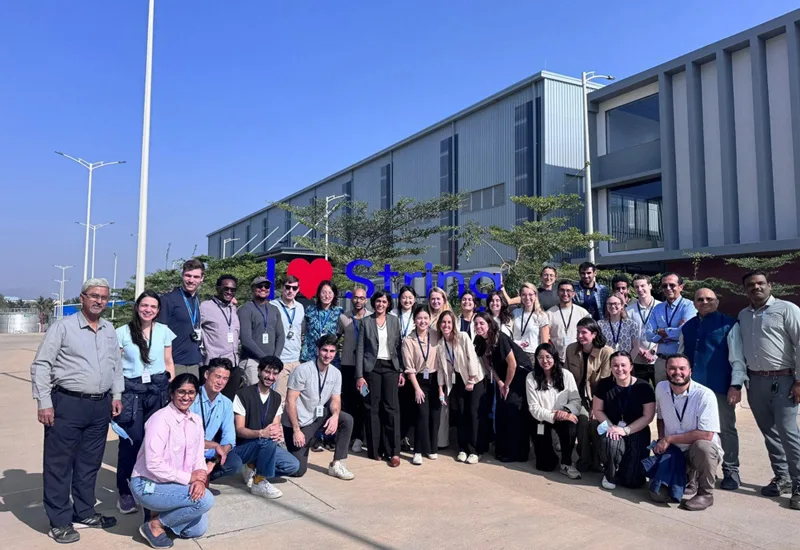
String Bio’s manufacturing facility, situated outside of Bangalore, is a visual testament to the deep technical expertise Dr. Subbian and her team bring to String Bio. The entire process is automated, with a massive system of fermentation tanks creating the “broth” that nurtures their proprietary microbe. The ultra-high-tech production line requires no direct human labor once it begins, and the connected nature of the process means even some employees can’t access the full intellectual property at work.
After touring the plant, we workshopped with String Bio on how to connect the end products to customers at scale. With a very diverse range of products available across multiple industries, String Bio has many avenues available for monetization. Within their agricultural line alone, their suite of solutions spans 11 different crops that target 80% of agricultural land globally.
Across crops, the vast majority of agriculture in India occurs on small-holdings of less than one hectare2, a stark contrast from US-based industrial-scale agriculture. In this fragmented landscape, smallholder farmers sell their yields to aggregators, who consolidate harvests for sale to wholesalers and food processing chains. Farmers themselves, though, are the ones who make decisions about which products to use on their crops. They buy products from small agricultural supply shops in their villages, guided by past experience, peer recommendations, and, most critically, the shopkeepers themselves.
These local retailers, colloquially known as distributors, function as more than just vendors; they are trusted advisors and essential financiers. Because many farmers lack formal education and depend on intermediaries for guidance, they rely heavily on the distributor’s expertise to choose products. Furthermore, because these shops often provide seeds and fertilizers on credit until harvest, the distributor’s recommendation carries significant weight.
For String Bio, winning over these distributors is a strategic imperative. Communicating the superior quality and proven benefits of the products is insufficient; competitors provide incentives to distributors in exchange for higher sales. String Bio will need to engage in comparable or greater incentives in order to capture market share, unless it can circumvent the distributors and communicate directly with farmers. So far, they have experimented with display ads and social media as marketing channels. Avenues like free trial or money-back guarantees may also be considered.
At String Bio, we learned that closing the gap between agricultural output needs and production won’t be solved by technology alone; innovators must also learn how to influence behavior and connect with local farming communities in order to drive adoption of their solutions. Once initial uptake occurs, results will hopefully speak for themselves, leading to a surge in usage village by village, hectare by hectare. In the meantime, String Bio continues to use their SIMP technology to develop new products that remove methane from the environment and offer superior nutrition and feedstocks for society at large.
1 Statista, https://www.statista.com/topics/9368/rice-market-in-india/?srsltid=AfmBOopWCMahxK921RNDanRhnuU XsMiGrCjWUiMY4LHbULz9ttpH4ZF0#topicOverview
2 Adam Smith Institute, https://www.adamsmith.org/blog/the-average-indian-farmer-is-poor-because-the-average-indian-farm-is-s mall