Professor Vikram Gandhi’s Immersive Field Course (IFC) “Development while Decarbonizing: India’s Path to Net-Zero" delved into the critical aspect of decarbonization and sustainability goals amid India's rapid development. The course presented an opportunity for students to advance their knowledge of sustainability efforts, decarbonization, and net zero in the context of a broader development agenda. The class culminated in a series of site visits in January 2026 in Mumbai and Bangalore and this is one of 8 student essays that highlights their reflections on uncovering sustainable solutions across the country.
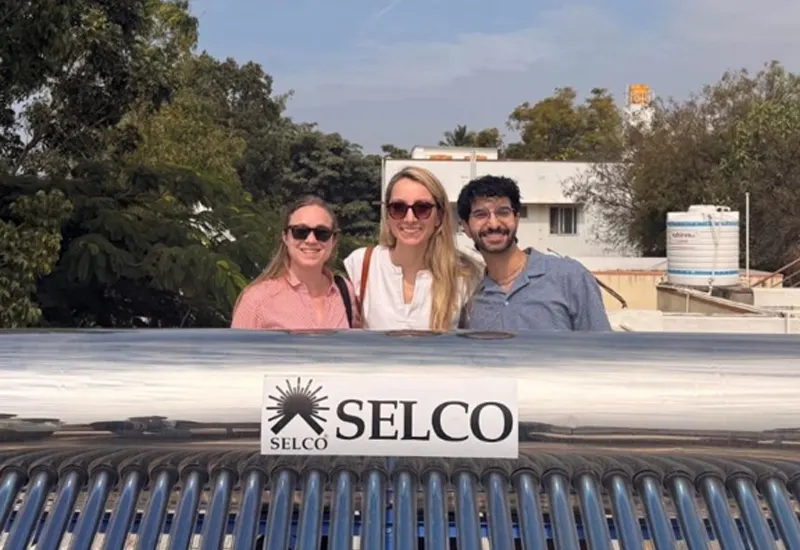
Beyond Kilowatts: What SELCO Teaches Us About Decentralized Renewable Energy That Actually Works
India’s energy story is often told in gigawatts and grid maps. But at the last mile, the metric that matters is reliability: can a clinic chill vaccines through a heatwave, can a potter run a wheel or a sewer stitch a dress when the grid sags, can a farmer irrigate without burning diesel? Our IFC India field visit to SELCO, a pioneer of decentralized renewable energy (DRE), made one thing clear: the real innovation isn’t a single product; it’s the system-building that combines energy, service, financing, and local community building to make clean and dependable power useful and affordable in the places that need it most.
Distributed renewable energy (DRE): not just power, but reliable power
India stands at a pivotal moment: it must keep building factories, homes, roads, and services, while bending its emissions curve to meet its 2070 Net Zero pledge. Despite surpassing its target of 50% of installed electricity capacity from non-fossil sources, coal remains central in generation in India and overall emissions are still projected to rise as the country industrializes and living standards improve. Under current policies, total greenhouse gas emissions are expected to increase by more than 40% by 2030, even as climate impacts intensify.For millions of rural households and enterprises, unreliable grid power forces a daily trade-off between productivity and pollution; without stronger reliability at the edge of the grid, rural communities will keep leaning on diesel back-up.
Decentralized renewable energy (which includes rooftop solar, village-scale mini-grids, and battery storage systems) offers a path to reconcile development and decarbonization. Reliable, local power enables clinics to operate through heatwaves, farmers to irrigate without diesel, and small businesses to invest in better equipment. Surveys show that while household electrification now exceeds 96%, more than 70% of rural households still experience unreliable power; DRE directly tackles this reliability gap while reducing emissions.
On the ground, productive use of energy (PUE) is the flywheel. When DRE reliably powers income-generating loads (cold storage, mills, sewing machines, pottery wheels, etc.), demand becomes less lumpy and tariffs become more sustainable for all users. That anchor demand is the business model backbone for DRE and a key cornerstone for SELCO’s projects.
SELCO: designing ecosystems for systems change
A brief history
SELCO India was established in 1995 by Dr. Harish Hande and Neville Williams as a private for-profit social enterprise based in Bangalore. While initially founded with a mission to sell and service PV systems in Karnataka, SELCO has grown through a model that transcends mere project installation and instead leverages a durable energy service model that pairs technology with service, finance (through their partnerships with Indian banks and microfinance institutions), and local communities.
The SELCO model: a convenor of the ecosystem
What sets SELCO apart is its role as a systems builder. Instead of treating electrification as a one-off hardware deployment, SELCO convenes the actors that make power useful and durable: local entrepreneurs, financial institutions, state programs, and service technicians. This approach aligns the energy product with the financial product and the service product, the combination of which is what constitutes true “infrastructure” for DRE.
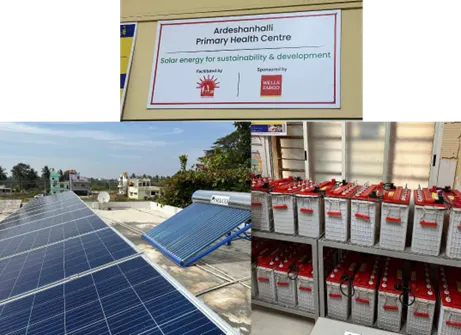
Overview of the Ardenshanhalli Primary Health Centre site visit
On January 9th of 2026, the Harvard Business School IFC India student group visited the Ardeshanhalli Primary Health Centre within the Bangalore Rual district. SELCO dubs this center as a “model outpatient health center”, whereby they’ve set up a grid-integrated solar power and water heating system, with supplementary battery storage, to serve as a model for how infrastructure in rural India can be developed, dependable, and simultaneously low-carbon.
SELCO did not stop at setting up the energy infrastructure, it also provided modern electrical medical equipment – this not only ensures that the patients of Ardenshanhalli have access to state-of-the-art medical care, but also guarantees that the installed PV-battery system has the associated PUE (productive use of energy) that it needs for an optimized financial business case.
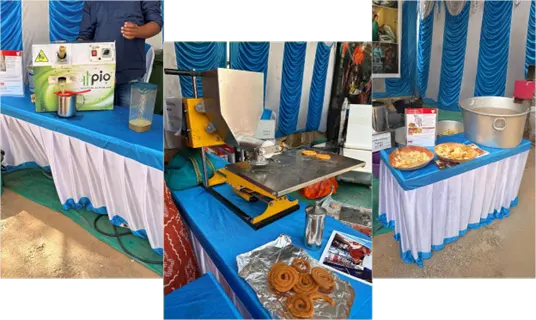
SELCO’s projects do not stop just at healthcare; SELCO’s system building approach also benefits microbusiness owners across rural India, which the SELCO team brought to our site visit center to demonstrate their solar-powered livelihood projects. This included automated, solar-powered sugarcane juicers, chakli setters, and potato slicers. These machines decrease manual labor and ensure that the microbusiness owners can continue producing the products their livelihoods depend on, without being at the mercy of grid power availability.
Decarbonizing while developing rural India: learnings for scaling up DRE
Our research surfaces three policy knots that, if untied, could let SELCO-style models scale faster:- “Grid arrival risk”: developers and lenders need uniform rules for when the main grid shows up (interconnection standards, compensation/buyout, and clear service-territory governance). Finalizing a national micro-/mini-grid policy with these protections can be a critical unlock to crowd in private finance.- Battery storage as a standard: battery storage is moving from optional to essential; pairing storage with rooftops and mini-grids cuts diesel runtime and unlocks heavier appliances. It could be prudent for project developers to prioritize concessional finance for storage and long-duration pilots where logistics justify them.- Policy innovation through Virtual Net Metering (VNM): VNM lets communities share credits from a single solar asset when rooftops are small or unsuitable; it is a regulatory unlock for dense, low-income clusters where structural constraints block adoption.
For the humans behind the acronyms, these choices add up to more than megawatt counts. Reliable power means a nurse can trust the vaccine fridge, a student can study after sunset, and a farmer can irrigate without the sting of diesel costs. India’s development story doesn’t have to conflict with its climate story. If we scale what SELCO demonstrates: reliability, inclusion, and productive use as the backbone of decentralized systems, then development and decarbonization can move forward together, one dependable circuit at a time.