Professor Vikram Gandhi’s Immersive Field Course (IFC) “Development while Decarbonizing: India’s Path to Net-Zero" delved into the critical aspect of decarbonization and sustainability goals amid India's rapid development. The course presented an opportunity for students to advance their knowledge of sustainability efforts, decarbonization, and net zero in the context of a broader development agenda. The class culminated in a series of site visits in January 2026 in Mumbai and Bangalore and this is one of 8 student essays that highlights their reflections on uncovering sustainable solutions across the country.
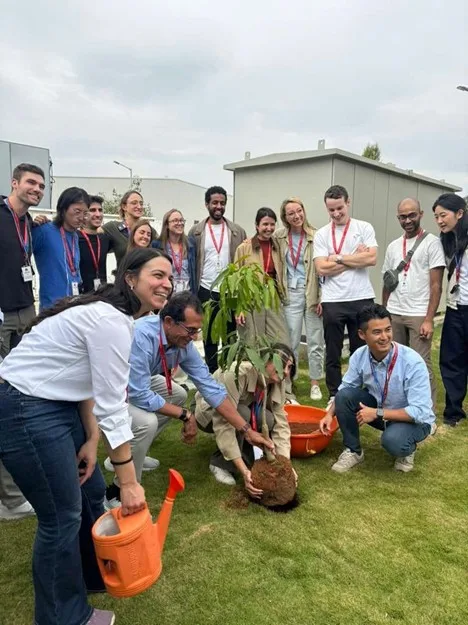
HBS students and professor Vikram Gandhi planting a tree at Ohmium facility in Doddabalapurra. HBS students: First line left to right: Sabrina Montovanelli (in white), and Julia Lawson-Johns (in brown), Kosuke Kobayashi (in blue) Second line left to right: Taylor Skingle, Le Qi, Michael Habibi, Rachel Carp, Arianna Bonomini, Isabelle Carpenter, Danno Lemu, Kathryn Porretta, Grace Missakian, James O’Byrne, Venk Muppaneni and Kaylee Kim.
On a sunny Saturday morning in January, twenty-five stud ents arrived at Ohmium’s electrolyser manufacturing plant in Doddaballapura, some 90 minutes outside Bangalore - and into one of the less glamorous front lines of the energy transition. What followed was less a factory tour than a lesson in why decarbonisation is no longer a question of physics, but of economics and policy.
The morning unfolded with a briefing on Ohmium’s history and strategy. Ohmium’s business is electrolyser manufacturing: the machines that split water into hydrogen and oxygen using electricity. These machines are indispensable to green hydrogen production and remain costly, accounting for roughly 30–40% of the levelised cost of hydrogen (LCOH)1,2. That matters because hydrogen, when produced with clean power, is one of the few viable ways to decarbonise hard-to-abate sectors – steel, cement, chemicals, oil and gas, as well as aviation, shipping and long-haul trucking – which together generate about 40% of global direct CO₂-equivalent emissions. In transport, hydrogen-based fuels may yet succeed where batteries struggle, particularly in applications where weight, range and refueling speed matter most.
The science, however, is not settled. Electrolysers come in several technological flavours, each with trade-offs in efficiency, materials and cost. Ohmium has opted for proton exchange membrane (PEM) technology, a relatively rare choice in India compared with the more established alkaline alternative. PEM electrolysers are nimbler: they can ramp up and down quickly, making them better suited to intermittent renewable power such as solar. They also achieve higher current density in a more compact footprint. Ohmium leans into this modularity. Its electrolysers resemble large industrial boxes that can be stacked to reach the desired capacity, deployed quickly, and moved if needed - an appealing proposition for industrial customers seeking flexibility and low-capex, on-site hydrogen generation.
The company’s pitch has found buyers well beyond India. Ohmium ships electrolysers to customers in the United States, South America, Eastern Europe and the Middle East, alongside partnerships with Indian industrial heavyweights such as the Tata Group. Its target clients are firms in emissions-intensive sectors facing mounting pressure to decarbonise, as well as less obvious customers with high reliability needs - for example, microgrids powered by hydrogen fuel cells.
Unlike many Indian electrolyser manufacturers, Ohmium did not emerge from a sprawling industrial conglomerate. Its capital structure is recognisably start-up-like. Early backing came from specialist climate and venture investors; later rounds included large funds such as TPG Rise Climate, alongside strategic investors like 3M. As with many deep-tech firms, the challenge emerges as the company scales: patient equity and low-cost, risk-tolerant debt become critical to financing the capital-intensive requirements of industrial facilities.
After the company’s presentation came the factory floor. Electrolysers were being assembled by hand, alongside advanced power electronics and closed-loop cooling systems. In the R&D lab, engineers were working on designs that could scale electrolyser packs to the gigawatt level. The system’s complexity was striking. This is not plug-and-play hardware; it is precision industrial equipment that Ohmium has mastered and is now in the process of automating. Outside, a full-scale mock-up showed how the modular units would look once stacked at a customer site - functional, imposing and, at least to climate-minded MBAs, rather beautiful.
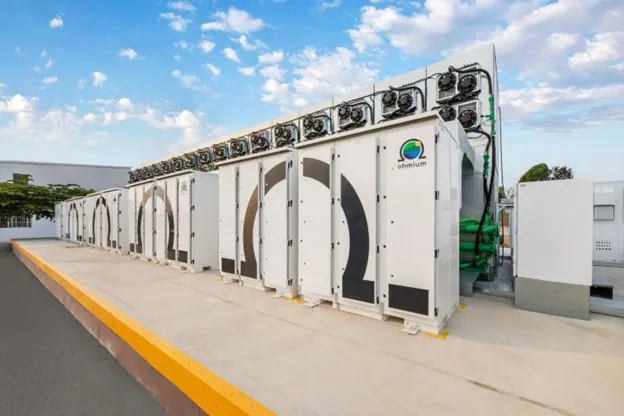
Real-size electrolyser plant mock-up. Ohmium website, all rights reserved to Ohmium.
Following a vegetarian lunch in the company canteen, the discussion turned from engineering to finance. With capacity built but demand still tentative, what funding options should Ohmium pursue next as it moves towards profitability and scale? Students debated equity versus debt, concessional capital, blended finance, working-capital and receivables-based solutions, and even monetising adjacent technologies while hydrogen markets mature. The exercise was revealing. The problem facing firms like Ohmium is not a shortage of ideas, but a world that has yet to fully align its incentives with its climate ambitions.
That misalignment points to three lessons that extend well beyond one factory outside Bangalore.
First, demand matters at least as much as supply. Ohmium’s facility is operational; the machines are ready. What is missing are firm, long-term orders. Governments, including India’s, have lavished attention on subsidising hydrogen production, but far less on guaranteeing demand. Contracts-for-difference, public offtake agreements, or credible mandates in sectors such as steel and fertilisers would do more to unlock investment than yet another round of production-linked incentives.
Second, public capital should de-risk, not displace, private finance - particularly commercial debt. The financing gap in green hydrogen is less about the availability of capital than about risk allocation. Early projects carry technology, offtake and demand risks that commercial banks are ill-equipped to bear in unproven markets. Concessional and blended instruments are better suited to absorbing these risks, whether through first-loss capital, guarantees or revenue backstops. Used well, sources of philanthropic or public money can make projects bankable and crowd commercial lenders in; used poorly, it merely pushes out progress.
Third, electrolysers should be viewed as strategic industrial assets, not experimental climate gadgets. Combined with cheap, abundant solar power, they offer the promise of domestic hydrogen production without CO2 emissions or import fuels, an energy-security prize as much as a climate one. The caveat, of course, is that PEM electrolysers still depend on critical inputs such as iridium, a scarce and geopolitically sensitive material. Even so, the factory floor makes clear this is mature manufacturing, not experimentation. Recognising electrolysers as core energy infrastructure would help drive standardisation, lower costs and speed scale-up.
The visit challenged a common refrain: that decarbonisation technology is not yet ready at scale. Ohmium’s factory suggests otherwise. The physics and chemistry largely work. Process automation is underway. What lags behind is the business case - policy frameworks, carbon pricing and financing structures capable of underwriting the transition.
Before leaving, the group followed an Ohmium tradition and planted a tree. Nature, after all, has been removing carbon efficiently for millions of years. The challenge now is whether human systems can learn to scale as reliably.
1 LCOH (Levelized Cost of Hydrogen) is the average cost per kilogram of hydrogen produced over a project’s lifetime, including capital, operating, electricity, and financing costs.
2 https://mission-innovation.net/wp-content/uploads/2025/08/Hydrogen-Production-Factsheet-Reducing-Electrolyser-Capital-Cost.pdf