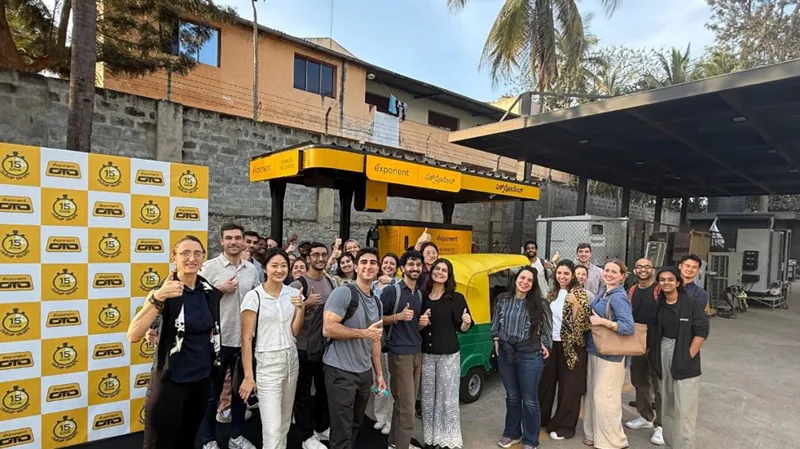
Professor Vikram Gandhi’s Immersive Field Course (IFC) “Development while Decarbonizing: India’s Path to Net-Zero" delved into the critical aspect of decarbonization and sustainability goals amid India's rapid development. The course presented an opportunity for students to advance their knowledge of sustainability efforts, decarbonization, and net zero in the context of a broader development agenda. The class culminated in a series of site visits in January 2026 in Mumbai and Bangalore and this is one of 8 student essays that highlights their reflections on uncovering sustainable solutions across the country.
This January, as part of Harvard Business School’s Immersive Field Course in India on Decarbonizing While Developing, our team revisited two companies playing central roles in India’s electric mobility transition: Ather Energy and Exponent Energy. These visits offered a grounded view into how India’s EV ecosystem is evolving, not through abstract climate commitments alone, but through products, platforms, and business models designed to work in the realities of the Indian market.
Transportation is one of India’s largest sources of pollution, accounting for around 12-15% of India’s greenhouse gas emissions. Two-wheeler (2W) vehicles constitute around 70-75% of all registered vehicles in India, and most are still powered by internal combustion engines. Electrifying this segment represents one of the most powerful levers for emissions reduction. Our research focused on the battery and charging value chain for two- and three-wheelers, examining where adoption is accelerating, where bottlenecks remain, and how companies are navigating the tradeoffs between affordability, performance, and scale.
Visiting Ather and Exponent brought these themes to life. While the two companies operate at different points in the ecosystem, Ather as a premium electric scooter manufacturer and Exponent as a fast charging infrastructure platform, they share a common philosophy. Solutions must be deeply Indian, economically compelling, and technically robust in order to scale.
Ather Energy: Winning the Upgrade, Not the Price War
Our visit to Ather Energy’s manufacturing facility in Tamil Nadu offered a window into how one of India’s most established EV companies has carved out a durable position in a fiercely competitive market.
Founded in 2013, Ather has evolved from a battery research startup into a fully integrated electric vehicle company. Today, it operates across battery pack manufacturing, scooter assembly, vehicle software, and charging infrastructure. What stood out most during our visit was the intentionality of Ather’s positioning.
Ather does not aim to serve the entire two-wheeler market. Instead, it focuses squarely on the premium segment, which represents roughly 12% of total industry volumes. Within that segment, Ather commands an estimated 76% market share, a striking figure given the presence of well-capitalized competitors like Hero, Bajaj, and Ola. Management was explicit that the company does not plan to move downmarket. Their view is that the market itself is moving upward as consumers increasingly see EVs not just as a cheaper alternative, but as an upgrade from ICE scooters.
This strategy is reflected in Ather’s economics. The company runs at roughly 250,000 units annually, with a revenue run rate of around $400 million and adjusted gross margins of approximately 22%, potentially among the highest in the Indian two-wheeler EV industry.
A core driver of this performance is Ather’s software-defined ecosystem. Unlike many original equipment manufacturers that outsource software or treat it as an add-on, Ather designs its vehicles around an integrated digital platform. This enables faster iteration, tighter control over performance and safety, and a better ownership experience overall. During discussions, it became clear that software is not peripheral to Ather’s strategy. It is the foundation of their competitive edge.
Ather has also invested heavily in ecosystem building. Ather Grid, now comprising over 2,500 fast chargers, directly addresses charging anxiety and uncertainty. Importantly, the company has chosen to make its charging standards interoperable, prioritizing broader EV adoption over exclusivity.
Beyond technology, Ather’s manufacturing operations reflected a broader commitment to inclusion. Roughly 70% of its battery production workforce is female, challenging traditional manufacturing norms and reinforcing the idea that the energy transition can and should be socially inclusive.
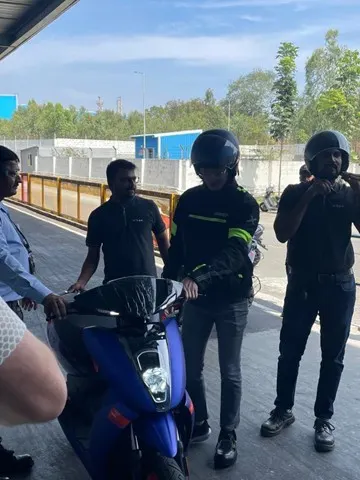
A demonstration of the Ather 450 Apex at the Tamil Nadu plant.
Exponent Energy: Making Fast-Charging Economically Inevitable
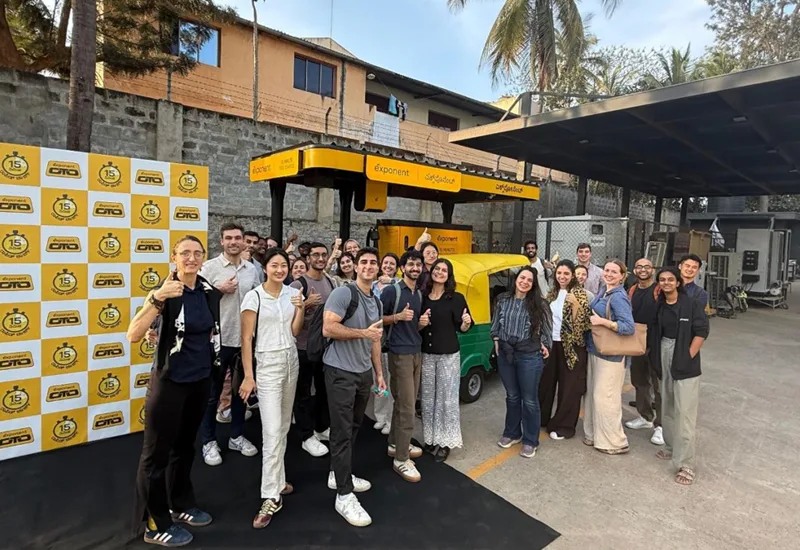
If Ather’s story is about upgrading the consumer experience, Exponent Energy’s story is about unlocking economics at scale. Exponent is tackling one of the most persistent barriers to EV adoption: charging time. During our visit, we observed a live demonstration in which a commercial three-wheeler was fully charged in under 15 minutes, among the fastest charging times globally for lithium iron phosphate batteries.
What distinguishes Exponent is that its business is not framed primarily as an environmental choice. Management emphasized that customers, especially fleet operators, care less about sustainability unless they see immediate and tangible benefits. For commercial vehicles, those benefits are higher uptime, faster turnaround, and better asset utilization.
Exponent’s focus on commercial three-wheelers is deliberate. While these vehicles represent a relatively small share of the total vehicle fleet, they consume a disproportionate share of mobility energy. In this segment, downtime is costly, and slow charging can erase the operating cost advantages of electric vehicles. By eliminating multi-hour charging windows, Exponent makes EVs competitive not just on emissions, but on productivity.
Technically, Exponent’s approach is deeply integrated. Rather than offering a standalone charger, the company has built a platform that combines battery design, thermal management, software, and charging infrastructure. This system-level thinking allows Exponent to push charging speeds without degrading battery life, a challenge that has limited fast charging adoption elsewhere.
Exponent is also innovating on deployment and financing. The company is not simply installing chargers, but building a network that OEMs and fleet operators can plug into without bearing the full upfront infrastructure cost. This platform approach lowers adoption barriers and accelerates scale, particularly in a cost-sensitive market.
Shared Constraints and Realistic Optimism
Despite their successes, both Ather and Exponent face constraints that extend beyond any single company.
Battery supply chains remain the most significant vulnerability. India continues to rely heavily on China for lithium-ion cells and key inputs. While domestic manufacturing capacity is beginning to emerge, credible substitutes are still three to five years away. Both companies acknowledged this dependence as a strategic risk, even as government initiatives aim to localize production.
The gradual phase-down of government subsidies was another common theme. Interestingly, both companies reported minimal near-term impact, suggesting that strong products and sound unit economics can withstand a reduction in incentives. That said, longer-term policy stability remains critical for capital intensive investments across the ecosystem.
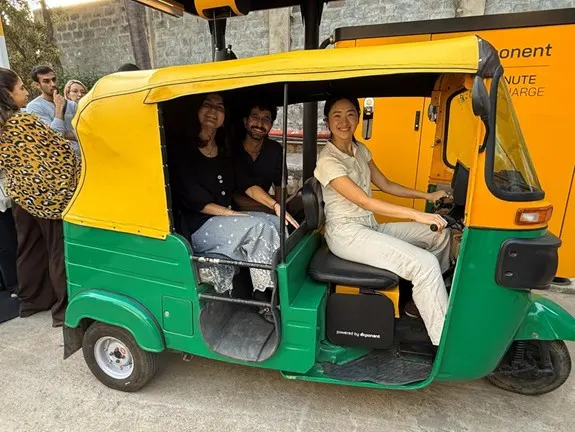
A three-wheel vehicle parked in front of a charging station at the Exponent Energy facility.
Conclusion
Revisiting Ather Energy and Exponent Energy reinforced a central insight from our research. India’s EV transition will not be driven by climate ambition alone, but by solutions that align with local economics, infrastructure realities, and consumer behavior.
Ather demonstrates that premium, software-driven products can pull consumers away from ICE vehicles without chasing the lowest price. Exponent shows that fast charging, when designed around real operational needs, can make EVs the rational choice for commercial fleets. Both companies embody an approach that is distinctly Indian, engineering for heat, voltage fluctuation, cost sensitivity, and scale.
As India advances toward its net-zero ambitions, the success of companies like Ather and Exponent will matter far beyond scooters and chargers. They offer a blueprint for how developing economies can decarbonize while continuing to grow, by making the clean choice the obvious one.