Just before nearly two feet of snow coated the Harvard Business School campus, a highly engaged group of HBS MBA students gathered in Aldrich Hall for the Short Intensive Program (SIP), AI and Climate Change: Unlocking Business Opportunities. Led by Professor Mike Toffel and Senior Lecturer John Mulliken, this new SIP was one of the 10 no-fee, no-credit four-day elective courses engaging over 675 students on campus that week.
Toffel and Mulliken built on their academic and professional expertise in business strategy and operations, climate change, and the AI opportunity landscape, to bring together nearly 30 guests for a series of engaging discussions, presentations, and extensive Q+A. These investors, academics, consultants, entrepreneurs, and managers at large tech companies led the students on a journey of discovery of the wide-ranging ways in which they are testing the potential for AI to provide a net positive impact on the climate at an unprecedented, accelerated pace.
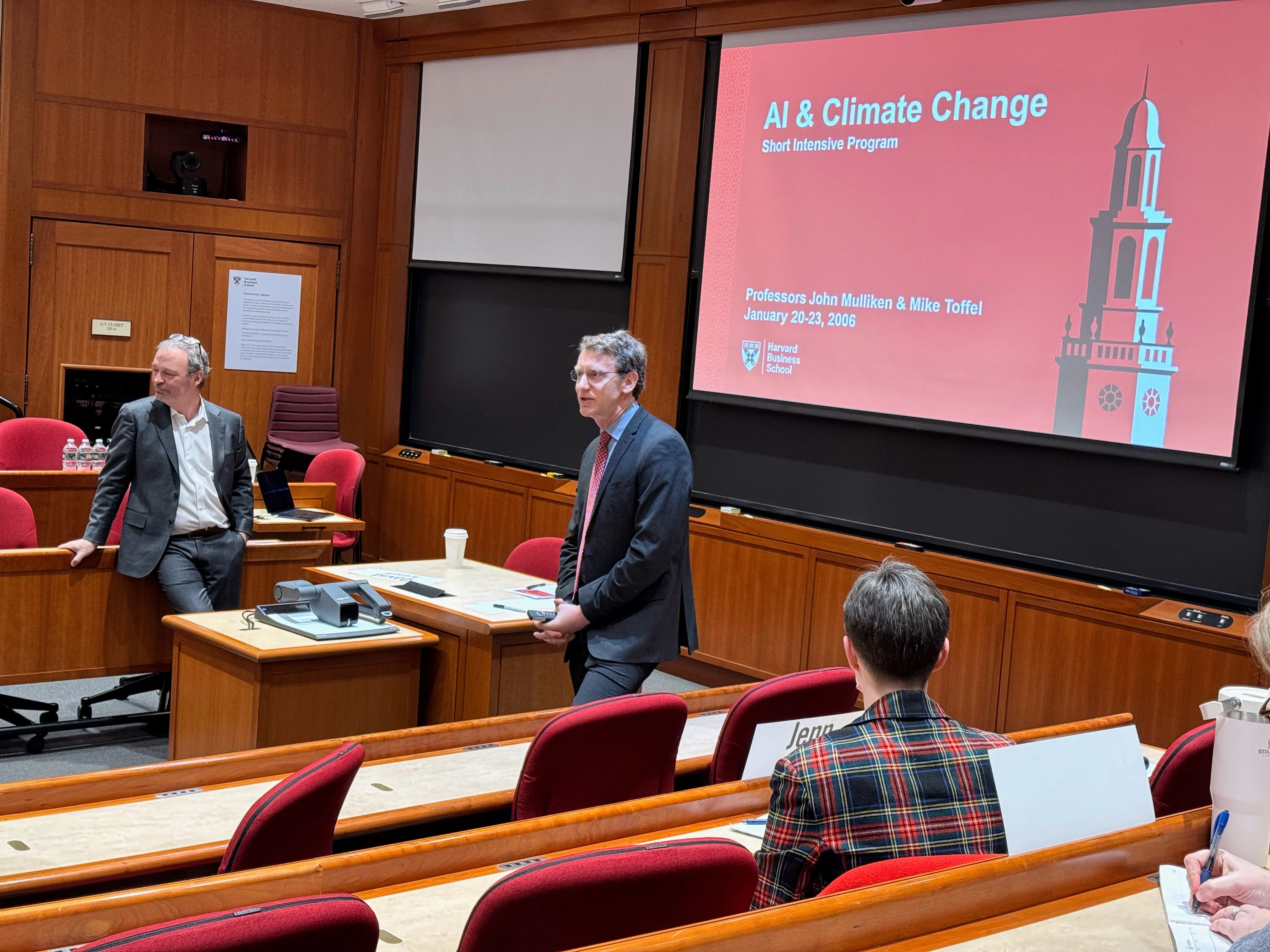
As Professor Toffel said, “We created this SIP to discuss the convergence of two megatrends that will have profound effects on our students’ careers: AI and climate change. While there’s increasing awareness of the vast amounts of energy that the AI revolution is requiring, there has been much less attention on the many business opportunities – and indeed many current businesses – that are using AI to help companies become more resilient to the physical manifestations of climate change, and to identify ways to decarbonize their operations, products, and services.”
Mulliken and Toffel organized the course around three main objectives: (1) Provide foundational knowledge of how and why the climate is changing as well as some core AI concepts and terminology; (2) Drive new discoveries through presenting a wide range of roles, technologies, and organizations; and (3) Enable new connections among students, faculty, and leaders in the field.
Students arrived eager to engage. As Ferhat Gherbi, MBA 2026 said at the outset of the class: “AI and climate are the zeitgeists of our generation; it’s exciting to see the intersection; I want to see if this is a bet I want to make on my career.”
Leading with Foundational Level Setting in Climate Change and AI
Spencer Glendon, HBS Executive Fellow and Founder of Probable Futures, demonstrated how we’ve entered an age of climate instability, altering the foundation on which business and economies have been built, driving the need for new analysis and questions. He implored students to “use AI as a question machine rather than an answer machine.” HBS Executive Fellow Jenn Turliuk then provided an overview of various forms of AI and highlighted potential areas of opportunity to connect the two topics. Turliuk also foreshadowed the framing she would help provide at the end of the week regarding the “double-edged reality” of AI and climate, where students would grapple with the energy demands of large-scale computing and data centers, and learn about different approaches to turning this potential liability into competitive advantage. This opening context set the tone that the course was designed to help students develop and ask increasingly informed questions, with the objective of inquiry not answer.
New Discoveries, New Questions
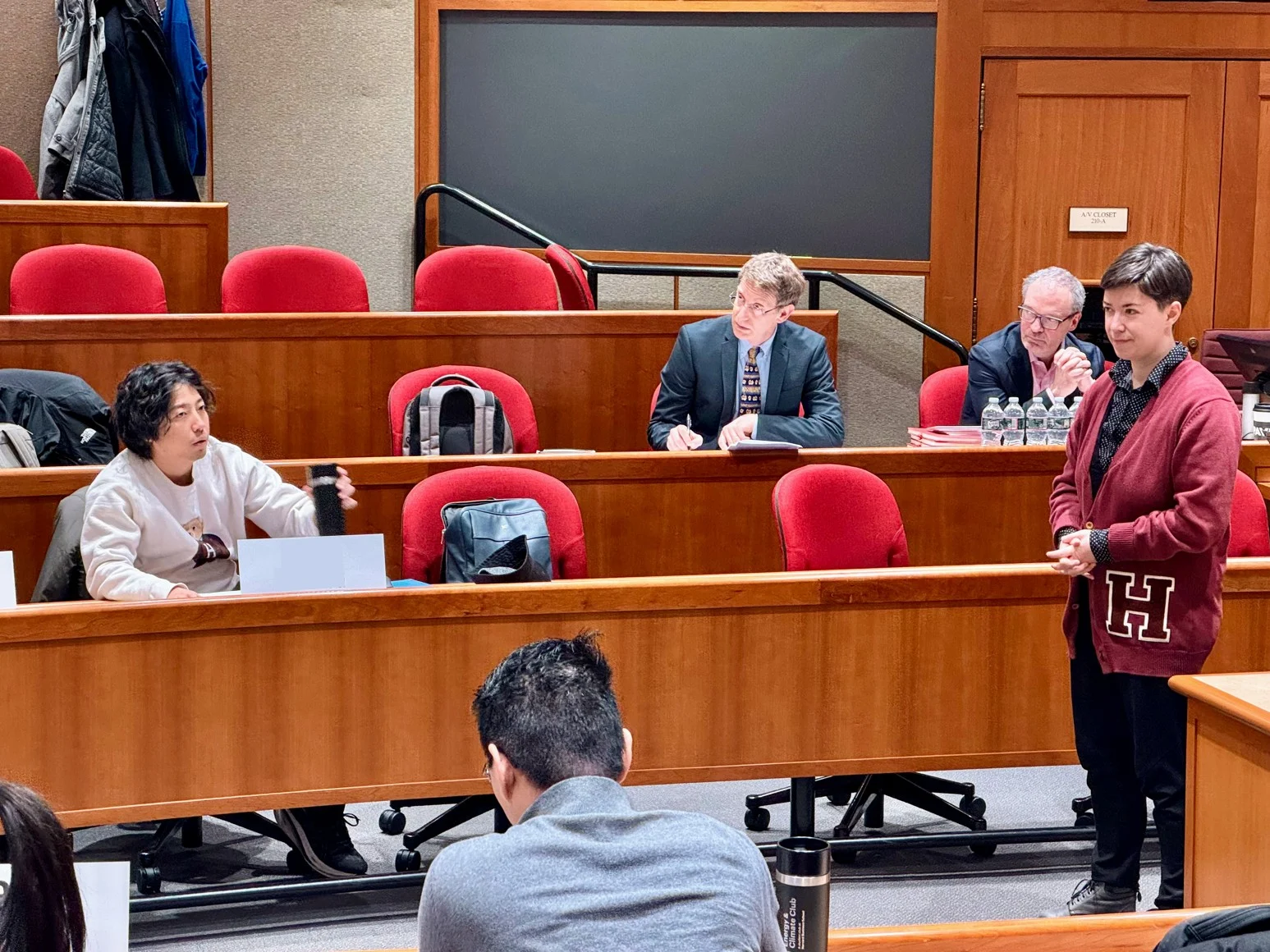
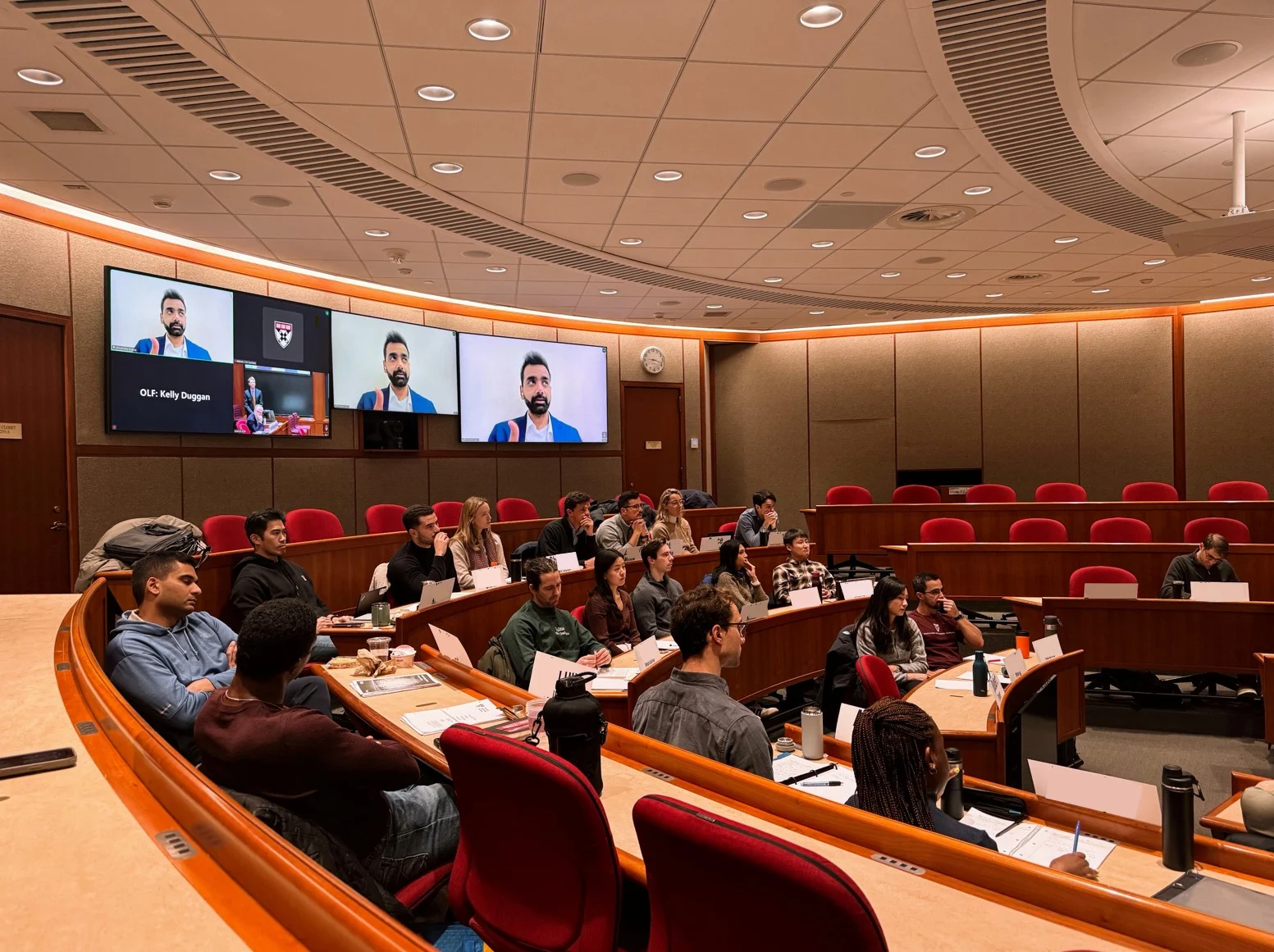
A clear strength of this SIP was the breadth and depth of high-level professionals developing new technologies, roles, or companies (see a complete list at the end of this article) that made up the quilt of insights delivered throughout the week. It was exciting, if not mind-boggling, to learn about the range of applications from SAS to heavy infrastructure development and everything in between.
Mulliken celebrated the outcome of the incredible bench of speakers: “Meeting this breadth of builders under one roof was remarkable. From startups building autonomy for wildfire suppression or sea floor exploration, to large enterprises optimizing traffic flow at city-scale, to quantum computing, it was great to see young leaders see how they can bring the tools of AI & Machine Learning to bear to meaningfully impact the challenges of climate change.”
Guests consistently led with the problem they were trying to address: the need to accelerate the R+D process for an alternative resource; wasted grid capacity; inefficient resource discovery or utilization; unpredictable availability of clean water; and more. As students compared these approaches for climate resilience/adaptation and mitigation/decarbonization through investment, developer, or manager angles, more questions arose than answers: Was the approach providing a net benefit? Could the business model work in context? Where does this company fit into the data and information value chain and how can they turn that into a competitive advantage? The very questions MBAs are trained to ask.
New and Enduring Community
Students joined this SIP with a range of ambitions, backgrounds, and personal experiences – but all with a strong motivation to connect. As unique and powerful as the content of SIPs can be – including a chance to experiment with a new topic not offered in the existing curriculum or offered in a new way – SIPs may shine brightest in their potential to create community around a topic.
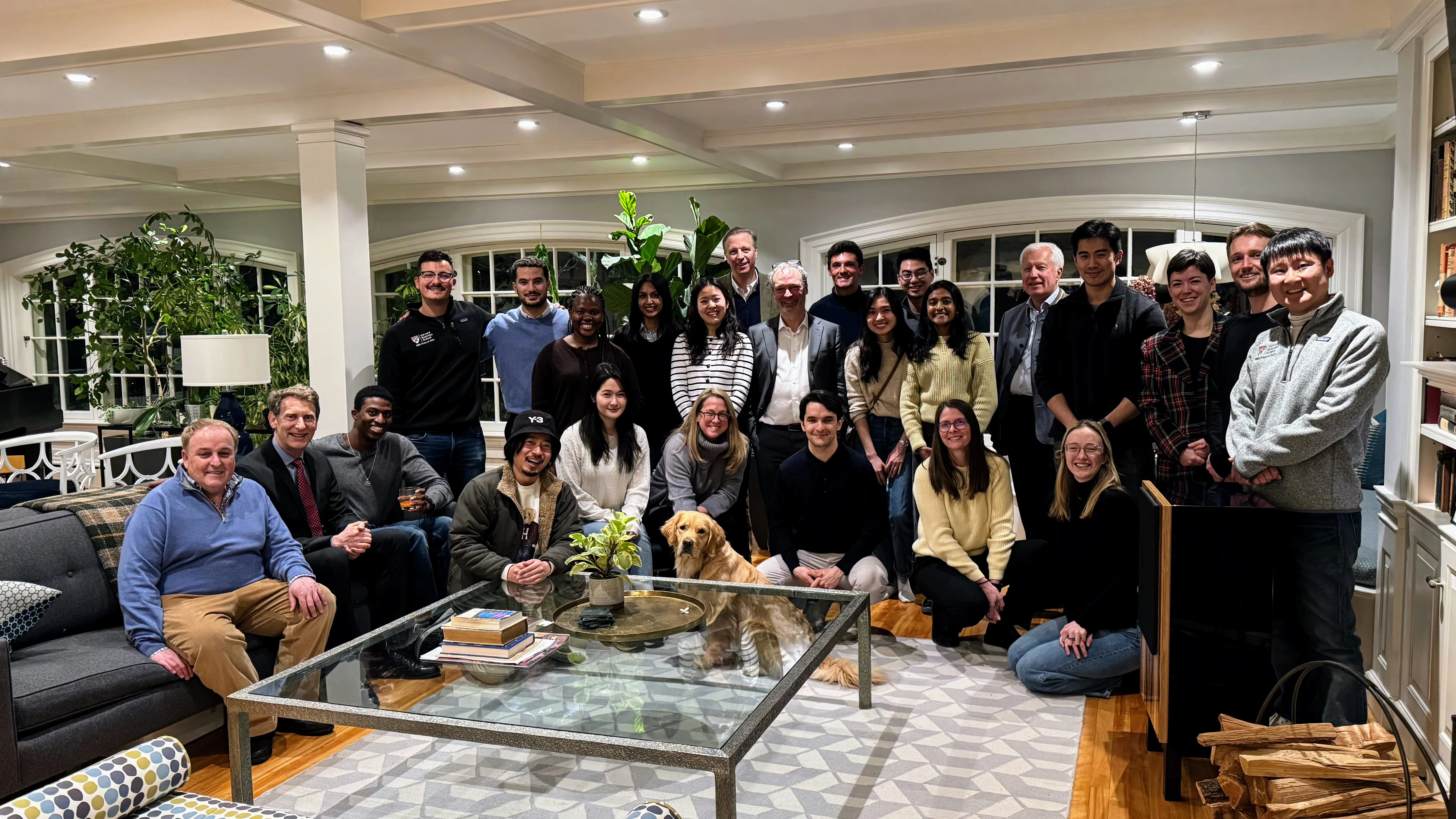
The Climate + AI SIP made connection a priority, starting with an evening gathering at John Mulliken’s home (featuring his delightful Golden Retriever, Tilly), giving the mix of RC and EC students, some Advanced Leadership Initiative Fellows, and faculty a chance to mingle and get to know each other. Additionally, the faculty reserved a dedicated lunch space each day in Spangler that provided students with a unique opportunity to continue the conversation with class guests – and to dive deeper on those pressing questions that came up in class. The lunch connections have already inspired new Independent Project ideas and potential internships or full-time job opportunities. A new WhatsApp group is active with SIP students eager to grow their connections and conversations.
Just the Beginning
HBS has begun a meaningful inquiry into the relationship between two of the most defining topics of the business landscape in the years ahead. The sense of urgency to discover the tools and the people that will help society move quickly and with purpose is clear. AI tools can gather and process data at unprecedented speed – a speed that is necessary in a climate context. How firms apply these tools for a net positive impact is the screening question that will permeate the competitive landscape in the years ahead. If anything, it’s an exciting time. As one student said in the closing session, “I’m a near-term AI skeptic, but some of the applications that we’ve seen this week have surprised me and left me cautiously optimistic.”
~~~~~
Mike Toffel is Senator John Heinz Professor of Environmental Management in the Technology and Operations Management Unit at HBS and is the Faculty Chair of the HBS Business and Environment Initiative.
John Mulliken is a Senior Lecturer of Business Administration in the Strategy Unit at HBS and a strategy consultant, former CTO & CPO, public & private company board member, retail & climate tech entrepreneur, early stage investor.
Thank you to the incredible SIP guests:
Spencer Glendon, Founder, Probable Futures, Executive Fellow, HBS; Jenn Turliuk, Executive Fellow, HBS; David Aronoff, Chairman & Managing Partner, MCJ; Jay Koh, co-founder & Managing Director, Lightsmith Group; Ben Greene, co-Founder, Tessi.ai; Maxwell Brodie, CEO, Rain; Himanshu Gupta, CEO & Co-Founder, ClimateAI; Nikita Singhal, Managing Director, Blue Owl; Ed Kearns, Chief Science Officer, First Street; Jon Davis, Chief Meteorologist, Everstream Analytics; Leni Peterson, Founder and CEO, Celeste; Tim Hall, Senior Scientist, S&P Global / The Climate Service; Juliet Rothenberg, Lead Product Manager, Climate AI, Google; Pasi Miettinen, CEO, Sagewell; Christian Kaps, Professor, HBS; Joel Edwards, Co-Founder & CTO, Zanskar; Christian Klimt-Moellenbach, Director, Head of Fleet Energy Optimisation and Performance, A.P. Moller – Maersk; Moti Gyamlani; COO; Ericsson; David Hallgren, General Manager - Electric Mobility, Einride; Adam Raphael, Head of Power and Energy Solutions, Amazon Last Mile; Hui Wen Chan, Director of Sustainability, Crusoe; Sami Nabulsi, CEO & Founder, Pythag.ai; Kent Cavender-Bares, CEO, Rowbot Systems; Jake Russell, Co-Founder & CEO, Orpheus Ocean; Christina Shim, Chief Sustainability Officer, IBM; David Potere, Managing Partner & Director, The Boston Consulting Group; Alice Brooks, Partner, Khosla Ventures; John Peto, US Consulting Services Lead - Sustainability Offerings, Deloitte; Priya Donti, Co-founder and Chair, Climate Change AI, Assistant Professor, MIT.
A version of this was originally posted on the HBS Newsroom.