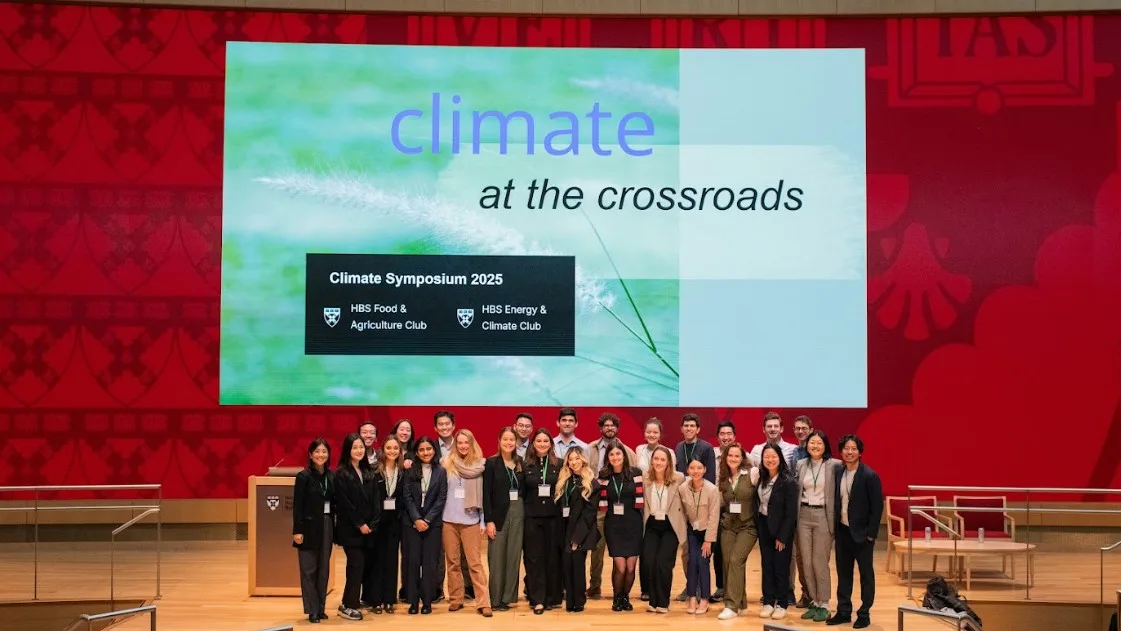
The 2025 Climate Symposium centered on the theme “Climate at the Crossroads,” capturing a pivotal moment where climate science, geopolitical dynamics, technological innovation, and economic influence intersect. Organized annually by the Energy & Climate and Food & Agriculture Clubs, this year’s event was co-chaired by Elinore Beitler, Hannah Shih, and Olivia Dejonghe, who convened global leaders, thinkers, and activists to chart a path toward a climate-resilient and equitable future.
Opening Keynote: Leading and Scaling Climate Solutions
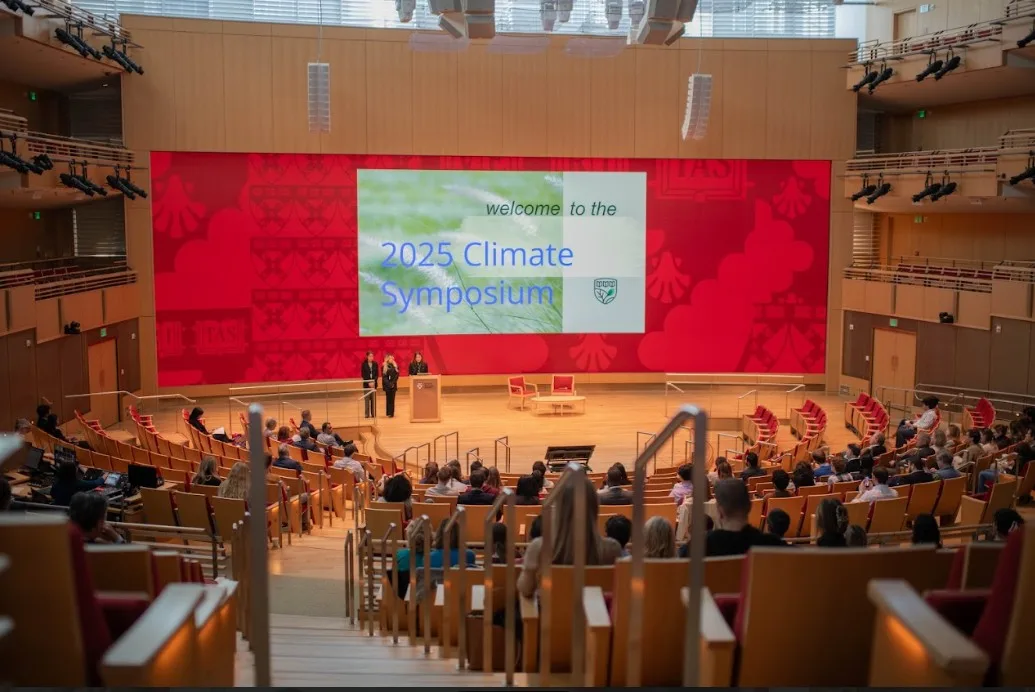
Chris Roe, Director of Worldwide Carbon at Amazon, opened the day with insights on embedding sustainability into Amazon’s core operations. Moderated by HBS Professor Suraj Srinivasan, Roe emphasized the mindset shift needed for climate leadership, noting, “A headwind is the flipside of an opportunity or problem to be solved.” Following this, HBS Professor Jim Matheson sat down with Mindy Lubber, President of Ceres, to discuss her lifelong commitment to sustainability and the imperative for private sector leadership. Lubber underscored that climate risk is fundamentally a financial risk that demands rigorous analysis.
Panels: Exploring Climate Solutions Across Sectors
Throughout the day, attendees chose from a wide range of panels covering climate finance, nuclear energy, adaptation strategies, and the Global South.
Clean Energy & Grid Innovation: Nick Devonshire (CleanCapital), Jesse Lazarus (Green Tech Alliance), Pablo Ruiz (NewGrid), and McKenzie Fowler (PowerIntel) explored the future of clean energy and grid optimization. Ruiz captured the scale of opportunity: “The grid is the world’s largest machine. Imagine what happens when it doubles in size.”
Climate Capital: Ely Sandler (Harvard Kennedy School) moderated a conversation with Nick O'Donohoe (British International Investment), Jonah Wagner (Constructive), and Joe Blair (Bay Bridge Ventures) on unlocking capital for climate solutions. The panel emphasized the importance of understanding existing systems to drive innovation.
Nuclear Energy’s Role: Sully Crevecoeur (Technetics Group), Alison Poortman (Urenco Global), and Paolo Venneri (Amazon) discussed nuclear energy’s potential in mitigating climate change.
Adaptation & Resilience: HBS Professor Christian Kaps led a discussion with Kathleen Ores Walsh (USAA), JT White (Forerunner), and Joel Wish (Bright Harbor) on the shared responsibility of climate resilience, especially in vulnerable communities.
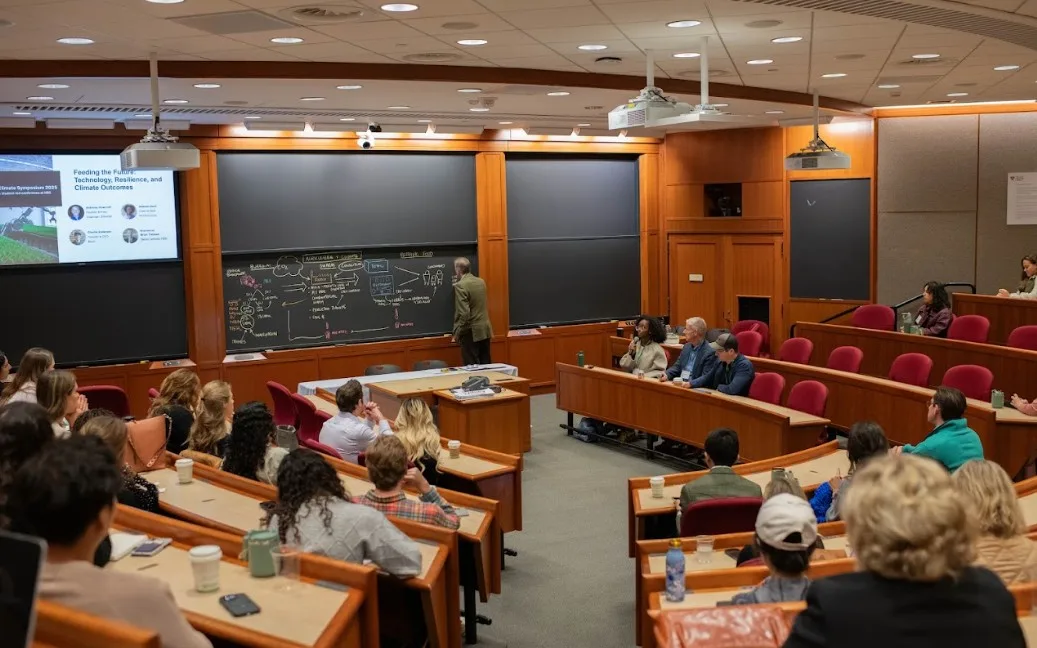
Feeding the Future: HBS Professor Brian Trelstad hosted a panel with Anthony Howcroft (SWARM), Adaeze Okoli (ReThink Food), and Charlie Andersen (Burro) on the intersection of technology, climate, and food systems.
Global South Finance: Wasim Tahir (Harvard Research Fellow) moderated a session featuring Morgan Defoort (Factor[e] Ventures) and Katya Gratcheva (IMF) on successful climate finance case studies in the Global South.
Infrastructure for Decarbonization: HBS EC student YB Kim led a panel with Digaunto Chatterjee (Eversource), Pablo Taccioli (Fluence), and Michael Pasternak (LineVision) on modernizing infrastructure for a low-carbon future.
AI & Energy Demand: Professor James Koehler explored the energy implications of AI with Dipul Patel (Soluna Computing), Michael Onolememen (NextEra), and Taylor Lalemand (Treaty Oak Clean Energy), highlighting how data centers are reshaping the energy landscape.
Live Podcast Recording: In a special Climate Rising episode, Professor Mike Toffel interviewed Jonathan Schrag, Deputy Chief of Climate for Massachusetts, on scaling state-level climate action.
Start-up Competition & Closing Keynote
Five finalist ventures— Upcylcex, Gallox, Oleo, Revolv, and Liftoff—pitched their climate innovations to a panel of judges. Oleo took home the grand prize, receiving a $10K cash award and $10K in legal services from DLA Piper. Revolv was the runner-up, earning a $2.5K cash prize and $10K in legal services, while Liftoff was named the crowd favorite, winning $10K in legal services.
The day concluded with an inspiring keynote from Daniel Goldman, Co-founder and Managing Partner of Clean Energy Ventures, moderated by HBS Professor Max H. Bazerman. The session focused on translating climate tech breakthroughs into scalable solutions.
A Global Gathering for Climate Action
With over 500 registrants from across the globe—including students, investors, operators, and academics—the Symposium showcased diverse voices and represented a rich mix of nonprofit, corporate, and startup sectors, united by a shared commitment to climate progress.