
Editor’s note: This year's election will impact companies in every industry. That’s why Harvard Business School’s Institute for Business in Global Society (BiGS) is launching its first-ever election guide for business leaders, offering insights from experts to help you navigate. In the coming weeks, we’ll publish a series showing how the Harris and Trump agendas will affect everything from trade and labor to diversity and environmental regulations. After the election, we’ll package these insights into a comprehensive guide showing what to expect in the months ahead. We hope you enjoy it.
Will companies be able to cover IVF treatments? What if a female employee needs an abortion?
These questions highlight some of the issues critical to women and their families in this year’s presidential election — far beyond the question of whether the United States will elect its first female president.
The national conversation this year, in fact, has expanded to include regular debates over abortion rights, fertility treatment, childcare and paid family leave — issues that directly impact women in all 50 states and, by extension, the companies they run or that employ them. And while companies in the past have had the luxury of avoiding involvement in social policy, they are now being forced — or at least strongly nudged — in that direction.
A new president, for example, could mean new mandates on family leave benefits. Or it could mean further restrictions on abortion and added pressure on companies to provide travel help for employees seeking abortions in other states. Even if companies would prefer to stay out of the fray on reproductive issues, their employees and customers may demand it. A recent survey found, for example, that by a two-to-one margin, workers want to be in states where abortion is legal and accessible, and more than half said they would consider state policies when deciding whether to accept a job requiring relocation.
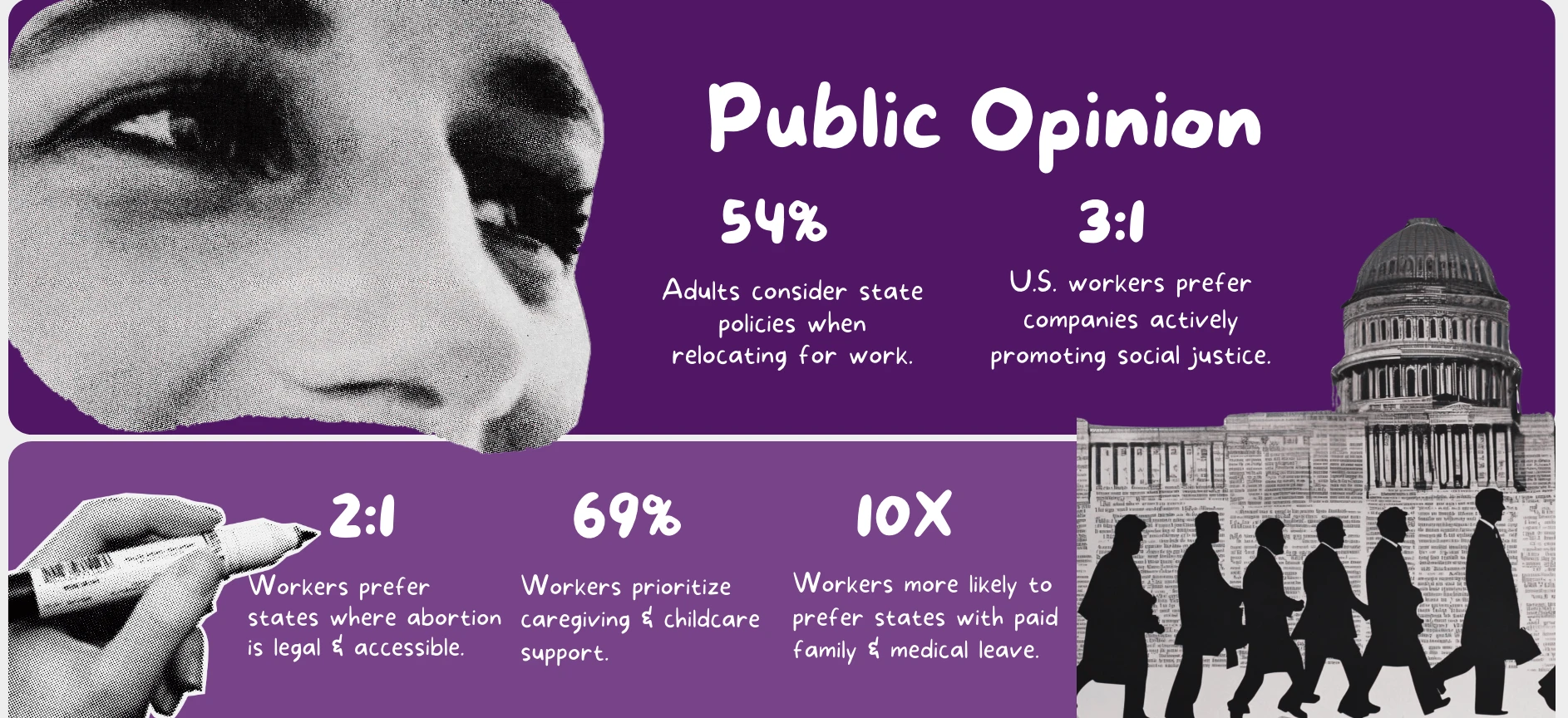
Survey from August 2024
Vice President Kamala Harris and former President Donald Trump present fundamentally different approaches to these topics. The outcome of the election could set a policy direction that significantly influences both family and work life, and impact how chief human resource officers manage policies for millions of workers. While women may find their rights and resources fluctuating based on their state of residence, businesses may need to adjust their benefits packages and practices to mesh with new policies, while also striving to attract and retain talent.
“This particular election has a starker choice than I think people have ever had,” said Sandra Sucher, a Harvard Business School professor and a leading scholar on stakeholder trust in companies. “Employee lives are at stake in a way that [was] not actually that prominent in other elections. It's not as if companies have a choice to ignore this, because the issues that are being debated are fundamental to the wellbeing of the employees who work for them.”
Abortion: Vastly different policies
Few issues have held the spotlight like reproductive rights, which became a state issue after the U.S. Supreme Court, in Dobbs vs Jackson Women's Health Organization, overturned the landmark Roe vs. Wade case that made abortion a federal right.
Trump has expressed pride in appointing three conservative justices who facilitated the overturning of Roe v. Wade, stating that abortion rights should be decided by states. He also claimed that he would veto a national abortion ban. While Trump’s stance on medication abortion has been inconsistent, Project 2025 — a blueprint by the conservative Heritage Foundation led by former Trump administration officials — calls for the enforcement of the 1873 Comstock Act, which could lead to a ban on mailing abortion-related medications such as mifepristone.
Harris said she would sign legislation reinstating abortion as a federal right and backed the elimination of the Senate filibuster to pass such a law. The Biden-Harris administration has not enforced the Comstock Act, and Harris has said she is committed to ensuring access to medication abortion.
Even after states began limiting or banning abortions, the practice increased in 2023 to about 1 million, 11% more than in 2020, when abortion was legal across the country, according to the nonpartisan Guttmacher Institute. The number of women seeking abortions who are required to cross state lines to do so doubled to one in five in that same period, according to the institute.
Companies such as Amazon, Apple, and Citigroup have offered aid to workers who must travel from their home states to another to receive an abortion, but a Kaiser Family Foundation study found that those companies are not typical, with only 7% of firms offering travel benefits for those seeking abortions.
Under a Trump administration, abortion-support benefits could be at risk if he refuses federal contracts to companies that offer such benefits, said Jen Stark, co-director of the Center for Business and Social Justice at the global consulting nonprofit BSR.
Companies will also need to consider individual state abortion laws when employing workers in multiple states, or even when considering where they choose to host meetings and events, Stark said.
Could abortion laws influence corporate recruiting and headquartering?
Businesses may prefer to focus on their corporate missions and avoid involvement with the personal lives of their employees. But abortion laws can affect their workforce — and with it, their business success and recruiting.
A January analysis by the Institute for Women’s Policy Research estimated that abortion restrictions led to employee turnover, reduced labor force participation, increased time off work, and other ramifications that cost the U.S. economy about $173 million a year.
More unintended pregnancies also could cost companies health insurance expenses, workforce deployment headaches, and higher training costs sparked by turnover, said reproductive rights attorney Kathryn Kolbert. The impact will be especially felt in companies with many young or low-wage workers.
Debora Spar, professor and senior associate dean at Harvard Business School and leader of the Institute for Business in Global Society (BiGS), said, "Even putting politics aside, women are worried about getting pregnancy care, and worried about moving to states where they don't have sufficient ob/gyns."
A May study issued by the Association of American Medical Colleges found that fewer medical school graduates are seeking residencies in states where abortion is banned or restricted. States also are losing their established ob/gyns. Idaho, for example, lost 22% of its obstetricians in the 15 months following the Dobbs ruling that left abortion laws to the states, according to a report by an Idaho physician and provider group.
Reproductive technologies at risk
Trump has stated that in vitro fertilization (IVF), an expensive procedure that can help women conceive, should be free, paid for by insurance or the federal government. But he did not spell out details of how the procedure would be financed.
While some businesses want to offer coverage for reproductive technology such as IVF as part of their employee health plans, Kolbert said, a mandate to cover IVF — with an average cost of almost $24,000 for a single cycle — could mean extra expenses for companies if insurers pass along the costs.
Harris railed against an Alabama court decision that defined frozen embryos as children. That ruling led to the shuttering of some fertility clinics for fear of legal liability, until the state legislature stepped in. Harris has not articulated a plan about whether IVF benefits should be mandated, so the business impact of her policy is not yet clear.
Childcare key for recruiting and retention
Childcare is often the single biggest line-item expense for families, with average day care costs at $321 a week for one child, according to Care.com. And while it is not a company's responsibility to secure childcare for employees, lack of reliable childcare leads to employee absenteeism, studies show.
Both presidential candidates have supported expanding tax credits for children. Harris proposes capping childcare costs for families at 7% of annual family income but has not detailed how it would be funded.
Trump has not laid out a comprehensive childcare plan but suggested in a speech at the New York Economic Club that his plan to impose tariffs on foreign imports would bring in enough dollars to support childcare programs.
The issue is crucial for businesses, because childcare expenses discourage some potential employees from working. Sucher said companies learned the importance of reliable childcare during the pandemic.
“I think a good employer would understand that if I want to have people who are undistracted at work and able to keep their minds on their jobs, that they … [need] a safe place for their kids to be taken care of when they're not at school,” Sucher said.
Paid family leave has broad support
In a highly polarized nation, paid family leave is one of the few issues that draws bipartisan support and may affect business recruiting. An October study by the Center for Business & Social Justice and Morning Consult found that adults are ten times more likely to prefer living in states with paid family and medical leave.
Harris proposed a federal program in 2019 that would guarantee six months of paid family leave and has spoken with less specificity about paid leave on the campaign trail this year.
Trump supported the idea of paid family leave during his first term and succeeded in winning pandemic-era paid leave and paid benefits for federal employees who were new parents.
For businesses, a national paid leave program would mean a single set of rules for companies to follow in the U.S. instead of the current patchwork of state-level laws. Some companies are open to legislation that would level the playing field with a nationwide rule, but others complain that a national program would reduce the flexibility of what companies can offer.
The nonpartisan Congressional Budget Office, in a 2021 report, calculated that government-paid family leave would cost $200 billion from 2022 to 2031. Employees would likely take more family leave if paid leave were offered, and companies would provide fewer weeks of leave — and less pay during leave — if a federal program was created, the CBO projected.
Stark says one thing is clear, no matter who wins. Companies likely will need to continue navigating a system where policy is different in each state, at least for the time being. That patchwork of policies creates administrative hassles, legal issues, and difficulty with talent mobility.
As Stark put it, “That creates a lot of cost and chaos for businesses.”