BiGS Actionable Intelligence:
BOSTON—Tech policies work best if they are created “downstream of the science,” as industries shift to take advantage of artificial intelligence technologies such as machine learning, said Sam Altman, co-founder and CEO of OpenAI, the AI research and deployment company behind ChatGPT and DALL·E.
Artificial intelligence (AI) has the potential to not only disrupt, but also to reshape industries, economies and social structures and impact how business is conducted. The effect of AI on employees and the workforce is just now being studied.
Altman is one of 22 CEOs, researchers, industry critics, politicians and people from various sectors who were chosen to be members of a new board established by the U.S. Department of Homeland Security this month to discuss and advise on the role of safe and secure deployment of AI technologies. The new board will address 16 critical infrastructure sectors, including defense, energy, agriculture, transportation, and internet technology.
Because technology is always changing and adapting to the needs of business and industry, government policies should also be updated to reflect those changes, Altman said.
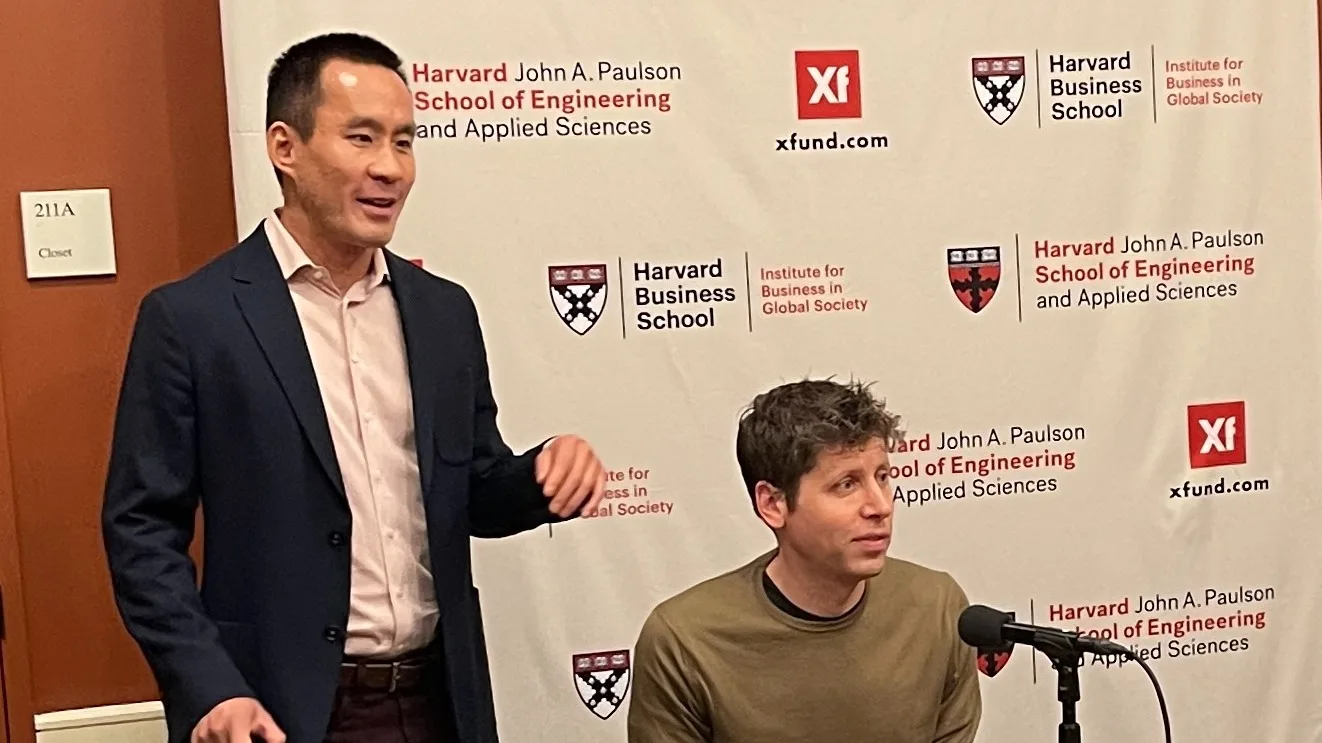
“If the tech goes in a super different way, you might need a different set of policy tools,” Altman told the Institute for Business in Global Society (BiGS) during a press conference at Harvard University on Wednesday.
The Role of Government Regulation
Altman suggested that the AI industry create an organization that is similar to the International Atomic Energy Agency, which is a self-governing organization.
“We could make an IAEA for advanced AI—if you have one of the top 10 AI systems, you will have the equivalent of weapons inspectors,” Altman said.
Altman’s comments and stance on how AI should be regulated by the government will be watched closely in the future as companies in many industries determine how they will use AI solutions, ranging from manufacturing to analysis and other business functions. The impact of how AI will be used throughout society, including in the U.S. workforce, is also being studied and researched, in part because the software can track the activity of workers.
Altman was the president of the early-stage startup accelerator Y Combinator from 2014 to 2019. In 2015, he co-founded OpenAI as a nonprofit research lab with a mission to build general-purpose artificial intelligence that benefits society broadly. The company remains governed by the nonprofit today.
Altman is the recipient of the 2024 Xfund Experiment Cup. The award is handed out by Xfund to extraordinary founders from the world’s best universities and is co-hosted by Harvard Business School's Institute for Business in Global Society (BiGS); the Harvard John A. Paulson School of Engineering and Applied Science (SEAS); and the Digital Data Design Institute at Harvard.