
BiGS Actionable Intelligence:
The Taiwan Semiconductor Manufacturing Company (TSMC), the world’s leading maker of semiconductors or “chips,” was set to open the first of several manufacturing facilities it planned to build in Phoenix in 2024. But the company ran into a problem.
It could not find enough workers with the skills and experience to install the complex equipment needed in its state-of-the-art semiconductor manufacturing facility. Ultimately, it announced that production would be delayed for a year.
The company scrambled to catch up, and signaled earlier this year that it will expand further to meet demand. But the delay illustrates a broader obstacle in the march to bring back chip manufacturing to the United States: a shortage of workers at every level, from technicians and engineers to scientists.
“Companies are ready to expand, the funding is there, and the demand for chips has never been higher,” said Shari Liss, vice president of global workforce development and initiatives for SEMI (formerly Semiconductor Equipment and Materials International). “But without enough skilled workers, timelines keep slipping, costs definitely rise and the companies face real challenges in meeting their goals.”
Semiconductors power a broad range of modern technology, including smart phones, automobiles, computers, and AI data centers. They are also a vital part of the transition to a green economy. Chips are used for electric vehicles. They also help harness and transfer energy from solar panels and wind turbines to the electric grid with minimal power loss.
The shortage of workers could limit the supply of chips needed for the green transition, and leaders in industry, government and academia say a ramp-up in training is essential to solving the problem. Without it, about 67,000 jobs needed to sustain industry growth in the U.S. industry would go unfilled, according to a report by Oxford Economics and the Semiconductor Industry Association (SIA).
“Semiconductors are used pervasively in products and services today,” said Willy Shih, a professor at Harvard Business School. “There’s been a lot of focus on building a more resilient supply base for them, including domestic production. But we won’t be successful if we don’t have the workforce to support that.”
A decline in homemade chips
Semiconductors were invented in California about 65 years ago. For decades, California-based Intel dominated the global and national market, though it eventually lost its market-leading position. The same happened to the United States more generally. In 1990, the U.S. manufactured 37% of the world’s chips, but that fell to 10% by 2022.
The drop was especially concerning during the pandemic, when worldwide supply chain disruption led to semiconductor shortages. Electric vehicle manufacturers were disproportionately affected because they rely so heavily on electronic systems for propulsion, safety, entertainment and other features. These companies use about 3,000 chips per car, twice as many as the average gas-powered vehicle.
In 2022 and 2023, EV makers had to slow down production, sometimes requiring customers to wait many months for their vehicles. In 2022, Tesla, citing the shortage, delayed the production of new models. In November of this year, CEO Elon Musk told shareholders he is concerned that even the planned expansion of chip manufacturing in the U.S. will not provide enough to serve his company’s needs.
“One of the things I’m trying to figure out is, how do we make enough chips?” Musk said. "Even when we extrapolate the best-case scenario for chip production from our suppliers, it’s still not enough.”
Government leaders also see risk in the shortage, fearing the U.S. could face problems due to over-dependence on TSMC, particularly if political tumult or a natural disaster hit the company’s home country of Taiwan. They also worry that U.S. has fallen behind on producing a building block of the modern economy.
Those concerns fueled the enactment of the 2022 CHIPS and Science Act, which provided $52 billion in incentives and grants to companies building chip-making facilities in the U.S. As of Jan 30. the program has spurred an additional $640 billion in private investments in 140 projects in 30 states, according to an SIA tally. Both TSMC and Intel are planning new factories for chip manufacturing. But the worker shortfall remains a problem.
Inside the worker shortage
The industry’s rapid expansion, high turnover and an aging workforce are driving the worker shortage, leaving chip manufacturers with a projected deficit of technicians (26,000), engineers or computer scientists with bachelor’s degrees (23,000) and engineers with post graduate degrees (17,400) by 2030, according to SIA.
In addition, more than half (53%) of domestic semiconductor workers were expected to leave the industry in 2024, compared to 40% in 2021, according to a report by McKinsey & Company. And, a third of the industry’s workers are 55 or older.
The industry also suffers from a sagging reputation. According to an earlier 2024 report by McKinsey and Company, employers, and college students find the semiconductor industry unattractive when compared to other high-tech fields.
“A lot of people working in the semi-conductor world found a way to pivot,” said Alex Jones, a professor at Syracuse University who chairs the Electrical Engineering and Computer Science department. “They moved into other fields – social media, cybersecurity, medical devices and AI.”
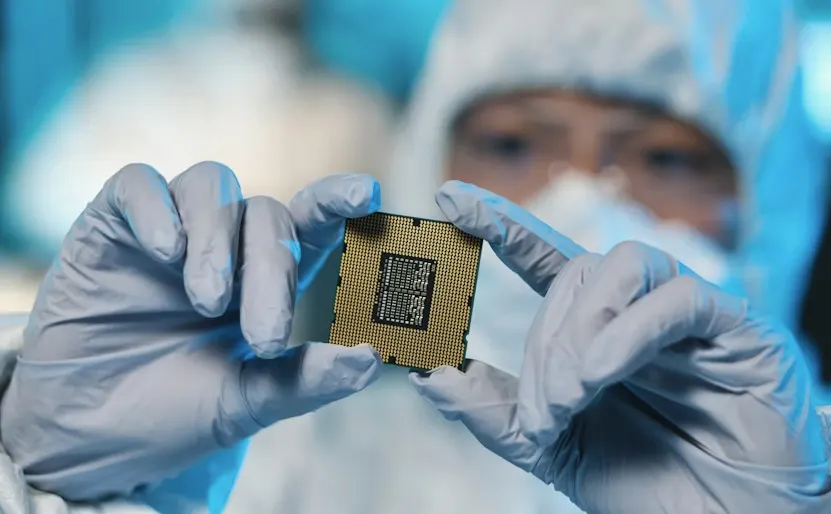
While some find it exciting to work with advanced technology, others see the semiconductor industry as unappealing. Much of the work is performed in cleanrooms, which require workers to wear full-body “bunny suits” to ensure that no dirt or contaminants enter the manufacturing process. They can be claustrophobic to some.
“We’re going to need plenty of people who see the importance and are willing to do that kind of work,” Shih said. “It’s a challenge because a lot of people sit in front of a screen and may not want to work in a cleanroom. It requires great discipline.”
An increase in training
Community colleges and universities across the country, with help from the semiconductor industry, are gearing up to increase the pipeline of workers.
The nonprofit, industry-supported SEMI Foundation offers online learning with industry-vetted courses and credentials offered on flexible time frames. It operates a vast online job board and is in the process of developing eight regional training and education hubs. The foundation also works to show younger students about the industry.
“We are laser-focused on building a unified, national talent ecosystem that connects education, workforce systems, employers, and learners,” said Liss, who oversees the SEMI Foundation.
Individual companies are contributing funds, creating internships and donating used equipment for cleanrooms that allow colleges to provide realistic, hands-on training.
Maricopa County Community Colleges, located in the Phoenix area, has developed an especially close relationship with companies building chip manufacturing plants in their region, including Intel and TSMC.
Educators meet regularly with those companies and other industry representatives to ensure their training programs are aligned with industry needs, said Leah Palmer, executive director of AZ Advanced Manufacturing Institute.
The community colleges operate an intense 10-day bootcamp known as the “Semiconductor Technician Quick Start,” which teaches the skills needed to be a technician in the semiconductor manufacturing industry, Palmer said. Students who pass the final test do not have to pay tuition — a feat 97% of the program’s 1,251 students have accomplished.
Universities around the country are also providing specialized training for engineering and computer science students.
The University of California, San Diego, with a grant from the National Science Foundation, is offering free classes, taught by Intel faculty, to students at the university and other area colleges. Participating students will be offered job opportunity connections in the semiconductor industry.
Syracuse University has partnered with the global semiconductor company Micron on a new research hub, the Center for Advanced Semiconductor Manufacturing, to prepare computer scientists and electrical engineers for work in the semiconductor industry.
“It is critical for us to be successful,” Jones said. “We need to pull together academics, government, and industry to solve the problem.”
Shih said there are two keys to success —hands-on training and patience. “We want stuff like this to happen overnight in this country, but it just doesn’t … not anywhere in the world,” he said. “It takes time.”