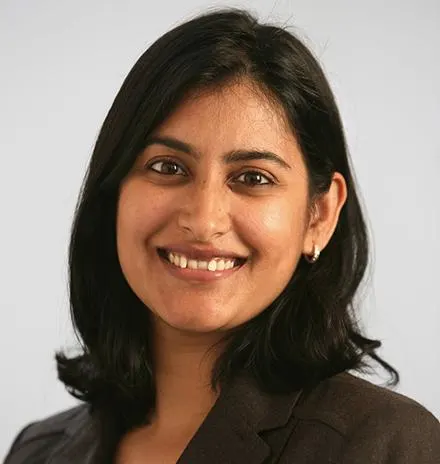

Editor’s Note: The third annual Relationships Across Differences conference, more commonly known as RADs, took place on the INSEAD campus last week, bringing dozens of experts and academics together to discuss building workplace relationships among diverse groups of people. The project is a joint effort by Lakshmi Ramarajan and Robin Ely at Harvard Business School; Stephanie Creary and Nancy Rothbard at Wharton; Kaisa Snellman and Jennifer Petriglieri at INSEAD; and Taylor Phillips at NYU. We caught up with some of the participants—and the founder herself—to discuss what was on the agenda.
BOSTON—Relationships matter in business, and the people who face historical barriers to developing those relationships aren't always given a platform to talk about it.
That's why Stephanie Creary, an assistant professor at the University of Pennsylvania's Wharton School of Business and a former BiGS Racial Equity Fellow, launched the Relationships Across Differences (RADs) roundtable, a place where scholars can share research and views on building relationships among diverse groups.
A collaboration among faculty from Wharton, Harvard Business School (HBS), the NYU Stern School of Business and the Institut Européen d'Administration des Affaires (INSEAD), the roundtable aims to help organizations make better decisions surrounding workplace culture and relationships.
“There are a lot of people who study topics like identity, status and power,” but those same people are not always invited to larger academic conferences, Creary said. “We wanted to make sure we had a conference where people who are studying marginalized groups and these big topics can come.”
The RADs roundtable, now in its third year, was hosted at INSEAD; prior conferences have been held on the HBS and Wharton campuses. Insights from the roundtables are disseminated through public-facing reports, toolkits and podcasts designed to educate senior leadership teams, boards of directors, legal teams, employees, students, media and policymakers.
“These research-based insights are intended to help teams and communities foster effectiveness, create clarity, and affirm the dignity of their members,” said Harvard Business School professor Lakshmi Ramarajan, faculty co-chair of the HBS Race, Gender and Equity Initiative, which, along with BiGS, provides support for RADs.
“At a time when our organizations are increasingly diverse, but our social identities are often turned into a source of polarization, it is crucial that we learn to cultivate workplaces and relationships that can help us bridge differences rather than isolate and divide us,” she said.
Talking about inequality in relationships and how that shapes work
This year's roundtable included a wide range of discussions related to gender, race, social class and how workplace culture affects the ability to advance and succeed.
Research presentations included "Gratitude and Resentment Withing Dual-Income Households" by Mandi Nerenberg of HBS and "Diversity as Structural Capital: How Team Diversity Shapes Inter-team Connectivity and Performance,” by Yiftach Yarmar of INSEAD. Other scholars looked at voice and identity on corporate boards, and how language related to inequality is used in the workplace.
Yarmar, in research conducted with INSEAD professors Sujin Jang and Kaisa Snellman, found that teams benefit from diversity not only because of the varied perspectives offered by the individuals themselves, but because they form more external ties. People tend to connect more with those who share their backgrounds, and a diverse team can bring in a broader array of ideas and perspective from outside sources, he said.
“Think of diversity as a networking asset. The diversity benefit here isn't just about having different ideas in the room; it's about expanding who the team can reach outside the room. Diverse teams are more connected to disparate parts of the organization, which makes them better at innovation,” Yarmar said.
He added that the dynamic works only when there is trust and coordination inside the team itself. “In short, diversity opens doors; cohesion determines whether teams can walk through them,” Yarmar said.
First-generation executives
Samantha Smith, a doctoral student at HBS, looked at the challenges first-generation and low-income executives face in their quest to join the C-suite.
Neither group tends to get the mentorship (which she defines as guidance and professional advice) or sponsorship (wherein an executive actively supports someone's promotion or advancement) that some others do, Smith said.
“Being first generation comes with more of a cultural capital deficit, [not] knowing the ins and outs of the coffee chats and networking,” Smith said. Meanwhile, low-income people have a “scarcity mindset, with a high focus on elevating out of poverty as a real psychological driver.” And that makes it harder to build relationships with people who can help get them to the next stage.
Without this “relationship capital, first generation folks, low-income folks, are not getting those calls” from higher-ups in a position to help them advance, Smith said. “They have to rely on their own grit.”
Being passed over for mentorship or sponsorship “is not malicious,” Smith said. “But people love to mentor and advise and sponsor people who remind them of themselves.”
The RADs discussion, Creary said, provides a platform for these issues, presented by the people who live it.
“Everyone understands relationships are important to the workplace,” Creary said. But even when corporate boards make a concerted effort to add diverse voices to the mix, those voices are not always heard, because the relationships are not there, an insight Creary explores in new research with Professor Lumumba Seegars of HBS.
“This is why RADs is important,” Creary said. “Oftentimes, people who are studying these topics are in the numerical minority at their institutions, so these broader dynamics feel personal.”
The roundtable is an especially important opportunity for emerging scholars, Ramarajan added. “RADs is particularly impactful for our junior faculty and doctoral students, who benefit from the developmental conversations and the mentoring relationships that extend beyond the individual conferences. And for all of us, the dedicated time to deeply explore cutting-edge, timely ideas is invaluable.”