
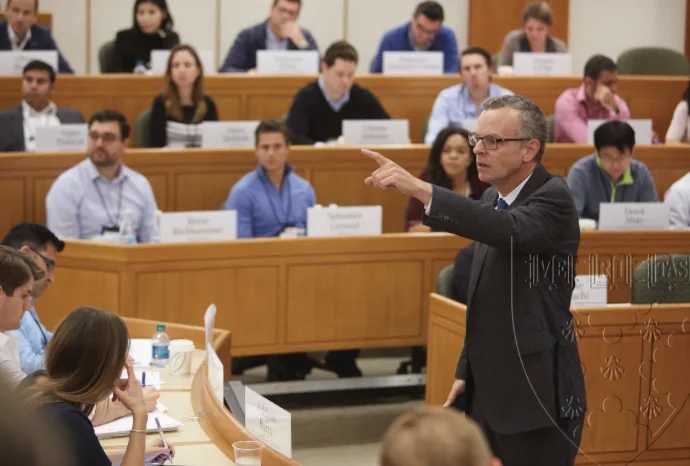
Editor’s Note: Amram Migdal is the Head of Knowledge at the Institute for Business in Global Society (BiGS), leading efforts to build a strong intellectual community of scholars studying the role business plays in addressing societal issues. He recently began attending a course by professor Gunnar Trumbull. This is the first in an occasional series in which Migdal reflects on how Harvard Business School’s research, teaching, and programming address critical societal issues such as climate change, economic mobility and inequality, AI, and geopolitical instability.
This semester, I’m back in the classroom. I have the privilege to audit Professor Gunnar Trumbull’s Global Climate Change course for second-year MBAs at Harvard Business School. Trumbull, as much as anyone, has been studying how firms are responding to climate change and thinking deeply about how to teach executives about the issue.
The impression I have so far is that business management around climate has changed dramatically over the last decade.
Ten years ago, the world was focused on multilateral agreements and top-down efforts. The aim was to force firms to decarbonize and entice consumers to adopt green products to hit certain global emissions and temperature limits. Developed countries who were “guilty” of historic emissions pledged to underwrite the global transition and help developing countries that were now emitting more.
Today, we are about to exceed the 1.5-degree Celsius Paris Agreement goal and are unfortunately on a path to end up with more than 2.5 degrees of warming. Meanwhile, the top-down agreements and national legislation seeded a renewables market that, at this point, is cheaper to install on a levelized-cost basis than new fossil fuels.
In short, it’s a whole new world.
The case of Kiribati
Trumbull opens the course and brings these dynamics to life by examining the island nation of Kiribati. Back in 2015, at the time of the Paris Agreement, Kiribati’s then-leader was lauded for his policy of “migration with dignity,” essentially telling his people that their atoll nation would be swallowed by the sea and urging them to develop marketable skills so they could migrate to wealthier, safer nations.
But it was all very theoretical. The harms weren’t yet visible. Globally, developed countries didn’t want to shoulder the burden of climate refugees. Renewables were still more expensive than fossil fuels. Only firms or consumers who felt strongly about climate change were adjusting their behavior. Within firms, climate was relegated to CSR offices, meeting compliance targets, and avoiding activists’ ire.
Since then, the world has changed. The people of Kiribati have rejected the leader who told them they had to accept migration with dignity, based on a top-down strategy rooted in global negotiations. Instead, they’ve said: let’s invest in making the best of what we have.
Kiribati has a strategic Pacific location and control over sea-floor minerals, so it is trying to play the U.S. and China against each other and make deals with international corporations. China has offered to support dredging to elevate vulnerable lands in the most populous city. The problems have become freshwater access and economic development, not how to flee altogether.
That’s a very different framing, and a look across the energy landscape shows that similar changes in thinking are taking place across the globe.
Lessons from the first energy transition
In class, students probed key insights from the history of the first energy transition. When countries moved from “biomass” like wood to fossil fuels like oil and coal during the Industrial Revolution, it was due largely to intrinsic economic motivations. The same is finally happening now with renewable energy.
Coal was not just cheaper than biomass, it was also more useful, transportable, and energy-dense. It reshaped labor, politics, and global trade. Fossil fuels centralized power in empires and petrostates. But coal and oil didn’t win because of global treaties. They won because they empowered firms and workers.
Today, renewables are cheaper on a levelized-cost basis than new fossil fuels, and the harms of climate change are more obvious than ever. If you’re a firm building new energy capacity today, renewables win. The issue is not just compliance anymore. It’s competitive pressure.
Firms are looking across supply chains and asking suppliers to decarbonize—not only because of international pressure, but because suppliers that adopt renewables can lower costs and improve offerings. The bet is that decarbonization can provide a competitive advantage. Distributed, renewable networks of solar and wind mean local entities can generate power. Smart grids can coordinate it.
As we discussed this possible future in class, students perked up, sensing entrepreneurial and investment opportunities. Yes, rare minerals and technological components from global supply chains still create bottlenecks. But they also create opportunities for nations like Kiribati, which is forging deals with corporations and great powers, moving forward with whatever resources it has at hand.
And the same is largely true for businesses across a range of sectors. Climate change management is no longer a specialty function tucked into CSR. Decisions about the firm’s energy portfolio, its supply chain emissions, and its transition risk exposure now occupy the C-suite. While some wait, others are moving ahead, finding profitable ways to operate in the world of climate change.
A different kind of optimism
In Trumbull’s framing, this is not optimism that climate harms will disappear. They are here. Rising seas, extreme weather, and freshwater shortages are well in evidence. Millions of people are suffering the consequences and facing the challenges.
But there is optimism that the global economy can continue functioning at high output in a renewable world and that firms on the front lines—in Bangladesh, in Kiribati, in the Mississippi Delta, the Gulf of Mexico, and in supply chains everywhere—are finding profitable ways to advance. Firms that still treat climate as a PR issue or a compliance box to tick are missing the shift. The change is happening in the competitive core of the business.
Reflecting back, I remember the first time I worked on climate change at Harvard Business School. In 2015, I helped author a note with HBS professor Rebecca Henderson called Climate Change: Implications for Business, and I co-wrote a case on the Paris climate accords with HBS professor Vincent Pons. Both took a structural, top-down approach: science from the UN’s Intergovernmental Panel on Climate Change (IPCC), adaptation versus mitigation, burden-sharing across nations. It was the outside-in model.
It is striking how different the framing is now. We’ve blown past 1.5 degrees and 2 degrees, and we won’t avoid all harms. But the renewable revolution is here, and it is embedding climate into the heart of business strategy. As with the first energy transition, the shift will reshape politics, institutions, and society in profound ways.
The old model was about pressure from above. The new model is about competitive logic. The optimism, then, lies in competition itself—compelling firms to move and driving the global economy toward shared prosperity and thriving societies.