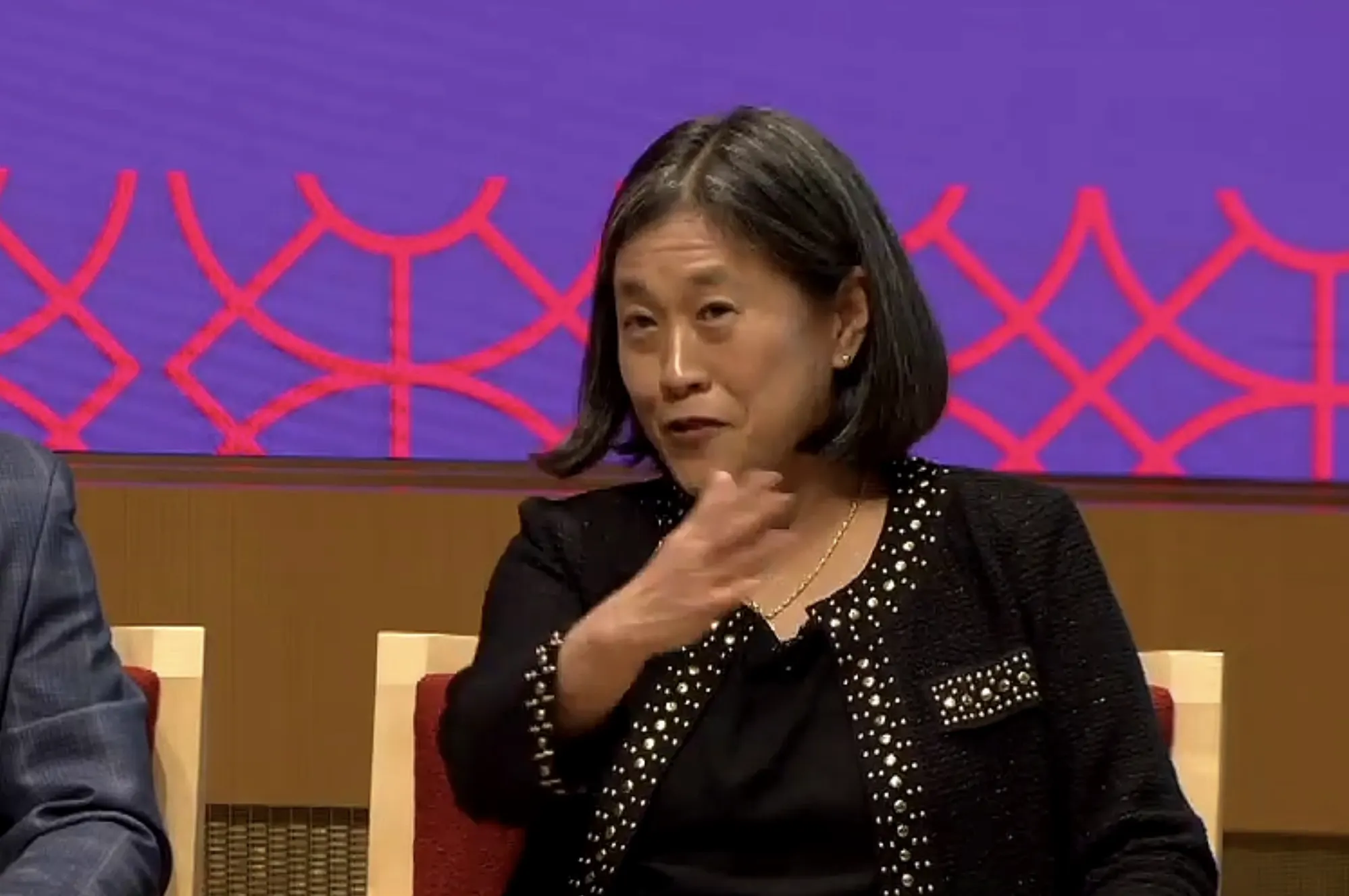
Editor’s Note: Katherine Tai has spent decades working on trade issues, including as U.S. Trade Representative in the Biden administration. She ushered in the first “worker-centered" trade policy in U.S. history, working to stop abuses to employee rights in other countries so American workers would be more competitive. Tai was one of four trade experts who met on stage at the BiGS Debate Nov. 5 to argue over a vital question: Will higher tariffs create a better future for the United States? We caught up with her to discuss U.S. trade policy, relations with China and the impact on American workers and consumers. The interview has been edited for length, clarity and style.
There hasn't been a major trade pact in decades, and the United States is in a tariff and trade war with many countries. Is the era of free trade over?
The political support in America has waned for the types of free trade agreements we were doing in the 1990s and 2000s. I think many people used to believe there was a very compelling case to be made for “free trade” as we practiced it. But when you look around at the hard evidence of what is happening in our economy, I think any reasonable person should come to the conclusion that the promises of free trade were never delivered. The fact of the matter is that inequality is as great today as it was in the era of the robber barons and the Gilded Age. That's not a good thing for a democracy, and frankly, that is not a good thing for the world, and world peace.
How do tariffs play into this — are they the way to counter earlier liberal trade policies?
Liberalization of trade was meant to be a means to accomplish a kind of prosperity. Full employment. Sustainable natural resource policies. But over time, the liberalization became an end in itself. It was liberalization for liberalization's sake. Right now, it often feels like we are pursuing tariffs for tariffs' sake. The question should not be whether tariffs are good or bad, but what are you trying to accomplish with the tariffs. In both cases, we are in danger if we mistake the tool for the policy objective.
When you were U.S. Trade Representative, you focused on how trade affects workers. Explain why that matters to the U.S. economy.
In previous decades of free trade and liberalization, our workers got the short shrift. When we were presenting our arguments, we really were limited to thinking about human beings in our economy just in their role as consumers. What we lost in all of that is that what empowers a person to consume in the marketplace is the job they have. That allows them to earn a wage to put money in their pocket in the first place.
Part of what happened in the era of free trade and liberalization is … we were [forcing] American workers to compete with workers in other jurisdictions who were often very exploited. When you look at the human being as not just a consumer, but also a worker, you couldn't just measure the benefit to American people through prices.
Your team went all around the country to talk to different communities. What was the goal?
It became clear that if we didn't place the responsibility on ourselves to leave Washington and introduce ourselves to, and communicate with, all the different parts of America, then we weren't doing our jobs. What are the challenges communities are facing, and how can we work with other countries to unlock the economic energy in all these different parts of our economy? If trade isn't delivering for enough Americans, it's probably because the trade conversation is limited and it has excluded most Americans.
Let's talk China. What challenges interfere with a fair and balanced trading relationship?
The United States and China are the two largest economies in the world. And we're not getting along. China's superpower is in producing, manufacturing and exporting. What our superpower is, in trade, is not as a producer or exporter; we are the consuming superpower in the world economy. You can see how imbalanced each one of us is. The tension that creates is substantial.
There are some very deep and structural problems that we have ourselves and also with each other, which are going to require very difficult and serious conversations to navigate. And it has implications for the world trading system and all other countries in the world.
What does that mean for China?
Increasingly, high-quality Chinese exports are going to flood world markets at very cheap prices. But you can't just produce for other markets. You should be empowering a consumer class that will lead to more prosperity, more stability, and more health in your economy.
And what does the U.S. need to do to fix its side of the equation?
You have this overlapping agreement between [Presidents] Trump and Biden around the desirability of reinvigorating manufacturing in America. It's a step toward becoming a more balanced economy, where we're not just consuming everything from the rest of the world, but actually revitalizing the benefits that come from manufacturing.
How has the supply chain become so fragile, and what are the impacts?
Producers make decisions that benefit their bottom line, their shareholders, to maximize profitability and what we would call “efficiency.” What's happened, as a result of a bad set of rules, is firms have been rewarded for chasing the lowest cost possible. [It's a] race to the bottom, lowering your standards on worker protections, environmental protections. The result is you have supply chains all over the world, because the lowest cost production for each of these links is really far from each other or you have supply chains overly concentrated in one place.
What happens if there's an earthquake in Japan, and everything shuts down for a couple of weeks? China has cornered the market on rare earth [minerals]. They've got this enormous amount of leverage. And if they decide, ‘I don't like what you're doing with these on-again, off-again tariffs, so I'm going to stop exporting the rare earth products you need,’ it will bring industries to their knees.
How can U.S. trade policy address that?
The solution to having more resilient supply chains lies in reprogramming the ‘software’ we put into our trading agreements and the global economic system. We should be figuring out what policies and rules incentivize and reward firms and producers that balance efficiency with resilience, where you're not ever single-sourcing. Industrial policy requires you to figure out how to reconfigure your supply chains and trade relationships, where you set the dials at each link and for each partner between liberalization and restriction. In my view, we need to move off of pure liberalization and free-trade policies — setting those dials all the way in one direction and continuing to expect, against all the evidence, that the outputs will be better than they have been.